Everyday Wellness / Guide
Eastern vs Western Astrology: How Each Works, Plus Where the Eastern Astrology Language Reading Fits
Eastern vs western astrology explained: animal years, elements and BaZi vs sun signs, planets and houses, plus the Eastern Astrology Language Reading.
- Author
- Supplement Health Expert Editorial Team
- Published
- Reading time
- 8 min
- Sources
- 0 cited
Key takeaways
- 01 The Chinese system runs on cycles of years: 12 animals and five elements repeat in a 60-year pattern. The Western system runs on the months: 12 sun signs plus planets, houses and an ascendant.
- 02 Chinese astrology reads mainly from your birth year, with BaZi adding the month, day and hour. Western astrology reads from the sky at your birth, which needs a time and place for a full chart.
- 03 Both are cultural, symbolic traditions that people enjoy for reflection and conversation.
- 04 The free 9-question quiz for the Eastern Astrology Language Reading lets you try the Chinese side with just a date of birth.
Curious about your zodiac but not sure which kind to follow? Eastern vs western astrology really comes down to two different ways of reading the same birth date. One system turns the calendar into a long cycle of animals and elements, and the other turns the sky at the moment you were born into signs, planets and houses. Here is how each one works, side by side, so you can see what you are looking at before you pick a favorite, and where the Eastern Astrology Language Reading fits.
Full disclosure before we dive in: nobody at the seller wrote or approved this guide. Our buttons carry affiliate tracking, so if one of them ends in an order, we may be paid a small commission.
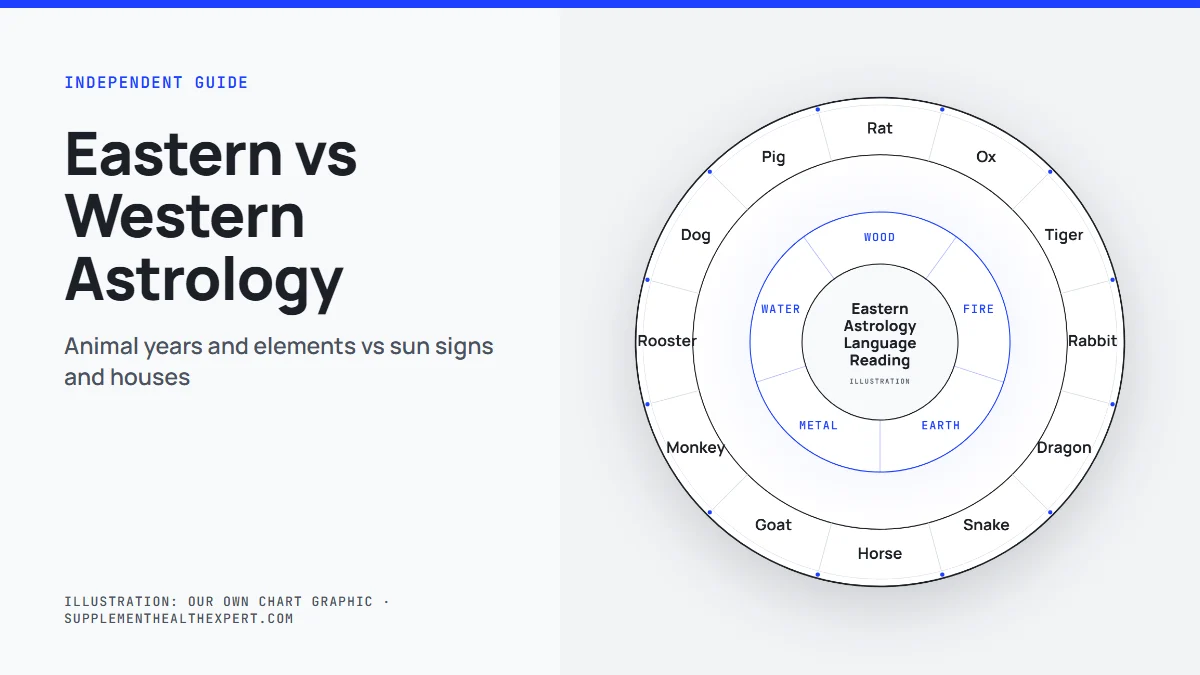
Eastern vs western astrology in one minute
Think of the Chinese system as a long cycle of years and the Western system as a yearly circle of months.
- Chinese astrology gives you an animal for your birth year, an element, and with the BaZi method a four-part chart (the “four pillars”) made from your year, month, day and hour.
- Western astrology gives you a sun sign from your birth month, then adds your moon sign, your rising sign (ascendant), the planets and twelve houses.
Both traditions are old, symbolic and loved around the world. Neither is science, and both work best as a reflective, enjoyable lens on personality and timing.
The clock: cycles of years versus months
The first difference is how each system counts time.
The Chinese system counts in years. Twelve animals take turns in a fixed order, from the Rat through to the Pig, and every year is tagged with an element as well. Twelve animals times five elements gives a full pattern of 60 years before the very same combination returns. A new animal year opens with the Lunar New Year, which moves around between late January and mid February, while BaZi marks its year pillar at the solar term called “Start of Spring”, around February 4.
The Western system counts in months. The tropical zodiac divides the year into twelve sun signs, each lasting about a month, with the sign changing around the 20th to 23rd of the month. Your sun sign comes from the day you were born, whatever the year.
That is why two people born in the same month but different years share a sun sign yet carry different animals, and why two people born in the same animal year can have very different sun signs.
How the Chinese system builds your profile
For a broader introduction to the tradition itself, see our overview of Chinese zodiac astrology.
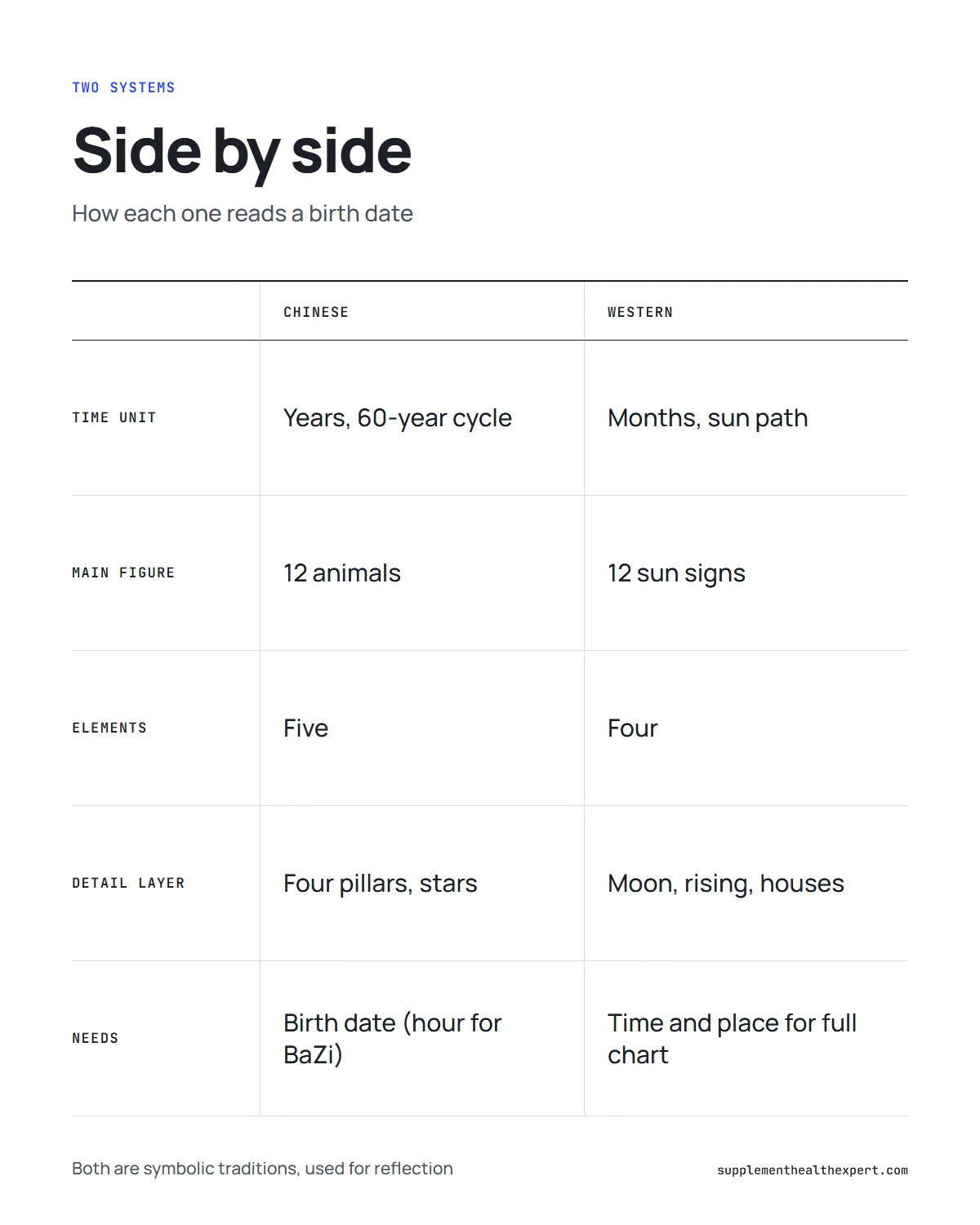
A Chinese reading is assembled from a few building blocks.
- Your animal. This comes from your birth year and sets the broad personality theme.
- Your element. One of five elements adds flavor to the animal. In the generating cycle each element nourishes the next one around a loop, and in the controlling cycle each one keeps another in check. Readers use both cycles to talk about balance.
- The four pillars (BaZi, “eight characters”). Your birth year, month, day and hour are each written down as a heavenly stem paired with an earthly branch. For a complete BaZi chart you need the hour of birth.
- Symbolic “stars”. Readers also mention named stars, one tied to wealth, one to romance and one to helpful people, and use them as playful prompts for a conversation.
How the Western system builds your chart
A Western chart is a map of the sky at your birth.
- Your sun sign. One of twelve, from Aries to Pisces, by birth month.
- Your moon sign and rising sign. The moon sign is tied to emotions and the rising sign (ascendant) to first impressions. The ascendant needs your birth time and place.
- The planets. Mercury, Venus, Mars and the rest each sit in a sign and stand for a theme such as communication, love or drive.
- The twelve houses. These divide the chart into areas of life, such as home, work and relationships.
- Four elements. Fire, earth, air and water group the twelve signs into families of temperament.
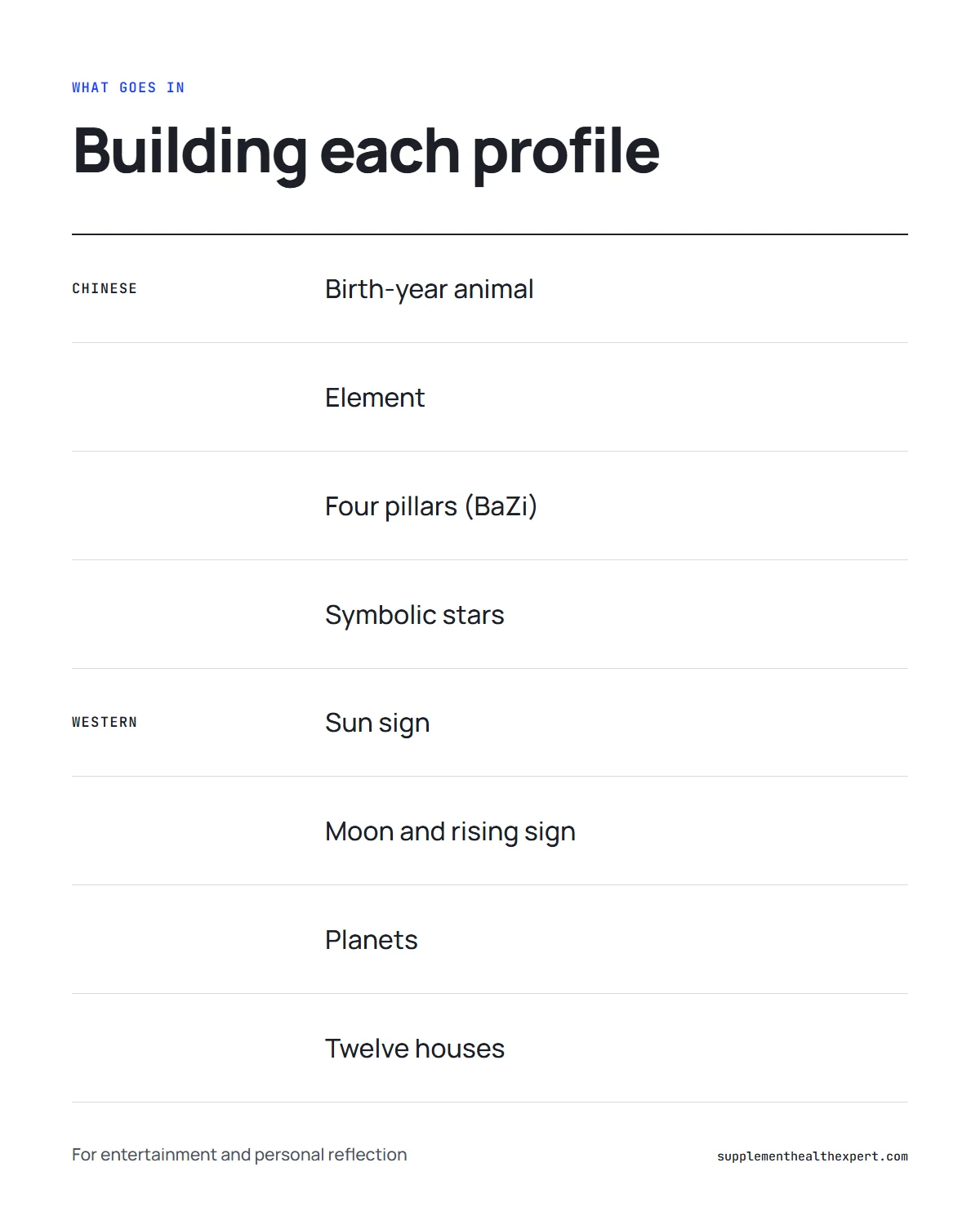
A side-by-side comparison
| Feature | Chinese (Eastern) | Western |
|---|---|---|
| Time unit | Years and a 60-year cycle | Months and the yearly sun path |
| Main figure | One of 12 animals | One of 12 sun signs |
| Elements | Five, working in cycles (Wood, Fire, Earth, Metal, Water) | Four, grouping the signs (fire, earth, air, water) |
| Where a year turns | At Lunar New Year (BaZi uses Start of Spring) | Sun sign changes around the 20th to 23rd |
| Detail layer | Four pillars and symbolic stars | Moon, rising sign, planets and houses |
| What you need | A birth date for the animal; the hour for full BaZi | A birth time and place for a full chart |
| How people use it | Compatibility, yearly themes, reflection | Personality, relationships, daily horoscopes |
One birthday, two readings
A quick example shows how differently the two systems slice the same date.
Take someone born on March 15, 1990. Lunar New Year fell on January 27 that year, so the birthday sits inside the new animal year, which makes this person a Metal Horse in the Chinese system. A mid-March birthday is a Pisces sun in the Western system. The Chinese lens brings in the Horse, traditionally described as sociable and energetic, plus the Metal element. The Western lens brings in Pisces, often described as imaginative and empathetic, plus whatever the moon and rising signs add.
Now take a birthday on January 10, 1990. Because it falls before Lunar New Year, it still belongs to the previous animal, the Snake of 1989, while the Western sun sign is Capricorn. This year-boundary quirk is the most common surprise for newcomers, and it is why a quiz that starts from your full date of birth is handy.
Common mix-ups to avoid
- Animal is not the same as BaZi. Your birth-year animal is only one piece of a four-pillar chart, so a BaZi reading has far more to say than the animal alone.
- Sun signs are not “Western animals”. The Western zodiac uses symbols such as the Ram, Bull and Twins, but its structure is entirely different from the twelve-animal Chinese cycle.
- January and early February birthdays need a second look. Look up when the new animal year began in your birth year before settling on your animal.
- The elements do not match up. Fire in one system is not the same idea as Fire in the other, so avoid mixing the lists.
- Daily horoscopes belong to one side. The Chinese tradition tends to speak in years and cycles, while daily and weekly forecasts are a Western habit.
What the two systems have in common
Even though the machinery differs, the two traditions share more than you might expect.
- Both use twelve main figures arranged in a circle.
- Both use elements to add nuance, even if the lists differ.
- Both describe personality themes and compatibility between figures.
- Both have been passed down for generations as cultural traditions rather than tested sciences.
If you want to see how the Chinese pairing idea works in practice, our guide to eastern astrology enemy signs covers the six clash pairs and the harmony trines.
Try the Chinese side with your own reading
If the Chinese lens has caught your eye, there is a ready-made way to see yours. The brand Your Astrology Language sells the Eastern Astrology Language Reading, a personalized chart that works from the animal, element and four-pillar ideas described above. The first step is a free quiz of nine questions that asks for a first name, an email address and a date of birth, and it ends with a sample reading well before any purchase comes up. For a short overview, see our quick guide.
- Essential Reading, $19: the seller’s 50+ page chart, arriving by email in about two to three days.
- VIP Reading, $47 (the seller shows a $97 regular price): the same chart with three bonus items valued by the seller at $147, plus personal lucky numbers and colors, peak days, a faster 12-hour delivery and priority support.
Every order is protected for 60 days, because ClickBank will return your money inside that window, which keeps the decision relaxed. One quiz detail to know: the email checkbox is ticked in advance, so clear it if all you want is your reading.
Pick the lens you enjoy
Neither system is better or worse; they simply ask different questions. If you like the sky, planets and houses, the Western chart will feel familiar. If you like animals, elements and cycles of years, the Chinese system is a rewarding place to explore. Many people enjoy both, so there is no need to choose just one.
Frequently asked questions
What is the biggest difference between the two systems?
The unit of time. The Chinese system organizes people by year, with animals and elements cycling through the calendar, while the Western system organizes people by month through the 12 sun signs, then adds planets, houses and the ascendant for detail.
Do I need my birth time for each system?
For a complete Western chart you need your birth time and place, since that sets your ascendant and houses. A basic Chinese animal and element only need your date of birth, although a full BaZi chart also uses the hour.
How many signs does each system have?
Both use twelve main figures. The Chinese zodiac has twelve animals, from the Rat to the Pig, and the Western zodiac has twelve sun signs, from Aries to Pisces.
What are the five elements in Chinese astrology?
Wood, Fire, Earth, Metal and Water. They interact through a generating cycle and a controlling cycle, and every year carries an element along with its animal.
Are the Western elements the same as the Chinese ones?
No. Western astrology groups the signs into four elements (fire, earth, air and water), while the Chinese system uses five (wood, fire, earth, metal and water) and treats them as cycles that interact.
Is the Chinese zodiac year the same as the calendar year?
Not quite. The animal year turns over at the Lunar New Year, so a birthday in January or early February can still belong to the previous animal.
Does either system have scientific support?
No. Both are symbolic traditions with long cultural histories. People enjoy them as a way to reflect and talk about personality, not as a scientific forecast.
Can I try the Chinese side without paying?
Yes. The quiz for the Eastern Astrology Language Reading costs nothing, runs for roughly a minute and ends with a sample reading, so you can look first and decide about a full chart afterwards.
eastern vs western astrology · chinese zodiac · sun signs · bazi four pillars · astrology systems