Supplement Reviews / Guide
FemiCore Ratings Explained: What the Seller's Stars and Our 6.3/10 Score Actually Measure
FemiCore ratings explained: the seller's unverified 19,263-review claim, our 6.3/10 editorial score in six parts, and how to read any star rating you find.
- Author
- Supplement Health Expert Editorial Team
- Published
- Reading time
- 8 min
- Sources
- 3 cited
Key takeaways
- 01 Two kinds of number circulate for FemiCore: a stars image on the seller's site citing 19,263 reviews, and our editorial score of 6.3 out of 10.
- 02 The seller's figure cannot be checked. No individual reviews, names or quotes are shown next to it, so we treat it as a sales claim.
- 03 Our 6.3 is the plain average of six categories. Transparency (3/10) and evidence (5/10) pull it down; the guarantee and ordering (8/10 each) hold it up.
- 04 The two numbers answer different questions, so neither one confirms or cancels the other.
- 05 Any rating you meet online is only as useful as what sits behind it: who collected it, from whom, and whether you can see the reviews.
Search for FemiCore ratings and you meet two very different numbers. One is a row of stars on the seller’s own page, set beside a claim of 19,263 reviews. The other is our editorial score of 6.3 out of 10. They look like they answer the same question. They do not, and reading them side by side without knowing that leads people to the wrong conclusion in both directions.
This page explains where each number comes from, what our six score categories mean, why the two figures cannot be compared, and how to read any rating you come across. A quick word on who wrote this: our team is independent, and this page belongs to us rather than to the seller. The order buttons are affiliate links, so a purchase made through them may pay us a commission.
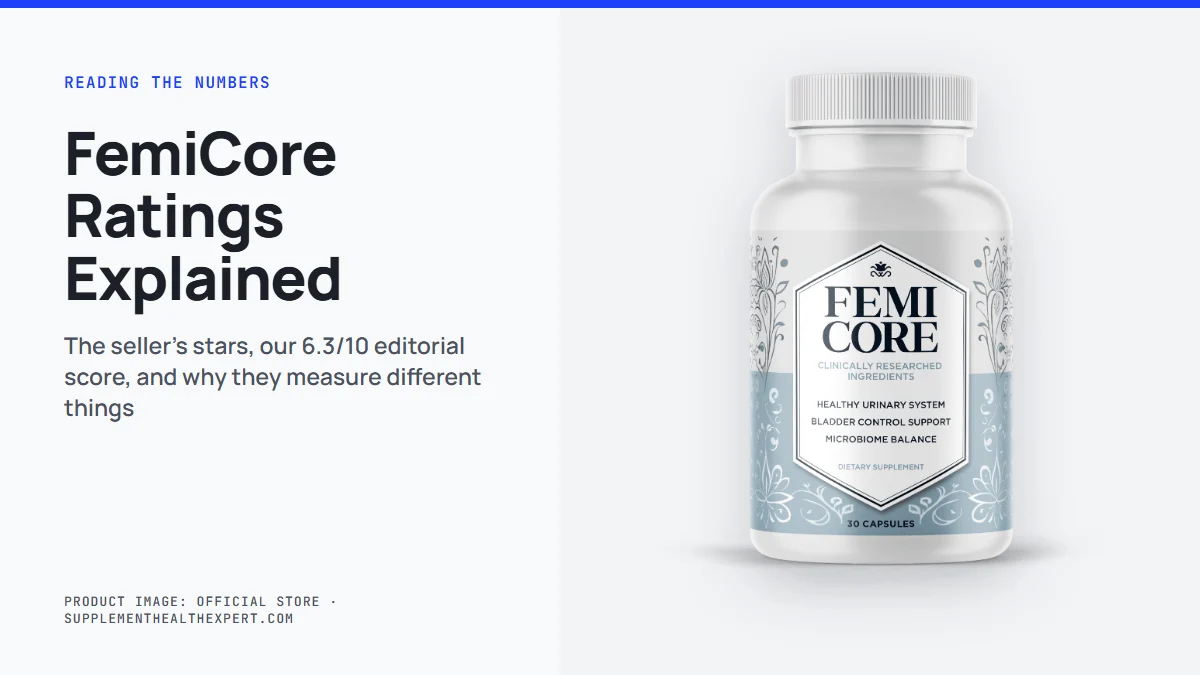
FemiCore ratings: two numbers, two different jobs
A rating is a summary. Every summary throws information away, and the question is always what got thrown away and who decided. For FemiCore the two numbers in circulation were made in completely different ways:
- The seller’s stars are meant to tell you that buyers are happy. The seller chose what to show, and the underlying reviews are not on the page.
- Our editorial score is meant to tell you how the product does against six fixed questions about its formula, its proof and its terms. The breakdown is published, so you can disagree with any part of it.
Neither is a measure of whether FemiCore will help your bladder. That is the one thing every reader wants to know, and it is the one thing no rating can promise.
The seller’s figure: 19,263 reviews behind a stars image
When we checked the official website on 9 October 2026, the home page and order page showed no individual testimonials at all. There were no names, no quotes and no customer photos. What it did show was a stars image with a line saying customers rate it highly, “based on 19,263 reviews”.
Three things are worth knowing about that number:
- The reviews are not shown. You cannot read one of the 19,263, sort them, or see a single low score.
- No platform is named. There is no link to an outside review service that collected them, so there is nothing to cross-check.
- The site’s own disclaimer hedges. It says testimonials “may not reflect the typical purchaser’s experience”. That line is standard on sales pages, but it is worth reading literally.
None of this proves the figure is wrong. It means the figure is a claim, in the same category as the seller’s “96% of customers order 6 bottles” line, which we also cannot verify. Our article on whether FemiCore is legit looks at how this fits with the rest of the offer.
What a 6.3 out of 10 is built from
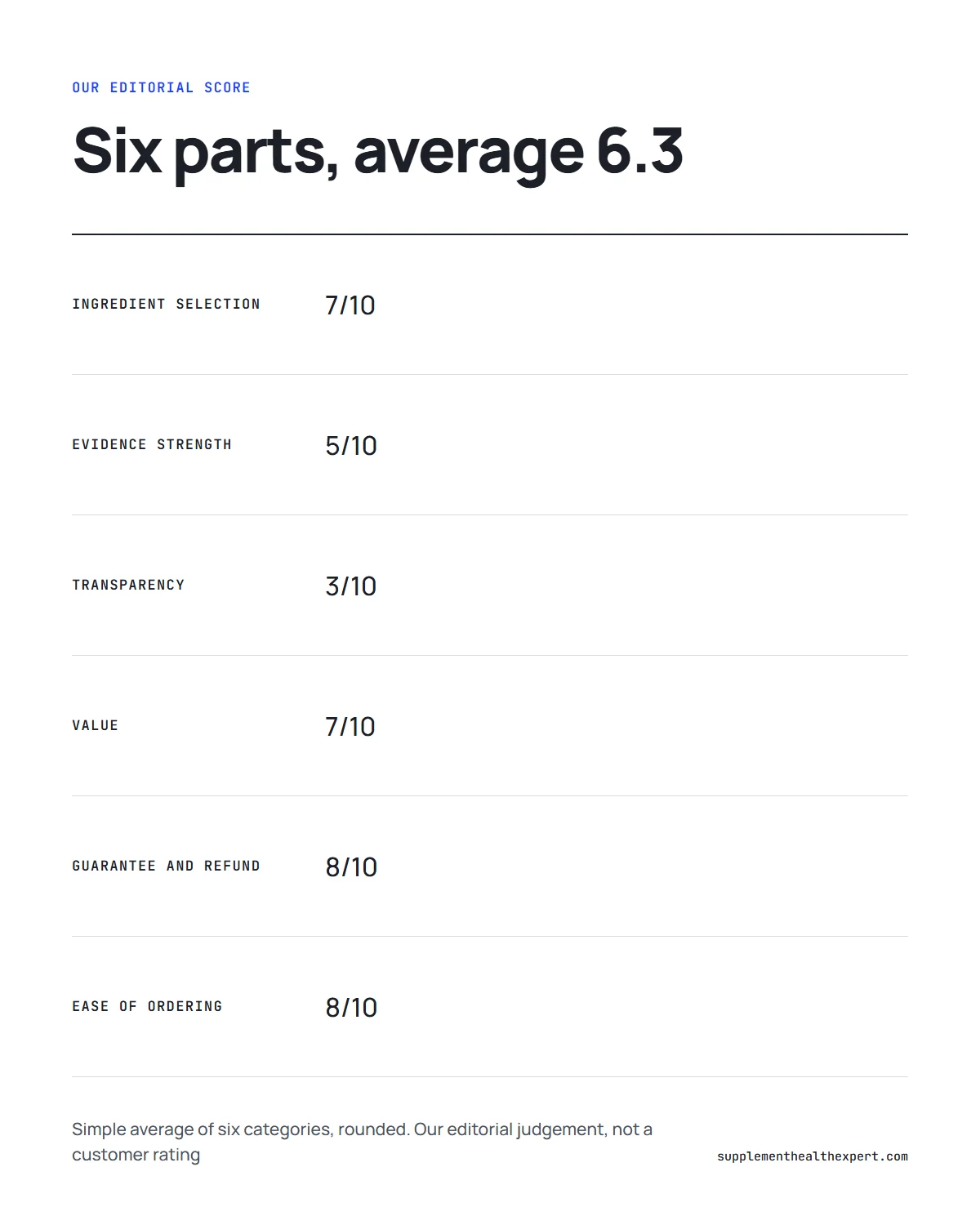
Our editorial score method uses the same six categories for every supplement. Each is scored from 0 to 10, and the overall number is their simple average. For FemiCore the six look like this:
| Category | What it asks | FemiCore |
|---|---|---|
| Ingredient selection | Do the chosen ingredients match the problem it is sold for? | 7/10 |
| Evidence strength | Is there human research at the doses sold, or on the product? | 5/10 |
| Transparency | Are doses, probiotic counts and strain codes disclosed? | 3/10 |
| Value | What does it really cost per day against plain options? | 7/10 |
| Guarantee and refund | How long is the refund window, and on what terms? | 8/10 |
| Ease of ordering | One clear store, one-time payment, shipping, support? | 8/10 |
| Overall | Simple average, rounded to one decimal | 6.3/10 |
The categories that hold the number up
The guarantee and the ordering process are the strongest parts of the offer. The official site runs a one-off checkout through BuyGoods with no hidden autoship, and every order carries a 60-day money-back window. The catch is that it counts from the delivery date, every bottle has to be returned along with the packing slip and a short note, at your own postage cost. Clear, written terms like these earn points even with conditions attached.
Value scores 7 because the per-bottle price drops from $79 to $49 as the pack size grows, and the 3 and 6 bottle packs ship free within the US.
The categories that pull it down
Transparency is the weak spot. The nine ingredients are pooled into one proprietary blend. The label lists Mimosa pudica, bearberry and cranberry extract, then berberine and five Lactobacillus species, but not how much of each, not the probiotic count, not strain codes, and not the cranberry PAC or bearberry arbutin content.
Evidence scores 5. Some ingredients have useful human research, cranberry for repeat urinary infections in particular, but no trial has tested the finished FemiCore formula, and without doses nobody can say whether the amounts match the studies. The label’s “clinically researched ingredients” refers to the ingredients in general, not to this product.
For the full scorecard with the reasoning behind each line, see our FemiCore review hub.
Why the two numbers cannot be compared
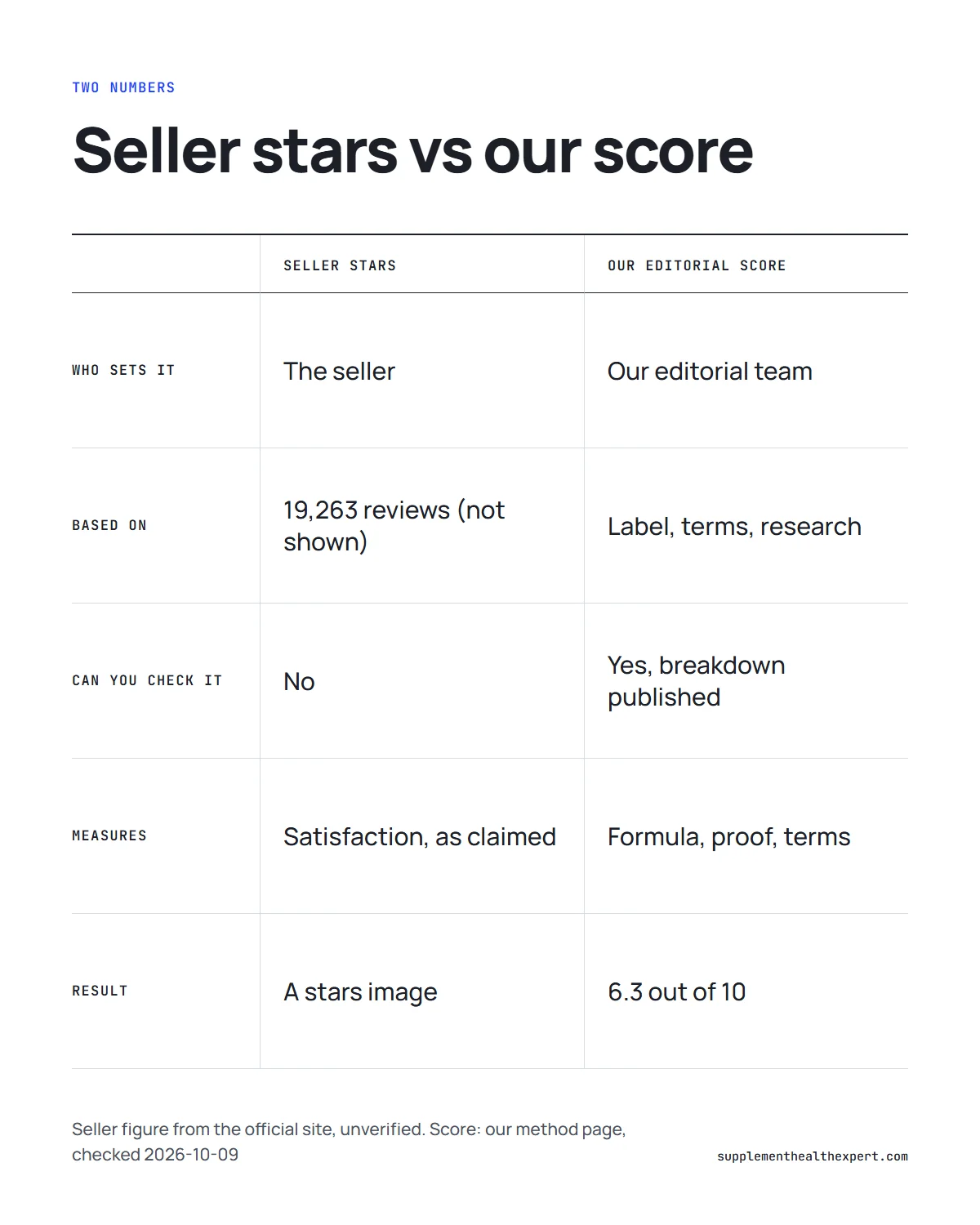
It is tempting to convert our 6.3 into roughly three stars and conclude that we think FemiCore is mediocre while buyers love it. That reading mixes up two different measurements.
| Question | Seller’s stars | Our editorial score |
|---|---|---|
| Who produced it? | The seller | Our editorial team |
| What is it based on? | Reviews that are not displayed | The label, the purchase terms and published research |
| Can you see the parts? | No | Yes, six published categories |
| Does it reflect use? | It claims to | No, we do not report personal use |
| Can a weak point be hidden? | Yes, by choosing what to show | No, each category is shown |
| What would move it? | Unknown | New facts about doses, trials, prices or terms |
A buyer can be satisfied with fast delivery, a polite support reply and a mild improvement that might have happened anyway. None of that touches whether the label discloses doses. Equally, a product can score well on our criteria and still disappoint someone whose symptoms have a cause a supplement cannot reach. The two numbers sit on different axes, so neither confirms or cancels the other.
Matching the score to what you care about
An average hides trade-offs, so it helps to read the six parts against your own priorities rather than stopping at 6.3.
- If you mostly care about risk at checkout, the 8s for guarantee and ordering matter most. The offer is easy to understand and easy to undo, provided you keep the packing slip and stay inside 60 days of delivery.
- If you mostly care about proof, the 5 for evidence and the 3 for transparency are the numbers to weigh. You are trusting a formula you cannot fully inspect.
- If you mostly care about price, remember that the seller’s $179 “regular” price is a reference figure. Real prices are $79, $69 or $49 per bottle, and the seller advises at least three months of use.
- If you have a health condition or take medicines, no rating helps. Berberine, bearberry and cranberry each carry interaction or safety notes that need a doctor’s view first.
Our earlier reviews and ratings breakdown walks through each category at greater length if you want the detail.
How to read any rating you find online
You will find other numbers for FemiCore on other sites. Before giving any of them weight, run through these questions. They come from the US Federal Trade Commission’s advice on online reviews, adapted to supplements.
- Who collected it? A rating gathered by the seller, or on a site the seller runs, is marketing. The FTC’s 2024 rule bars brands from passing off a site they control as independent.
- Can you read the reviews behind it? A number with nothing underneath is a claim, not data.
- Are there low scores? A spread of opinions is normal. A wall of five-star entries suggests filtering, which the 2024 rule also targets.
- When were they written? A burst of reviews in a short period is a warning sign.
- What does the reviewer’s history look like? An account that has reviewed one product only deserves less weight.
- Was anything given in return? Paid or rewarded reviews must be disclosed, and rewards tied to positive reviews are banned.
- Is it a score or an opinion? An editorial score should publish its categories. If it does not, you cannot tell what it measures.
Numbers no rating will give you
Some of the most useful figures for judging a supplement are absent from every FemiCore rating, because the seller does not publish them:
- the amount of each of the nine ingredients
- the probiotic count (CFU) and the strain codes
- the cranberry PAC content and the bearberry arbutin content
- the berberine dose, which matters for interactions
- a certificate of analysis showing what the capsules contain
Until those appear, any rating, ours included, is working around a gap. That is why transparency scores 3 and why it is the first thing we would look at again.
What the FemiCore numbers add up to
Our quick FemiCore review gives the verdict in a few minutes; this page is about the numbers behind it. Read together, they say: the seller’s stars tell you the company wants you to see satisfied buyers, and nothing more, because the reviews are not there to read. Our 6.3 tells you FemiCore is easy and fairly safe to buy and return, reasonably priced in the larger packs, sensibly chosen on paper, thinly proven as a finished product and poorly disclosed.
If those trade-offs suit you, and a doctor has checked your symptoms and medicines, the 60-day refund window from delivery is your real safety net. The full product picture sits on our FemiCore product hub.
Frequently asked questions
What does the 19,263 figure on the FemiCore website refer to?
The official site shows a stars image with the line that customers rate it highly 'based on 19,263 reviews'. The reviews themselves are not displayed, and no independent platform is named, so the number is a seller claim that nobody outside the company can confirm.
Why do you use a score out of 10 rather than stars?
Stars usually signal an average of buyer opinions. Our number is not that. It is an editorial judgement across six fixed categories, and a 10-point scale makes it harder to mistake it for a customer average.
How is the 6.3 worked out?
Ingredient selection 7, evidence strength 5, transparency 3, value 7, guarantee and refund 8, ease of ordering 8. The six are added and divided by six, which gives 6.33, rounded to 6.3.
Which category costs FemiCore the most points?
Transparency, at 3 out of 10. The label pools every ingredient into one blend, so you get neither per-ingredient amounts nor a CFU figure, and strain codes and a certificate of analysis are missing as well.
Can a star average be compared with an editorial score?
Not directly. A star average reflects how satisfied some buyers say they were. An editorial score reflects how a product does against set criteria such as disclosure and evidence. A product can do well on one and poorly on the other.
Will your 6.3 score ever change?
Yes, if the facts change. Published doses, a trial on the finished formula, a new price or different refund terms would all lead us to rescore it and update the page date.
Does a high star average mean a supplement works?
No. Ratings mix many things, including delivery speed, customer service and expectations. They cannot separate a real effect from symptoms that improve on their own, and they are open to filtering and fake entries.
Sources
- 01 U.S. Federal Trade Commission. How to evaluate online reviews.
- 02 U.S. Federal Trade Commission. Federal Trade Commission announces final rule banning fake reviews and testimonials (August 2024).
- 03 U.S. Federal Trade Commission. Health products: be wary of miracle cures and too-good-to-be-true offers.
femicore ratings · femicore · supplement star ratings · editorial score · online reviews · bladder supplement