Supplement Reviews / Guide
The Genius Switch Reviews: How to Tell a Real Review Page From a Rewritten Sales Video
The Genius Switch reviews often repeat the sales video. Our checklist shows how to judge any review page by its disclosure, sources, evidence and refund facts.
- Author
- Supplement Health Expert Editorial Team
- Published
- Reading time
- 9 min
- Sources
- 1 cited
Key takeaways
- 01 Most review pages for this product draw on one source, the seller's 36-minute sales video, so they tend to repeat the same names, numbers and promises.
- 02 A useful review page discloses how it earns money, names its sources, separates claims from evidence and states the refund rules correctly.
- 03 The facts any honest page should include: an 8-minute digital track, $39 plus local tax, ClickBank checkout, 4 bonuses and a 90-day refund window in the Terms and at checkout.
- 04 Red flags: a page that calls itself official, treats the video testimonials as customer reviews, shows star ratings with no source or promises luck, money or weight loss.
Search for The Genius Switch reviews and you will see page after page that reads like a summary of the same sales video. The names match, the numbers match and the promises match. That is not a coincidence, and it is not proof of anything either. This guide does something different from a normal review. It explains why so many pages sound alike, gives you a checklist you can use on any review page, and sets out what a trustworthy review of this product would actually contain.
A quick word about us. The seller does not run this site; we write it ourselves. Order buttons here carry an affiliate code, which means ClickBank can pay us a commission on a sale. Each fact below is traced to its source, and gaps in what we could confirm are marked plainly.
Why so many Genius Switch reviews sound the same
There is very little independent material about this product. What exists is the seller’s own: a 36-minute sales video, a sales page and the Terms of Service. A writer who has nothing else to go on will paraphrase those, and a reader then meets the same story five or six times on five or six different sites. Repetition starts to feel like confirmation, even though it all traces back to one origin.
The repeated material usually falls into a few groups:
- The named stories. “Lisa, a nurse from San Diego”, “Matthew in Houston”, “Ellie from Manhattan” and “Joyce Webb from Tempe” all come from the video.
- The numbers. The 18,456 “everyday Americans” the video says were helped, and its “stacks of five star reviews”, are figures supplied by the seller alone.
- The authority. The man presenting the video introduces himself as Dr. Daniel Barone and says he practises neurology in New York City. He also leans on Roger Sperry’s Nobel Prize.
- The promises. Insights, faster learning, better memory, luck, money, better relationships, weight loss and easier quitting of smoking all appear in the video.
None of this means the stories are invented. It means that a page repeating them has added nothing you could not get from the seller directly.
Where the repeated material comes from
This table traces the items you will see most often back to their origin, with what we could and could not confirm.
| What review pages repeat | Where it comes from | What we found |
|---|---|---|
| The four named testimonials | The sales video | Per the Terms, actors or digital avatars may play these stories |
| 18,456 people helped | The sales video | Seller figure, not verified |
| Stacks of five star reviews | The sales video | No source named, not verified |
| Nobel Prize backing | The video’s use of Roger Sperry | Sperry’s 1981 prize honoured split-brain work, unrelated to any audio product |
| $39 price | Sales page and checkout | Confirmed, plus local tax or currency |
| 90-day money back guarantee | Sales page, Terms, ClickBank checkout | Confirmed in the Terms and at checkout |
The bottom two rows are the only ones a reader can check for themselves. The others depend entirely on the seller’s word.
A checklist for judging any review page
Use these questions on any page that claims to review the track, including ours. A page does not have to be negative to be useful. It has to be clear.
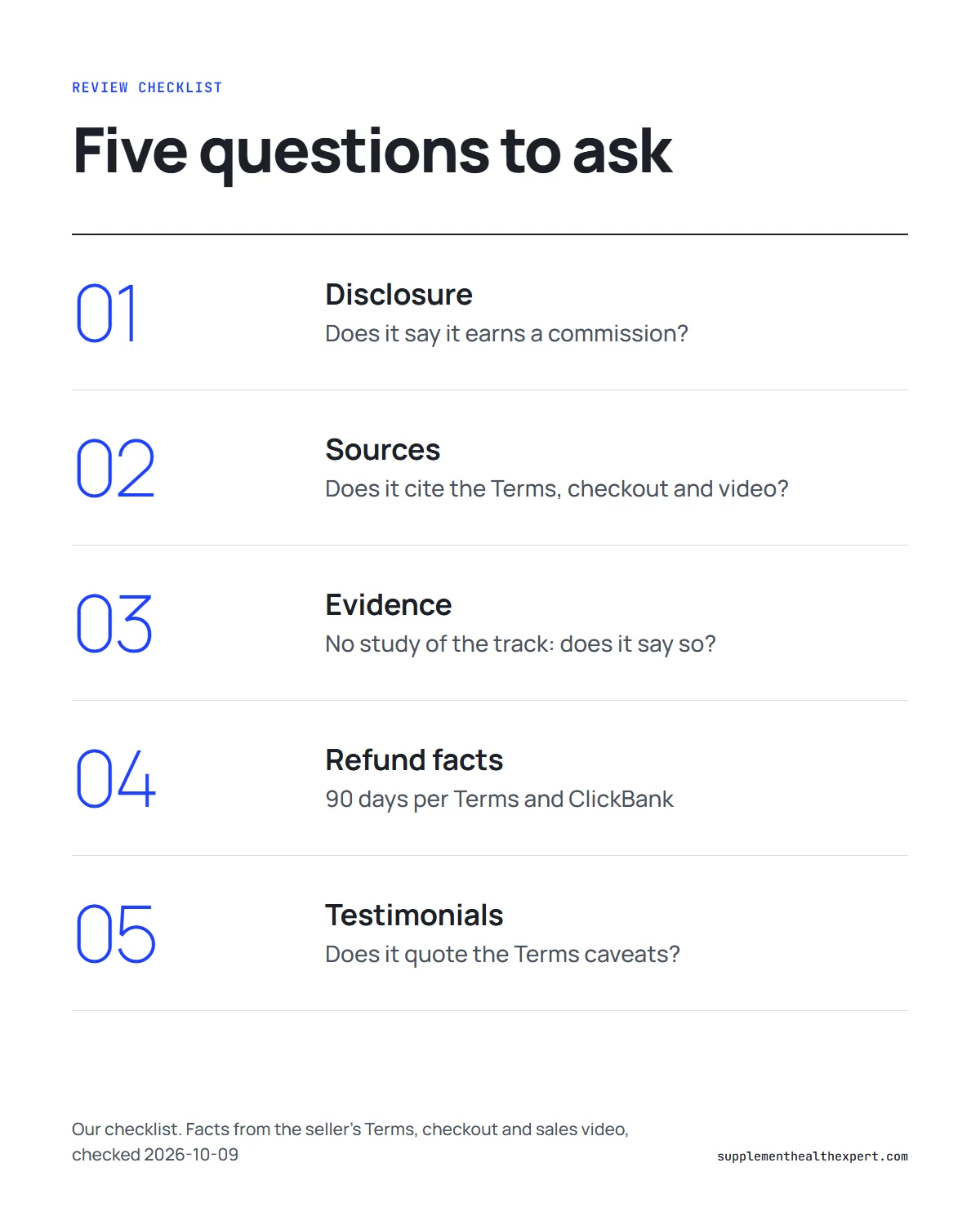
1. Disclosure
Does the page say whether it earns a commission? Does it make clear that it is not the seller? A page that calls itself the official site, or hides the fact that its buttons are affiliate links, has already told you something about how it treats the truth.
2. Sources
Does it name where its facts come from? The useful sources here are the seller’s Terms of Service, the ClickBank checkout page and the video itself. A page that quotes the video with no context, or cites “research” without saying which, gives you nothing to check.
3. Evidence
Does it keep the seller’s claims apart from what research shows? A careful page notes that nobody has published a trial of this particular track. It may add that the sales page lists a 2020 paper by Ross and Lopez on 40 Hz beats and the attentional blink, that a handful of small studies like it found brief shifts in focus or mood, and that the overall research picture is thin and inconsistent. It should also flag a contradiction: the video insists the method “has nothing to do with brain waves”, yet the reference list on the sales page is made up of brain-wave papers.
4. Refund facts
Does it get the guarantee right? The Terms give buyers of digital products a 90-day window, counted from the order date, to request their money back, and ClickBank’s checkout quotes the same 90 days. There is also a second refund page on the site, left over from a product called “NeuroActivate”: it covers unopened bottles for 60 days and lists a return address in Tallmadge, Ohio. A page that quotes that 60-day page as the rule, or does not mention the mismatch, has not read the fine print.
5. Testimonial handling
Does it tell you what the Terms say about the stories? The seller’s own document allows actors or digital avatars to perform them, admits that some people featured may be “early supporters, friends, or family members of the company’s founders”, and labels the testimonials “exceptional results”, warning that an ordinary buyer may see something different. A review that leaves this out is leaving out the seller’s own warning.
Red flags that a page is just repeating the pitch
Some warning signs are quick to spot:
- It calls itself official or uses the seller’s branding as if it were the seller.
- It repeats the urgency. The video says the $39 price is “not guaranteed beyond today”. A review that copies that pressure is selling, not reviewing.
- It presents the video’s characters (Lisa, Matthew, Ellie, Joyce Webb) as people it spoke to. Those names come straight from the sales video.
- It says a doctor endorses the product. Nothing we found confirms who the presenter is or what role he plays, and the Terms permit actors in the marketing.
- It shows a star rating or review count with no source. There is no published customer rating we could find.
- It uses words like “proven” or “clinically tested”. No study of the track exists that we could find.
- It promises results. Luck, money, promotions, weight loss and pain relief are claims made in the video, not outcomes anyone can promise.
Two or three of these on one page is a strong hint that you are reading the sales video in another font.
What a trustworthy review would contain
If you were to write the ideal review of this product, it would cover the parts below. Use it as a yardstick.
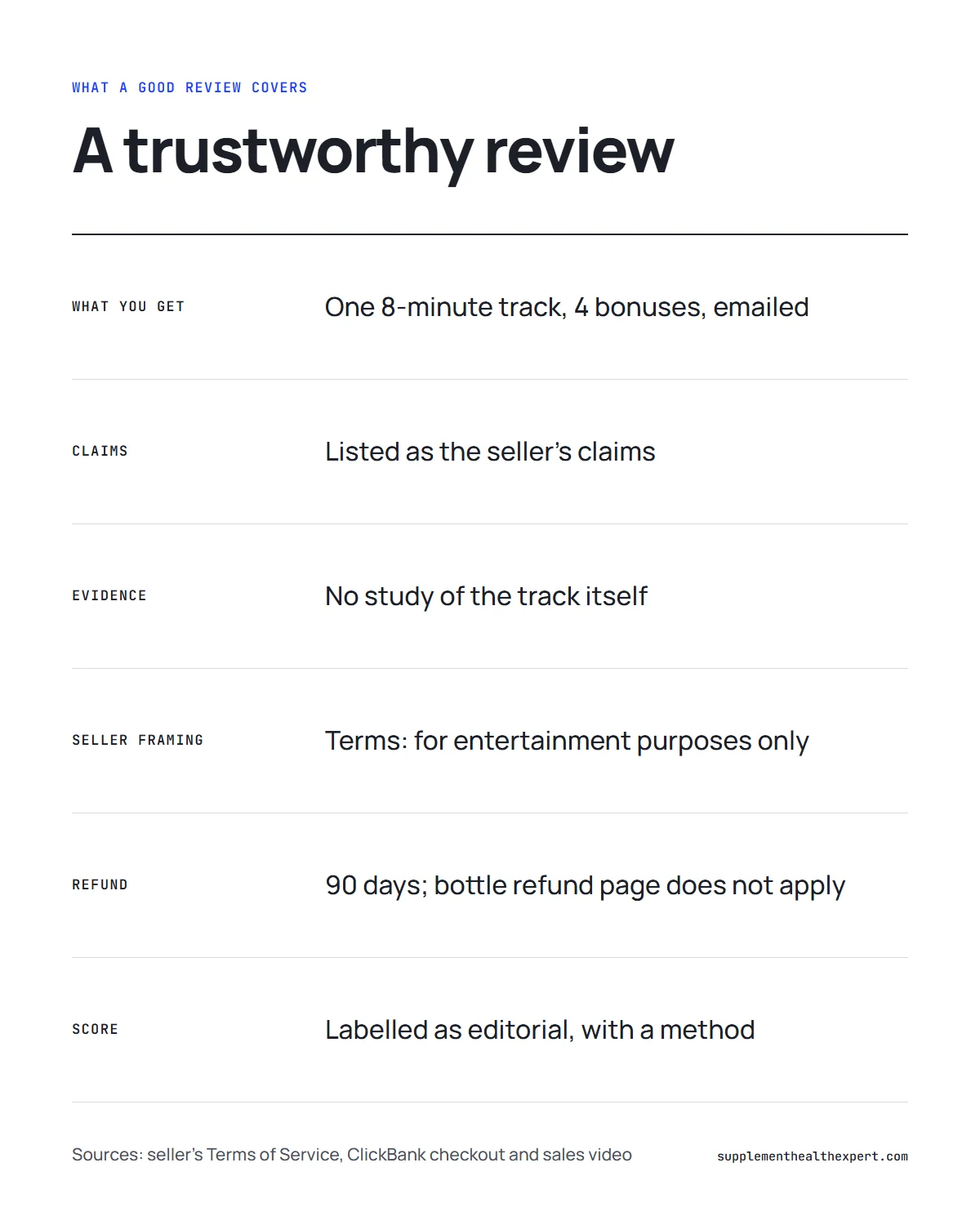
| Section | What it should say about this product |
|---|---|
| What you receive | One 8-minute track, 4 bonuses, emailed after checkout, for personal use only |
| Daily routine | Eight minutes of listening with eyes shut and headphones on; the video says a missed day is “okay” |
| Claims | Listed as the seller’s claims, not as results |
| Evidence | No study of the track; binaural-beat research small and mixed |
| Seller’s framing | The Terms’ section “For Entertainment Purposes Only” |
| Testimonials | The Terms’ caveats on avatars, actors and connections to the founders |
| Price and refund | $39 plus tax; 90 days per the Terms and ClickBank; the bottle page does not apply |
| Safety | Comfortable volume, never while driving, ask a doctor with epilepsy or hearing problems |
| Score | A clearly labelled editorial opinion with a published method |
The section on the seller’s framing is the one most pages skip. The Terms say “brain entrainment is not an exact science” and that the products “are provided for entertainment purposes only.” That sentence alone changes how the rest of the marketing should be read.
How the facts of this product score
We publish our own score so readers can see how we reached it. We rate the product 5.0/10 as an editorial score, worked out with our scoring method. It is our judgement, not a customer rating. Points were lost mainly on evidence and transparency, and gained on the 90-day guarantee and the straightforward ClickBank ordering.
If you want to go deeper, our look at the testimonials and the seller’s own disclaimers covers the video stories in detail, the full 2026 review gives our complete verdict, and our legitimacy check looks at the payment and refund side.
Testing it yourself instead of trusting reviews
Because there is so little independent feedback, the most reliable review may be the one you write for yourself. The 90-day window makes that possible. Write down before the first listen what you hope will change, listen for 8 minutes a day as the seller suggests, and keep brief notes. If nothing you care about has changed well before day 90, ask ClickBank for a refund. ClickBank order support is on 1-800-390-6035, and the charge appears on statements as CLKBANK*GeniusSwitch.
Look after yourself during the trial. Our general rule for audio of this kind: set the volume low enough to be comfortable, and never play it at the wheel or while operating machinery. Anyone with past seizures, epilepsy or hearing trouble should check with a doctor before starting. The site itself states that the product is “not intended to diagnose, treat, cure, or prevent any disease”, so do not change any treatment because of it.
Bottom line on Genius Switch reviews
Most Genius Switch reviews online are retellings of one sales video. A page earns your trust when it discloses its commission, names its sources, keeps claims apart from evidence, quotes the seller’s own disclaimers and gets the 90-day refund rules right. Measured that way, many pages fall short. The product itself is simple: an 8-minute track for $39, with a refund window long enough to judge it on your own experience rather than anyone’s stories.
Frequently asked questions
Why do so many review sites say the same thing about this track?
Almost all of them work from the same material: the seller's sales video and sales page. If a page has no source of its own, it ends up retelling the four named stories, the 18,456 customers figure and the Nobel Prize framing from the video, often without saying where they came from.
Do review sites earn money when I buy through them?
Many do, including this one. The product is sold through ClickBank, which pays a commission to sites that refer buyers. That is not a problem in itself, but a trustworthy page tells you about it near the top instead of hiding it.
What should a review page disclose before I trust it?
Look for three things: whether it earns a commission, whether it is independent or run by the seller, and where its facts come from. A page that cites the seller's Terms, the checkout page and the video, and says which claims it could not check, is more useful than one that only praises the product.
Are star ratings for this product reliable?
Treat any star rating with no named source as meaningless. The sales video mentions stacks of five star reviews but does not say where they are published, and we could not verify that claim. Our own 5.0 out of 10 is an editorial score, not a customer rating.
What refund details should a good review mention?
It should explain that the Terms give digital buyers 90 days from purchase to ask for their money back, that ClickBank's checkout shows the same 90 days, and that a stray refund page about bottles of another product, with a 60-day limit, has nothing to do with a downloaded track.
Has any review page proven that the track works?
No. We found no published study that tests this track. Pages that say it is proven are repeating the seller's claims. The most a careful page can say is that a few small binaural-beat experiments saw brief changes in attention or mood, and that the research as a whole is limited and uneven.
Sources
genius switch reviews · the genius switch · review checklist · affiliate disclosure · clickbank