Everyday Wellness / Guide
How to Use The Brain Song: A Simple Daily 12-Minute Routine With Timing, Headphones and Volume Tips
How to use The Brain Song in a simple daily routine: when to listen, how to set up headphones and volume, a four-week plan and fixes for common hiccups.
- Author
- Supplement Health Expert Editorial Team
- Updated
- Reading time
- 8 min
- Sources
- 0 cited
Key takeaways
- 01 The seller's routine is one listen a day, 12 minutes, at home, ideally with headphones.
- 02 The seller names no best time of day, so choose one you can repeat, such as before a study or work block.
- 03 Comfortable volume matters more than loudness, and the audio should not be played while driving or operating machinery.
- 04 A four-week plan with short notes makes it easy to judge how the habit feels.
- 05 The 90-day refund window gives you room to adjust your routine before deciding.
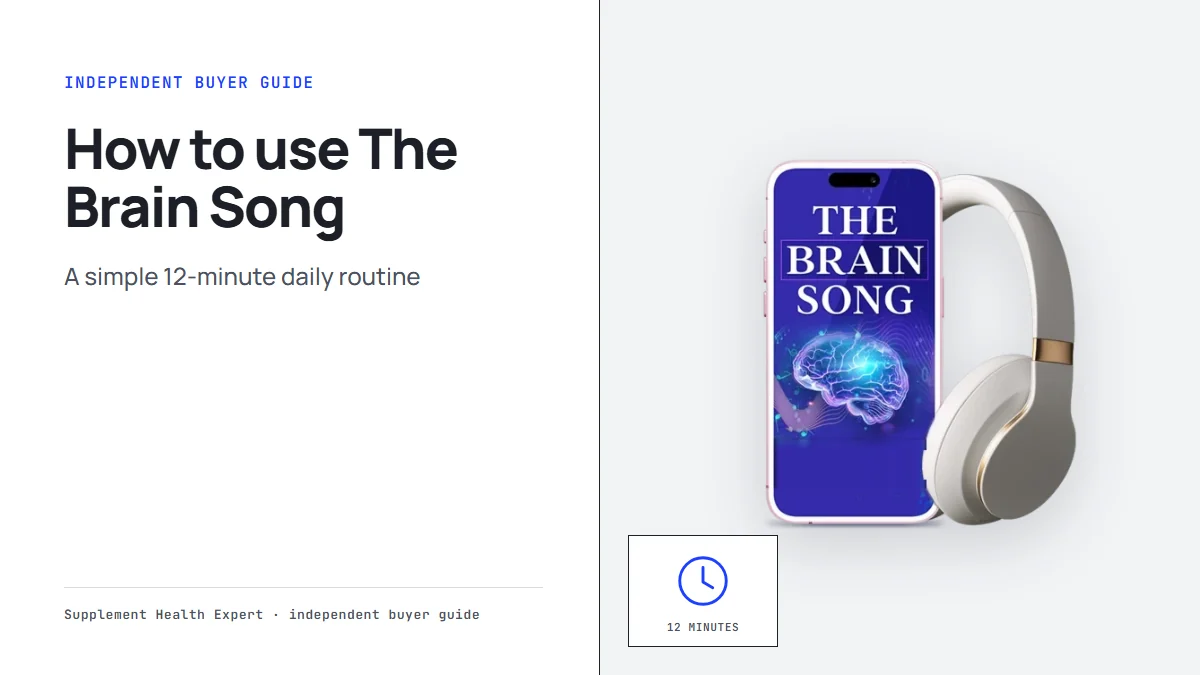
A product that asks for twelve minutes a day lives or dies on whether you actually make the time. This guide on how to use the brain song turns the seller’s one-line instruction, listen once a day for twelve minutes, ideally with headphones, into a simple routine you can follow: when to listen, how to set up your sound, how to protect the habit over four weeks and what to do when life gets in the way.
How to Use The Brain Song: The Seller’s Routine
The seller’s instructions fit in a few lines.
- Listen once a day.
- Each session is 12 minutes long.
- Listen at home.
- Use headphones if you can.
- Keep the volume comfortable.
Everything else is up to you, which is why the details below matter. They are our suggestions, built from common sense about habits, not from any claim by the seller.
Choosing Your Time of Day
The seller does not name a best time, so the right answer is the time you will keep. A few easy anchors:
| Time | Why it works |
|---|---|
| After breakfast | The day is quiet, and the habit attaches to something you already do |
| Before a work or study block | It gives you a clear start to focused time |
| Mid-afternoon break | A short reset between tasks |
| Early evening | A calm moment once the day’s tasks are done |
Pick one and stay with it for at least two weeks. Changing the time every day makes a habit harder to form.
Setting Up Your Sound
Good setup takes two minutes and removes most excuses.
- Headphones on. Over-ear pairs and snug earbuds both work. Comfort matters more than the model.
- Volume low to moderate. If you could not talk over it, it is too loud. Hearing is worth protecting.
- Notifications silenced. Put your phone on a do-not-disturb setting so the twelve minutes stay yours.
- A seat, not a commute. Settle somewhere calm. Never listen while driving or operating machinery.
Our audio review looks at headphones and devices in more depth.
A Four-Week Plan
A plan makes the habit easy to start and easy to judge.
| Week | Focus | Small task |
|---|---|---|
| 1 | Show up | Listen at the same time daily, no pressure to notice anything |
| 2 | Settle in | Keep the same spot and headphones, and note whether the routine feels easy |
| 3 | Observe | Jot a line after each listen about how the next hour of work goes |
| 4 | Review | Read your notes and decide whether to keep going |
Over four weeks you will listen for about 5.6 hours in total if you do it daily (12 minutes times 28 days is 336 minutes, our arithmetic). That is a fair sample for judging a habit.
Making the Habit Stick
Habits stick when they are easy and attached to something that already happens. These ideas help.
- Stack it. Link the audio to a daily event, such as your first coffee.
- Prepare the night before. Charge your phone and set your headphones where you will see them.
- Use a reminder. A calendar alert at the same time every day does the thinking for you.
- Keep it short. Twelve minutes is small on purpose, so resist the urge to add extras.
- Forgive a missed day. Carry on the next day rather than starting over.
What to Do After Each Session
After the audio ends, take a minute before you jump into your next task. Breathe, stretch and then begin your focused work or reading. If you keep a short log, jot one line now: the date, one word for how you feel and how your next hour goes. After a few weeks those lines form a record that is more reliable than memory.
Common Hiccups and Fixes
| Problem | A simple fix |
|---|---|
| Too busy to find twelve minutes | Move the session to the first free slot of the day |
| Distracted by notifications | Switch on do-not-disturb before you press play |
| Headphones feel uncomfortable | Try a different pair or a looser fit |
| Cannot find a quiet spot | Use a closed room, a quiet corner or a calm break room at work |
| Forgot to listen | Listen later the same day if you can, or carry on tomorrow |
Safety Notes
Keep the sound at an easy level and leave driving and machinery out of it. A seizure history or a hearing device calls for a word with your doctor before you start. Our safety guide covers all of this at more length.
Sample Weekday and Weekend Schedules
Routines look different on different days, and a plan that covers both is more likely to survive. Here are two simple examples you can copy or adapt.
| Day type | When | Setting |
|---|---|---|
| Weekday | Right after breakfast, before opening your laptop | Desk or kitchen chair, headphones on |
| Weekday alternative | Just before an evening study session | A quiet room with a closed door |
| Weekend | Mid-morning, after a slow start | A comfortable chair at home |
The principle is the same each time: pick a fixed anchor, such as breakfast or the start of study, and attach the audio to it. On weekends, allow a little flexibility, because the point is regularity, not rigid timing.
When to Adjust Your Routine
Habits need small tweaks now and then, and changing something is not a failure. Consider adjusting if:
- you keep skipping the slot you chose, which suggests the time is unrealistic
- you feel rushed during the twelve minutes, which suggests you need a calmer moment
- your headphones feel uncomfortable, which suggests trying another pair
- your surroundings are noisy, which suggests a different room
Change one thing at a time so you can tell what helped. If after a few weeks the routine still does not feel right, remember that a refund request is possible for three months after buying. Our The Brain Song hub shows the guarantee beside the price.
Making It Part of a Bigger Focus Routine
A twelve-minute audio works best when it has company. You might pair it with a short list of the three things you plan to finish that day, a glass of water and a clear desk. The audio then becomes the start of a small ritual: sit down, listen, then begin the first task on your list. The ritual marks a clear line between everything else and the work you want to do.
You can also use it before a learning session. Listen, then open your book or course straight away, so the shift from audio to study is quick. Over several weeks, the sequence becomes familiar, and starting gets easier.
Our View
An easy-to-follow routine helps The Brain Song reach 9.0/10 as our editorial score. Our The Brain Song overview and safety page gather the facts.
Start Tonight
The whole routine fits in a coffee break. Order, choose your time, put on your headphones and press play.
Frequently asked questions
How often should I listen?
The seller describes a once-a-day routine of 12 minutes. A steady daily habit is the simplest way to follow it.
What is the best time of day?
Nothing is specified, so choose a slot you can keep, for instance after breakfast or ahead of a study session.
Do I need headphones?
Headphones are the seller's ideal, and its pictures show a phone paired with them. A comfortable pair also shuts out room noise.
How loud should it be?
At a comfortable level, never loud. A good test is that you could still hold a quiet conversation over it.
What if I miss a day?
Simply pick up the next day. A routine only needs to be steady, not perfect.
When should I not listen?
Not behind the wheel and not around machinery. With a seizure history or a hearing device, see a doctor first.
how to use the brain song · the brain song daily routine · the brain song when to listen · the brain song headphones and volume · the brain song four week plan · brain song how to use · the brain song best time of day