Supplement Reviews / Guide
The Genius Switch Binaural Beats: Is the Track Binaural, What the Research Says and How to Listen Safely
The genius switch binaural beats question, checked: what the sales video says, what the sales page cites, what research shows and how to listen safely.
- Author
- Supplement Health Expert Editorial Team
- Published
- Reading time
- 10 min
- Sources
- 1 cited
Key takeaways
- 01 The Genius Switch is a single 8-minute digital audio track. The seller never calls it a binaural-beat recording; the sales video calls it a 'targeted auditory sequence' that uses 'neural sync technology'.
- 02 The video says the method 'has nothing to do with brain waves', yet the sales page lists studies on 40 Hz binaural beats and gamma stimulation as references, and the Terms describe the product area as brain entrainment.
- 03 Research on binaural beats is small-scale and mixed: some studies report short-term effects on attention or mood. No published study tests The Genius Switch track itself, and it is not a treatment for anything.
- 04 If you try it, keep the volume comfortable, never listen while driving, and ask a doctor first if you have epilepsy, a seizure history or hearing problems. The Terms give 90 days from purchase to ask for a refund.
People who search for the genius switch binaural beats usually want a straight answer to one question: is this 8-minute audio track simply a binaural-beat recording sold under a new name? The honest answer is that the seller’s own materials point in two directions at once. The sales video insists the method “has nothing to do with brain waves”, while the sales page lists studies on 40 Hz binaural beats as its references. This page lays out both sides, explains what binaural beats are in plain English, summarises what the research can and cannot tell you, and finishes with practical advice on listening safely.
A word about us. This is an independent site, not the seller’s page. Links to the product are affiliate links, so we may earn a commission if you buy, at no extra cost to you. We have not analysed the audio file itself, so nothing below is based on measuring the track’s frequencies. Everything we say about the product comes from the sales video, the sales page and the seller’s Terms.
What The Genius Switch actually is
Before getting into frequencies, it helps to be clear about the product. The Genius Switch is one 8-minute digital audio track. In the sales video it is described as a “targeted auditory sequence”, and a heading on the sales page calls it the “Genius Switch Audio Series”. The Terms of Sale describe the purchase as “a copyrighted digital article for personal use”. It is not an app and not a game; our guide to the Genius Switch app question covers how to download and play the file.
| Item | What the seller’s materials say |
|---|---|
| Format | One 8-minute digital audio track |
| Seller’s description | A “targeted auditory sequence” using “neural sync technology” |
| How to use it | Headphones on, eyes closed, 8 minutes a day |
| Missed days | Missing a day is “okay”, according to the video |
| Delivery | Emailed right after checkout; digital only, nothing shipped |
| Price | $39 at checkout, plus local tax or currency differences |
| Guarantee | Refund requests within 90 days of initial purchase (Terms and ClickBank) |
Notice what is missing from that list: any technical description of the sound. The seller tells you how long the track is and how to listen, but not what it contains.
The Genius Switch binaural beats question: what the seller says
The sales video is surprisingly firm that this is not a brainwave product. These are the key lines, with their approximate timestamps:
- At about 00:35 the presenter says “this simple at home ritual has nothing to do with brain waves.”
- At about 02:47: “the answer isn’t brain pills or brainwaves.”
- At about 06:04 he describes “sound waves” as “an incomplete method”, because “sound waves only address brain waves”.
- At about 06:50 he says the track “uses neural sync technology which works by syncing up both hemispheres to each other.”
- At about 23:57: “It’s not a brain pill or a brain wave.”
The video also claims that a neural sync session “normally takes one hour” and that the team turned “one hour of neural sync into an eight minute auditory sequence”. Nowhere in the 36-minute video is “neural sync technology” explained in technical terms. We could not find a definition of it in any of the seller’s materials.
The person delivering all of this is the presenter, who introduces himself as Dr. Daniel Barone, a New York City neurologist. We could not verify his identity or whether he is involved with the product, so we treat his statements as the seller’s marketing rather than as an expert opinion.
What the sales page and the Terms say
The rest of the seller’s material tells a different story. The sales page lists research references, and those references are studies on 40 Hz binaural beats and on gamma stimulation. One example is a 2020 study by Ross and Lopez on 40 Hz binaural beats and the attentional blink, a lab measure of attention.
The Terms go further. Under “For Entertainment Purposes Only” they say: “We believe brain entrainment is a wonderful way to improve your situation in life”, and then add that “brain entrainment is not an exact science”. A later section says that “all claims regarding brainwave entrainment, focus, and mental energy are substantiated by established scientific research”. That last sentence is the seller’s own statement, not something we could confirm.
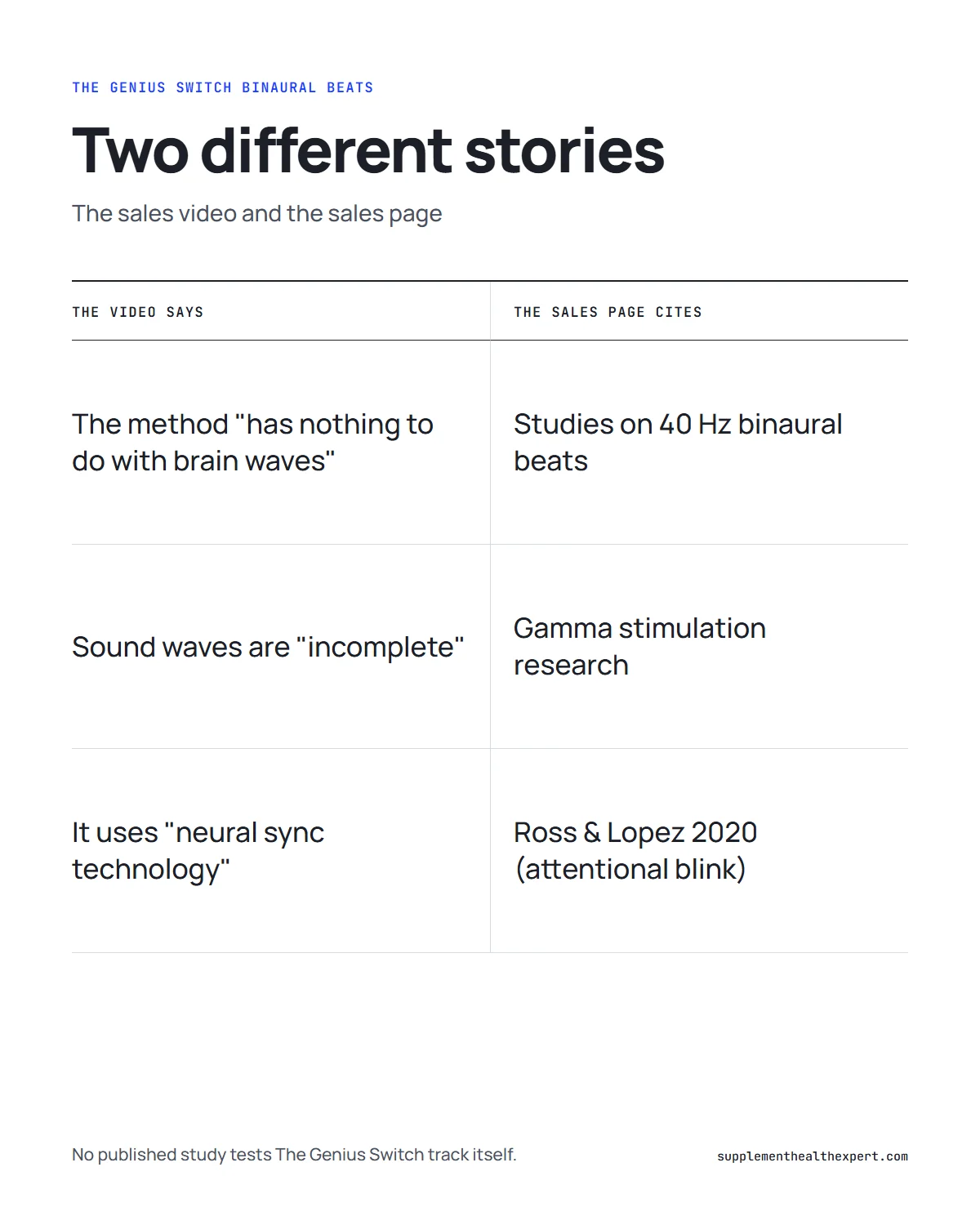
Put side by side, the picture looks like this:
| Source | What it says |
|---|---|
| Sales video | The method “has nothing to do with brain waves” |
| Sales video | Sound waves are “incomplete” |
| Sales video | The track uses “neural sync technology” |
| Sales page | Lists studies on 40 Hz binaural beats as references |
| Sales page | Lists gamma stimulation research, for example Ross and Lopez (2020) |
| Terms | Calls the area “brain entrainment” and mentions “brainwave entrainment” claims |
| Not found anywhere | A published study that tests The Genius Switch track itself |
How to read the contradiction
We do not know why the video and the reference list disagree, and we would rather not guess at motives. What we can say is what the contradiction means for you as a buyer.
First, the video positions the track as something new and different from the free audio you can find elsewhere. The presenter says tracks on YouTube and Spotify were “disappointing” and that many had “no neural sync technology embedded” at all. Second, the reference list borrows its scientific support from binaural-beat and gamma research. Both things can appear on the same page, but they cannot both be the full explanation of how the product works.
The practical result is simple. You cannot tell from the seller’s materials what the track contains, so you cannot judge it the way you would judge a recording with published frequencies. What you are buying is an 8-minute audio file backed by a 90-day refund window, not by a study. In our view, that is the fairest way to frame the purchase.
What binaural beats are, in plain English
This section is general background, not a claim about The Genius Switch.
A binaural beat is something your brain produces rather than something in the recording. If one ear hears a steady tone and the other ear hears a tone at a slightly different pitch, most people perceive a soft pulsing “beat” at the difference between the two. For example, a 200 Hz tone in the left ear and a 240 Hz tone in the right ear produce a perceived beat of 40 Hz. That 40 Hz figure is the one that appears in the studies the sales page cites, and it falls in the range usually called gamma, which is why the reference list also mentions gamma stimulation.
Two practical points follow from that:
- Binaural beats need headphones. Each ear has to receive its own tone. Through speakers, the two sounds mix in the room before they reach you.
- The effect depends on the recording. A binaural track only contains binaural beats if it was built with two separate tones. Without published details, there is no way to know whether a given track does.
The seller’s instruction to use headphones fits how binaural beats are delivered. It proves nothing either way, though, because headphones are also simply how most people listen to audio privately.
What binaural-beat research says, and what it does not
The research on binaural beats is real but limited. Some small studies, such as the 40 Hz attentional-blink study by Ross and Lopez (2020) that the sales page cites, report short-term effects on attention or mood. Reviews of the field describe the evidence overall as mixed and small-scale. None of that research tested The Genius Switch, because no published study tests the track itself.
| Question | What we can fairly say |
|---|---|
| Do binaural beats have any measured effect? | Some small studies report short-term effects on attention or mood |
| Is the evidence strong? | No. Reviews describe it as mixed and small-scale |
| Has The Genius Switch been studied? | No published study tests the track itself |
| Does research support luck, money or promotions? | No. These are claims made in the sales video |
| Is it a treatment for any condition? | No. The site’s own disclaimer says it is “not intended to diagnose, treat, cure, or prevent any disease” |
There is a large gap between “a short-term change on an attention test in a small study” and what the sales video promises. The video links the track to eureka moments, faster learning and better memory, but also to luck and synchronicities, promotions and money, better relationships, weight loss (including a 17 lb anecdote), quitting smoking, headaches and joint pain easing, and children’s grades improving. It says the track “starts working the very first time you listen”, that many customers notice a difference “within the first two to three days”, and that most people “begin to see results within a couple weeks”. None of these outcomes has been shown for this track.
Even the presenter draws a line at one point. Asked whether the product helps at the casino, he says: “there is of course no evidence to support that the genius switch caused that.” We would apply the same caution to the other outcomes.
The Nobel Prize connection
The video opens by linking the product to a Nobel Prize. Roger Sperry did win the 1981 Nobel Prize in Physiology or Medicine, for split-brain research. He did not win it for “whole brain activation”, which is the seller’s own term rather than a clinical one. Sperry’s work is real; the step from that work to an 8-minute audio track is the seller’s interpretation.
Claims to weigh carefully in the sales video
Beyond the brainwave question, a few other parts of the pitch deserve a sceptical eye.
The customer numbers. The video says the track has helped “18,456 everyday Americans” and that it has “stacks of five star reviews”. These are the seller’s figures. We found no way to verify either one.
The testimonials. The video features stories attributed to Lisa, a nurse from San Diego, Matthew in Houston, Ellie from Manhattan and Joyce Webb from Tempe. Please do not read these as independent reviews. The seller’s Terms say that feedback may be dramatised using “digital representations, avatars, or actors”, that some people giving testimonials may be “early supporters, friends, or family members of the company’s founders”, and that the testimonials are “exceptional results and may not reflect the experience of a typical customer”. The Terms also say names in the marketing have been changed and pen names are used. Our Genius Switch reviews guide looks at the testimonials in more detail.
The presenter. As above, the presenter introduces himself as Dr. Daniel Barone. We could not verify his identity or his involvement, and nothing here should be read as an endorsement by any real doctor.
How to listen safely to The Genius Switch or any similar track
The points below are our own general advice for audio-entrainment products, not instructions from the seller.
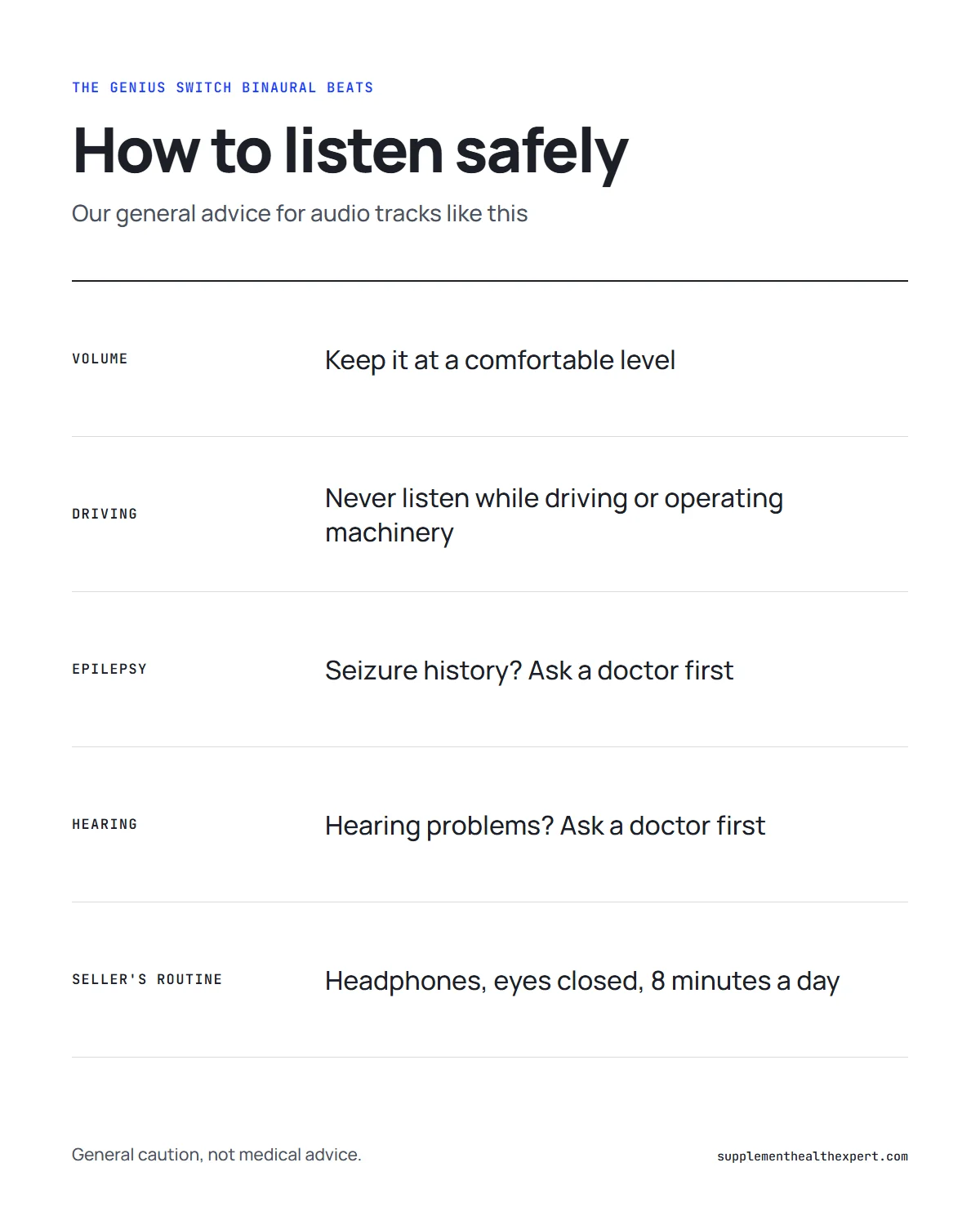
- Keep the volume comfortable. You should be able to hear the track clearly without strain. If it feels loud, it is too loud, especially with headphones.
- Never listen while driving or operating machinery. The seller’s routine asks you to close your eyes and relax, which is the opposite of what you need behind the wheel.
- Epilepsy or a seizure history: ask a doctor first. Rhythmic audio stimulation is a general caution area, so get personal advice before you start.
- Hearing problems: ask a doctor first. That includes tinnitus or any recent change in your hearing.
- Follow the seller’s routine, and no more. The seller’s instructions are headphones on, eyes closed, 8 minutes a day. Longer or louder sessions are not part of the instructions.
Two more points of our own. Stop listening if you feel dizzy, unwell or get a headache. And do not change any medicine, treatment or care plan because of the track. The Terms also say the service should only be used by people over the age of 18.
Price and refund fine print
At the time of writing the checkout price is $39, plus local tax, and the final amount can vary with your country and currency. The sales page shows a “regular price” of $200, then $100, then $49 before “Today Just For $39”. In the video the presenter first offers $49, then a “special price” of $39, and says that price is “not guaranteed beyond today”. Treat those reference prices and the deadline as sales urgency rather than as a real discount you might miss.
For refunds, two sources agree. The Terms say digital products can be refunded if you ask “within 90 days of your initial purchase”, and the ClickBank checkout states a return window of 90 days from the date of purchase. The site also has a separate refund page at /TOS/refunds/, but it is a copy of a policy for “NeuroActivate” bottles: 60 days, unopened bottles only, and a return address in Tallmadge, Ohio. It does not fit a digital track, so rely on the Terms and the ClickBank policy instead.
Practical steps if you buy:
- Keep the ClickBank receipt email. Your card statement should show CLKBANK*GeniusSwitch.
- ClickBank order support is on 1-800-390-6035.
- Product support is listed as [email protected].
- Note the purchase date, so you can ask well inside the 90 days if the track does nothing for you.
If you want to check you are on the genuine order page before paying, see our Genius Switch website guide.
Who might try it, and who should skip it
| Might be worth a try | Better to skip |
|---|---|
| You are curious about audio tracks and want an 8-minute routine | You want proof that the track does what the video says |
| You are comfortable treating $39 as an experiment with a refund window | You are hoping it will treat a health problem |
| You will keep the receipt and ask for a refund within 90 days if needed | You have epilepsy, a seizure history or hearing problems and have not spoken to a doctor |
| You understand the benefits are the seller’s claims | You are expecting luck, money or a promotion from listening |
Our view on The Genius Switch binaural beats debate
This is our editorial opinion. The Genius Switch is marketed as something that is not about brain waves, yet the sales page leans on binaural-beat and gamma research for its references, and the Terms describe the field as brain entrainment. Since the seller does not say what the track contains and no study has tested it, the most you can reasonably expect is what small binaural-beat studies report in general: possible short-term effects on attention or mood, with mixed evidence. The bigger promises in the video, from promotions to weight loss, are the seller’s claims and nothing more. If you are curious, try it as a low-cost experiment, listen safely, and use the 90-day refund window if it does nothing for you.
Frequently asked questions
Does The Genius Switch use binaural beats?
The seller does not say so directly. The sales video calls the product a 'targeted auditory sequence' using 'neural sync technology' and says the method 'has nothing to do with brain waves'. The sales page, however, lists studies on 40 Hz binaural beats among its references. We have not analysed the audio file, so we cannot tell you which tones or frequencies it contains.
Is there scientific proof that The Genius Switch works?
No published study tests the track itself. The studies listed on the sales page are about binaural beats and gamma stimulation in general, and that research is small-scale with mixed results, mostly describing short-term effects on attention or mood. The benefits described in the video are the seller's claims.
What is 'whole brain activation'?
It is the seller's own term, not a clinical one. The video connects it to Roger Sperry's Nobel Prize, but Sperry won the 1981 Nobel Prize for split-brain research, not for anything called whole brain activation.
Do I need headphones for The Genius Switch?
The seller's instructions are to put on headphones, close your eyes and listen for 8 minutes a day. Headphones are also the usual way binaural beats are delivered, because each ear has to receive its own tone. Keep the volume at a comfortable level.
Is a free binaural-beat track on YouTube or Spotify the same thing?
The presenter says the tracks on YouTube and Spotify are not the same and that The Genius Switch is not sold there. We cannot test that claim, because the seller does not publish what the track contains. If you only want to try binaural beats in general, that is a separate decision from buying this product.
Is it safe to listen to an audio track like this?
Our general advice for any audio-entrainment track: listen at a comfortable volume, never while driving or operating machinery, and speak to a doctor first if you have epilepsy, a history of seizures or hearing problems. Stop if you feel unwell. It is not a substitute for medical care.
Can I get my money back if it does nothing for me?
The Terms say digital products can be refunded if you ask within 90 days of your initial purchase, and the ClickBank checkout states the same 90-day window. Ignore the site's separate refund page, which is copied from a supplement policy. Keep your ClickBank receipt.
Sources
the genius switch binaural beats · the genius switch · binaural beats · 40 hz binaural beats · audio entrainment · clickbank