Supplement Reviews / Guide
The Last Wish Pineal Gland: What It Really Does, Why Night Light Matters and the Video's Claims Checked
The last wish pineal gland claims checked: it makes melatonin and times sleep, calcifies often with age, and no evidence ties sound or money to it.
- Author
- Supplement Health Expert Editorial Team
- Published
- Reading time
- 9 min
- Sources
- 4 cited
Key takeaways
- 01 The pineal gland makes melatonin and helps set the timing of sleep. That is the well-documented part of its job, and it has nothing to do with money.
- 02 Calcification of the gland is common with age. We found no good evidence that sound activates it, that a guide can reverse it or that it affects wealth.
- 03 The video says the human gland has a retina. It does not: light reaches it indirectly, through the eyes. The video also links the words cherubim (Hebrew) and cerebrum (Latin), which do not share a root.
- 04 A dark, quiet wind-down can feel relaxing and light at night can lower melatonin, so the advice to listen in the dark has a sleep logic, whatever you think of the rest.
The last wish pineal gland story is the centre of the whole sales pitch: the seller says its audio “activates” a small gland deep in the brain and that this attracts abundance. Some of the surrounding facts are real, such as the gland’s role in sleep. Others are not, and a few are easy to check. Below we set each claim from the video beside what medical references say.
This is independent editorial content. The product links on it are paid referral links, which means the seller’s program may pay us when someone orders. For a compact version, see our quick guide.

The last wish pineal gland claims at a glance
| What the video or pages say | What is known |
|---|---|
| The gland is the “hidden part” of the mind that holds the key to wealth | It makes melatonin and helps time sleep; no link to money is shown |
| Fluoride, metals and indoor living make it “calcify and shut down” | Calcification is common with age; the causes claimed are unproven |
| Calcite crystals are sensitive to sound, so frequencies “activate” it | No published evidence of this |
| The gland “has a retina in it” and shuts down in light | The human gland has no retina; light reaches it indirectly |
| “Cherubim” and “cerebrum” share a root | One is Hebrew, the other Latin; they are not the same root |
| Backed by research from two universities | No study is named on the pages |
How the gland works: melatonin and sleep timing
Deep in the brain sits a tiny structure, the pineal. Its cells make and release melatonin, according to the Endotext chapter on its physiology. NCCIH describes melatonin as “a hormone that your brain produces in response to darkness” that “helps with the timing of your circadian rhythms (24-hour internal clock) and with sleep”.
In plain terms, the gland works as a night-time signal. When it is dark, melatonin rises; when it is light, the signal drops. That timing role is the solid ground in this story, and it is the part of the video’s description that matches the literature.
Why light at night matters
The gland does not sense light itself. Endotext explains that light is picked up by the inner retina in the eye, and that cells containing the pigment melanopsin pass the message on through several nerve connections, by way of the brain’s clock centre and an area near the neck, until it reaches the gland. NCCIH adds a practical point: “Being exposed to light at night can block melatonin production.”
That gives the “listen in the dark” instruction a plain, sleep-related basis. A dim room before bed fits ordinary advice about bedtime habits. It does not show that darkness or the audio turns on a gland for wealth.
Calcification: common with age, and what follows from it
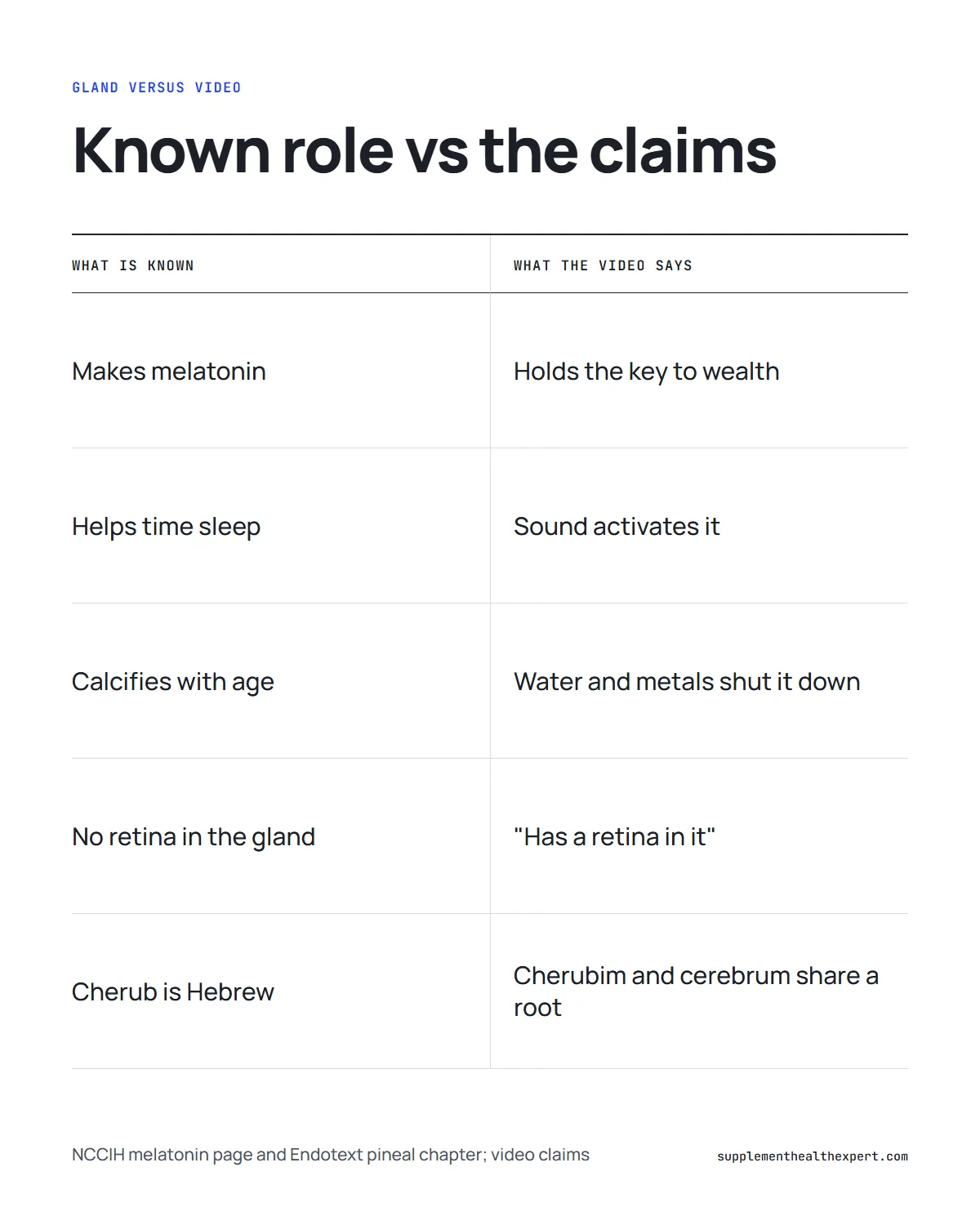
Endotext notes that the pineal gland “usually shows a degree of calcification with age”, which makes it a useful marker on imaging. In other words, calcium deposits in the gland are a familiar finding, not a rare sign of something dramatic. If a scan report ever mentions it, your doctor is the right person to explain what it means for you.
The seller goes further. Its video says fluoride in water, heavy metals in grooming products, time indoors and pesticides cause the gland to “calcify and shut down”, and calls this “a deliberate effort”. Those are unproven claims, and we do not repeat them as fact. One of the free gifts is a “Pineal Gland Decalcification Plan” with steps said to “speed up the decalcification process”. We found no good evidence that diet or a guide changes pineal calcification, or that doing so would affect anything else.
Sound and the gland: where the claim runs out
The video says tiny calcite crystals in the gland are “extremely sensitive to sound” and that certain frequencies “activate” it. We found no published study showing this. No study that we know of tests The Last Wish recordings either.
The nearest research concerns other audio, such as binaural beats, and it shows small, mixed, short-term effects on relaxation or attention in some trials. That is a long way from activating a gland for money. A calm listening habit may still feel pleasant, just as soft music or a breathing exercise can.
Two wording slips: the retina and the root words
Two details in the video can be checked without any specialist knowledge.
The retina. The video says the gland “has a retina in it”. The human pineal gland has no retina. The retina is in the eye, and, as Endotext describes, the eye’s light signal reaches the gland by an indirect route. This is why bright light at night can lower melatonin, but it is not a retina inside the gland.
Cherubim and cerebrum. The video points to the biblical “two cherubim of gold” and says the word shares a root with cerebrum. “Cherub” is a Hebrew word, “cerebrum” is Latin, and they are not the same root. It is wordplay, not etymology.
Neither point diminishes the Bible, art or tradition the video draws on. It only means the factual statements should be held to the same standard as any other.
Does it affect money?
No evidence says so. The pages tie the gland to wealth through the narrator’s stories, including a one-day commission figure, a tax refund and a scratch-off win, and all of those are unverified. The order page also mentions research from Harvard and the University of Michigan but names no study. Research that does exist on goals is much more down to earth: picturing the steps towards a goal, and planning for obstacles, helps people follow through. A 1998 review in American Psychologist found that rehearsing the steps led to progress while picturing only the successful outcome did not, and a 2001 paper by Oettingen and colleagues found that contrasting a wish with present reality shapes how committed people become to a goal.
Neither supports the idea that wishing or listening brings money by itself.
How to read a science-sounding pitch
Sales pages often borrow real words (melatonin, calcification, neuroscience) to make a claim feel settled. A few habits help:
- Ask what is named. A study, an author and a link can be checked. “Research from two universities” cannot.
- Separate the parts. A true statement about sleep hormones does not make the next sentence about wealth true.
- Notice the pressure. A countdown timer, “Today Only” and “could be taken down” are sales tactics, not evidence.
- Check the small facts first. If the easy ones, like where the retina is, are wrong, be careful with the hard ones.
A wind-down that does not rely on the claims
If you enjoy the idea of a quiet nightly listen, you can do it on sleep-friendly terms:
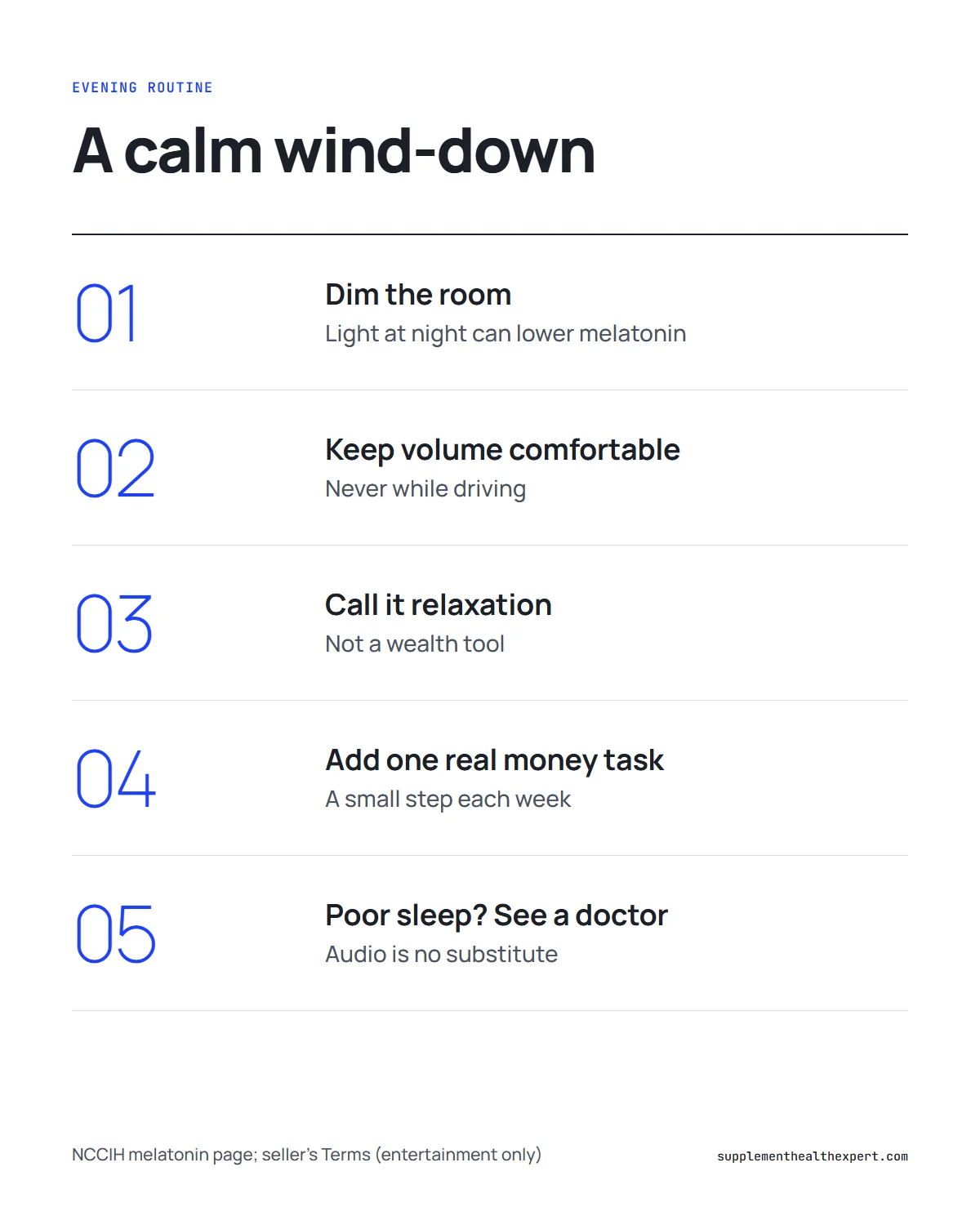
- Dim the room and put screens away.
- Keep the volume comfortable. Never listen while driving or in any situation that needs your attention.
- Treat it as relaxation, not as a wealth tool.
- Pair it with a real goal and a plan, such as one small money task a week.
- If you have a medical condition, take medication or are pregnant, check with your doctor first, as the seller itself advises.
For persistent sleep trouble, NCCIH points to behavioral approaches and, for chronic insomnia, cognitive behavioral therapy as the usual first step, so a doctor is the better route than any audio.
The money side
The audio costs $37.44 per the order page and Terms (the video page shows 37.11), with optional extras and a 60-day refund through ClickBank. Do not spend money you need for bills in the hope of an income. Real help for money worries starts with a written budget and a nonprofit credit counselor. We lay out the checkout in our walkthrough of the buying steps, and the broader claim check sits in our piece on the manifestation claims. What arrives after payment is covered in our product breakdown.
Bottom line
The gland is real, it makes melatonin, and light at night can lower that melatonin. Beyond that, the video mixes sound science, wordplay and unverified stories. There is no evidence that sound activates the gland or that the gland affects money. If you want a calm routine, a dark quiet room is fine on its own terms. If you want a better financial position, plan, budget and act.
Frequently asked questions
What does the pineal gland do in the body?
It makes melatonin, a hormone released in response to darkness that helps time the body clock and sleep. Light from the eyes tells the brain when it is day, and that signal controls how much melatonin the gland releases.
Can sound or a particular frequency activate it?
We found no published evidence that sound makes calcium deposits in the gland vibrate or switch it on. The video makes that claim without citing a study. Research on audio such as binaural beats shows small, mixed, short-term effects on relaxation or attention at best.
Does a calcified pineal gland mean something is wrong?
Calcification is common with age and shows up on scans, and medical references treat it as a marker rather than a diagnosis. If a scan report mentions it, ask your doctor what it means for you instead of relying on a sales video.
Can a diet or a guide reverse pineal calcification?
There is no good evidence that it can. The seller's gift plan promises steps to speed up decalcification, but none is shown and none is tied to any study that we could find.
Is the gland really a third eye or a place to meet God?
Those are spiritual and philosophical ideas with a long history, and many people hold them sincerely. They are beliefs, not findings of biology, so a science check cannot confirm or refute them. We only compare the factual claims.
Does the pineal gland affect money or luck?
No evidence links it to either. The seller's money stories are unverified, and its Terms call the content entertainment, so do not make financial decisions on the strength of a claim about a gland.
Should I see a doctor if I sleep badly?
Yes, if poor sleep is frequent or affects your days. A relaxing evening routine is a fair habit, but it is not a substitute for medical advice, and your doctor can look at causes a sales page cannot.
Sources
- 01 NCCIH. Melatonin: What You Need To Know.
- 02 Arendt J, Aulinas A. Physiology of the Pineal Gland and Melatonin. Endotext, NCBI Bookshelf (updated 2022).
- 03 Taylor SE, Pham LB, Rivkin ID, Armor DA. Harnessing the imagination: mental simulation, self-regulation, and coping. American Psychologist, 1998 (PubMed).
- 04 Oettingen G, Pak H, Schnetter K. Self-regulation of goal setting: turning free fantasies about the future into binding goals. Journal of Personality and Social Psychology, 2001 (PubMed).
the last wish pineal gland · pineal gland melatonin · pineal calcification · light at night · sound frequencies pineal · manifestation audio claims