Supplement Reviews / Guide
Who Created The Last Wish Manifestation? The Narrator, the Terms and What the Seller Pages Reveal
Who created the last wish manifestation? The narrator calls himself Danny Kelly, the Terms allow pen names, and the seller trail is thin. What can be checked?
- Author
- Supplement Health Expert Editorial Team
- Published
- Reading time
- 9 min
- Sources
- 4 cited
Key takeaways
- 01 The video's narrator introduces himself as Danny Kelly. We could not verify that this person exists, and the seller's own Terms say names may be changed or represented by pen names.
- 02 The same Terms say some scenarios may be dramatized, so the priest, the parchment and the 'end of my days' story should not be taken as fact.
- 03 The seller side is thin: a ClickBank vendor account called umakebread, a support email at soul-mountain.com (the site did not load for us), Delaware governing law, and footer links to a second company.
- 04 The Vatican archive was renamed the Vatican Apostolic Archive in 2019. Its own access page lists degree-based requirements for researchers, which is easy to check against the video's claim.
Who created the last wish manifestation audio? The honest answer is that the pages never say. A narrator who calls himself Danny Kelly tells the story, the seller’s own Terms allow pen names, and the paper trail behind the sale is a payment vendor and an email address. Below is what each source says, what we could check, and what we left unconfirmed.
Our page sits outside the seller’s own site. Its order buttons carry our tracking code, so a purchase made through them may earn us a fee. A shorter version lives in our quick guide.

Who created The Last Wish Manifestation? The short answer
| Question | What we found |
|---|---|
| Who is named? | A narrator who calls himself Danny Kelly |
| Can that person be verified? | No, we found no independent record |
| Is the story presented as true? | Yes in the video, but the Terms allow pen names and dramatization |
| Which company sells it? | Not named on the pages we saved |
| Who processes the payment? | ClickBank, vendor account umakebread |
| Where is support? | [email protected], plus ClickBank |
The narrator and the name he gives
On the video page a photo carries a caption in which the man introduces himself: “My name is Danny Kelly”. In the video itself he gives the same name near the five-minute mark, and he says “Dan Kelly” at the very end. He describes himself as someone who has kept a secret and is near the end of his life.
We have not used his photo and we do not describe it. More to the point, we cannot confirm that this is a real person, a real name or a real situation. A voice and a name on a sales video are not records. We refer to him throughout as the narrator, who calls himself Danny Kelly.
What the Terms say about names and scenarios
The seller’s Terms contain a short section on marketing materials. In its own words: “Names and details in marketing materials may be changed or represented by pen names to protect individuals’ privacy. Some scenarios may be dramatized for entertainment purposes.” Another section says that images or videos “may be dramatizations”.
Read plainly, that means the seller has told you in advance that the person and the story in its video may not be literal. That is a fair thing to disclose, and a fair thing for a buyer to weigh. It also explains why we do not treat any of it as established fact.
The priest, the parchment and the archive: an unverified story
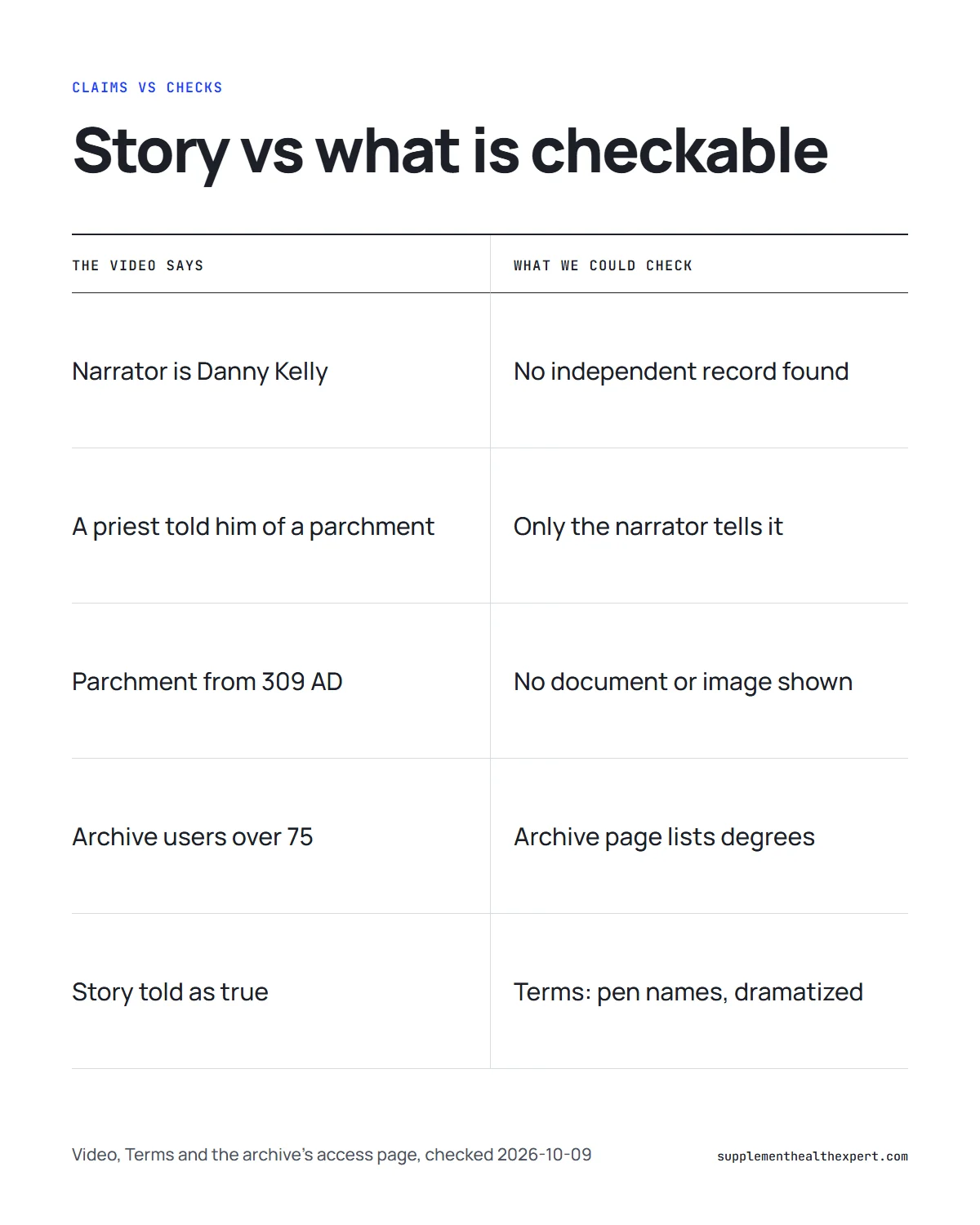
According to the video, about twenty years ago a priest described as the head of a church gave the narrator a story and a CD. The story concerns a parchment from a prayer book said to date from 309 AD, kept in the “Vatican’s Secret Archives”, which supposedly shows a brain diagram with the Hebrew word for God at its center. The video also says people allowed into the archive must be over 75.
| Claim in the video | Can we check it? |
|---|---|
| A priest told him about a parchment | No, only the narrator tells it |
| A prayer-book parchment from 309 AD | No document or image is shown |
| It shows a brain diagram | Not shown |
| Archive users must be over 75 | The archive’s own page lists degree-based requirements |
| The priest gave him a CD | Nothing to check |
We make no judgement about anyone’s faith or about the sacred texts the video quotes. The point is narrower: this particular story has no document, name or place that an outsider can look up, and the seller itself warns that scenarios may be dramatized.
What the Vatican Apostolic Archive actually is
One fact is easy to check. In October 2019 a decree of Pope Francis gave the former Vatican Secret Archive its current name, Vatican Apostolic Archive, with immediate effect, as Vatican News reported. His stated reason: “secret” now sounds like hidden, whereas the Latin word meant something closer to private or personal.
The archive’s own access page says it is open to qualified scholars carrying out scientific studies. It lists a university M.A. degree or equivalent for researchers, a licentiate or doctorate for clergy, and an admission card that needs a letter of introduction, the latest academic qualification and a valid ID. We did not see an age rule of 75 on that page, though we only read the excerpt about eligibility. This does not prove or disprove a story about a private visit twenty years ago. It simply shows that the archive’s public rules can be read by anyone.
What is known about the seller
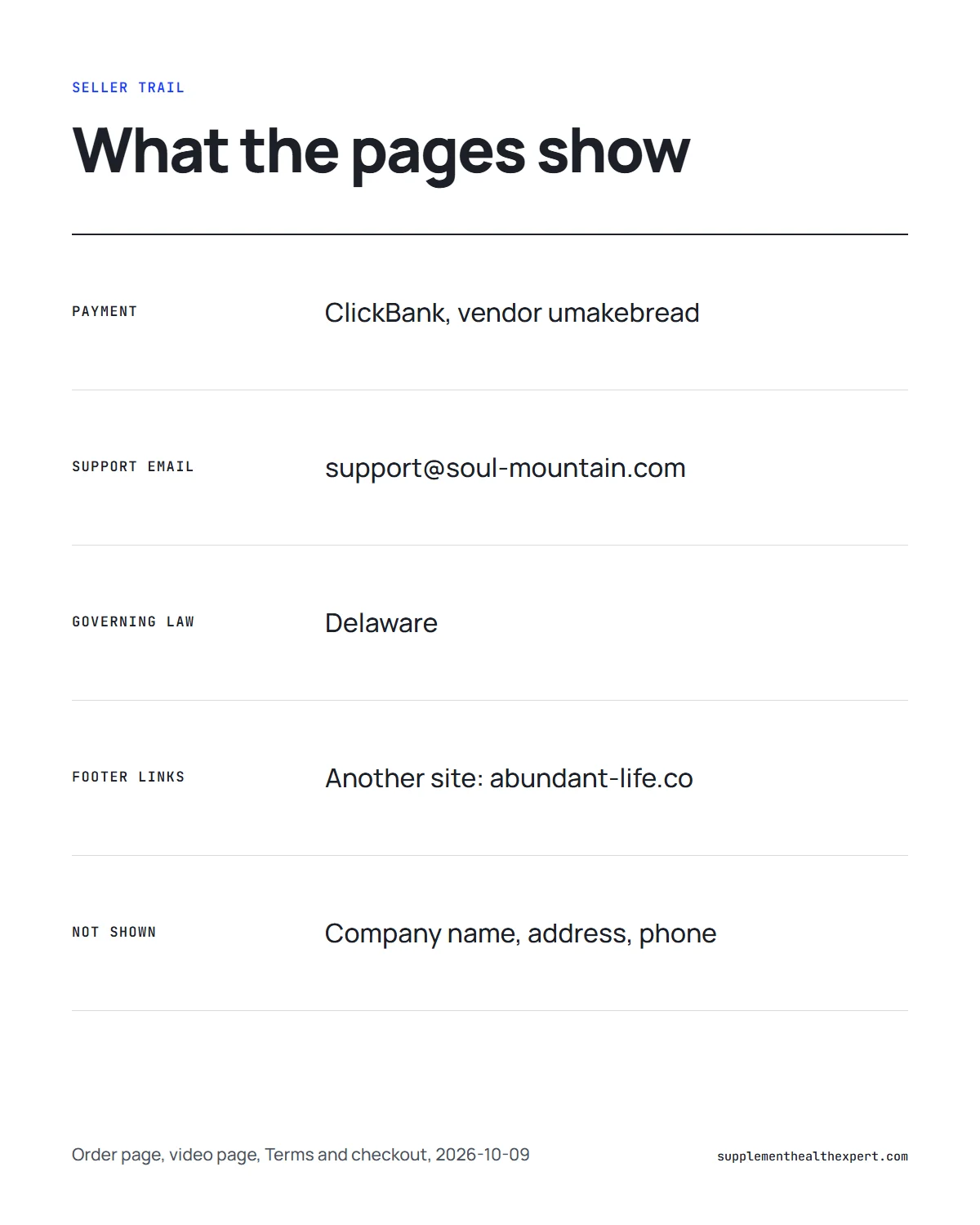
Taken from the order page, the video page, the Terms and the ClickBank checkout (all opened on 2026-10-09):
- Payment. The checkout runs on a ClickBank pay address under the vendor ID umakebread. ClickBank says it is the retailer and that this role “does not constitute an endorsement, approval or review of this product”.
- Support. The Terms give one contact: [email protected]. The soul-mountain.com website did not load for us.
- Law and location. The Terms say they are governed by Delaware law and that the service is based in Delaware, with personal information possibly transferred to Delaware, Canada and other places.
- Audience. It is aimed at adults.
- What is missing. We found no company name, street address or phone number for the seller on the pages we saved, and no separate contact, FAQ or refund page. The Terms and privacy policy are one page.
That is all we can state. We do not know who owns the vendor account, who wrote the script or who recorded the audio. The video says the recordings were improved with sound engineers, but names none.
The abundant-life.co footer links
The footer of the video page has “Terms And Conditions” and “Privacy Policy” links. They go to a different site, abundant-life.co, instead of the order site’s own page. The terms there cover this product and two others, “The Abundance Brain Accelerator” and “The Abundance Sequence”, the same two named in the Terms of Sale with their prices.
In those terms a refund depends on showing 30 days of consistent use, asking inside 90 days, and accepting that the company’s ruling is “final and binding”. That does not match the 60 days in the order-site Terms or at the ClickBank checkout. It tells you the sales funnel is built from more than one set of documents, not that any of them is false. Treat ClickBank’s 60-day policy as your route, and keep your receipt.
How to judge a seller you cannot fully identify
You do not need to know a name to protect yourself. These checks work on any digital offer.
- Look at the processor. A recognised retailer such as ClickBank gives you an order record and a refund channel.
- Save the evidence. Keep the order email and note the statement text, here CLKBANK*TheLastWish.
- Read the disclaimers. Wording about pen names, dramatization and “entertainment purposes only” shows how the seller files its own product.
- Handle testimonials carefully. Compensation is allowed for in the seller’s wording, and the FTC’s 2024 rule bans fake or AI-generated testimonials and undisclosed insider reviews, so a missing disclosure deserves a second look. See the FTC announcement.
- Prefer facts you can look up. If the key claim rests on a story with no name, date or document, weigh it accordingly.
Does it matter who made it?
Partly. For a $37.44 audio, the main risks are modest: money, time and email marketing. Anonymity matters most for support and trust. When a problem comes up, ClickBank is your contact, not a named company.
It matters less for the central question of whether it works. That question is about evidence, and no published study of this audio is cited on the pages. The sales page mentions “research from Harvard and University of Michigan”, but names no study. For the price, the add-on and the refund steps, see our checkout walkthrough. The seller’s claims about the gland and the research are examined in our look at the claims, and the lack of independent buyer feedback in our piece on reviews.
None of this requires disrespecting anyone’s beliefs. Many people find quiet time, prayer or music meaningful, and that is a good in itself. Our concern is only with claims nobody can check that come with a promise of wealth. For money worries, start with a written budget and a conversation with a nonprofit credit counselor.
Our summary
Nobody is identified as the creator in a way we could verify. The narrator calls himself Danny Kelly; the seller’s Terms say names may be pen names and scenarios may be dramatized; the Vatican parchment story cannot be checked; and the seller trail consists of a ClickBank vendor, one email address and a second company’s footer. The product can still be bought, and refunds go through ClickBank within 60 days. Just buy it, if you do, as an entertainment purchase with your eyes open.
Frequently asked questions
Is Danny Kelly a real person?
We could not confirm it. He is the name the narrator gives in the video and in a photo caption on the video page. The seller's Terms say names in marketing materials may be changed or represented by pen names, so the name alone proves nothing either way.
Is the story about the priest and the parchment true?
It is unverified. It is told only in the seller's video, with no documents, photographs or independent source. Because the Terms also say some scenarios may be dramatized, we present it as the seller's story, not as history.
Who is the company that sells it?
The pages do not name a company or give a street address. What they show is a ClickBank vendor account called umakebread, a support email at soul-mountain.com, Delaware as governing law and footer links to a site called abundant-life.co.
Who do I contact if something goes wrong?
For a payment or refund, start with ClickBank at clkbank.com or 1-800-390-6035, since it is the retailer. The Terms list [email protected] for product questions, but we could not load soul-mountain.com on the day we checked.
Are the testimonials from real customers?
The Terms say testimonials are from real people but may have been compensated or incentivized, and that the seller does not verify their accuracy. We found none on the pages we saved, and we do not quote any as independent.
Why does the video page link to a different company's terms?
The footer links on the video page go to abundant-life.co rather than to the order site's own Terms. We cannot say why. Those terms cover this product and two others and set stricter refund conditions than the 60 days promised at checkout.
Does it matter who made an audio like this?
It matters for trust and for knowing who answers when you need support. It does not change the main issue, which is evidence: no study of the audio is cited, and the Terms call it entertainment.
Sources
- 01 Vatican Apostolic Archive. Access and Consultation (official page, requirements for researchers).
- 02 Vatican News. Motu proprio of Pope Francis: Vatican Archives to be renamed (28 October 2019).
- 03 U.S. Federal Trade Commission. Final rule banning fake reviews and testimonials (August 2024).
- 04 ClickBank order support.
who created the last wish manifestation · danny kelly last wish · umakebread clickbank · vatican apostolic archive · pen names marketing · who is behind the last wish