Eye Health/Ingredients
VisiFlora Ingredients: Antioxidant Vitamins, Carotenoids, Plant Extracts and the Rest of the Label
VisiFlora ingredients explained: the seven amounts the label prints, the 351 mg blend of 14, the roles the seller gives them and the research we link.
- From $49 per bottle
- 60-day refund
- Eye Health
By Supplement Health Expert Editorial Team · · 9 min read
- Refund window
- 60 days counted from the day you receive the order, with shipping fees not refunded
- Lowest per bottle
- $49 largest bundle
- Category
- Eye Health
- Our score
- 9.2/10 editorial
Key takeaways
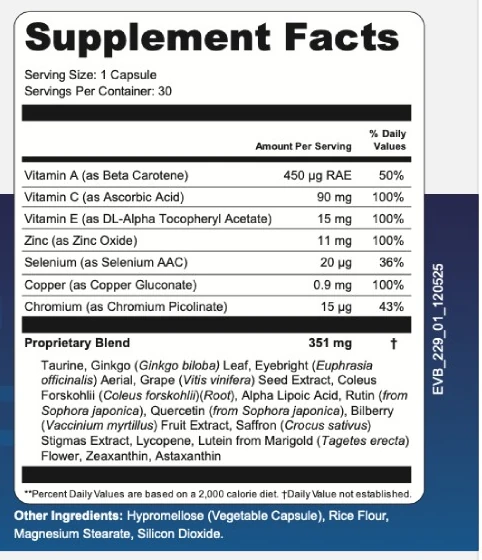
- 01 Per capsule the label prints seven amounts: vitamin A, vitamin C, vitamin E, zinc, selenium, copper and chromium.
- 02 A 351 mg proprietary blend holds 14 more ingredients, including lutein, zeaxanthin, astaxanthin, ginkgo and bilberry, with no dose for each.
- 03 Other ingredients are hypromellose (the vegetable capsule), rice flour, magnesium stearate and silicon dioxide.
- 04 The studies we link are about single ingredients or the gut-eye topic, not tests of VisiFlora itself.
VisiFlora has two layers: a short list of vitamins and minerals that each carry an amount, and a longer blend of carotenoids, bioflavonoids and plant extracts that shares a single total. This page goes through both. The roles below are the seller’s own statements, repeated as such and never as results we tested, and every figure comes from the Supplement Facts panel.
The formula at a glance
The first layer, one capsule at a time:
| Nutrient | Amount in one capsule | What the seller says |
|---|---|---|
| Vitamin A | 450 mcg RAE, supplied as beta carotene | Listed as supporting cell health |
| Vitamin C | 90 mg, supplied as ascorbic acid | Antioxidant support |
| Vitamin E | 15 mg, supplied as DL-alpha tocopheryl acetate | Antioxidant support |
| Zinc | 11 mg, supplied as zinc oxide | An essential mineral |
| Selenium | 20 mcg, supplied as selenium AAC | An essential mineral |
| Copper | 0.9 mg, supplied as copper gluconate | An essential mineral |
| Chromium | 15 mcg, supplied as chromium picolinate | Linked with healthy metabolic function |
The second layer is the 351 mg proprietary blend. The label prints its 14 ingredients in one run, so here they are sorted by type instead:
| Type | Blend ingredients | What the seller says |
|---|---|---|
| Carotenoids | Lutein (from marigold flower), zeaxanthin | Carotenoids found in the eye |
| Carotenoid antioxidants | Astaxanthin, lycopene | Antioxidant support |
| Bioflavonoids | Grape seed extract, rutin, quercetin | Linked with healthy circulation around the eyes |
| Circulation plants | Ginkgo leaf, coleus forskohlii root | Linked with healthy circulation and nutrient delivery |
| Traditional botanicals | Eyebright, bilberry fruit extract, saffron | Eyebright long used for eye comfort; bilberry rich in anthocyanins; saffron a carefully studied extract |
| Amino acid and antioxidant | Taurine, alpha lipoic acid | Cellular hydration, and antioxidant support |
A serving is one capsule and a bottle holds 30 servings. The label shows no doses inside the blend, and we have not guessed any.
Vitamins C and E, plus the antioxidant blend
Vitamin C and vitamin E are the antioxidant vitamins on the label, and each has an amount of its own. In the seller’s wording they help the body deal with everyday oxidative stress. The blend adds more of the same family: astaxanthin, which the seller calls a potent carotenoid antioxidant, plus lycopene and alpha lipoic acid. Because those three sit inside the blend, the exact amount of each is not published.
Lutein, zeaxanthin and vitamin A
Lutein and zeaxanthin are carotenoids, plant pigments that also turn up in the eye, and the seller singles them out. Lutein comes from marigold flower here. Vitamin A is supplied as beta carotene, which the body can convert, and the seller lists it as support for cell health. The label gives amounts for vitamin A but not for lutein or zeaxanthin, since the two are part of the blend.
Grape seed, rutin and quercetin
These three are bioflavonoids, plant compounds found in fruit and flowers. The seller describes them as supporting healthy circulation around the eyes. Rutin and quercetin on this label come from Sophora japonica, and grape seed comes as an extract of Vitis vinifera seed. All three share the blend total.
Ginkgo, coleus, eyebright, bilberry and saffron
Five plant extracts round out the blend. The seller links ginkgo leaf and coleus forskohlii root with healthy circulation and nutrient delivery. Eyebright is a traditional botanical that the seller says has long been used for eye comfort. Bilberry is noted for its anthocyanins, a family of plant pigments. Saffron is described as a carefully studied extract. These are familiar names that are easy to look up, and because ginkgo, coleus, quercetin and grape seed are among them, the safety page says who should ask a doctor first.
Taurine and zinc, selenium, copper and chromium
Taurine is an amino acid, and the seller says it supports cellular hydration. Zinc, selenium and copper are described as essential minerals, and chromium as linked to healthy metabolic function. Each mineral has a dose on the label, which makes them handy comparison points if you line VisiFlora up against another product or against your multivitamin.
What else is in the capsule
Hypromellose, the material behind a vegetable capsule, forms the shell. Rice flour, magnesium stearate and silicon dioxide complete the list under other ingredients. The seller calls the product non-GMO, stimulant-free and vegetarian-friendly, and says its ingredients are handled in a certified facility to strict quality standards. These are the seller’s statements, and we have not inspected anything ourselves. If you have a food sensitivity, read the panel again when your bottle arrives.
The research behind the ingredients
The seller’s references page lists a number of papers. We opened five that stay close to the ingredients and the topic, and none of them put VisiFlora itself to the test. They do not show that the capsule works, and we would never frame them as if they did.
- A 2024 review of lycopene in the Journal of Nutrition and Metabolism, about lycopene as an antioxidant. Read the review.
- A 2005 lab study in Investigative Ophthalmology & Visual Science, on how human cells from the eye convert beta carotene into vitamin A. Read the PubMed entry.
- A 2014 lab study in the Balkan Medical Journal, on eyebright extract and human corneal cells. Read the paper.
- A 2020 review in Antioxidants, on lutein, zeaxanthin and beta carotene in eye health. Read the PubMed entry.
- A 2022 review in Ophthalmic Research, on the gut-eye link, offered as background reading. Read the review.
The full titles and journals sit under Sources at the bottom of this page.
How to read a blend label
Many supplements print one total for a group of ingredients, and VisiFlora does it for 14 of them. The practical way to use that is to compare label to label: note which ingredients each product names, check whether each has its own amount, and weigh the price per day. The seven nutrients that do carry amounts here make easy comparison points. For questions about amounts or sourcing, email [email protected].
How the capsule is taken
The label directs one capsule daily and says not to exceed the recommended dose. For timing, the seller’s FAQ points to mealtime, with water. Thirty capsules last 30 days, so the three packages stretch to 60, 90 and 180 days. If you take medicine, the label asks you to consult a physician first, and any change in how you see calls for a visit to an eye doctor. Our safety page lists questions worth bringing along.
To see how the formula turns into a daily cost, our price page lays out the packages and the per-day numbers.
Official bundle pricing
As listed on the official order page · checked Oct 28, 2026
2 bottles60-day supply
$79per bottle
Total $158 · $198
- Plus $9.95 US shipping
- 3 free e-books
- 60 days from delivery to decide
Most popular
3 bottles90-day supply
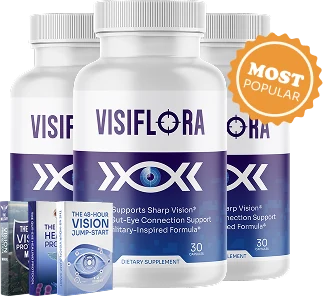
$59per bottle
Total $177 · $297
- Free US shipping
- 3 free e-books
- 60 days from delivery to decide
Best value
6 bottles180-day supply
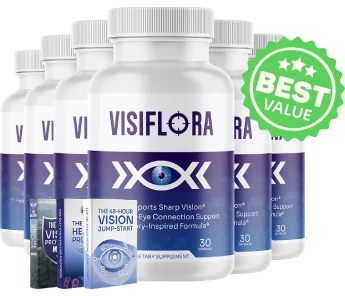
$49per bottle
Total $294 · $594
- Free US shipping
- 3 free e-books
- 60 days from delivery to decide
Crossed-out prices are the seller's own reference figures. Refunds: 60 days counted from the day you receive the order, with shipping fees not refunded.
Frequently asked questions
What are the ingredients in VisiFlora?
Each capsule has vitamin A (as beta carotene), vitamin C, vitamin E, zinc, selenium, copper and chromium, plus a 351 mg blend of taurine, ginkgo leaf, eyebright, grape seed extract, coleus forskohlii root, alpha lipoic acid, rutin, quercetin, bilberry, saffron, lycopene, lutein, zeaxanthin and astaxanthin.
Does VisiFlora list a dose for every ingredient?
No. The seven vitamins and minerals have their own amounts, while the 14 blend ingredients share one 351 mg total, so no individual amounts are published.
What are lutein and zeaxanthin?
They are carotenoids, plant pigments that are also found in the eye. The label lists lutein from marigold flower and zeaxanthin inside the blend, with no separate amounts.
What else is in the capsule?
The shell is hypromellose, a vegetable capsule. The label's other ingredients are rice flour, magnesium stearate and silicon dioxide.
Sources
- 01 Lycopene: A Potent Antioxidant with Multiple Health Benefits. Journal of Nutrition and Metabolism, 2024 (a review of an ingredient, not research on VisiFlora)
- 02 Conversion of beta carotene into vitamin A in human cells from the eye. Investigative Ophthalmology & Visual Science, 2005 (a lab study of an ingredient, not research on VisiFlora)
- 03 Eyebright (Euphrasia officinalis L.) extract and human corneal cells in lab tests. Balkan Medical Journal, 2014 (a lab study of an ingredient, not research on VisiFlora)
- 04 A review of lutein, zeaxanthin and beta carotene in eye health. Antioxidants, 2020 (a review of ingredients, not research on VisiFlora)
- 05 A review of the gut-eye link. Ophthalmic Research, 2022 (background reading, not research on VisiFlora)
visiflora ingredients · visiflora ingredient list · visiflora formula · visiflora label · visiflora supplement facts