Everyday Wellness / Guide
Akusoli insoles side effects: comfort and safety notes for new users
Akusoli insoles comfort and safety notes: how to break them in, who should ask a doctor first, washing care and the seller's own terms.
- Author
- Supplement Health Expert Editorial Team
- Updated
- Reading time
- 7 min
- Sources
- 0 cited
Key takeaways
- 01 Break the insoles in with short wear periods at first; the seller gives no schedule.
- 02 Anyone with a pacemaker or another implanted electronic device should ask a doctor before use, because of the small magnets.
- 03 Foot pain, swelling, numbness, wounds or a foot problem linked with diabetes or vascular disease need a doctor or podiatrist.
- 04 The seller's terms say the product is not for children, and the seller does not sell it as a medical device.
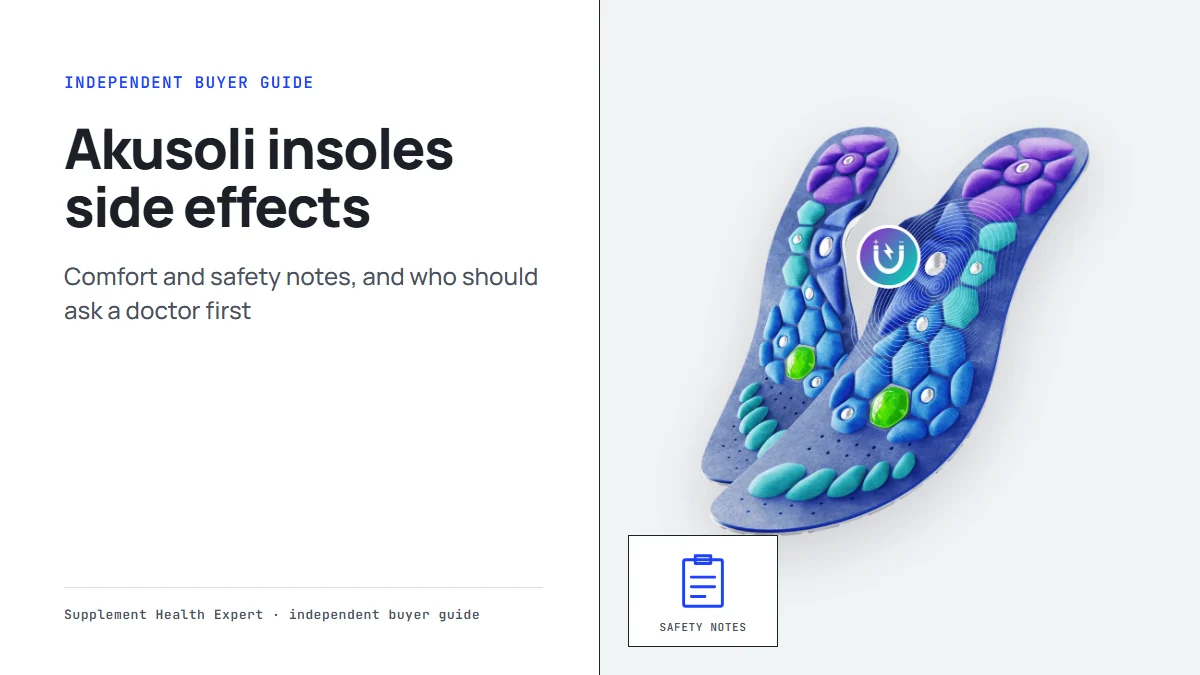
If you are asking about Akusoli insoles side effects, the useful answer is about comfort, fit and the handful of people who should check with a professional before wearing them. This guide keeps to those points. It explains how to break a new insole in with common sense, who should ask a doctor first, when to stop, how the insoles are cared for and what the seller says about its own product. None of the claims below are medical promises, and the seller’s wording is marked as the seller’s.
Akusoli insoles side effects: getting used to a new insole
A new insole can feel unfamiliar, and that is true of these as well. The cushion pads are raised, the top is suede-style, and the trimmed edge is where a new insole can rub if it sits wrong. The seller describes the insoles as soft and flexible, non-slip and designed to adapt to the shape of the foot. Those are the seller’s words, and they describe how the insole is built, not how it will feel on your foot.
Your foot may notice the raised pads or the arch shape when you first wear them. Pay attention to how your feet feel, and use the steps below if anything rubs or hurts.
A break-in plan of your own
The seller gives no break-in schedule, and it does not state any number of hours per day. This guide does not give one either. Our own advice is simple: wear the insoles for short periods at first, and check how your feet feel afterward. Keep the same approach for each shoe you use, since a different shoe can change how the insole sits.
There is no timeline to follow and no point at which the insoles are guaranteed to feel right. Your comfort is the test, and it is fine to take a break and try again later.
Who should ask a doctor first
Some people need advice before they use any new insole, and the insoles contain small magnets. Our list is below.
- Pacemaker or implanted electronic device: talk with your doctor before use, since magnets are built into the insoles. This is our advice, not the seller’s.
- Foot pain that continues: a doctor or podiatrist should look at it, since an insole is not a substitute for that visit.
- Swelling, numbness or wounds: speak to a doctor before you wear the insoles, and do not use them to manage the problem yourself.
- Diabetes or vascular disease affecting the feet: a doctor or podiatrist should guide foot care. No insole can take the place of that medical attention.
The seller’s terms also say the product is not for children, so it is aimed at adults only.
When to stop wearing them
If a pair rubs, pinches or hurts, take it out of rotation. Take them out, check your feet and the shoe, and give your skin time to recover before you try again. If the discomfort does not clear up, speak to a doctor or podiatrist rather than trying a different trim.
Look at the trimmed edge too. A rough or uneven cut can rub against the skin, so smooth the edge with care or trim it again along the traced line before you wear the insole.
The seller’s trim steps are simple: trace the existing insole, cut along the line and insert. Trimming slowly gives a cleaner result.
What the seller says about its medical status
In full, the seller’s disclaimer says “not intended to diagnose, treat, cure, or prevent any specific disease or condition”. The seller does not sell it as a medical device, and the insoles are described as comfort products. We repeat the disclaimer so you can read it for yourself, and we do not add to it.
That statement matters for how you use the insoles. They are a comfort product, so they are not a route to a diagnosis, and they are not a replacement for a medical visit when you need one.
Washing and care
Care is straightforward. Hand-wash the pair in mild-temperature water and let it dry in the open air. The seller advises against a machine dryer and against wringing, since both can change the shape of the insole and the feel of the suede-style fabric. Dry them flat, away from direct heat.
Store them flat between wears so the arch shape holds. A clean, dry insole also sits better in the shoe, which is a small detail that makes a new pair easier to live with.
Before the first wear
A short checklist keeps the first wear simple, and none of it costs anything:
- Clean and dry your shoe before you place the insole inside.
- Check the trimmed edge along its whole length for a rough or uneven cut.
- Walk around the house in the shoes before you plan a long day out.
- Keep your old insoles close by, so you can compare how your feet feel.
- Note any rubbing, pinching or pressure, and stop if it continues. Note the time of day as well, since feet can feel different after a long stretch on them.
If the shoe feels tight with the insole in place, that is a fit question rather than a comfort one. The size chart and the trim steps are the place to start, and a larger size may suit a shoe that already feels snug. Take a photo of the insole’s shape before you trim, so you can compare the cut with the original if you need to. Stopping for a day and trying again later is a reasonable step, and it does not mean the insole has failed a test.
Magnets and what the seller says about them
Small magnets are built in, and the seller describes them as producing a gentle massage-like sensation. That wording belongs to the seller, and we repeat it without embellishment. The same applies to the raised acupressure-style cushion pads, which the seller describes as targeted cushions for the feet.
Because the magnets are part of the insole, the pacemaker and implanted device advice in this guide applies to every wear, not only the first one. Anyone who is unsure should speak to a doctor first. A short note of what you felt, and where, makes that conversation more useful. Start your product research at the Akusoli insoles hub for the full file.
Comfort, size and the return window
A good fit makes most of the difference. Check the seller’s size table before you order, pick S/M or L/XL, and trim the insole to your shoe. If the fit still does not suit you, the seller’s return terms give a 60-day window from delivery, and you pay the return postage. A full refund requires opening a return within 14 days of receipt, and returns submitted later in that window may carry fees. Details of the return procedure appear in the return policy guide.
Where to read more
For the exact size ranges and the trimming steps, see the size chart post. Wondering how to weigh online feedback? The customer reviews guide covers what to watch for.
The complete product file lives on the Akusoli insoles hub. The safety page lists the same safety points in shorter form, and it is a good place to check before you buy.
Frequently asked questions
Could the insoles cause discomfort at first?
Any new insole can feel unfamiliar for a while. Start with short periods of wear, check how your feet feel, and stop if the insole rubs or hurts.
Who should check with a doctor before using them?
Anyone with a pacemaker or another implanted electronic device should ask a doctor first, because the insoles contain small magnets. People with foot pain, swelling, numbness, wounds or a foot problem linked with diabetes or vascular disease should see a doctor or podiatrist.
Are the insoles safe for children?
The seller's terms say the product is not for children, so it is intended for adults.
How do I wash them?
Hand wash gently in mild-temperature water and air dry. Do not use a dryer and do not wring them out.
Does the seller present the insoles as a medical product?
No. The seller does not sell it as a medical device, and its disclaimer is quoted in full in the body of this guide.
What if I am not happy with the fit?
The seller's return terms give a 60-day window from delivery. You pay the return postage, and the full-refund route is a return started within 14 days.
akusoli insoles side effects · akusoli insoles safety · akusoli insoles comfort · akusoli insoles magnets · akusoli insoles care · akusoli insoles for children · akusoli insoles break in