Everyday Wellness / Guide
Arctic Blast Side Effects: Label Warnings and Careful Use Steps
Arctic Blast side effects explained calmly: every label warning, the directions for adults 18 and over, and our own safety steps before the first use.
- Author
- Supplement Health Expert Editorial Team
- Updated
- Reading time
- 7 min
- Sources
- 0 cited
Key takeaways
- 01 The label warnings are short: external use only, keep off the eyes, avoid wounds and damaged skin, and do not bandage tightly.
- 02 Arctic Blast is flammable, so keep it away from fire, flame, sparks and heated surfaces.
- 03 The directions cover adults 18 and over, and anyone pregnant or breastfeeding should ask a physician first.
- 04 Our own steps: patch test a small area, keep taking prescribed medicines and see a doctor for pain with warning signs.
- 05 The label lists wintergreen (methyl salicylate) and St. John's wort, so check with a doctor or pharmacist if either applies to you.
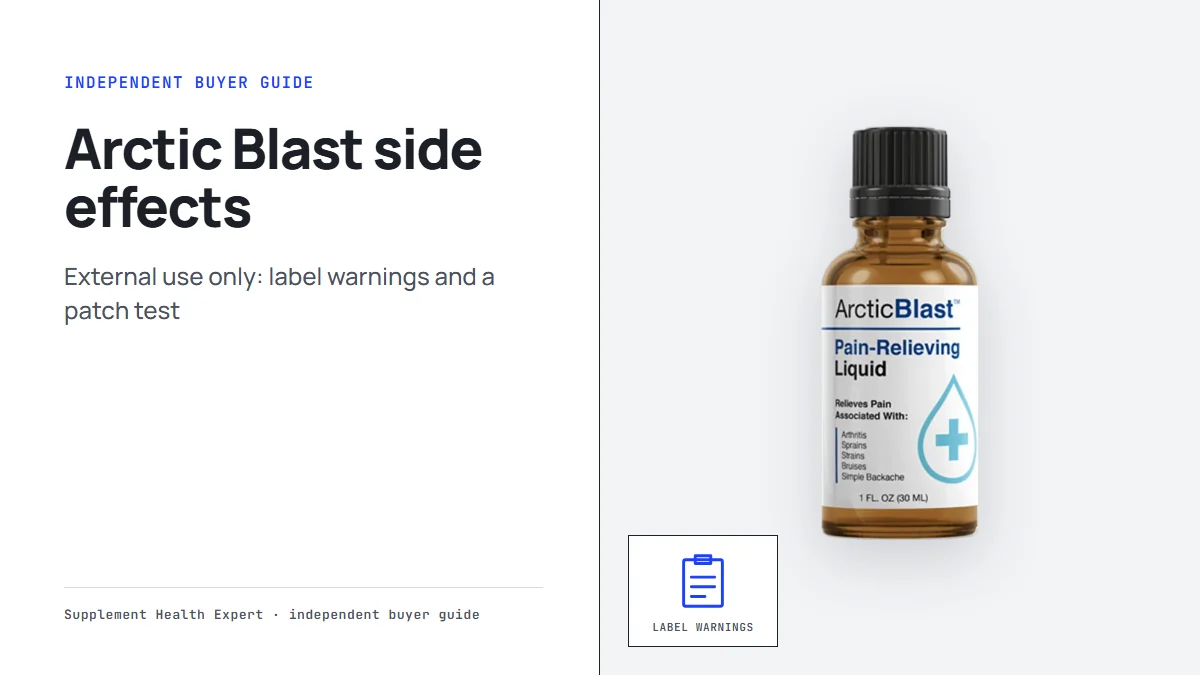
Reading up on Arctic Blast side effects before you start is a wise step. Any topical product earns a careful look before its first application, and this liquid is no exception. Happily, the printed cautions are plain and simple to follow. Below, we list every warning that appears on the product, then add our own safety steps. Our steps are marked as ours, so they stay separate from the seller’s wording.
Arctic Blast Side Effects: The Printed Cautions
Every caution printed for Arctic Blast comes from the seller and its label. We reproduce the full set below, with nothing dropped:
- Outside use only; keep the liquid out of the eyes.
- Not for open wounds or compromised skin.
- No tight wraps over the area you applied it to.
- Flammable: stay clear of fire, flames, sparks and hot surfaces, and tighten the cap.
- Out of children’s reach at all times.
- Directions are for people aged 18 and up.
- Pregnant or nursing? Ask a physician before using it.
- Swallowed by mistake? Consult a physician.
- Keep at ordinary room temperature.
- Follow the directions and nothing beyond them.
For adults, the directions call for applying the liquid to the sore spot, no more than three to four times daily, using enough to cover it. The directions never ask for more than that.
What Each Warning Means in Everyday Use
“External use” signals that the product belongs on the surface of the body only. Apply it to the spot you want to cover, and keep it away from the mouth, nose or any other opening. The eye caution is equally direct. If some reaches your eyes, our suggestion is to rinse with clean water and speak with a doctor should the irritation persist.
Open wounds and compromised skin are excluded, since the liquid should never touch broken tissue. The bandage caution works on similar reasoning: a snug wrap interferes with a thin film of liquid, so let the spot breathe or use a loose covering instead.
“Flammable” tells you the liquid can ignite. Stay clear of a stove, a candle, a fireplace, a lit cigarette and hot surfaces such as space heaters. The age limit comes from the seller, whose directions target people 18 and older. Pregnancy and nursing do not ban use, but the label asks you to check with a physician first. If the liquid is swallowed, contact a physician without delay. Room temperature storage means avoiding a hot car or a steamy bathroom shelf.
Our Safety Steps Before the First Application
Everything in this list originates with us. Read it alongside the label, never as a substitute for it.
- Patch test first. Apply a dab to a discreet patch of skin and observe it for a while before spreading the liquid further.
- Start on clean, dry skin. Dirt, sweat and old creams can change how the liquid sits on the surface.
- Do not layer it over other products. DMSO can carry other substances across the skin, which is why creams and products should stay apart from this liquid unless a pharmacist signs off on a combination.
- Keep taking prescribed medicines. Do not stop or change a prescription because of this liquid, and keep seeing your doctor.
- Know the warning signs. If pain comes with swelling, redness, heat, fever, numbness or weakness, follows an injury, or wakes you at night, a physician should see it; a liquid is not the answer.
Questions to Bring to Your Doctor
Uncertain whether the liquid fits your situation? A brief talk with your doctor settles a lot. Bring these specifics:
- The area you want to cover, and how long the pain has been there.
- Each prescription on your list, blood thinners included, plus any pain relievers you already reach for.
- Whether you are pregnant or breastfeeding.
- Any reaction history involving aspirin, salicylates or another listed ingredient.
Those four details let your doctor answer for your situation, rather than giving a general answer that could miss it.
Two Label Entries Needing Caution
Two entries on the panel need a second look: methyl salicylate (wintergreen oil) and hypericum perforatum (St. John’s wort). Methyl salicylate belongs to the salicylate family, which sits close to aspirin, so anybody with an aspirin or salicylate allergy should talk to a doctor or pharmacist before use. People on blood thinners, or taking any other prescription drug, should also check first, since St. John’s wort is printed on the label.
The label’s alcohol entries, isopropyl alcohol plus SD-Alcohol 40B, explain the flammability caution, so the bottle belongs well away from any heat source or open flame. Want the whole panel? Our ingredients page goes through it entry by entry.
Groups That Pause Before the First Use
Several groups should hold off until they have checked: people who are pregnant or nursing, those with an aspirin or salicylate allergy, anyone using blood thinners or prescription drugs, and anyone whose pain shows warning signs. The seller’s directions are aimed at people 18 and older, which means the bottle is not intended for younger users.
Children should never get near it. Between uses, put it somewhere high and closed so curious hands cannot reach it.
Calm Habits for Everyday Use
Routine habits keep things simple. Use only the quantity that covers the spot. Screw the lid down tightly every time you finish. Keep the bottle at ordinary room temperature, clear of heat sources and flames. Afterward, wash your hands and make sure none of it drifts toward your eyes.
Other products deserve the same attention. Vitamins, herbal products and other creams can sit differently on the skin than the liquid does, and the label does not describe those combinations. Check with a pharmacist before layering products, and keep a short written note of what you apply each day, so the list is easy to share with your doctor. Bring the label itself to any appointment as well, since your doctor can then read the exact ingredients rather than relying on memory.
When to Stop and Ask for Help
Our rule of thumb is straightforward. Should the spot turn red, itchy, blistered or swollen, or should a burning sensation linger, cease use and ask a doctor or pharmacist. Numbness, weakness or fever appearing with the pain follows the same path, because those signs need medical attention first. Rubbing on more liquid is never the way to wait them out.
Pay attention to what the pain itself is signalling. The use line printed on the label reads: for the temporary relief of minor aches and pains of muscles and joints. Pain that is new, sharp, spreading or worsening suits a clinic far better than a bottle. Anything severe, unexplained or long-lasting belongs with a doctor first.
The Seller’s Disclaimer, Word for Word
The seller’s own disclaimer reads, in full, as follows.
These statements have not been evaluated by the FDA. This product is not intended to diagnose, treat, cure or prevent any disease.
That wording is the seller’s own, and we reproduce it without edits. It sits beside the label warnings and leaves them unchanged. The hub gathers the cautions, packages and FAQ into a single view, while the safety page lists the cautions in catalog form.
Reading the Guarantee With Safety in Mind
Should the liquid prove a poor match, the seller’s 365-day money-back guarantee leaves you room to step away. Counting begins on the purchase date, and used, unused or empty bottles qualify under the seller’s terms. Begin any return by reaching out to support for the steps. Keep the order email with your records, since it is your proof of the purchase date. Our money-back guarantee guide walks through the whole sequence, and our customer reviews guide shows how to weigh online feedback with the same caution you bring to the label.
Common Questions About Safety
The FAQ at the end of this guide handles the common questions about the cautions. Each answer rests on either the label or our safety steps above, and the wording makes clear which one applies.
Careful use is an ongoing habit rather than a box to tick. Read the label, run the patch test, keep your prescriptions on track and check with a doctor whenever a warning sign appears. Then decide whether the liquid fits your routine. The hub places the packages beside the FAQ and these cautions, so everything sits in one view before you order.
Frequently asked questions
What are the Arctic Blast side effects?
The warnings printed for the product are cautions to follow rather than a list of reactions: external use only, keep off the eyes, avoid wounds and damaged skin, and do not bandage tightly. Any product can affect some people differently, so our advice is to patch test and stop use if you notice a reaction.
Can I use Arctic Blast if I am pregnant or breastfeeding?
The label says to contact a physician before use if you are pregnant or breast feeding. We agree, and we would ask a doctor first before the first application.
What happens if the liquid is swallowed?
Arctic Blast is for external use only. The label says that if it is swallowed, you should consult a physician. Keep the bottle out of reach of children at all times.
Who should check with a doctor before using it?
Anyone pregnant or breastfeeding, anyone allergic to aspirin or salicylates, anyone on blood thinners or other prescription medicine, anyone with sensitive skin and anyone whose pain carries warning signs should speak with a doctor or pharmacist first.
What should I do before the first application?
Test a small area of skin first, apply only to clean skin, keep the liquid away from the eyes and any broken skin, and do not place it over other creams or products without checking with a pharmacist.
How should the bottle be stored?
Store it at room temperature, keep it away from fire, flame and heat, close the cap firmly and keep it out of reach of children.
arctic blast side effects · arctic blast safety · arctic blast warnings · arctic blast external use · arctic blast patch test · arctic blast pregnancy · arctic blast wintergreen · arctic blast flammable · arctic blast how to use