Supplement Reviews / Guide
Does The Genius Switch Work? The Seller's Promises Weighed Against the Evidence
Does the Genius Switch work? We set each promise in the sales video against the research and the seller's own fine print, then show how to test it in 90 days.
- Author
- Supplement Health Expert Editorial Team
- Published
- Reading time
- 9 min
- Sources
- 1 cited
Key takeaways
- 01 Nobody has published a study of the Genius Switch track, so there is no direct evidence that it produces any of the outcomes promised in the video.
- 02 The promises range from things you could notice yourself, such as feeling calmer, to things no audio file can plausibly control, such as luck at the casino, which the presenter admits has no evidence behind it.
- 03 The seller explains the method in two conflicting ways: the video says it is not about brain waves, while the sales page cites binaural-beat research.
- 04 The only way to find out whether it does anything for you is a personal trial, and the 90-day refund window gives you room to run one.
Does the Genius Switch work? The sales video answers yes, loudly, with stories of sudden insights, better grades, pay rises and lost pounds. Our job here is narrower and more useful: to take each thing the track is supposed to do, ask what evidence exists for it, and then explain how you could check it for yourself without risking much. We based this on the full sales video, the sales page and its reference list, the Terms of Service and the ClickBank checkout.
So you know where we stand: this page is independent and is not run by the seller. Our order buttons carry affiliate tracking, and a purchase through them may pay us a commission. That arrangement has no say in our conclusions, and anything we were unable to confirm is labelled as such.
Does The Genius Switch work? Start with what “work” is meant to mean
The product is one 8-minute audio track. You listen once a day through headphones with your eyes shut, and missing the odd day is “okay”, according to the video. Everything it promises has to come from those eight minutes.
The seller’s case is that the track produces “whole brain activation” by bringing the two hemispheres of the brain into step with each other. The video says it uses “neural sync technology” and that an hour’s worth of neural sync has been squeezed into eight minutes. In the seller’s telling, that state leads to clearer thinking, and clearer thinking leads to almost everything else.
To judge whether the product delivers, it helps to sort the promises into groups. Some describe feelings you could notice yourself. Others describe events in the outside world that an audio file has no plausible way to influence.
The promised outcomes, and how each could be checked
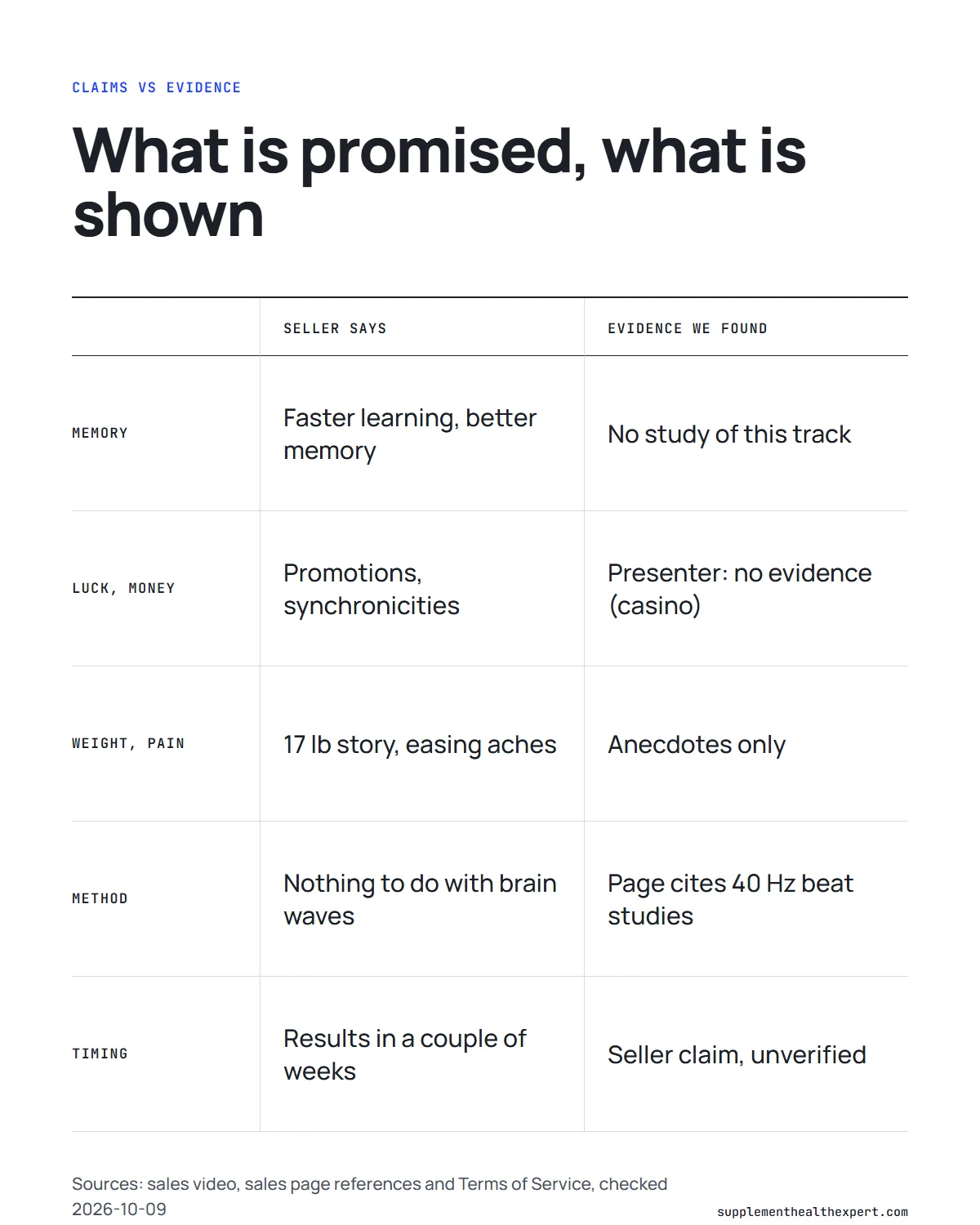
| Promised outcome | What backs it up | How you could judge it |
|---|---|---|
| Eureka moments and clearer thinking | Stories in the video | Only subjectively, through your own notes |
| Learning faster, better memory | Stories; no trial of the track | Track a skill you are learning before and after |
| Luck and synchronicities | Stories; the presenter admits no evidence for the casino one | Not in any meaningful way |
| Promotions, money, better relationships | Stories about individual buyers | Too many other causes to separate out |
| Weight loss, quitting smoking | A 17 lb anecdote and smoking stories | See a doctor; do not rely on audio |
| Headaches and joint pain easing | Stories in the video | Talk to a professional about any pain |
| Children’s grades | Stories in the video | Too many other causes to separate out |
The pattern is clear once you lay it out. The outcomes that are easiest to notice, such as feeling calmer or more focused for a while, could just as easily come from sitting quietly with your eyes shut for eight minutes. The outcomes that would be remarkable, such as income or luck, are the ones with no route to proof at all.
What the seller offers as proof
A Nobel name. The video returns often to Roger Sperry, who shared the Nobel Prize for Physiology or Medicine in 1981, recognised for work with split-brain patients. The prize was not awarded for a method of switching on the whole brain, and “whole brain activation” is a marketing phrase rather than a recognised medical concept.
Binaural-beat references. The reference list on the sales page includes gamma-stimulation papers and work on 40 Hz binaural beats, among them a 2020 attentional-blink experiment by Ross and Lopez. Small studies like this have reported short-lived shifts in attention or mood. Wider reviews of the field call the findings mixed and based on small samples. And no study on the list examined the Genius Switch recording. Our article on the Genius Switch and binaural beats covers this research in more depth.
A contradiction. In the video, the method is said to have “nothing to do with brain waves”, and ordinary sound waves are called “incomplete”. The reference list on the sales page points the other way, towards brain-wave and binaural studies. The seller does not explain which account is correct, and the two cannot both be the reason the track works.
Customer numbers. According to the video, the track has helped 18,456 “everyday Americans” and earned “stacks of five star reviews”. Both numbers come from the seller alone. We found no way to check them, and no location for those reviews is given.
Why the testimonials cannot settle the question
The video’s stories, from “Lisa, a nurse from San Diego” to “Ellie from Manhattan”, are presented as proof that the track works. The seller’s Terms describe them very differently. They warn that avatars or actors may be used to dramatise feedback, that the people featured can include friends, relatives or early backers of the founders, and that these are exceptional outcomes which “may not reflect the experience of a typical customer”. The full breakdown sits in our Genius Switch review for 2026.
Even taken at face value, success stories have a basic weakness. People who noticed nothing rarely send a testimonial, and the seller chooses which stories to show. A hundred glowing accounts could sit beside thousands of shrugs, and the video would look the same.
The fine print adds one more signal. The Terms carry a section headed “For Entertainment Purposes Only”, which calls brain entrainment “not an exact science” and states that what it sells is meant for entertainment. The site also states the product is “not intended to diagnose, treat, cure, or prevent any disease”. When the seller’s legal text describes its product as entertainment, the sales video’s promises deserve a heavy discount.
Run your own 90-day test
Since no study can answer the question for you, the fairest approach is a simple personal trial. This is our suggested routine, not something the seller prescribes.
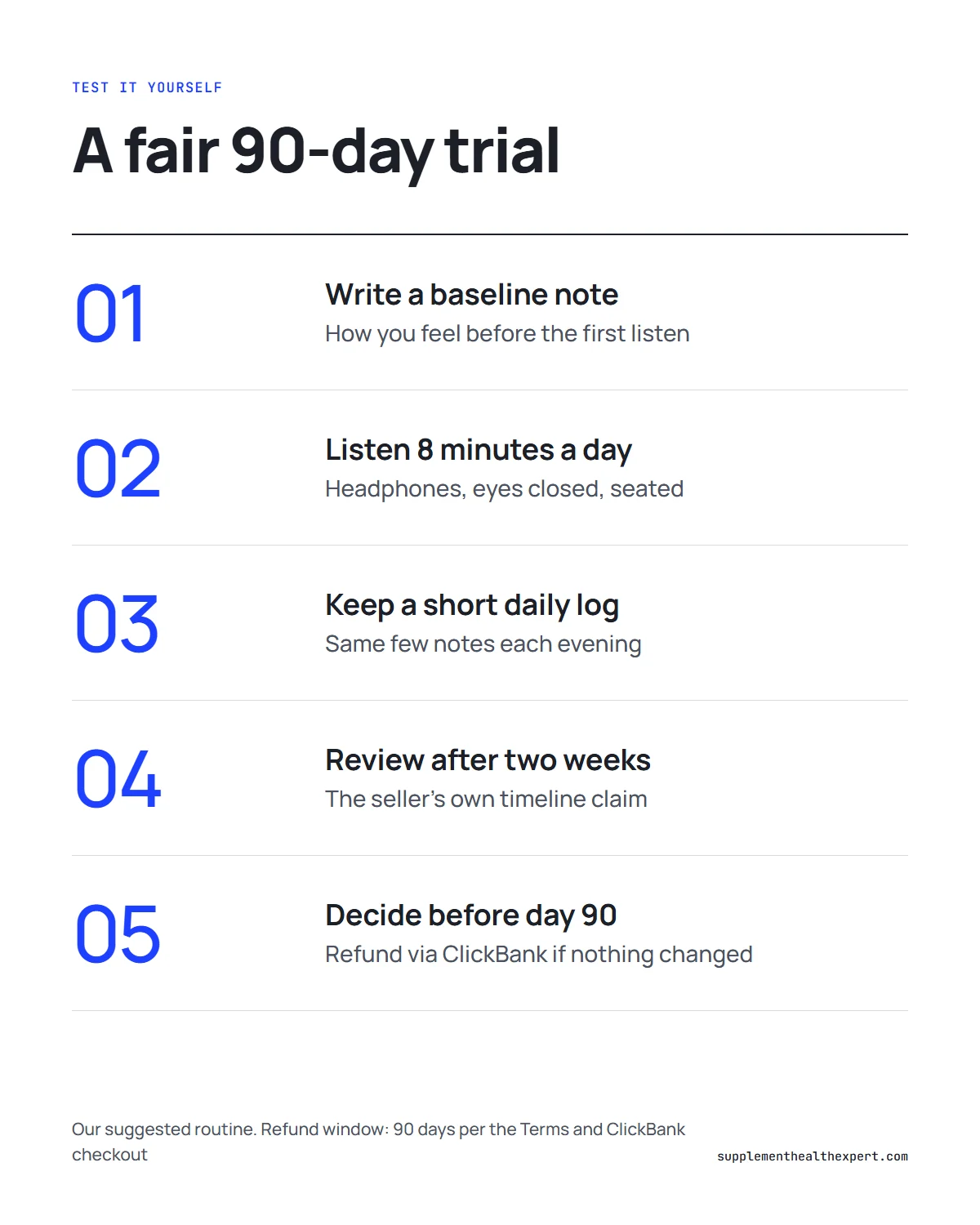
- Before the first session, write a baseline. Rate in one line how focused, rested and calm you feel, and note anything specific you hope will change.
- Listen as directed. Eight minutes a day, sitting down, headphones on, eyes closed, at a comfortable volume.
- Log the same things each evening. Keep it short and consistent so you can compare days honestly.
- Review after two weeks. The video puts results for most daily listeners at roughly two weeks, so this checkpoint holds the track to the seller’s own standard.
- Decide well before day 90. If your notes show no real change, request a refund through ClickBank while you are still inside the window.
Two cautions keep the test honest. First, judge the track against your notes, not against the stories in the video. Second, do not change anything else important at the same time, such as starting medication or a new diet, or you will not know what caused any difference.
Who is likely to be satisfied, and who is not
| Likely to feel it was worth $39 | Likely to be let down |
|---|---|
| You want a short daily pause with headphones and closed eyes | You expect sharper memory backed by science |
| You see the cost as a small experiment | You want the track to bring luck, cash or a better job |
| You will keep notes and use the refund window if needed | You want help with pain, weight or smoking |
| You enjoy audio-based relaxation already | You want an app, a game or a course rather than one file |
Listening safely
Our own advice for any audio product like this: keep the volume moderate, and never listen while driving or using machinery, because the routine involves sitting with your eyes closed. If you have epilepsy, have ever had a seizure, or have a hearing problem, check with your doctor before starting. Do not stop or change any treatment on the strength of a sales video.
Our answer
Does the track work? For the big promises in the video, such as luck, money, weight loss, pain relief and memory, we found no evidence, and some of those claims are ones even the presenter admits cannot be linked to the product. For smaller effects, such as feeling a little calmer after eight quiet minutes, the honest answer is that it may for some listeners, but nobody has tested this track to show it does more than any quiet break would.
That is why we land on the personal trial. Our editorial score for the Genius Switch is 5.0/10, based on our scoring method rather than any customer rating. If $39 and a refund deadline feel like a fair price for finding out, try it with low expectations and a notebook.
Frequently asked questions
Does The Genius Switch work from the first listen?
That is what the video claims: it says the track starts working the very first time you play it. We found no data behind that statement. The seller's own timelines also vary, from a first-listen effect to a couple of weeks of daily use.
How long does the seller say results take?
The video gives three timeframes: an effect from the first session, a difference many customers notice within two to three days, and results for most daily listeners within a couple of weeks. All three are claims we could not check.
Has the track been tested in a clinical trial?
We found none. The sales page points to outside studies on binaural beats and gamma stimulation, but none of them tested this particular recording.
Can listening help with weight loss or quitting smoking?
The video includes a 17 lb weight-loss story and mentions people giving up smoking. Those are anecdotes chosen by the seller. Nothing we found shows that an 8-minute audio track changes body weight or nicotine habits, and we would not rely on it for either.
Will it bring luck or more money?
The sales video suggests it can, with stories about promotions, synchronicities and a casino win. On that casino story, the presenter himself says there is no evidence the track caused it. We treat every luck and money claim as unsupported.
What happens if it does nothing for me?
You can ask for a refund within 90 days of your first purchase, which is the period given in both the seller's Terms and the ClickBank checkout. Keep your receipt email so you have the order number ready.
Is daily listening safe?
We know of no safety data on this particular track. Our own advice: skip it while driving or running machinery, and speak to a doctor beforehand if you live with epilepsy, have had seizures, or have trouble with your hearing.
Sources
does the genius switch work · the genius switch · binaural beats · brain entrainment · evidence check