Buying Guides / Guide
FemiCore Capsules: What One Capsule Holds, 30 to a Bottle, and How to Keep and Carry Them
FemiCore capsules up close: what one capsule holds, why a bottle has 30, taking it with water, missed days, storage, travel and who should ask a doctor first.
- Author
- Supplement Health Expert Editorial Team
- Published
- Reading time
- 8 min
- Sources
- 2 cited
Key takeaways
- 01 Each capsule carries one proprietary blend of nine ingredients: four plant ingredients and five Lactobacillus species. The amount of each is not disclosed.
- 02 A bottle holds 30 capsules. The label direction is one capsule each morning with a big glass of water, so one bottle lasts about a month.
- 03 If you miss a morning, simply carry on the next day. Nothing on the label suggests taking two to catch up.
- 04 Keep the bottle closed, dry and away from heat, and travel with it in its original labelled bottle.
- 05 Ask a doctor or pharmacist before the first capsule if you are pregnant or nursing, take medicines or have a medical condition, especially kidney disease.
FemiCore capsules are the whole product: there is no powder, drink or gummy version, just a bottle of 30 capsules and a direction to take one each morning. That makes the capsule worth a closer look. This guide covers what a single capsule holds and what its label leaves out, why one bottle equals about a month, how to take it with water, what to do when you forget a day, how to store the bottle at home and on the road, and who should speak to a doctor before swallowing the first one. We stick to what the seller states on the label and its website, and we do not add dosing advice of our own.
First, so you know where this comes from: the seller did not write this page; an independent team did. Any store link here is an affiliate link, and a sale through it can pay us a small commission without changing what you pay.
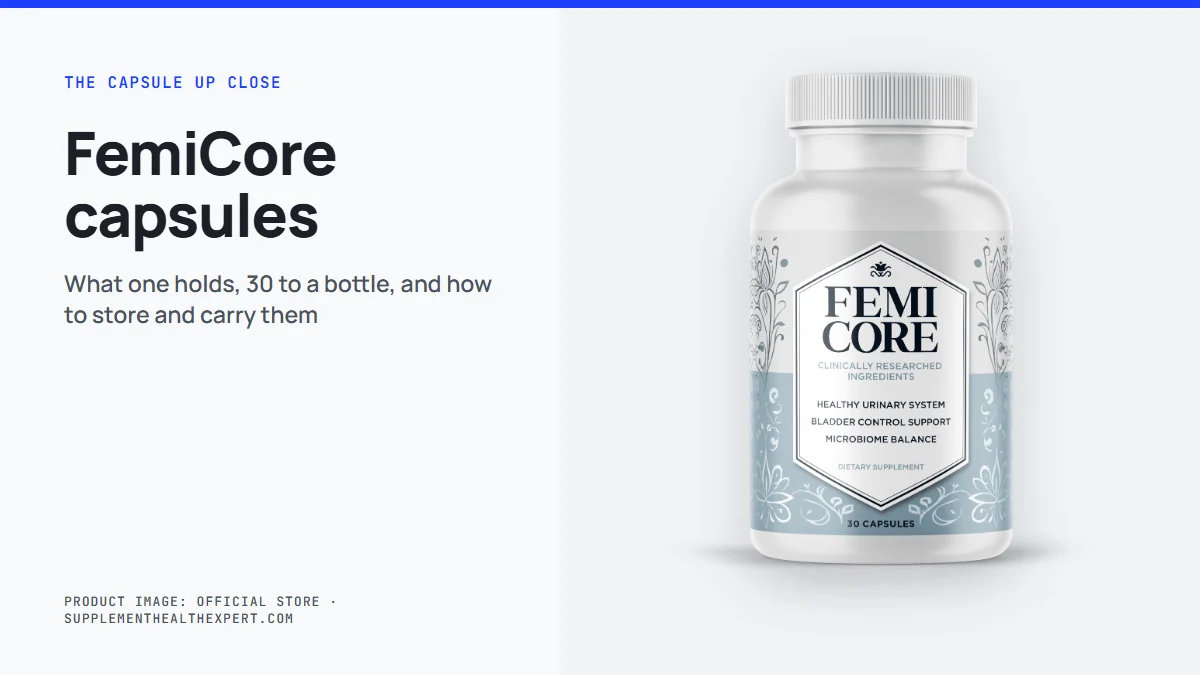
FemiCore capsules at a glance
| Question | What the seller states |
|---|---|
| Form | Capsule, swallowed whole |
| Capsules per bottle | 30 |
| Daily amount | 1 capsule every morning |
| Taken with | Plenty of water |
| One bottle lasts | About a month |
| Contents | Proprietary blend of 9 ingredients |
| Amount of each ingredient | Not disclosed |
| Other notes from the seller | No stimulants, non-GMO |
| Before judging | Seller suggests at least 3 months |
For a walk through the full label panel, including the serving size and warnings section, see our label guide to the FemiCore supplement. Here we stay with the capsule itself.
What one capsule holds
Every capsule carries the same mix. The seller lists nine ingredients in a single proprietary blend.
The plant side of the capsule
- Mimosa pudica, a creeping plant studied in the lab and in animals, with no human trials for bladder symptoms.
- Bearberry (uva ursi), a leaf whose arbutin turns into an antibacterial compound in urine. European herbal regulators describe it for short courses only.
- Cranberry extract, the best researched piece, studied mainly for repeat urinary infections rather than leaks.
- Granular berberine, well studied in people for blood sugar and cholesterol levels, with little to show for the bladder.
The probiotic side of the capsule
Five Lactobacillus species share the same capsule. In no particular order they are L. casei, L. gasseri, L. crispatus, L. plantarum and L. acidophilus. Only species names appear, never the individual strains, and with probiotics it is the strain that decides what the research applies to.
What the capsule label does not tell you
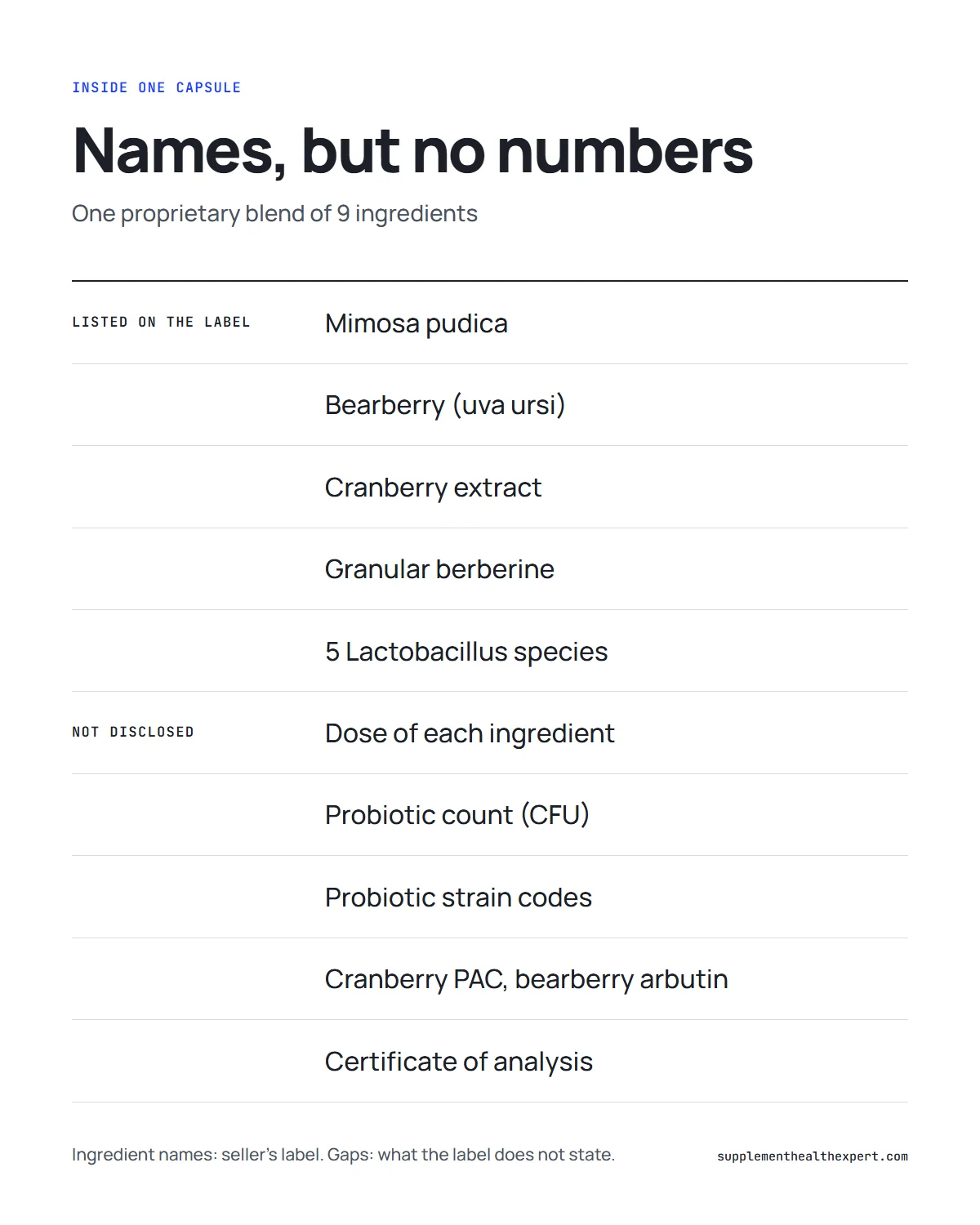
Because everything sits in one proprietary blend, a capsule’s label gives you names without numbers. These details are not disclosed:
- how many milligrams of each of the nine go in, berberine included;
- how many live bacteria (CFU) one capsule delivers;
- which exact strains sit behind the five species names;
- how much PAC the cranberry provides, or how much arbutin the bearberry;
- any certificate of analysis for a batch.
We also could not confirm from the seller’s published information whether the shell is gelatin or plant-based, or how much the capsule weighs. If either matters to you, check the bottle you receive or ask support before you order. None of this makes the capsule unsafe or fake. It does mean you are trusting the blend rather than checking it against the doses used in research.
One a day, 30 to a bottle: the arithmetic
The maths is simple and it shapes how you buy. With one capsule a day, each bottle covers about a month.
| Package | Capsules | Days covered | Price per bottle |
|---|---|---|---|
| 2 bottles | 60 | About 60 | $79 |
| 3 bottles | 90 | About 90 | $69 |
| 6 bottles | 180 | About 180 | $49 |
Refunds are accepted for 60 days after delivery, yet the seller suggests three months before judging. A two-bottle order fits inside the refund window. Three bottles match the seller’s suggested trial. Six bottles go well past both, so only choose that if you already know you want to continue. US shipping is free on the three and six bottle packages; the two-bottle order adds $9.99.
Swallowing it: why the big glass of water
Each morning’s capsule is meant to go down with a large glass of water, according to the directions. Sticking to that is the easiest approach:
- Take the capsule at the same point each morning, for example with your first drink of the day.
- Drink the whole glass, not a sip. It helps the capsule go down and keeps your fluid intake up, which matters for anyone watching their bladder.
- Swallow the capsule whole. The directions do not mention opening it or mixing the contents into food.
If capsules tend to stick in your throat, ask a pharmacist before changing anything. Our step-by-step morning routine covers building the habit in more detail.
If you miss a capsule
Everyone forgets a morning now and then. The directions ask for a single capsule daily and say nothing about catching up, so there is no reason to take two after a gap. So the rule is short: skip the missed day, take your normal single capsule the next morning and carry on.
Two habits make this rarer:
- Keep the bottle where you see it each morning, next to your glass or the kettle, but not in a steamy spot.
- Tick a calendar or a notes app when you take it. If you are tracking results, missed days are worth knowing about anyway, since a month with many gaps tells you less.
Storage at home
The seller’s online pages that we checked do not give storage instructions, so read the label on the bottle you receive and follow it if it says anything specific. Without one, the usual common sense for supplements applies:
- Lid on tight. Close the bottle after each capsule.
- Dry place. A bathroom cabinet fills with steam every time you shower, which is not ideal for capsules, especially ones that contain probiotics.
- Away from heat. Keep it off sunny windowsills and away from the stove or a radiator.
- Keep the original bottle. It carries the label with the directions and the ingredient list.
- Out of reach of children.
If capsules ever look damp, clumped or discoloured, do not take them. Contact support instead.
Travelling with your capsules
The capsule format is easy to travel with. A few points help:
- Count your days. Pack one capsule for each morning away, plus a few spare in case of delays.
- Keep the original labelled bottle rather than loose capsules in a bag. It identifies the product at security or customs, and it keeps the capsules dry.
- Use your carry-on bag. Checked luggage can sit in hot holds or go missing.
- Pill organisers are a trade-off. They are convenient, but each compartment exposes capsules to air and moisture. Use one for short trips only.
- Changing time zones? Keep it simple and take your capsule when your new morning starts.
- Flying abroad? Rules on bringing supplements into another country vary, so check them before you go.
Who should check with a doctor before the first capsule
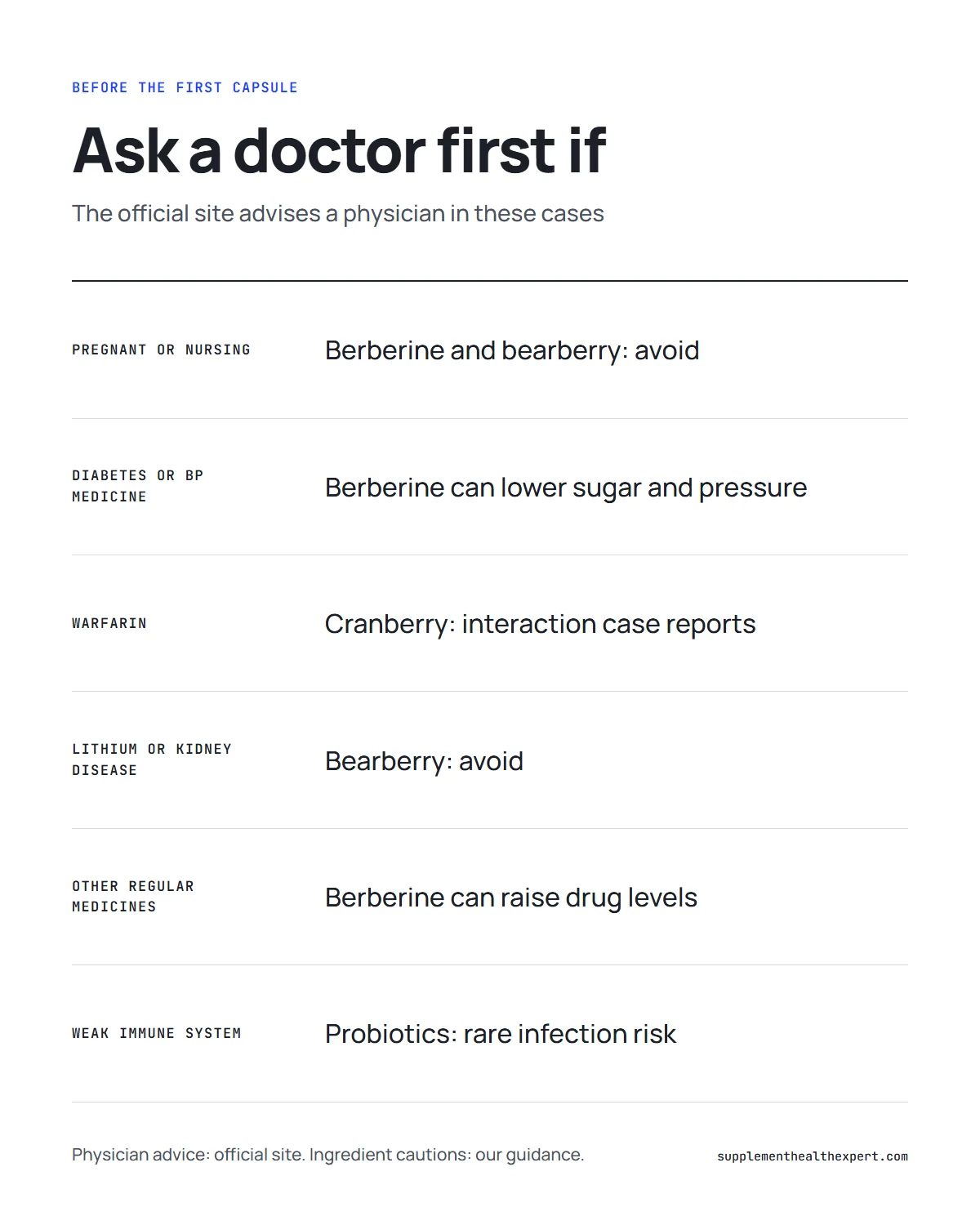
On its website the seller recommends checking with a physician first in three situations: pregnancy or nursing, any current medication, and any medical condition. Looking at what the capsule contains, that is sound advice:
- Berberine. It may bring blood sugar down, which matters if you use diabetes medicines, and blood pressure too. It also slows the liver enzymes CYP3A4 and CYP2D6, so drugs such as cyclosporine can build up to higher levels. Pregnancy and breastfeeding are times to leave it out.
- Bearberry. Traditional guidance limits it to brief courses, which a daily capsule taken for months does not match. Skip it during pregnancy or breastfeeding or with kidney disease, keep it away from children, and mention it if you take lithium. A green-brown tint to urine can happen and is harmless.
- Cranberry. People on warfarin have had interaction reports, so INR checks matter, and its oxalate is worth raising if kidney stones are part of your history.
- Probiotics. A severely weakened immune system is the rare case where live bacteria can cause infection.
Some wind or a bloated stomach early on is possible, as with many probiotic products. Our guide to FemiCore side effects covers the rest.
Separately from all of this, some symptoms belong with a doctor, not a capsule: a temperature or chills, pain in the flank, any blood when you pass urine, stinging on urination, or bladder control that shifts abruptly.
Our take on FemiCore capsules
As a format, the capsule is about as easy as a supplement gets: one a day, a glass of water, no mixing, nothing to measure. The weakness is not the capsule but what its label withholds. You know the nine names, not the amounts, so you cannot compare a capsule with the doses used in research. Store the bottle somewhere dry and cool, travel with it in its original packaging, do not double up after a missed day, and clear it with your doctor first if any of the safety points above apply.
For prices, ingredients and our full overview in one place, see our FemiCore product guide.
Frequently asked questions
How many capsules come in one bottle?
Thirty. With one capsule a day, a single bottle covers about a month, two bottles about 60 days, three bottles about 90 days and six bottles about half a year.
What is inside a single FemiCore capsule?
Four plant ingredients (cranberry extract, bearberry, granular berberine and Mimosa pudica) plus five Lactobacillus species, from crispatus and gasseri to acidophilus, casei and plantarum. They share one proprietary blend, and the label gives no amount for any of them.
Can I open the capsule and mix it into a drink?
The directions say to take the capsule with a big glass of water and do not mention opening it. Swallow it whole as sold. If swallowing capsules is hard for you, ask a pharmacist before changing how you take it.
Is the capsule shell gelatin or plant-based?
We could not confirm this from the information the seller publishes online. Read the other-ingredients line on the bottle you receive, or ask support before ordering if it matters for your diet.
I skipped a day. Should I take two capsules tomorrow?
No. The directions stop at one capsule daily and never mention doubling up. Take your usual single capsule the next morning and carry on.
How should I pack the capsules for a trip?
Keep them in the original labelled bottle, in your carry-on bag, with a few spare days counted in. The label identifies the product if anyone asks, and the closed bottle protects the capsules from moisture.
Which medicines are worth mentioning to a pharmacist first?
Diabetes and blood pressure medicines, warfarin, lithium, and drugs whose levels can rise when liver enzymes are slowed, such as cyclosporine. Berberine, bearberry and cranberry in the blend are the reasons to ask.
Sources
femicore capsules · femicore · capsule storage · travel with supplements · bladder health · proprietary blend