Everyday Wellness / Evidence C · Limited
FemiCore Side Effects: An Ingredient-by-Ingredient Safety Check and Who Should Ask a Doctor First
FemiCore side effects by ingredient: probiotic adjustment, berberine drug interactions, bearberry limits, cranberry and warfarin, and who should check first.
- Author
- Supplement Health Expert Editorial Team
- Published
- Reading time
- 9 min
- Sources
- 5 cited
Key takeaways
- 01 FemiCore contains no stimulants, so side effects tied to caffeine-type ingredients, such as jitteriness or poor sleep, are not expected.
- 02 The most likely side effect is a short probiotic adjustment period: mild bloating, gas or looser stools in the first week or two.
- 03 Berberine is the main safety concern. It can upset the stomach, lower blood sugar and change how the liver clears several medicines, including cyclosporine.
- 04 Bearberry is meant for short courses in European herbal guidance and should be avoided in pregnancy, breastfeeding and kidney disease. Cranberry can interact with warfarin.
- 05 Anyone pregnant, breastfeeding, on regular medication, with kidney disease or with a weakened immune system should speak to a doctor or pharmacist before starting.
Most questions about FemiCore side effects come down to one worry: is a daily bladder capsule likely to cause a new problem while it tries to fix an old one? For most healthy adults the answer is probably not, but “probably” depends on who you are and what else you take. FemiCore combines four botanicals with five probiotic strains, and two of those botanicals, berberine and bearberry, carry cautions that are easy to miss on a sales page.
This guide works through the label one ingredient at a time, explains what each could do to your body, and finishes with a plain checklist of the people who should talk to a doctor or pharmacist before they open the bottle. We have no tie to the manufacturer. Buttons on this page are affiliate links; they do not change the safety advice.

FemiCore side effects in brief
FemiCore is one capsule a day and, according to the official website, contains no stimulants. That rules out the jittery, sleep-disrupting effects common to many supplements. What remains falls into three groups:
| Type of effect | Which ingredients | How likely |
|---|---|---|
| Digestive adjustment (bloating, gas, loose stools) | The five Lactobacillus strains, berberine | Most likely, usually short-lived |
| Drug interactions | Berberine, cranberry | Matters only if you take certain medicines |
| Long-term use concerns | Bearberry | Matters for continuous use over months |
The difficulty is that FemiCore lists all nine ingredients in one proprietary blend with no individual amounts. We can say which ingredients carry a caution. We cannot say how much of each is in the capsule, so the size of any risk is unknown.
Ingredient safety check
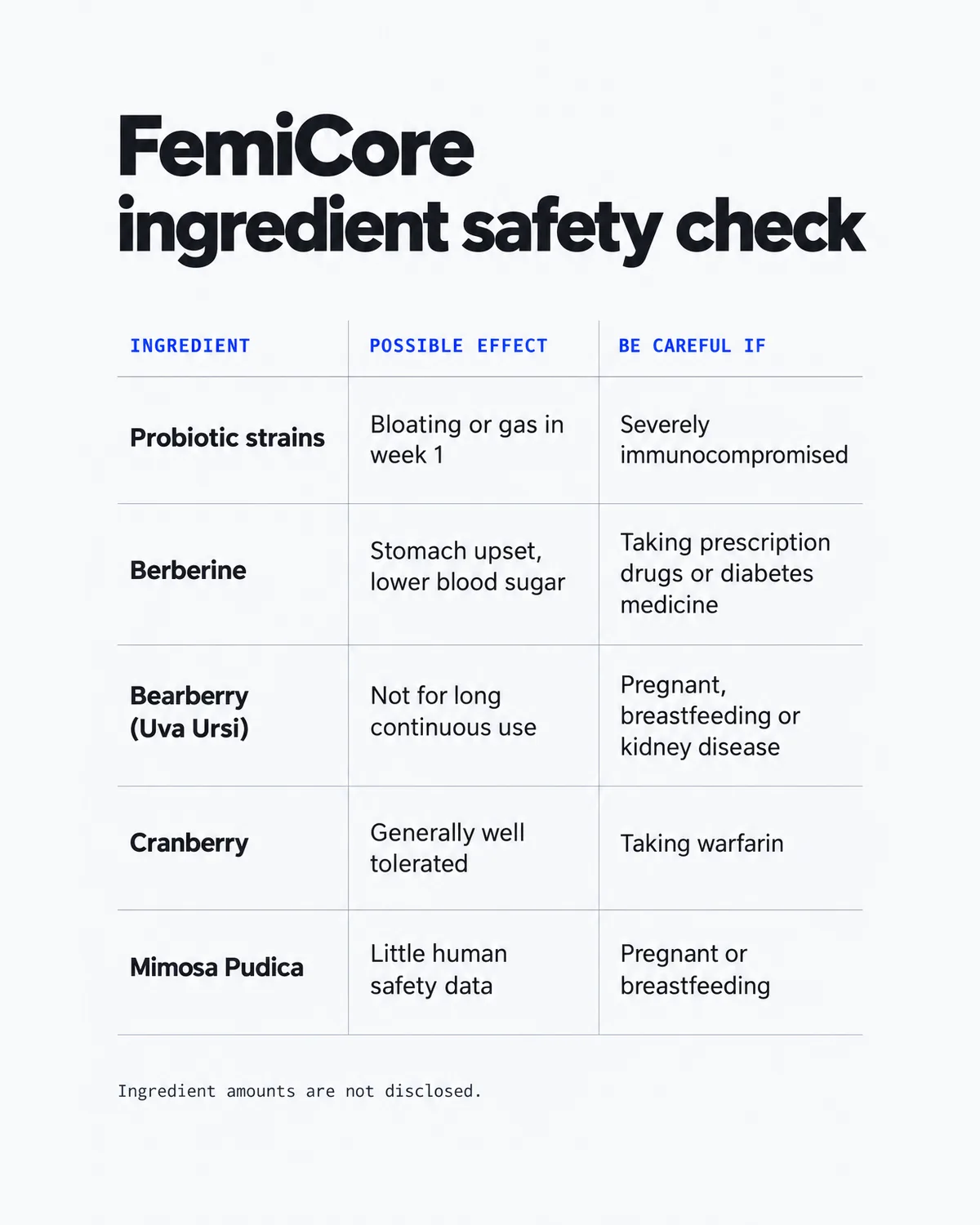
| Ingredient | Possible effect | Be careful if |
|---|---|---|
| Lactobacillus strains (5) | Bloating, gas, looser stools early on | Severely weakened immune system, central line, recent major surgery |
| Granular Berberine | Stomach upset, constipation or diarrhoea, lower blood sugar | On prescription drugs, diabetic medicines, pregnant or breastfeeding |
| Bearberry (Uva Ursi) leaf | Nausea; concern with long continuous use | Pregnant, breastfeeding, kidney disease, planning months of daily use |
| Cranberry Extract | Generally well tolerated; mild stomach upset | Taking warfarin, history of kidney stones |
| Mimosa Pudica | Little human safety data | Pregnant or breastfeeding |
The probiotic strains: an adjustment period
Five of the nine ingredients are live bacteria: L. crispatus, L. acidophilus, L. plantarum, L. gasseri and L. casei. When you start any probiotic, the gut sometimes reacts for a week or two with extra gas, a bloated feeling or a change in stool consistency. This is not a sign of harm and usually settles without action.
Taking the capsule with breakfast rather than on an empty stomach can make the first days easier. If digestive symptoms are still present after two to three weeks, the product probably does not suit you.
The one group for whom live bacteria need more care is people with a severely weakened immune system, for example during chemotherapy or after an organ transplant. In that situation any probiotic should be cleared by the treating team.
Berberine: stomach upset and drug interactions
Berberine is the ingredient we would ask most people to think about. Its human research is mainly in blood sugar control at doses of 1,000 to 1,500 mg a day (Yin, 2008), and at those doses the common complaints are cramping, constipation or diarrhoea. FemiCore’s amount is undisclosed and almost certainly much lower, which should make digestive effects milder.
Interactions are the bigger issue, because they do not need a large dose to matter:
- Liver enzymes. Berberine slows CYP3A4, CYP2D6 and CYP2C9, the enzymes that break down a large share of prescription drugs. Slower clearance can mean higher drug levels in the blood.
- Cyclosporine. Berberine has been shown to raise cyclosporine levels, which is a serious concern for transplant patients.
- Blood sugar. Berberine lowers glucose. Combined with insulin or other diabetes medicines, that could push blood sugar too low.
- Pregnancy and breastfeeding. Berberine is not considered safe at these times, partly because of a risk of jaundice in newborns.
If you take any regular prescription medicine, this is the reason to speak to a pharmacist before starting FemiCore.
Bearberry: a short-course herb in a daily capsule
Bearberry (uva ursi) leaf contains arbutin, which the body turns into hydroquinone. European herbal guidance limits bearberry to short courses, typically no longer than a week at a time and only a few times a year, because of uncertainty about continuous exposure. FemiCore is designed to be taken every day for 60 to 90 days or longer.
The amount of bearberry in one capsule is probably small, but the manufacturer does not say. Bearberry is also not recommended during pregnancy or breastfeeding or for people with kidney disease. It can occasionally cause nausea, and it may turn urine a greenish-brown colour, which is harmless.
Cranberry: warfarin and kidney stones
Cranberry is among the gentlest ingredients on the list and is widely used for urinary tract health (Williams, 2023). Two cautions apply. Large amounts of cranberry may strengthen the effect of warfarin, so anyone on warfarin should have their doctor’s agreement and keep up their usual blood tests. People with a history of oxalate kidney stones should also mention it, as cranberry contains oxalate.
Mimosa pudica: not much data either way
Mimosa pudica is a traditional herb with laboratory research but very little human data. That means there is no strong safety signal, and also no solid safety record. It is another reason to avoid FemiCore during pregnancy and breastfeeding.
Why the proprietary blend matters for safety
For effectiveness, the missing amounts are a frustration. For safety, they are a practical problem. A pharmacist checking an interaction will ask “how much berberine?” and the honest answer is “unknown”. The same is true for bearberry and the probiotic count.
This does not make FemiCore unsafe. It means the cautious approach is the right one: treat each ingredient as if it could be present in a meaningful amount, and let a professional judge whether that matters for you. Our FemiCore ingredients list shows exactly what the label does and does not disclose.
Talk to a doctor before FemiCore if…

Check with a doctor, midwife or pharmacist first if any of these apply to you:
- You are pregnant, trying to conceive or breastfeeding.
- You take any regular prescription medicine, particularly for diabetes, blood thinning (such as warfarin), heart rhythm, blood pressure, cholesterol or transplant care (such as cyclosporine).
- You have kidney disease or a history of kidney stones.
- You have liver disease.
- Your immune system is weakened by illness or treatment.
- You already take berberine, cranberry or a probiotic for another reason.
- You are buying for someone under 18. FemiCore is marketed to adult women, and bearberry is not recommended for children.
How to start FemiCore carefully
If you have checked with your doctor or have no risk factors, a careful start makes side effects easier to spot:
- Take one capsule with breakfast and a glass of water. Do not take more than the label says.
- Start it on its own. Avoid beginning another new supplement in the same fortnight, so you know which product caused any change.
- Note anything new for the first two weeks: digestion, sleep, energy, skin.
- Stop if symptoms persist beyond two or three weeks, or if anything feels wrong. Restart later only if the effect was mild.
- Keep the bottles and the packing slip. The 60-day guarantee requires all bottles to be returned, so do not throw empties away.
If you decide to stop because of side effects, the guarantee still applies. Email support within 60 days of delivery, return every bottle with the packing slip at your own postage cost, and the purchase price is refunded to your original payment method. Shipping fees may not be refunded. Our FemiCore official website guide explains why the guarantee covers official-store orders only.
Side effects or simply no effect?
It is worth separating two different reasons to stop. A side effect is something new and unwanted. No effect is when nothing changes at all. Both are common with supplements, and both are covered by the guarantee if you act inside 60 days.
The manufacturer suggests 60 to 90 days before judging results, while the refund window is 60 days from the day your order is delivered. If you are tolerating FemiCore well but seeing no change by about week seven, that is the time to decide, not after the window has closed. For a full verdict on whether the formula is worth trying, see our ingredient-graded FemiCore review.
The bottom line on FemiCore side effects
For most healthy adult women, FemiCore’s likely side effects are mild and digestive, and they usually pass within the first two weeks. The real cautions sit with two ingredients. Berberine can interact with common medicines and is not suitable in pregnancy. Bearberry is a short-course herb in a daily product. Cranberry adds a warfarin caution.
Because the amounts are not disclosed, the safest approach is to check with a professional if any item on the checklist applies to you, start slowly, and keep the bottles so the guarantee stays available.
Frequently asked questions
What are the most common FemiCore side effects?
The most likely effects are digestive: mild bloating, gas or a change in stool consistency during the first week or two. These are typical when starting any probiotic and usually settle as the body adjusts. If they do not settle, stop taking it.
Can FemiCore interact with my medication?
It can. Berberine slows the liver enzymes CYP3A4, CYP2D6 and CYP2C9, which clear many common medicines, and it can raise blood levels of drugs such as cyclosporine. Berberine also lowers blood sugar, and cranberry can interact with warfarin. Show the ingredient list to your pharmacist before starting.
Is FemiCore safe during pregnancy or breastfeeding?
No. Berberine is not considered safe during pregnancy or breastfeeding, and bearberry is also not recommended at these times. Talk to your midwife or doctor about bladder symptoms during pregnancy instead.
Can FemiCore cause a urinary tract infection?
There is no reason to expect it to. However, burning when you pass urine, fever, cloudy or bloody urine are signs of infection or another problem that needs a doctor. Do not try to manage them with a supplement.
Is it safe to take FemiCore long term?
The probiotics and cranberry have reassuring long-term safety records. Bearberry is the exception: European herbal guidance recommends it only for short courses. Because FemiCore does not disclose its bearberry amount, anyone planning months of use should discuss it with a clinician.
What should I do if I get side effects from FemiCore?
Stop taking it and see whether the symptoms go away. If they are mild, you can restart later and see if they return. If they are severe, or if you notice anything like yellowing skin, unusual bruising or low blood sugar symptoms, seek medical advice. Keep the bottles in case you want to use the 60-day guarantee.
Sources
- 01 Afshar K, et al. Uva-ursi extract and ibuprofen as alternative treatments for uncomplicated urinary tract infection in women (ATAFUTI). Br J Gen Pract. 2018.
- 02 Yin J, Xing H, Ye J. Efficacy of berberine in patients with type 2 diabetes mellitus. Metabolism. 2008.
- 03 Williams G, et al. Cranberries for preventing urinary tract infections. Cochrane Database Syst Rev. 2023.
- 04 U.S. Food and Drug Administration. Tips for dietary supplement users: making informed decisions.
- 05 National Institute of Diabetes and Digestive and Kidney Diseases. Bladder control problems (urinary incontinence).
femicore side effects · femicore · femicore safety · berberine interactions · bearberry safety · probiotic side effects · bladder supplement safety