Supplement Reviews / Guide
FemiCore Directions, Line by Line: What Each Instruction and Warning Means in Practice
FemiCore directions read line by line: one capsule, every morning, a big glass of water, the 3-month advice and the doctor warning, and what each means for you.
- Author
- Supplement Health Expert Editorial Team
- Published
- Reading time
- 8 min
- Sources
- 2 cited
Key takeaways
- 01 The directions the seller gives are short: one capsule every morning with a big glass of water. A 30-capsule bottle lasts one month.
- 02 The seller adds that you should use it for at least 3 months before judging, while the refund window is 60 days from delivery.
- 03 The official site advises seeing a physician first if you are pregnant, nursing, on medication or have a medical condition. Several of the ingredients explain why.
- 04 The directions do not tell you the amount of any ingredient, and they do not set a limit on how long to take it, even though bearberry is traditionally used only in short courses.
- 05 If the label on your own bottle says something different from this page, follow the bottle and ask a pharmacist.
Supplement directions are usually a single line that people glance at once and never read again. The FemiCore directions are short too, but each part of them carries a decision: how much, when, with what, for how long, and who should ask a doctor before the first dose. This page takes them one line at a time and explains what each instruction and warning means once the bottle is on your kitchen counter.
We write this independently; it is our reading, not the seller’s page. The buttons point to the store through affiliate links, so a purchase can earn us a commission. If you want a practical routine for building the habit, that lives in our guide on how to use FemiCore. Here we stay with the wording itself.

FemiCore directions at a glance
The directions below are the ones the seller publishes. If the label on the bottle you receive is worded differently, the bottle wins.
| Line | What it says | What it means in practice |
|---|---|---|
| Amount | 1 capsule | The whole daily amount, not a starting point |
| Timing | Every morning | One fixed time, once a day |
| With | A big glass of water | Swallow it with a full glass, not a sip |
| Supply | 30 capsules per bottle | One bottle covers one month |
| Duration | At least 3 months, per the seller | Longer than the 60-day refund window |
| Warning | Ask a physician first: pregnancy, nursing, medicines, any medical condition | A real check, not small print |
Line 1: one capsule
One is the number, and the directions stop there. They do not offer a higher dose for faster results or a lower one for sensitive users. Read it as the full daily amount.
There is a practical reason not to improvise. FemiCore lists its nine ingredients inside a proprietary blend, without the amount of each. You cannot work out how much berberine or bearberry a second capsule would add, so you cannot judge whether doubling up is sensible. Two capsules also means a bottle lasts two weeks instead of four, which changes the cost of the whole course.
If one capsule gives you stomach trouble, the answer is not to split or skip at random. Talk to a pharmacist about whether to pause, and note what you felt and when.
Line 2: every morning
The instruction has two parts. “Every” asks for daily use with no breaks. “Morning” sets the time. The seller does not give a reason for the morning, so we will not invent one. What the timing does give you is a routine that is easy to anchor to something you already do.
The directions do not mention food, and they do not say what to do if you miss a morning. A plain reading of “one capsule every morning” is that you take the next one the following morning, rather than taking two at once to catch up.
The first two weeks
During roughly the first fortnight, the probiotic part may leave you gassy or bloated, and berberine is known to unsettle some stomachs. A morning dose means you will notice any of that during the day rather than at night. If it lasts beyond the first couple of weeks, or is more than mild, stop and ask a doctor. For an ingredient-by-ingredient look at possible reactions, read our guide to FemiCore side effects.
Line 3: with a big glass of water
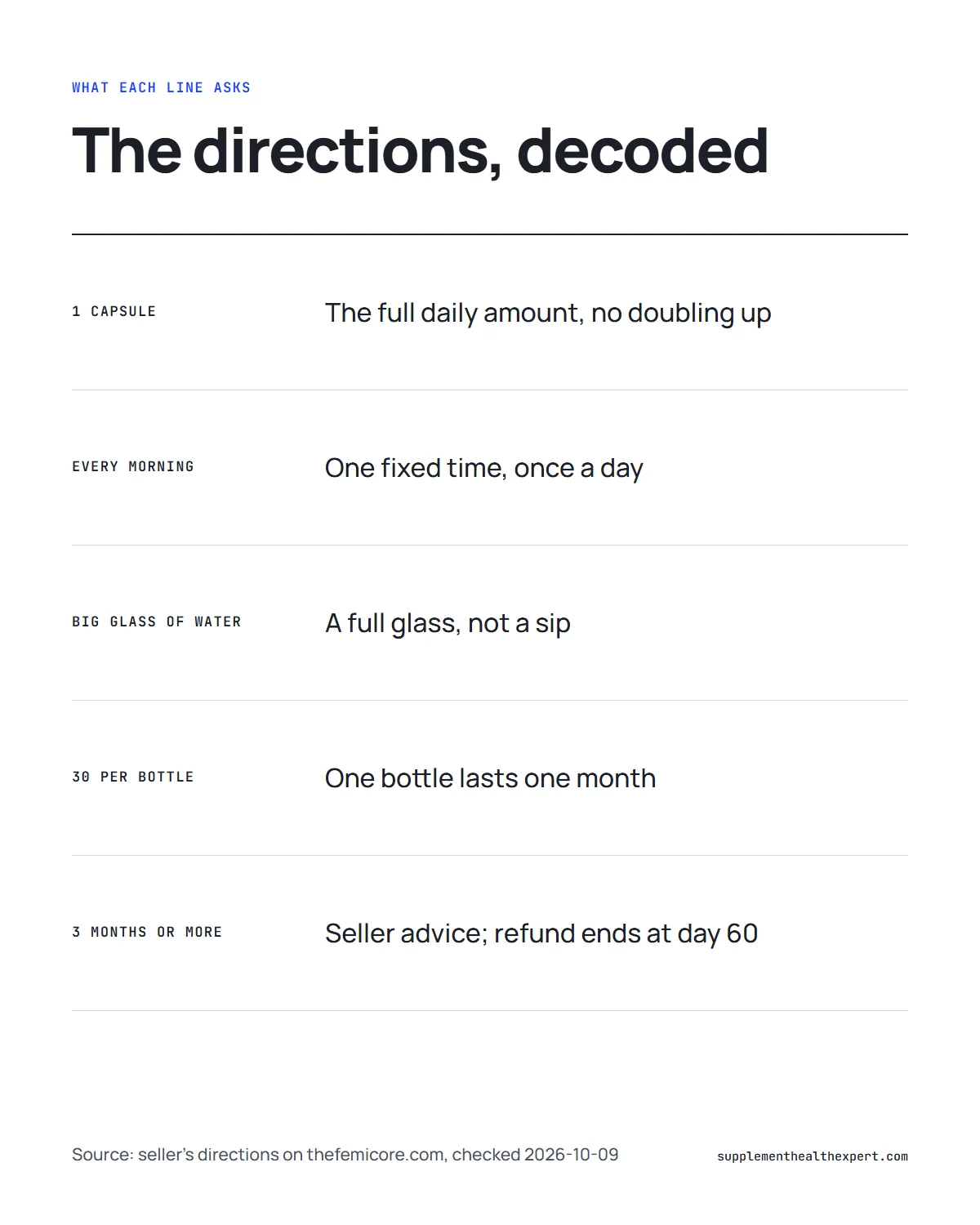
The phrase is “a big glass”, not just “water”. The seller does not say why. In everyday terms, a full glass helps a capsule go down cleanly and starts your fluid intake for the day.
There is a detail here that matters for the people this product is aimed at. FemiCore is marketed for bladder control. If you deal with urgency, a big glass of water first thing will probably send you to the bathroom within the hour. That is not a side effect of the capsule; it is just water. Plan around it. Take your dose when you know you will be near a bathroom for a while, rather than as you walk out the door.
Skipping the glass to avoid that trip is not a good trade. The directions ask for it, and a sip of water is a poor way to swallow any capsule.
Line 4: 30 capsules per bottle
This line is about supply, not dosing, but it shapes your planning. One capsule a day from a 30-capsule bottle gives one month. A 2-bottle pack covers two months, a 3-bottle pack three months and a 6-bottle pack six months.
Count your capsules now and then. If the bottle runs out early, someone in the house has been taking extra, or doses have been doubled. If it runs out late, mornings are being missed, which matters if you are trying to judge whether the product helps.
Line 5: at least 3 months
This is advice from the seller rather than a dosing instruction, but it belongs with the directions because it tells you how long the routine is meant to last. The seller asks you to give FemiCore at least 3 months before judging.
There is a timing gap to know about. Refunds are only open for 60 days, and the count begins on the delivery date. By then you will have used about two bottles. If you follow the 3-month advice to the end, the refund window will already have closed. Settle ahead of time which of the two you care about more, and put both dates in your calendar on the day the parcel arrives.
The warning line, read slowly
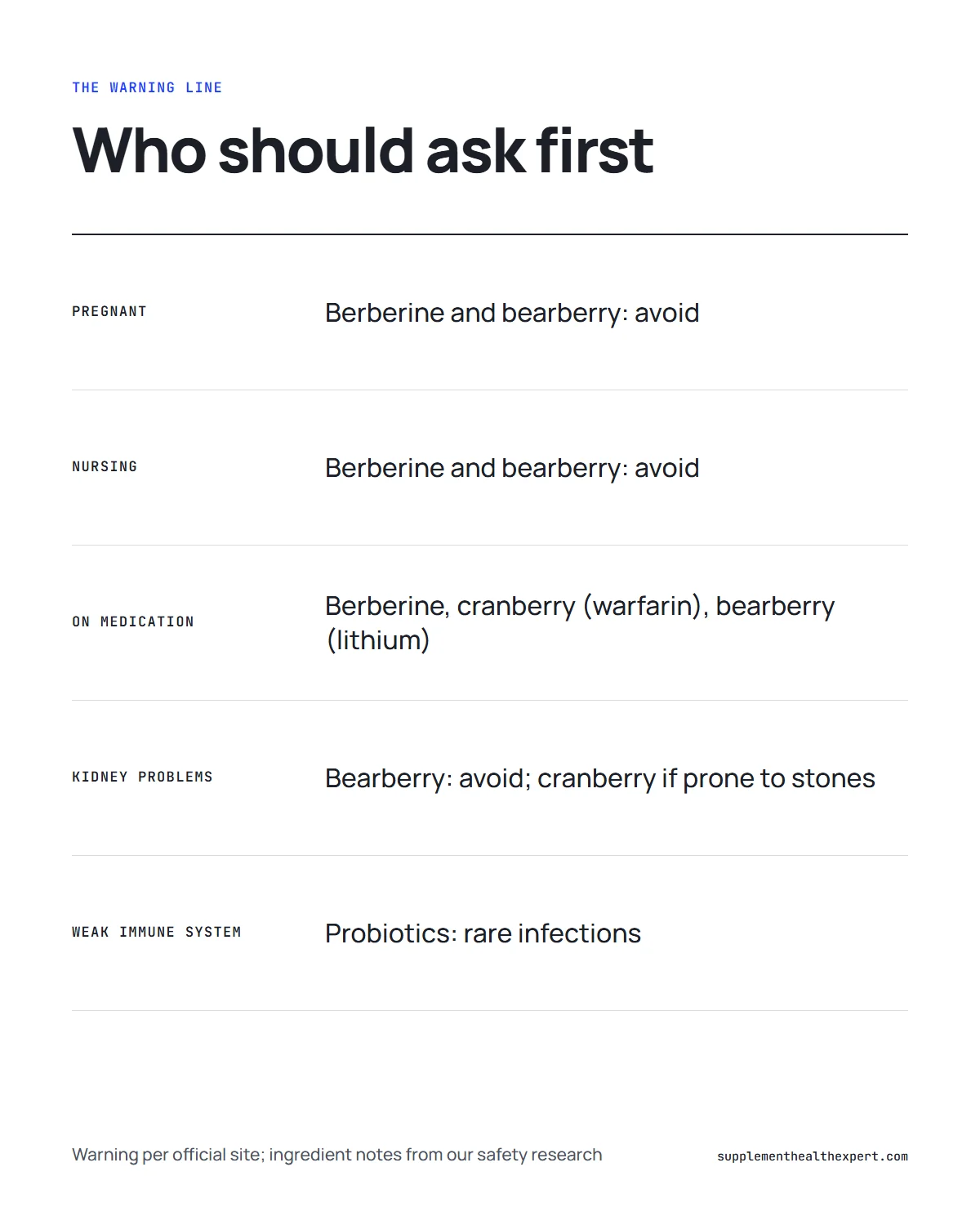
The official site tells four groups to see a physician before starting: anyone pregnant, anyone nursing, anyone taking medication and anyone with a medical condition. Warnings like this are easy to treat as legal boilerplate. With this formula, each part has a concrete reason behind it.
Pregnant or nursing
Pregnancy and breastfeeding are times when berberine is regarded as unsafe. Bearberry should also be avoided in pregnancy and while breastfeeding. Because both are in the blend, this part of the warning is close to a firm “do not start without your doctor’s agreement”.
On medication
Two liver enzymes that clear many everyday drugs, CYP3A4 and CYP2D6, are slowed by berberine, which can push the blood level of those drugs up. Cyclosporine is one example. Berberine can also lower blood sugar, which matters with diabetes medicines, and may lower blood pressure. With warfarin, cranberry has turned up in case reports, which is why INR checks may be needed. Bearberry interacts with lithium. Show your pharmacist the ingredient list, on the bottle itself or as a phone photo.
A medical condition
Bearberry should be avoided with kidney disease. Cranberry contains oxalate, which matters if you have had kidney stones. Probiotics have, rarely, caused infections in people with a severely weakened immune system. Diabetes and low blood pressure link back to berberine. If any of these apply, the physician check is not optional.
What the directions do not tell you
Reading directions closely also means noticing the gaps. These are the ones we found:
- Amounts. No dose for any of the nine ingredients, no CFU count for the probiotics and no strain codes.
- An end point. A minimum of 3 months, but no point at which to stop or take a break.
- Food and missed doses. Neither is covered.
- Storage. The directions we have do not include storage advice, so check your bottle for any storage line and follow it.
None of this makes the product unsafe by itself. It does mean the directions leave more decisions to you than a medicine leaflet would.
The words on the front of the bottle
The front label carries three phrases: “Healthy urinary system”, “Bladder control support” and “Microbiome balance”. These are support claims, the kind of wording supplements use. They are not promises to fix a medical problem, and FemiCore is not a medicine.
The label also mentions clinically researched ingredients. That points to studies of individual ingredients, such as cranberry for repeat urinary infections. No trial has tested the finished FemiCore formula. For the regulatory side, our FemiCore supplement guide covers the label panel in more detail.
The official site also shows a seal saying the product is made in an FDA registered facility. FemiCore, like any supplement maker, falls under the FDA’s rules for dietary supplements, not the approval route that medicines go through. The registered-facility seal tells you the factory is on the FDA’s register; whether the capsule helps is a separate question.
When to put the bottle down and call a doctor
No set of directions covers symptoms that need medical care. Skip the supplement and book a doctor if you notice any of these:
- Blood showing in the urine
- A fever, or shivering chills
- Flank pain, at the side of the back below the ribs
- Stinging or burning while peeing
- Bladder control that changes suddenly
If an older relative becomes confused and also has urinary symptoms, get medical advice the same day.
Our reading of the directions
The FemiCore directions are simple to follow: a single capsule each morning with a large glass of water, kept up for at least 3 months. The harder part is what sits around them. The warning names four groups who should see a doctor first, and the ingredient list gives solid reasons for each. The directions leave out doses, an end point and storage advice.
Our editorial score for FemiCore is 6.3/10 (how we score), held back mainly by the undisclosed amounts and the lack of a trial of the formula itself. If you go ahead, read your own label, run it past a pharmacist if you take any medicine, and keep the delivery date handy for the refund window. More background is on our FemiCore product page.
Frequently asked questions
What do the FemiCore directions say?
As the seller words them, the routine is a single capsule each morning, swallowed with a large glass of water. A bottle holds 30 capsules, so it lasts a month. The seller also wants you to stay on it for 3 months or more before making up your mind.
Is one capsule a minimum or a maximum?
Treat it as the full daily amount. The directions give one capsule and say nothing about taking more, and because the ingredient amounts are not disclosed, you have no way to judge what a second capsule would add, including to side effects.
Does the capsule have to be taken in the morning?
The directions say every morning. The main point is a fixed daily time so you do not forget or double up. If a different time suits you better, ask a pharmacist whether that is fine with your other medicines.
Why do the directions ask for a big glass of water?
The seller does not explain it. In practice it helps the capsule go down and adds to your fluid for the day. If you have urgency, expect a bathroom trip soon after and plan the timing around leaving the house.
What does the warning about pregnancy, nursing and medication mean for me?
It means a doctor should agree before you start. During pregnancy and breastfeeding berberine is regarded as unsafe, and it changes how many drugs are handled by the body. Bearberry is one to avoid in pregnancy and kidney disease, and warfarin users should know about the cranberry case reports.
Does 'clinically researched ingredients' mean FemiCore was tested?
No. The phrase points to studies of the individual ingredients. There is no clinical trial of the finished FemiCore formula, and the label does not give the amounts used.
What if the label on my bottle differs from this page?
Follow the label on the bottle in your hand. This page reads the directions as the seller publishes them. If anything on your bottle is unclear, ask a pharmacist or contact support before you start.
Sources
femicore directions · femicore · femicore label · supplement directions · bladder support supplement · probiotics