Supplement Reviews / Guide
FemiCore Review 2026 Women: When It Fits, When to Skip It and What to Ask Your Doctor
FemiCore review 2026 women can use: which situations suit it, when pregnancy, kidney disease or medicines rule it out, and questions to take to your doctor.
- Author
- Supplement Health Expert Editorial Team
- Published
- Reading time
- 9 min
- Sources
- 2 cited
Key takeaways
- 01 FemiCore is marketed to women for bladder control, urinary health and microbiome balance. It is a supplement, not a diagnosis or a medicine.
- 02 The most sensible use is mild bladder bother that a doctor has already looked at, in a woman who takes no medicines that clash with the blend.
- 03 Pregnancy, breastfeeding and kidney disease are reasons to skip it, because of berberine and bearberry. Diabetes drugs, warfarin, lithium and cyclosporine need a doctor's view first.
- 04 Blood in the urine, fever, burning, flank pain or a sudden loss of control are red flags for a doctor, not a capsule.
- 05 Our editorial score is 6.3 out of 10. The weakest points for a careful reader are the hidden doses and the lack of a trial on the finished product.
Most product reviews are written about the bottle. This FemiCore review 2026 women can use is written about the person holding it: a woman deciding whether a daily bladder capsule makes sense for her body, her stage of life and the medicines already in her cabinet. It covers the situations where FemiCore can reasonably fit, the ones where it should be left on the shelf, and the questions worth taking to a doctor before you spend anything.
A note on who we are: this is our independent page, not the seller’s. Some links on it are affiliate links, and we may receive a commission when an order is placed through them.

FemiCore review 2026 women: a reader-first verdict
FemiCore can be a reasonable experiment for one kind of reader: someone whose bladder troubles are minor and have already been examined by her own doctor, who takes nothing that clashes with the formula, and who is comfortable judging the result inside the refund window. For almost everyone else, there is a better first step.
The product is a once-a-day capsule. The label promises support for “Healthy urinary system, Bladder control support, Microbiome balance”. It mixes three plant ingredients, berberine and five Lactobacillus probiotic species in a blend whose individual amounts are not disclosed. No one has published a trial of the finished capsule. Our editorial score is 6.3 out of 10, held up by clear refund terms and simple ordering and pulled down by transparency and evidence.
Start with the symptom, not the bottle
The single most useful thing a woman can do before buying any bladder product is find out what is causing the problem. Leaks when you cough, a sudden rush to the bathroom, waking at night and recurring infections can look alike from the inside but have different causes and different fixes. A capsule cannot tell them apart the way an examination can, and relying on one can delay a diagnosis.
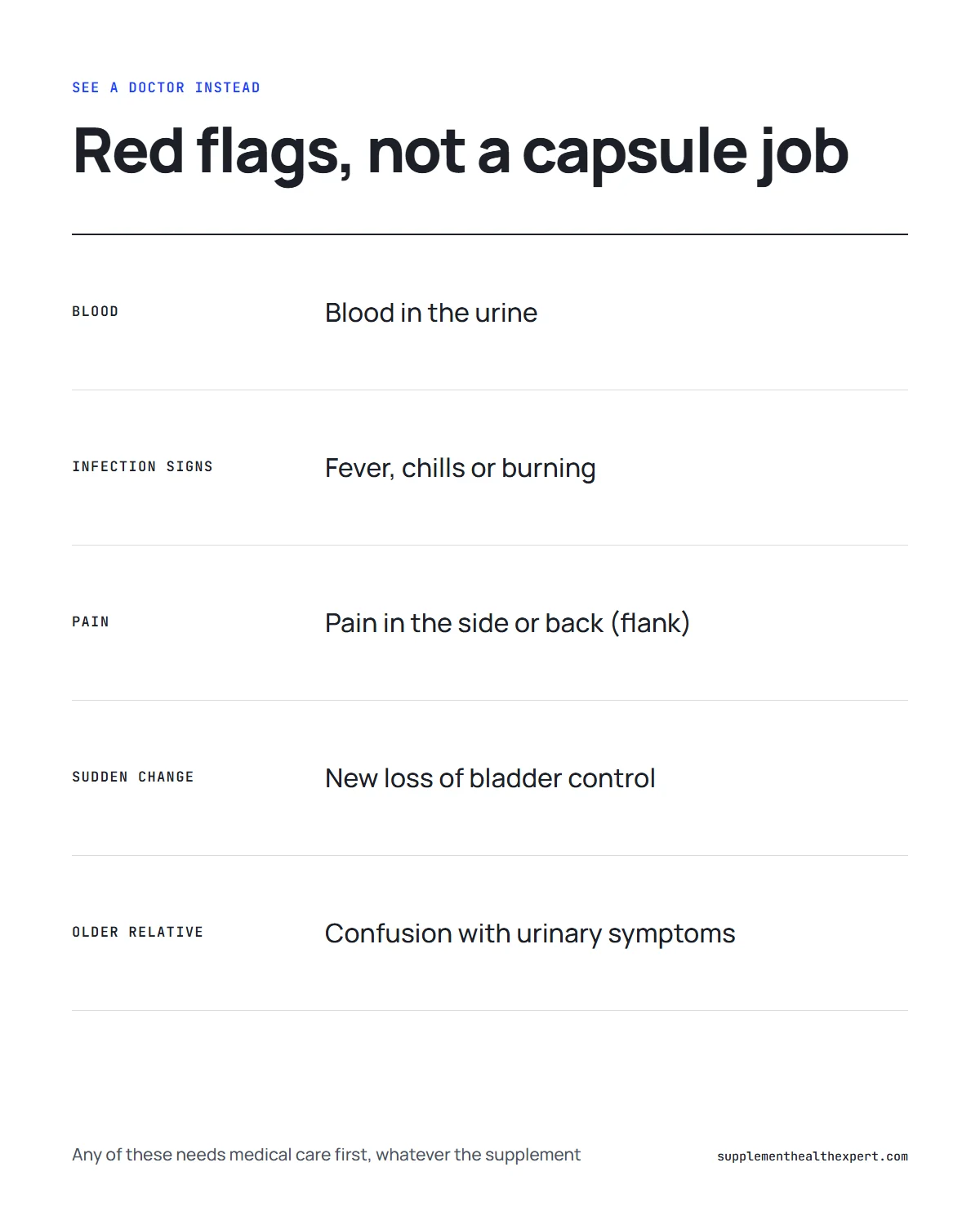
Once those have been ruled out and a doctor has described the problem as mild, the question of whether to try a supplement becomes a fair one.
Where FemiCore fits in a woman’s routine
If you are cleared to try it, the routine is light. One capsule goes down with a full glass of water in the morning. Each bottle holds a month’s supply of 30. The seller says the capsules contain no stimulants and are non-GMO, and the vendor’s own advice is to give it at least three months before judging.
The ingredients each have a different story, and it helps to know which ones carry the weight:
| Ingredient | What it is there for, in our reading | What the research says |
|---|---|---|
| Cranberry extract | Urinary tract support | Best human data, for women prone to repeat infections, not for leaks |
| Bearberry (uva ursi) | Traditional urinary herb | Limited, mixed; regulators advise short courses only |
| Berberine | Plant compound | Strong for blood sugar and cholesterol, not studied for the bladder |
| Mimosa pudica | Plant ingredient | Lab and animal reports only |
| Five Lactobacillus species | Microbiome balance | Effects depend on the strain; strains are not named |
The idea behind the probiotics comes from research since about 2012 showing the female bladder is not sterile, and a few studies saw lower Lactobacillus levels in women troubled by urgency incontinence. It is an interesting lead. Still, no study has shown that probiotics taken by mouth change how the bladder behaves. For the deeper ingredient-by-ingredient view, see our guide to who FemiCore is meant for.
Life stages and conditions that change the answer
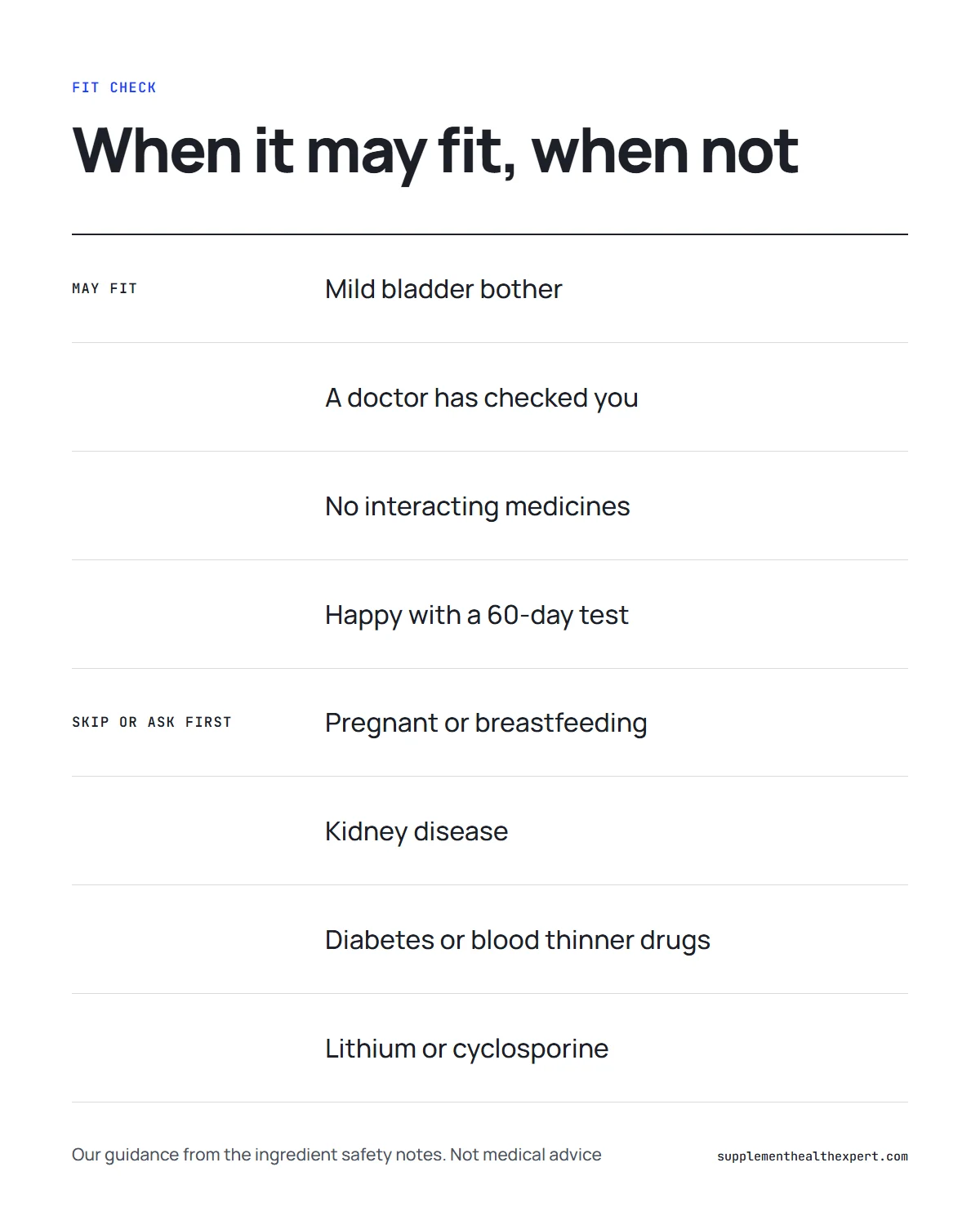
Because FemiCore is a fixed blend, you take all nine ingredients or none. That matters more for women than the label suggests, because two of the nine carry clear warnings.
| Your situation | The ingredient involved | Our guidance |
|---|---|---|
| Pregnant | Berberine, bearberry | Skip it |
| Breastfeeding | Berberine, bearberry | Skip it |
| Kidney disease | Bearberry; cranberry and oxalate | Skip it, or ask your kidney doctor |
| History of kidney stones | Cranberry (oxalate) | Ask first |
| Taking diabetes medicine | Berberine can lower blood sugar | Ask first |
| Taking warfarin | Cranberry, with case reports on INR | Ask first; INR checks may be needed |
| Taking lithium | Bearberry | Ask first |
| Taking cyclosporine or other drugs cleared by CYP3A4 or CYP2D6 | Berberine slows these enzymes | Ask first |
| Taking blood pressure medicine | Berberine may lower blood pressure | Ask first |
| Severely weakened immune system | Probiotics, rare infections | Ask first |
The seller’s own site agrees in its own wording, telling women who are expecting, nursing, taking medication or managing a health condition to talk with a physician. Our side effects article explains each interaction in more depth.
Questions to take to your appointment
A short visit goes further with a written list. These are the questions we would bring.
- What is most likely causing my symptoms? Is it stress leakage, urgency, an infection pattern or something else?
- Have infection, stones and other causes been ruled out? Do I need a urine test first?
- Does anything in this ingredient list clash with my medicines? Bring every prescription and supplement you take.
- Is berberine a problem for me? Especially if you take diabetes, blood pressure or transplant medicines.
- Is daily bearberry acceptable for my kidneys and for several months? European herbal regulators describe it for courses of about a week.
- Would pelvic floor training or another approach suit my type of problem better?
- Which changes should make me stop and call you?
- How would we judge whether it is helping? Agree on what you will track.
Planning a trial around the refund window
If your doctor sees no problem, plan the trial before the parcel arrives. The money-back guarantee lasts 60 days from the delivery date. To use it you email support with the subject line “Refund Request” and post back every bottle from the order, opened or sealed, plus the slip from the box and a note. You pay the return postage.
That window is shorter than the three months the vendor recommends. A practical approach:
- Week 0: write down your current symptoms, such as daytime trips, night-time waking and any leaks.
- Weeks 1 to 2: expect possible gas or bloating as the probiotics settle; stomach upset is also possible. Green-brown urine from bearberry is harmless.
- Weeks 3 to 8: keep the same short notes once a week.
- Around week 8: compare with week 0 and decide while a refund is still open.
Packages are $79 a bottle for two, $69 for three with free US shipping, or $49 for six with free US shipping and three bonus guides. A two or three bottle order matches a 60-day test more closely than six. Our October 2026 verdict covers what we rechecked on the offer this year.
How we score it for this reader
Our editorial score does not change by reader, but the parts that matter most do. For a woman weighing her own health, transparency (3 out of 10) is the category to look at hardest, because hidden doses make it impossible for a doctor to judge how much berberine or bearberry is in each capsule. Evidence (5 out of 10) tells you that no trial has tested this capsule for leaks or urgency. The guarantee (8) and ordering (8) tell you that a trial is easy to undo, and value (7) and ingredient selection (7) sit in between.
On the FDA question we stay neutral. FemiCore, like every supplement brand, follows the agency’s rules for dietary supplements, which differ from the approval route for medicines. The “FDA registered facility” seal on its site refers to the factory’s registration. More on the product as a whole is on our FemiCore hub.
The verdict for women weighing it in 2026
FemiCore is not a starting point. It is, at most, a second step for a woman whose symptoms are mild, explained and checked, whose medicines do not clash with berberine, bearberry or cranberry, and who is not pregnant, breastfeeding or living with kidney disease. For that reader it is a reasonable, refundable experiment with modest odds and a clear exit. For anyone with red-flag symptoms or interacting medicines, the right move is the doctor’s appointment, and the capsule can wait.
Frequently asked questions
Which parts of the FemiCore blend matter most during pregnancy or while nursing?
Berberine and bearberry. Our guidance is to avoid both during pregnancy and breastfeeding, and since they are inside a fixed blend you cannot leave them out. The seller also advises expectant and nursing mothers to consult a physician.
I have reduced kidney function. Is anything in the blend a concern?
Yes. Bearberry should be avoided with kidney disease, and cranberry is linked with oxalate and kidney stones. Raise both with your kidney doctor before ordering.
My urine looks green-brown since I started. Should I worry?
Bearberry can tint urine green-brown, and that change is harmless on its own. Blood in the urine is different and needs a doctor promptly.
Could the capsules affect my diabetes medicine?
Possibly. Berberine has a glucose-lowering action of its own, and stacked on top of diabetes drugs that could push levels too low. Do not start without asking the doctor who manages your diabetes.
What should I tell my doctor before I start?
Show them the full ingredient list, mention that the doses are not disclosed, and list every medicine and supplement you take. Ask whether your symptoms have been fully explained first.
How long should I try it before deciding?
The vendor suggests three months, yet the money-back period ends two months after the parcel arrives. Many women set the decision point at about eight weeks so a refund is still possible.
Can a bladder supplement stand in for a urologist visit?
No. A supplement cannot find the cause of a symptom. A doctor or urologist can rule out infection, stones and other problems, and can suggest options such as pelvic floor training.
Sources
femicore review 2026 women · femicore · women's bladder health · urinary health · supplement safety · questions for your doctor