Buying Guides / Guide
FemiCore Safety Warnings: A Stop-and-Ask-First Checklist Built From the Seller's Advice and the Ingredients
FemiCore safety warnings as a checklist: the seller's own caution, plus our ingredient-based stop-and-ask lists for pregnancy, kidneys, medicines and red flags.
- Author
- Supplement Health Expert Editorial Team
- Published
- Reading time
- 9 min
- Sources
- 2 cited
Key takeaways
- 01 The seller's own caution is short: speak to a physician if you are pregnant, nursing, taking medication or living with a medical condition.
- 02 Our ingredient-based list adds detail to that: berberine and bearberry are both poor choices in pregnancy and breastfeeding, and bearberry should be avoided with kidney disease and in children.
- 03 Diabetes medicines, blood pressure tablets, warfarin, lithium and drugs such as cyclosporine are the prescriptions most worth raising with a pharmacist first.
- 04 European herbal regulators describe bearberry as a short-course herb of about a week, while FemiCore is a daily capsule. Ask a doctor before using it for months.
- 05 Blood in the urine, fever or chills, flank pain, burning or a sudden change in bladder control need a doctor, not a supplement.
Most supplement pages bury their cautions in a footer. This one puts FemiCore safety warnings at the front, in the form a careful buyer can use: short “stop and ask first” lists you can tick through before the first capsule. We start with the warning the seller gives, then add our own cautions based on what is in the formula. The aim is not to scare you off. It is to make sure the right people talk to a doctor or pharmacist before they order, not after.
Our team works independently, and nobody from the FemiCore seller reviews this page. Its store buttons are affiliate links, which means an order through one can earn us a commission.

FemiCore safety warnings at a glance
FemiCore is a once-a-morning capsule for women, marketed for bladder control and urinary health. Inside are nine ingredients mixed as one proprietary blend. Four come from plants (Mimosa pudica, bearberry, also called uva ursi, cranberry extract and granular berberine) and five are Lactobacillus probiotics. Individual amounts are not disclosed, which shapes everything below.
| Warning | Where it comes from | What to do |
|---|---|---|
| Expecting, breastfeeding, on prescriptions or living with a condition | The seller’s own advice | Speak to a physician before starting |
| Pregnancy or breastfeeding | Our reading of berberine and bearberry | Do not start without your doctor’s agreement |
| Kidney disease or kidney stones | Our reading of bearberry and cranberry | Ask your kidney doctor first |
| Prescription medicines | Our reading of berberine, cranberry and bearberry | Show the label to a pharmacist |
| Continuous daily use | European guidance on bearberry | Ask whether months of use suit you |
| Blood, fever, flank pain, burning | Urinary red flags | See a doctor; skip the supplement |
Warning 1: what the seller itself says
The official site keeps its caution brief. It tells anyone expecting a baby, breastfeeding, on prescription drugs or living with a health condition to check with a physician. That covers a lot of adults. Read it as a real instruction rather than legal boilerplate, because it is the only safety line the seller offers and the label gives your doctor no doses to work from.
The directions matter too: a single capsule first thing in the day with a generous glass of water, 30 capsules to a bottle, so one bottle per month. There is no instruction to take more for a faster result, and nothing on the page suggests doubling up.
Warning 2: stop and ask first if any of these describe you
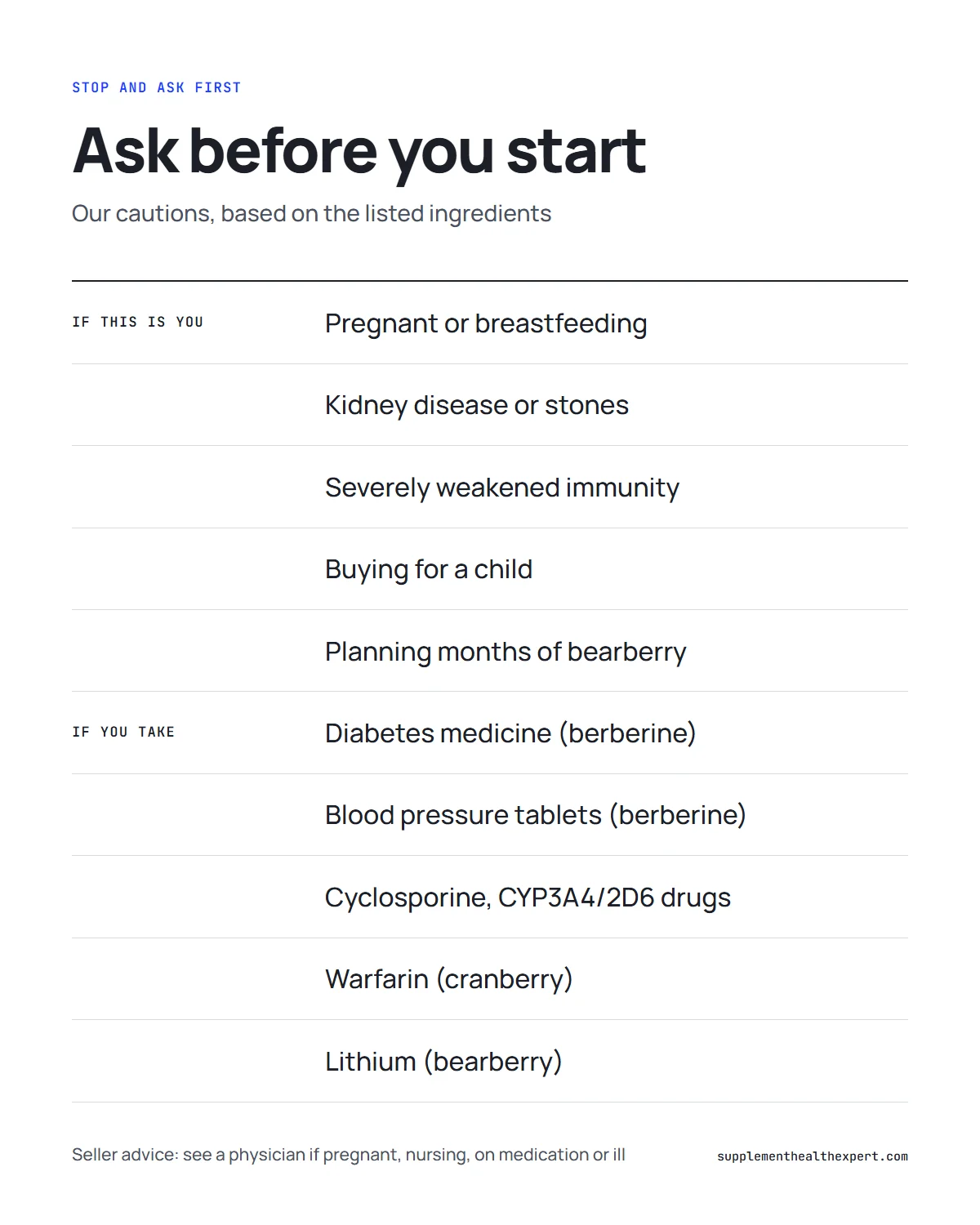
These are our cautions, built from published information on the individual ingredients. They are not printed by the seller.
- You are pregnant, trying to conceive or breastfeeding. Berberine is considered unsafe in pregnancy and while nursing, and bearberry should be avoided in both.
- You have kidney disease. Bearberry is one to avoid with kidney problems.
- You have a history of kidney stones. Cranberry contains oxalate, which is relevant for some stone formers.
- Your immune system is severely weakened. Probiotics have been linked to rare infections in severely immunocompromised people.
- You are buying for a child or teenager. Bearberry should be avoided in children, and the product is aimed at adult women.
If one line fits, the safe move is to pause and ask. It may well turn out to be fine for you, but that decision belongs with someone who knows your history.
Warning 3: medicines to raise with a pharmacist
Berberine carries the most interaction questions in this formula. Bring the ingredient list and your full medicine list, including anything you buy over the counter.
| If you take | Ingredient in question | The concern |
|---|---|---|
| Diabetes medicines | Berberine | Can bring blood sugar down, on top of what your tablets do |
| Blood pressure medicines | Berberine | May push pressure down further |
| Drugs cleared by CYP3A4 or CYP2D6, such as cyclosporine | Berberine | Can hold back these enzymes and let drug levels build up |
| Warfarin | Cranberry | Case reports of changes in INR; extra checks advised |
| Lithium | Bearberry | Known interaction to clear with your prescriber |
Your pharmacist can tell you which of your own medicines use the CYP3A4 or CYP2D6 route. That list is long, which is exactly why the conversation is worth five minutes.
Warning 4: bearberry is a short-course herb
This one is easy to miss. European herbal regulators describe bearberry for mild lower urinary complaints as something to use in short courses of roughly a week, not every day without a break. FemiCore is designed as a daily capsule, and the vendor suggests giving it at least three months.
We cannot tell how much bearberry each capsule holds, because the blend does not disclose it, and the arbutin content is not given either. So we cannot say whether the amount is small enough for the gap to matter. What we can say is that a daily herb with short-course guidance is a reasonable thing to ask your doctor about before you commit to several months, particularly if you have any kidney history.
Bearberry can also turn urine a green-brown shade. That on its own is harmless, but it helps to know in advance so it does not cause alarm.
Warning 5: red-flag urinary symptoms that belong in a doctor’s office
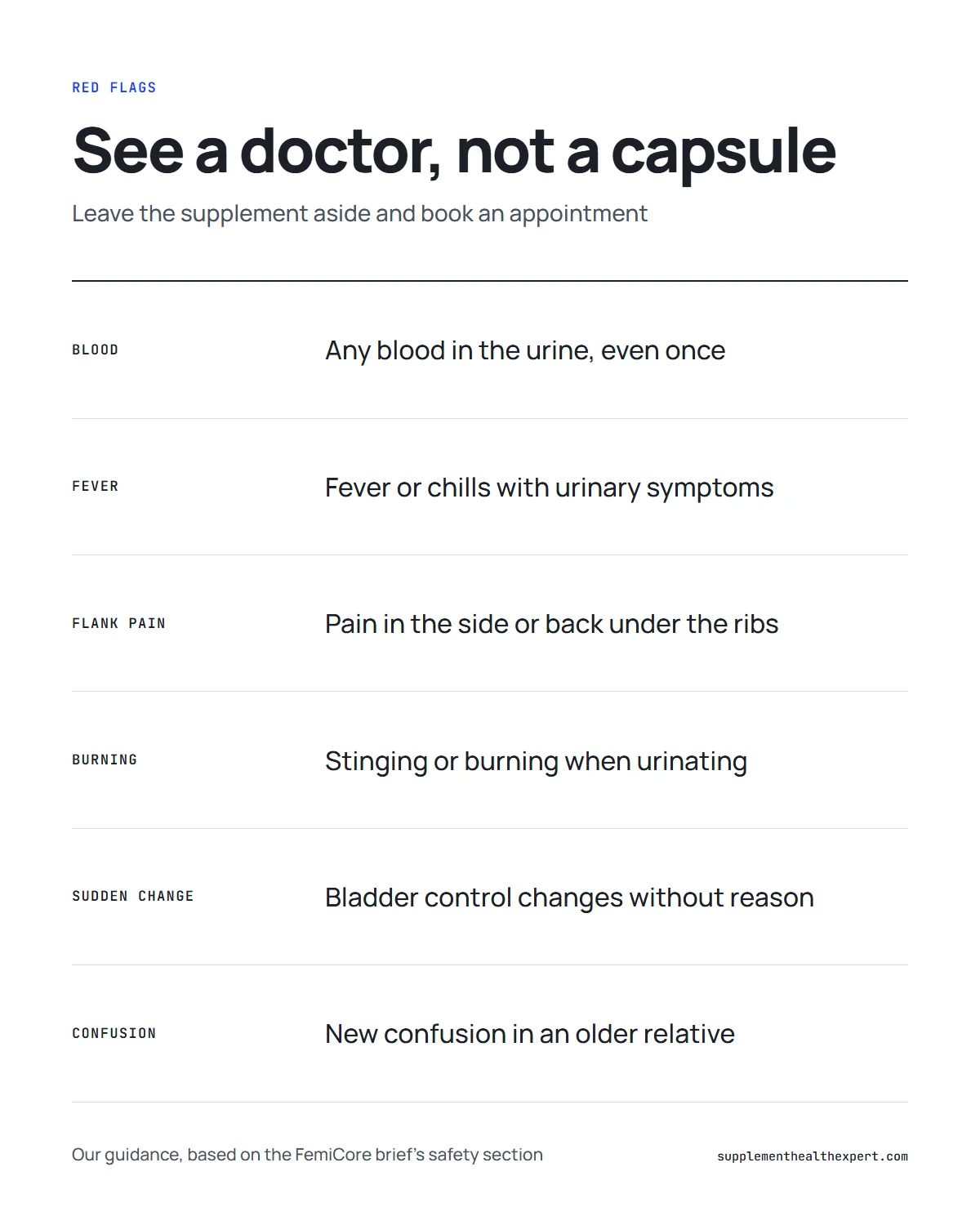
A bladder supplement is meant for everyday comfort and control. It is not a substitute for medical care when something new or acute is happening. Book an appointment, and leave the capsules aside, if you notice:
- Blood in your urine, even once.
- Fever or chills alongside urinary symptoms.
- Pain in your side or lower back under the ribs (flank pain).
- Burning or stinging while urinating.
- A sudden change in bladder control that you cannot explain.
- An older relative who seems newly confused while also having bladder or urine trouble.
These signs can point to problems a supplement is not designed for. Getting them checked quickly matters more than any capsule.
Milder effects worth watching, briefly
This page is not a full side-effect review; our ingredient-by-ingredient side effects guide does that job. In short, the probiotic part can bring wind or a bloated feeling during the first couple of weeks, some people get an unsettled stomach, berberine can cause digestive upset, and bearberry can cause nausea. A sensible rule: if an effect is mild and fading, give it a few days; if it is getting worse or worries you, stop and ask.
Why hidden doses widen the warnings
When a label lists exact amounts, a pharmacist can say “that is a small dose, you are fine” or “that is high, avoid it”. FemiCore’s blend does not allow that. There is no stated berberine dose, no bearberry or arbutin figure, no cranberry PAC content and no probiotic count. The cautious answer to an unknown dose is a broader warning, which is why our lists above lean towards “ask first” rather than “probably fine”.
On the seals: the official site shows a “Made in an FDA registered facility” badge. The badge refers to the plant and its registration with the agency. As with any supplement on sale in the US, FemiCore is governed by the dietary supplement framework, not by the drug approval route, so the badge tells you nothing about whether the capsules suit you.
A five-question check before your first capsule
Answer each honestly. A single “yes” means talk to a doctor or pharmacist before ordering.
- Am I pregnant, trying to conceive or breastfeeding?
- Do I have kidney disease, kidney stones or a weakened immune system?
- Do I take any prescription medicine, especially for diabetes, blood pressure, blood thinning, lithium or drugs such as cyclosporine?
- Do I have blood in my urine, fever, flank pain, burning or a sudden change in control right now?
- Am I planning to take a bearberry product every day for months without asking anyone?
If all five are “no”, the remaining question is whether the product is worth trying for your situation. Our fit guide on who the formula suits covers that, and our daily-use walkthrough explains the routine. The FemiCore catalog page collects the core facts in one place.
The bottom line on FemiCore safety warnings
The seller’s own caution is one sentence, and it is a good one: physician first if you are pregnant, nursing, medicated or managing a condition. Our ingredient reading turns that sentence into concrete lists, with berberine interactions, bearberry’s short-course guidance and the kidney cautions standing out. Hidden doses make all of these harder to judge, so the honest default is to ask.
None of this makes FemiCore unusually risky for a healthy adult who is not on interacting medicines. It does mean the warnings deserve two minutes of your attention before the first order, and a doctor’s attention if anything on the red-flag list shows up.
Frequently asked questions
What caution does the seller itself give?
Its one safety line tells expectant or nursing mothers, anyone on a prescription and anyone with an existing health condition to get a physician's view before starting. It does not list doses, so a doctor or pharmacist will be working from the ingredient names alone.
Which prescriptions are most worth checking with a pharmacist first?
Medicines for diabetes and blood pressure, because berberine can lower blood sugar and may lower blood pressure; drugs cleared through the CYP3A4 or CYP2D6 pathways, such as cyclosporine; warfarin, because of cranberry case reports; and lithium, because of bearberry.
How long is bearberry meant to be taken for?
European herbal regulators describe bearberry for mild lower urinary complaints in short courses of about a week, not continuous use. FemiCore is a daily capsule with an undisclosed bearberry amount, so ask your doctor before taking it for months.
Which bladder symptoms should send me to a doctor instead?
Any of these: red or pink urine, a temperature or shivers, an ache in the flank under the ribs, stinging on urination, or bladder control that shifts suddenly. For an older parent, fresh confusion together with urinary trouble also calls for a prompt medical visit.
Should I hold off if I have had kidney stones?
Talk to your doctor first. Cranberry contains oxalate, which matters for some people who form kidney stones, and bearberry should be avoided by anyone with kidney disease.
My urine has turned a green-brown colour. Is that a problem?
Bearberry can tint urine green-brown, and that change on its own is harmless. If the colour comes with pain, fever or blood, stop the capsules and see a doctor.
Does the 'FDA registered facility' seal mean the capsules were safety-checked by the FDA?
No. The badge tells you the production site is on the FDA's facility register. FemiCore, in common with all supplement makers, sits under the FDA's dietary supplement regulations, which do not involve the pre-market sign-off that medicines go through.
Can a teenager take it?
We would not give it to children or teenagers. Bearberry should be avoided in children, and the formula is marketed for adult women.
Sources
femicore safety warnings · femicore · bearberry · berberine interactions · supplement safety checklist · urinary red flags