Ingredients / Evidence C · Limited
FemiCore Ingredients List: All 9 Ingredients, What Each Does and What the Label Leaves Out
The FemiCore ingredients list in full: 4 botanicals and 5 Lactobacillus strains, why each is in a bladder formula, what studies show and what is not disclosed.
- Author
- Supplement Health Expert Editorial Team
- Published
- Reading time
- 9 min
- Sources
- 5 cited
Key takeaways
- 01 FemiCore contains nine ingredients: Mimosa Pudica, Bearberry (Uva Ursi) leaf, Cranberry Extract, Granular Berberine and five Lactobacillus strains (crispatus, acidophilus, plantarum, gasseri, casei).
- 02 All nine sit inside one proprietary blend. The label names them but does not give individual amounts, a probiotic CFU count or strain identifiers.
- 03 The two best-supported ingredients are L. crispatus and cranberry, both with trial evidence for urinary tract infection outcomes, not for leaks.
- 04 Berberine and bearberry carry the main cautions: berberine interacts with several medicines and bearberry is a short-course herb in European guidance.
- 05 We score ingredient selection 7/10 but transparency only 3/10, which keeps the overall evidence grade at C (Limited).
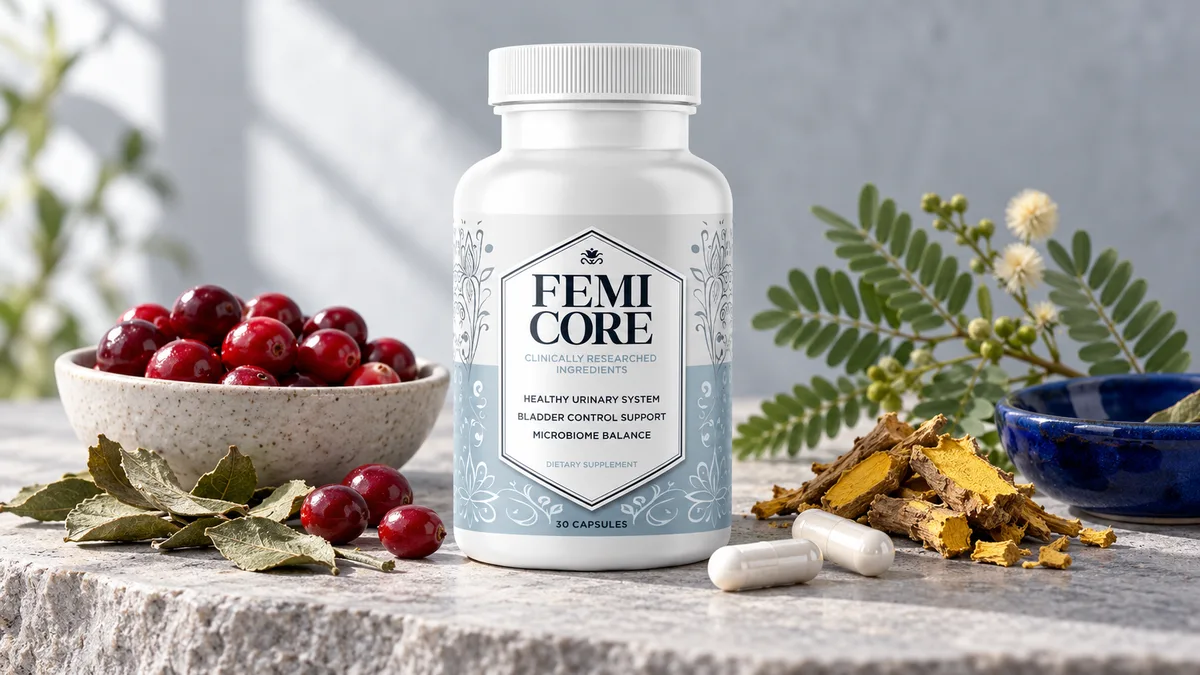
The FemiCore ingredients list is short to read and harder to judge. Nine names appear on the label: four plant ingredients and five strains of Lactobacillus bacteria. What does not appear is how much of each one the capsule contains. This guide goes through the list one ingredient at a time and answers three questions for each: what it is, why a bladder formula would include it, and what the human research actually says.
FemiCore is a once-daily capsule sold to women for bladder control and urinary health support. A bottle holds 30 capsules, the directions are one capsule each morning with water, and the manufacturer suggests giving it 60 to 90 days. We are not connected to the manufacturer. The buttons on this page are affiliate links, and the grades below would be the same without them.
The FemiCore ingredients list at a glance
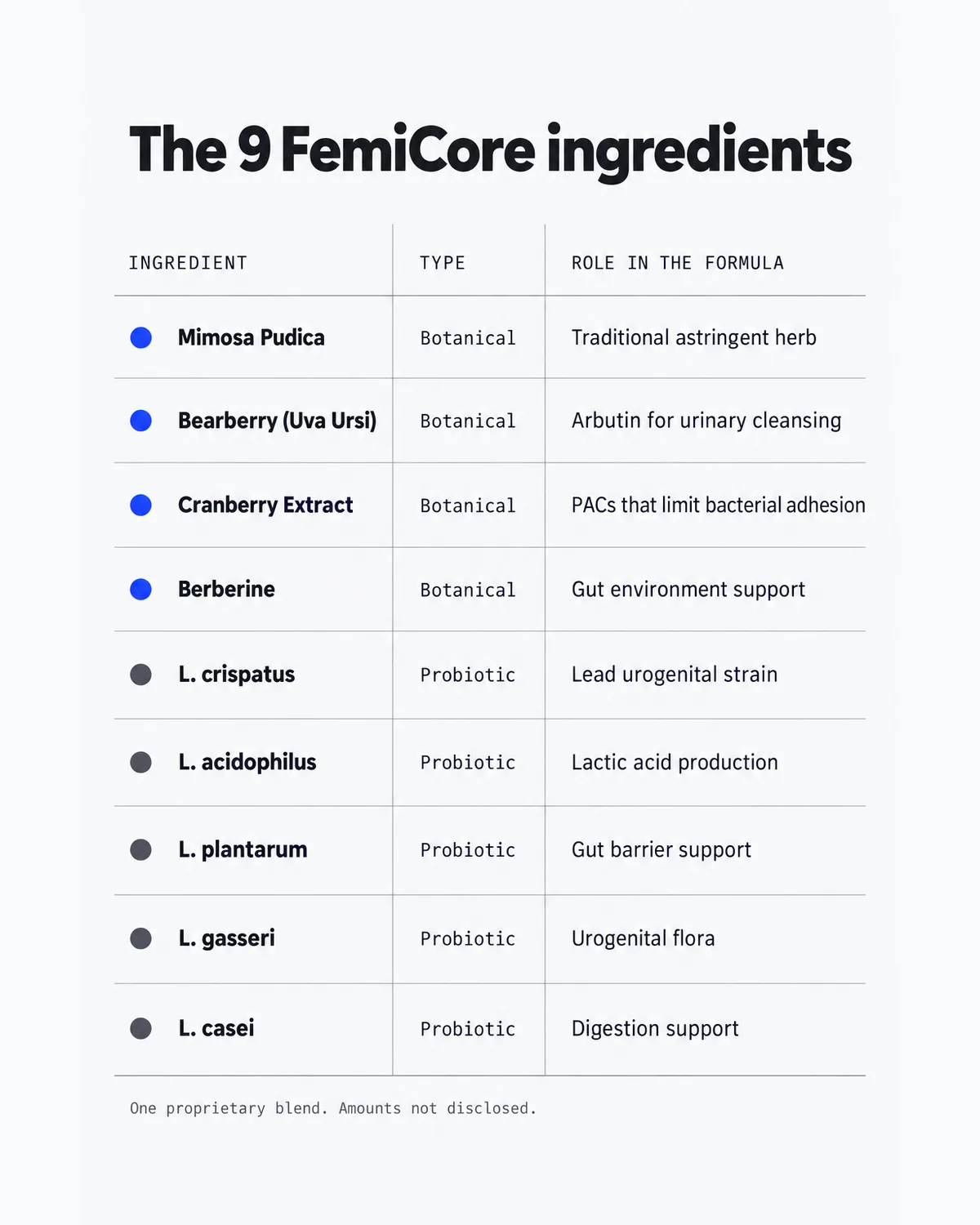
Here is the complete list, in the two groups the formula is built around. The “role” column describes why the ingredient is included in a urinary product, not a proven effect.
| # | Ingredient | Type | Role in the formula |
|---|---|---|---|
| 1 | Mimosa Pudica | Botanical | Traditional urinary herb, said to soothe the bladder lining |
| 2 | Bearberry (Uva Ursi) leaf | Botanical (leaf) | Traditional urinary antiseptic |
| 3 | Cranberry Extract | Botanical (fruit) | Helps stop bacteria sticking to the urinary tract wall |
| 4 | Granular Berberine | Plant compound | Aimed at the gut environment that feeds the urinary microbiome |
| 5 | Lactobacillus crispatus | Probiotic | The main Lactobacillus species in many healthy bladders |
| 6 | L. acidophilus | Probiotic | Lactic acid producer, gut and vaginal flora |
| 7 | L. plantarum | Probiotic | Gut lining and general digestive support |
| 8 | L. gasseri | Probiotic | Common in healthy vaginal flora |
| 9 | L. casei | Probiotic | Digestion and immune signalling |
Why a bladder formula pairs botanicals with probiotics
Most bladder supplements are either a cranberry product or a herbal blend. FemiCore is unusual in giving more than half its ingredient slots to probiotic bacteria, and that choice comes from a specific line of research.
For decades, healthy urine was assumed to be sterile. Work at Loyola University in Chicago changed that. Using DNA sequencing on urine taken directly from the bladder, researchers found a resident bacterial community in women without symptoms (Wolfe, 2012). A follow-up study then compared women with urgency incontinence against women without it and found that the symptom-free group more often had bladders dominated by Lactobacillus, especially L. crispatus (Pearce, 2014).
FemiCore’s logic is simple: supply Lactobacillus strains to encourage that pattern, and add traditional urinary botanicals to support the urinary tract while it happens. The idea is reasonable. The open question, which the ingredient sections below keep returning to, is whether a swallowed capsule at an unknown dose can do what the research describes.
The four botanicals
Mimosa Pudica
Often called the “sensitive plant” because its leaves fold when touched, mimosa pudica has a long history in Ayurvedic practice for digestive and urinary complaints. Laboratory and animal studies describe astringent and anti-inflammatory activity. We found no human trial of mimosa pudica for any bladder outcome, so its place here rests on traditional use and preclinical work. Our grade: D (Weak).
Bearberry (Uva Ursi) leaf
Bearberry leaf is one of the oldest herbal remedies for the urinary tract. It contains arbutin, which the body converts into hydroquinone, a compound with antibacterial activity in urine. That is the reason it appears in bladder formulas.
The modern evidence is thin. The ATAFUTI trial in UK general practice gave women with urinary infection symptoms either uva ursi extract or placebo and found no meaningful difference in how long symptoms lasted (Afshar, 2018). European herbal guidance also limits bearberry to short courses rather than continuous daily use, which sits awkwardly with a product meant to be taken for months. Our grade: C (Limited).
Cranberry Extract
Cranberry is the best-researched botanical on the list. Its proanthocyanidins (PACs) make it harder for E. coli to attach to the bladder wall. The 2023 Cochrane review, pooling 50 trials, concluded that cranberry products reduce the risk of symptomatic urinary tract infections in women with recurrent infections (Williams, 2023).
That evidence is about infection, not continence. Cranberry has not been shown to reduce leaks or urgency in women who do not have an infection. FemiCore also does not state its cranberry dose or PAC content, so it is impossible to say whether it matches the amounts used in the trials. Our grade: B for urinary tract infection prevention, D for leaks.
Granular Berberine
Berberine is a yellow alkaloid found in plants such as goldenseal and barberry. It has strong human evidence, but for blood sugar rather than the bladder: a randomised trial in people with type 2 diabetes found clear improvements in glucose control at 1,000 to 1,500 mg a day (Yin, 2008). In FemiCore it is there to support the gut environment, on the theory that the gut is the reservoir for bacteria that later reach the urinary tract. That link has not been tested.
Berberine is also the ingredient with the most practical cautions. It slows liver enzymes (CYP3A4, CYP2D6 and CYP2C9) that clear many medicines, can raise blood levels of drugs such as cyclosporine, and is not suitable during pregnancy or breastfeeding. Our FemiCore side effects guide covers those interactions in detail. Our grade: A for blood sugar, D for bladder.
The five Lactobacillus strains
Lactobacillus crispatus
This is the centrepiece of the probiotic half. L. crispatus is the dominant species in the vaginal microbiome of many healthy women and was linked to the symptom-free group in the Loyola bladder study.
The strongest clinical result comes from a phase 2 randomised trial in women with recurrent urinary tract infections. Women given an L. crispatus strain had fewer recurrences than those given placebo (Stapleton, 2011). Two details matter: the product was given intravaginally, not by mouth, and the outcome was infection, not leaks. FemiCore does not name the strain it uses, so we cannot tell whether it is the one tested. Our grade: B (Moderate).
L. acidophilus and L. gasseri
Both are lactic acid producers that help keep the vaginal environment slightly acidic, which discourages the overgrowth of unwanted bacteria. They are among the most common species in women’s probiotic products. Neither has been tested for bladder control. Our grade: C (Limited).
L. plantarum and L. casei
These two are mainly gut species. L. plantarum has research on the gut lining and digestive comfort, and L. casei is widely used in fermented dairy products and studied for digestion and immune signalling. Their role in FemiCore is supportive: a healthier gut is meant to be a better source of beneficial bacteria for the urogenital area. Our grade: C (Limited).
What the label tells you and what it does not
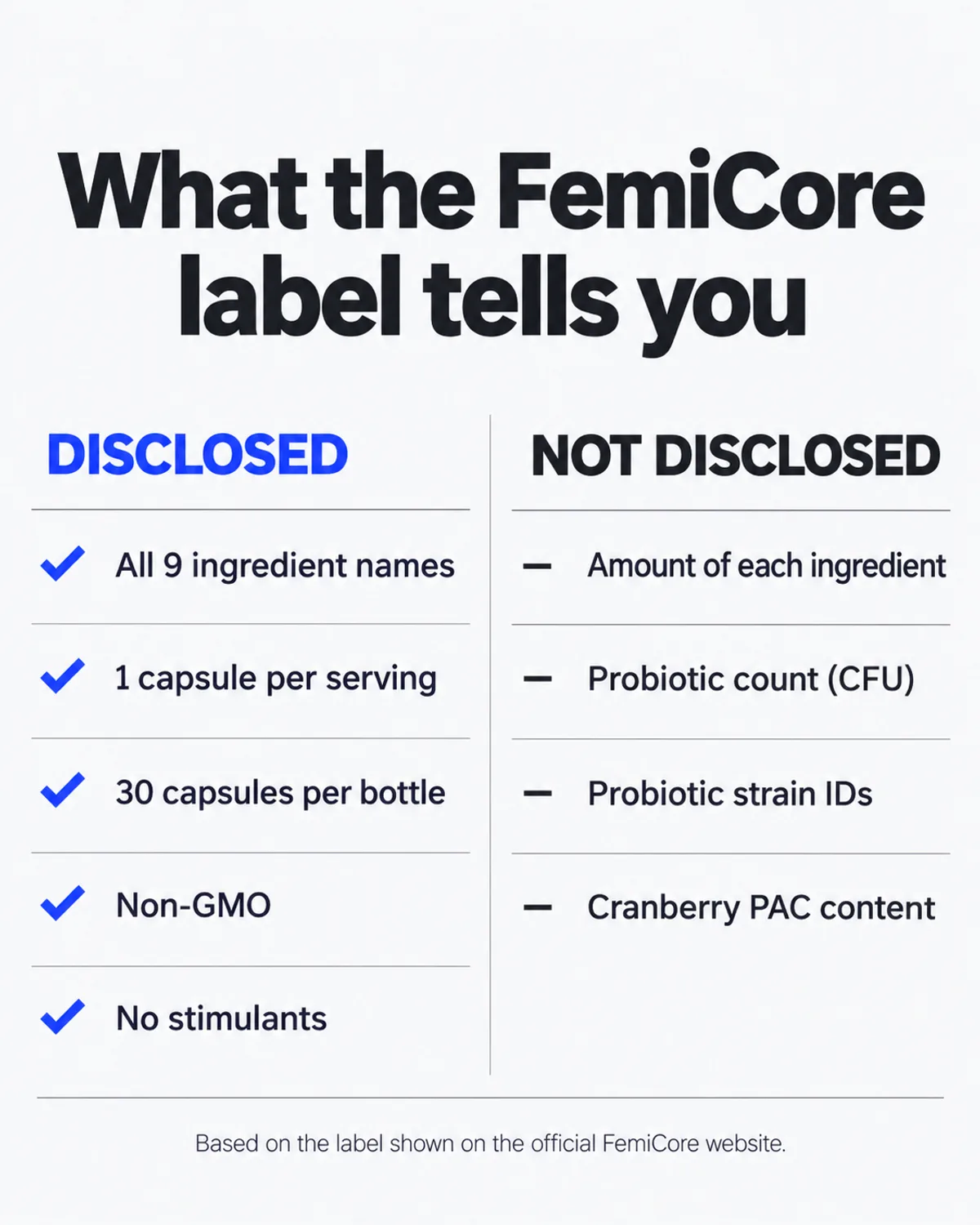
All nine ingredients are listed inside one proprietary blend. US labelling rules allow this, provided the ingredients are listed in descending order by weight and the total blend weight is given. Individual amounts can stay private.
| The label tells you | The label does not tell you |
|---|---|
| The name of every ingredient | How many milligrams of each botanical |
| That there is one capsule per serving | The probiotic count in CFU |
| 30 capsules per bottle | Which strain of each Lactobacillus species |
| The total weight of the blend | The PAC content of the cranberry |
| Non-GMO, no stimulants | How the probiotics are protected through stomach acid |
Each missing item has a practical cost. Without milligram amounts, you cannot compare the cranberry or berberine with the doses used in research. Without a CFU count, you cannot judge whether the probiotics are present in meaningful numbers. Without strain IDs, you cannot link the L. crispatus in the bottle to the strain in the trial.
What is not in the capsule
The manufacturer states that FemiCore is non-GMO and contains no stimulants. None of the nine ingredients is caffeine, a hormone or a laxative. The official website also displays certification seals, including “GMP Certified”, “Made in an FDA registered facility” and “Manufactured in USA with imported ingredients”; we have not verified them. The FDA does not approve dietary supplements before they go on sale, and FemiCore is not “FDA approved”.
How to use this ingredients list before you buy
Reading a list is only useful if it changes a decision. These are the checks worth making:
- Compare with what you already take. If you use a cranberry supplement, a separate probiotic or a berberine product for blood sugar, you would be doubling up. Ask whether you need both.
- Check your medicines. Show the list to a pharmacist if you take any regular prescription drug, especially anything for blood sugar, transplant medicines or blood thinners such as warfarin.
- Think about pregnancy and kidney health. Berberine and bearberry are the reasons FemiCore is not suitable in pregnancy or breastfeeding, and bearberry is best avoided with kidney disease.
- Match the ingredients to your symptoms. The microbiome rationale is aimed at urgency. Leaks when you cough or lift are stress incontinence, where pelvic floor training is the first-line approach.
For the full evidence discussion and how these ingredients add up to a product verdict, read our ingredient-graded FemiCore review.
Our take on the FemiCore ingredients
On ingredient choice alone, FemiCore is better thought out than many bladder products. L. crispatus and cranberry are the two ingredients a urinary researcher would expect to see, and both have trial evidence for urinary tract outcomes. The supporting probiotics are sensible companions. Mimosa pudica and the bladder role of berberine are the weak links.
| Area | Our score |
|---|---|
| Ingredient selection | 7/10 |
| Evidence strength | 5/10 |
| Transparency | 3/10 |
| Overall product score | 6.3/10 |
Transparency is what holds the list back. With amounts, a CFU count and named strains, this formula could be checked against the studies and might earn a higher grade. Without them, the honest rating is evidence grade C (Limited). If you want to see the current packages and per-bottle prices, our FemiCore sale guide lays them out, and our FemiCore product page summarises everything on one screen.
Frequently asked questions
What is on the FemiCore ingredients list?
Nine ingredients in a single proprietary blend: Mimosa Pudica, Bearberry (Uva Ursi) leaf, Cranberry Extract, Granular Berberine, Lactobacillus crispatus, L. acidophilus, L. plantarum, L. gasseri and L. casei. Four are botanicals and five are probiotic bacteria.
How much of each ingredient is in FemiCore?
The manufacturer does not say. All nine ingredients are listed under one proprietary blend, so only the total blend weight is shown. That means you cannot compare any single ingredient with the doses used in research.
How many CFU are in a FemiCore capsule?
The probiotic count in colony-forming units is not disclosed on the label or the official website. For a product that relies on live bacteria, this is the most useful number missing from the label.
Does FemiCore contain hormones or stimulants?
The manufacturer states FemiCore has no stimulants and is non-GMO. None of the nine listed ingredients is a hormone. The FDA does not approve supplements before sale, so FemiCore is not FDA approved.
Which FemiCore ingredient has the strongest evidence?
Lactobacillus crispatus and cranberry extract, both rated B on our scale for urinary tract infection research. Neither has been tested for bladder leaks, and the strongest L. crispatus trial used a vaginal product rather than an oral capsule.
Is any FemiCore ingredient a concern?
Berberine can interact with medicines processed by certain liver enzymes, including cyclosporine, and is not suitable in pregnancy or breastfeeding. Bearberry is recommended only for short courses in European herbal guidance. Anyone on regular medication should check with a pharmacist first.
Sources
- 01 Pearce MM, et al. The female urinary microbiome: a comparison of women with and without urgency urinary incontinence. mBio. 2014.
- 02 Stapleton AE, et al. Randomized, placebo-controlled phase 2 trial of a Lactobacillus crispatus probiotic given intravaginally for prevention of recurrent urinary tract infection. Clin Infect Dis. 2011.
- 03 Williams G, et al. Cranberries for preventing urinary tract infections. Cochrane Database Syst Rev. 2023.
- 04 Afshar K, et al. Uva-ursi extract and ibuprofen as alternative treatments for uncomplicated urinary tract infection in women (ATAFUTI). Br J Gen Pract. 2018.
- 05 Yin J, Xing H, Ye J. Efficacy of berberine in patients with type 2 diabetes mellitus. Metabolism. 2008.
femicore ingredients list · femicore · femicore ingredients · bladder supplement ingredients · lactobacillus crispatus · bearberry uva ursi · cranberry extract · proprietary blend