Ingredients / Guide
Finessa Ingredients: Every Label Line Explained, Blend by Blend
Finessa ingredients explained: the per-scoop facts, four blends with their totals, Akkermansia 2 mg, 5 billion CFU at manufacture and the other ingredients.
- Author
- Supplement Health Expert Editorial Team
- Updated
- Reading time
- 8 min
- Sources
- 0 cited
Key takeaways
- 01 Per scoop the label lists 10 calories, 3 g of total carbohydrate, 1 mcg of selenium, 40 mg of sodium and 10 mg of potassium.
- 02 Four blends make up the formula: polyphenol (1,000 mg), gut health (755 mg), liver health (450 mg) and probiotic (52.5 mg), plus Akkermansia muciniphila AH39 at 2 mg.
- 03 The probiotic blend is labeled 5 billion CFU at manufacture.
- 04 Each blend prints one total, so no amount is given for the items inside it.
- 05 Ask your doctor before you start and keep taking prescribed medicines.
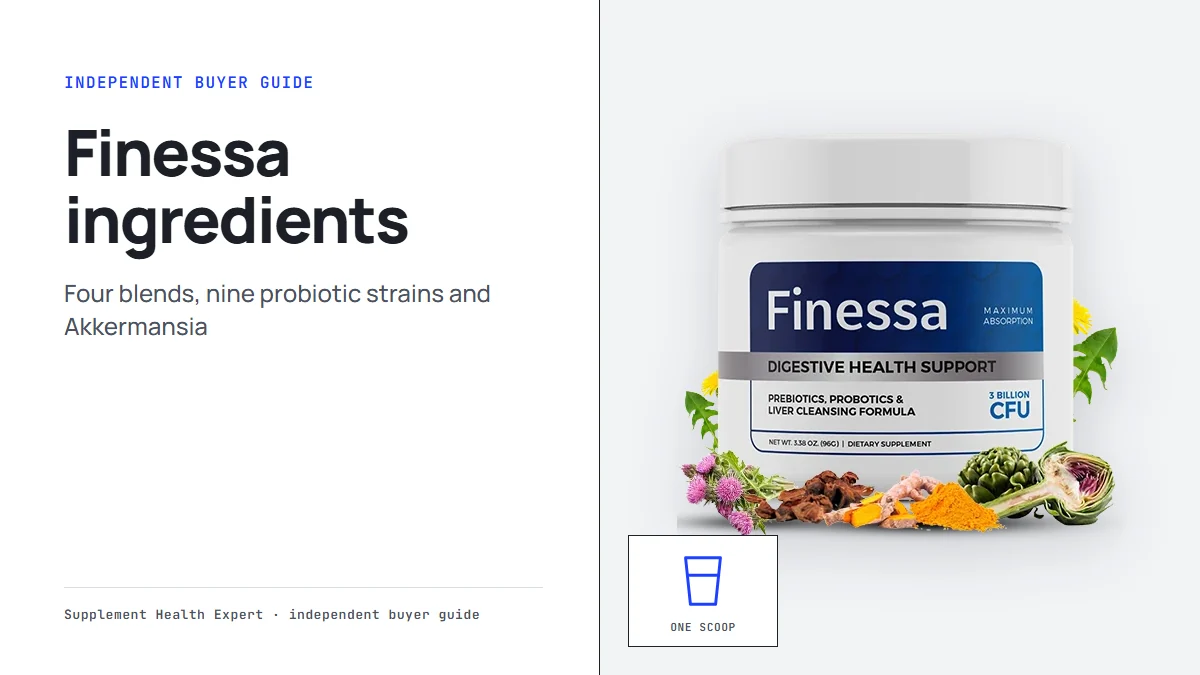
A morning scoop deserves a label you can read with confidence, and the Finessa hub is a handy companion while you do. The Finessa ingredients list is longer than a typical one-line formula, so this guide takes it blend by blend and says, in plain words, what each item is. The seller says it is designed to support smooth digestion, regularity and a healthy gut balance, and we credit every aim to the seller while keeping our own wording close to the label.
Finessa Ingredients at a Glance
The heading on the bottle reads “Digestive Health Support: prebiotics, probiotics & liver cleansing formula, 5 billion CFU”. One scoop, stirred into water or a favorite drink in the morning, is the serving.
The nutrition lines come first. A scoop counts 10 calories and 3 g of total carbohydrate, with three small mineral lines: selenium at 1 mcg, sodium at 40 mg and potassium at 10 mg.
Then come the blends, each printed with one total:
| Blend or ingredient | Printed total |
|---|---|
| Polyphenol blend | 1,000 mg |
| Gut health blend | 755 mg |
| Liver health blend | 450 mg |
| Probiotic blend | 52.5 mg |
| Akkermansia muciniphila AH39 | 2 mg |
We skip daily-value percentages and any sums of our own. The printed numbers are the cleanest basis for comparing this bottle with another.
The Polyphenol Blend: 1,000 mg
The label prints one 1,000 mg total for this blend. Polyphenols are a broad family of plant substances, and nine colorful fruits and vegetables are named in it.
| Item | What it is |
|---|---|
| Beet root | The crimson root of the beet plant |
| Black currant | A glossy, tart, near-black berry |
| Pomegranate | A round fruit packed with ruby seeds |
| Raspberry | A soft red berry |
| Strawberry juice | Pressed juice from strawberries |
| Cranberry | A sharp, bright red berry |
| Blueberry | A small round blue berry |
| Purple carrot | A carrot grown with purple skin |
| Acai berry | A dark purple berry from the acai palm |
The Gut Health Blend: 755 mg
This blend carries a 755 mg total across five items.
| Item | What it is |
|---|---|
| Cinnamon (cassia) bark | A warm spice cut from tree bark |
| Ginger root | The knobbly spice root used in cooking and teas |
| Cascara sagrada bark extract 10:1 | An extract of a bark from traditional herbal practice; “10:1” tells you how concentrated the extract is |
| Deglycyrrhizinated licorice (DGL) root extract | Licorice root extract from which one substance, glycyrrhizin, has been taken out |
| Fructooligosaccharides (FOS) | A prebiotic fiber |
Because cascara sagrada is a traditional bark, it is the one item that comes with a safety note. Our side effects guide covers it calmly and in full.
The Liver Health Blend: 450 mg
The third blend prints a 450 mg total and names five items.
| Item | What it is |
|---|---|
| Dandelion root | The taproot of the familiar dandelion plant |
| Turmeric root | The orange-gold root that gives the spice its color |
| Milk thistle | A prickly flowering plant |
| Artichoke extract (Cynara scolymus, std. to 5% cynarin) | Extract from the artichoke plant, set to the stated cynarin level |
| Silymarin 80% | A family of plant substances from milk thistle, shown at 80% |
That is the extent of what the label says, so that is where we stop. The seller’s aim belongs to the formula as a whole, and no single item here is credited with a result.
The Probiotic Blend: 5 Billion CFU at Manufacture
The probiotic blend prints 52.5 mg in total. CFU stands for colony-forming units, a count of live organisms, and the label gives the figure at manufacture: 5 billion. It names nine strains:
- L. casei
- L. acidophilus
- L. rhamnosus
- Clostridium butyricum
- Streptococcus thermophilus
- Bacillus coagulans BC99
- Lactobacillus acidophilus LA85
- Bifidobacterium lactis BLa80
- Lactobacillus reuteri LR08
Strain names combine a genus, a species and sometimes a code such as BC99 or LA85, which identifies the particular strain.
Akkermansia muciniphila AH39: 2 mg
This one earns its own line on the panel. Akkermansia muciniphila is a bacterium, and AH39 is the strain code. The label lists it at 2 mg, apart from the probiotic blend.
The Other Ingredients
Below the panel come the supporting ingredients that shape the taste, texture and feel of the powder:
- Resistant dextrin is a fiber made from starch.
- Natural flavors are listed as the flavoring.
- Citric acid adds a little tartness and balances acidity.
- Sea salt is a mineral seasoning.
- Stevia leaf extract is a plant-based sweetener.
- Silicon dioxide keeps a powder loose and easy to scoop.
Anyone who avoids certain sweeteners or has reacted to a food before should read this list slowly and show it to a doctor.
Why Each Blend Has One Total
The panel prints a total for every blend and no split between the items inside. That is how blends are written on labels, so nobody outside the seller can say how much of each item is in a scoop. We would rather say so than invent numbers. If exact amounts matter for a medical reason, sit down with your doctor or pharmacist and go through the label together.
What the Seller Is Aiming For
The seller designed the formula as a whole to support smooth digestion, regularity and gut balance, and names liver and colon health, energy and a lighter-feeling belly among its aims. It labels the idea the “gut-liver axis”. Those are aims, stated by the seller, and they are not promises about any single ingredient. Individual results differ, and daily meals and habits matter as much as any scoop.
Why a Powder Format
A scoop suits a morning routine. There is one measured amount, one glass and about a minute of effort. Because every bottle is sold as a 30-day supply, the calendar does the counting for you: one bottle is roughly a month, and six bottles make a half-year plan that the 180-day guarantee matches.
A Short Glossary for the Label
- mg and mcg: milligrams and micrograms. A microgram is one thousandth of a milligram, so the 1 mcg of selenium is a very small amount.
- CFU: colony-forming units, a count of live organisms.
- Strain code: letters and numbers such as BC99 or LR08 that name one particular strain within a species.
- Extract 10:1: a way of describing how concentrated an extract is compared with the plant material it came from.
- Std. (standardized): the extract is set to a stated level of one marker, such as 5% cynarin.
- Prebiotic fiber: a fiber, here FOS, that sits in the gut blend. Resistant dextrin, in the other ingredients, is a second fiber on the label.
Questions to Bring to Your Doctor
A printed panel makes a short appointment more useful. Photograph the bottle or copy the table above, add your current medicines and ask whether Finessa fits your situation. Two good openers are “Does anything on this label matter for the medicines I take?” and “Is a daily morning drink a good idea for me?” Your doctor knows your history, and a minute with the label in hand usually settles it.
Reading Any Label Like a Pro
When you compare Finessa with another bottle, line up the same four things. Is the serving size stated? Are the named nutrients shown with amounts? Does each blend print a total? Are the supporting ingredients listed in full? Finessa answers yes to all four. Our ingredients page keeps the label beside the price, and the Finessa hub gathers the rest.
Taking It
The directions are brief: a single scoop, mixed into water or a drink you enjoy, every morning. The seller advises checking with your physician before use, as for any supplement. Stay on whatever your doctor has prescribed, and bring the label along if you have questions.
Our Take
The panel is detailed and readable, with one limit worth knowing: each blend shows a single total. Still, the nutrition lines are printed, every blend is named and the supporting list is complete. We score Finessa 9.0/10 on our own editorial scale. If you want the buyer’s verdict next, our review has it.
Frequently asked questions
What are the Finessa ingredients?
Four blends and one named bacterium. The polyphenol blend (1,000 mg), gut health blend (755 mg), liver health blend (450 mg) and probiotic blend (52.5 mg) are joined by Akkermansia muciniphila AH39 at 2 mg.
What is in the probiotic blend?
Nine named strains: L. casei, L. acidophilus, L. rhamnosus, Clostridium butyricum, Streptococcus thermophilus, Bacillus coagulans BC99, Lactobacillus acidophilus LA85, Bifidobacterium lactis BLa80 and Lactobacillus reuteri LR08. The blend is labeled 5 billion CFU at manufacture.
What does the label list per scoop?
10 calories, 3 g of total carbohydrate, 1 mcg of selenium, 40 mg of sodium and 10 mg of potassium.
Does the label say how much of each ingredient is inside a blend?
No. Each blend prints a single total, such as 755 mg for the gut health blend, and the individual items are listed without separate amounts.
What are the other ingredients?
Resistant dextrin, natural flavors, citric acid, sea salt, stevia leaf extract and silicon dioxide.
What is Finessa designed to do?
The seller says the formula as a whole is designed to support smooth digestion, regularity and a healthy gut balance. Individual results differ.
finessa ingredients · finessa label · finessa supplement facts · finessa probiotic blend · finessa polyphenol blend · finessa liver health blend · finessa gut health blend · finessa akkermansia