Buying Guides / Guide
The Genius Song Reviews: Where to Find Honest Buyer Feedback and How to Spot a Copied Review Page
The Genius Song reviews are full of recycled sales-video stories. Where real buyer feedback turns up, five checks for any review page, and copy red flags.
- Author
- Supplement Health Expert Editorial Team
- Published
- Reading time
- 9 min
- Sources
- 5 cited
Key takeaways
- 01 Most review pages for this product recycle the seller's sales video: the same named letters, the same customer count and the same promises, usually next to a buy button.
- 02 Five quick checks sort useful pages from copied ones: a clear disclosure, citations of the seller's own documents, correct refund facts, honesty about the video stories, and a source for any star rating.
- 03 Correct facts to test pages against: $39 once, digital delivery described two ways, a bonus list that changes between pages, a 90-day refund through ClickBank, and a presenter whose name the site calls a pen name.
- 04 The seller says it sells only through its own website, so 'reviews' on Amazon, Spotify or app stores cannot be about this product.
Search for The Genius Song reviews and a pattern shows up fast: page after page with the same names, the same “eureka” promises, the same star scores and a big order button at the bottom. This guide is not one more verdict on the track. It is a field guide for readers: where real buyer feedback can turn up, how to test any review page in a few minutes, and the signs that a page lifted its “reviews” straight from the seller’s sales video.
Fair warning, since this guide is about disclosure: we are an independent site, the seller has no say over what we publish, and our buttons are affiliate links. A purchase through one of them may earn us a commission. Hold this page to the same five checks you will read below.
Why genius song reviews are hard to judge
Three things make this product tricky to research.
One source feeds everything. The 39-minute sales video contains three named letters (Rachel, Michael and Hannah), a run of results the presenter credits to unnamed colleagues, and a question section full of first names and cities. Most pages you find simply retell these.
The seller’s own fine print undercuts the stories. Its Terms say marketing names “have been changed”, that feedback may be acted out by “digital representations, avatars, or actors”, that some testimonial givers are “early supporters, friends, or family members of the company’s founders”, that contributors were “compensated”, and that testimonials “are exceptional results”. A section headed “For Entertainment Purposes Only” adds: “brain entrainment is not an exact science and we recommend that you do not treat it as such. The products are provided for entertainment purposes only.”
The results are hard to measure. The promises (insight, luck, money, memory, relationships) are things a listener cannot easily attribute to a seven-minute track. Even the presenter concedes, about a casino win, that “there is, of course, no evidence to support that the genius song caused that.”
Five checks for any review page
Run any page through these five questions before you trust a word of it.
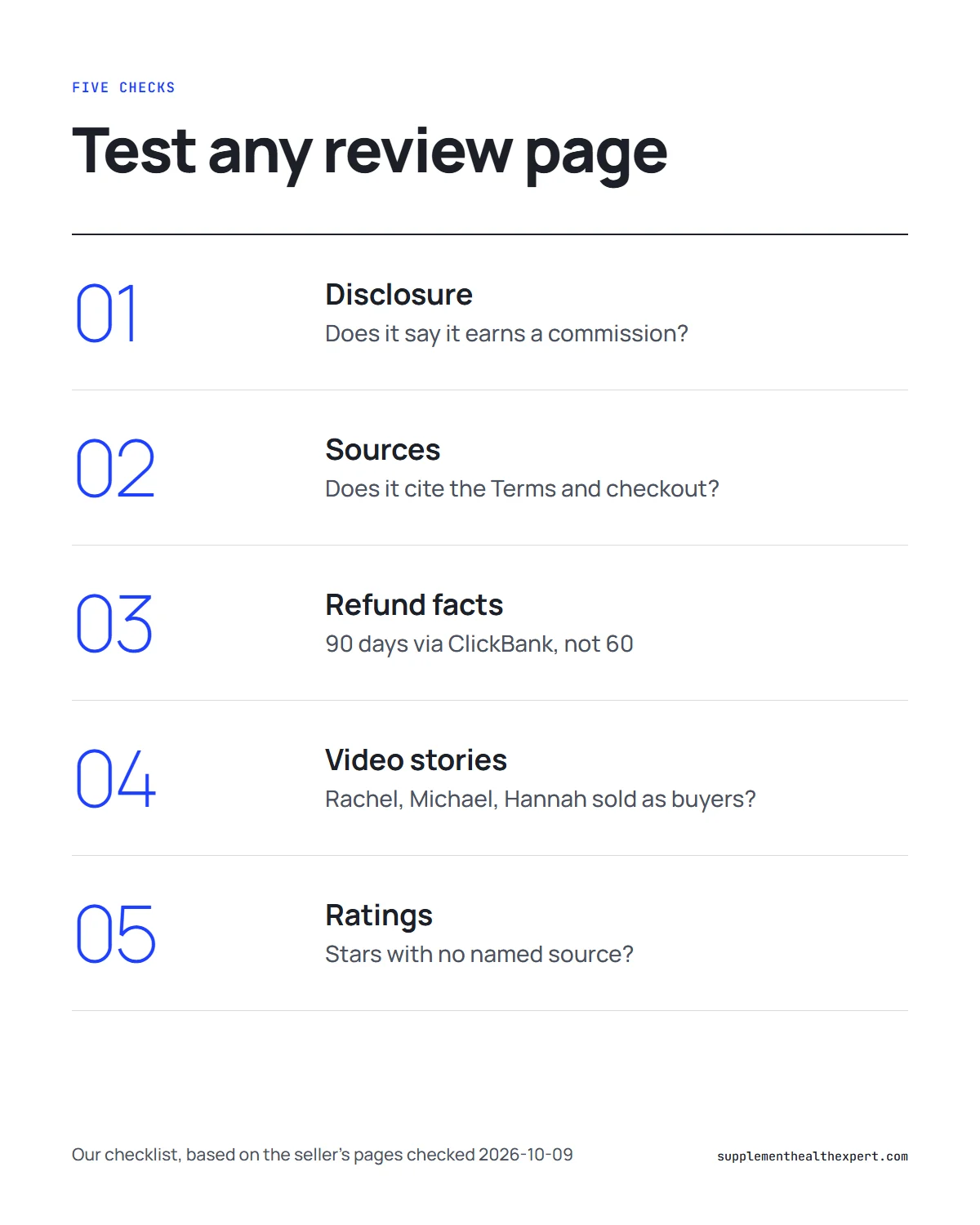
1. Does it disclose how it makes money?
Nearly every page about this product is paid per sale through ClickBank, including ours. That is normal, but it should be stated near the top, in plain words. A page that hides it, or calls itself “official” while being a third party, fails at once.
2. Does it cite the seller’s own documents?
An honest page points to the Terms of Service, the checkout and the sales page, and quotes them. If a page never mentions the entertainment-only section or the testimonial disclaimer, the writer probably never read them.
3. Are its refund facts right?
The Terms allow refunds on digital purchases asked for within 90 days, and ClickBank’s checkout states the same limit. The site also hosts a stray refund page for NeuroActivate bottles (60 days, unopened bottles, an Ohio return address). A page quoting that 60-day policy has copied the wrong document.
4. Does it pass off video stories as customer reviews?
Rachel the nurse from Tustin, Michael in Dallas and Hannah from Manhattan are characters in an advertisement, under names the Terms say may be changed. So are the colleagues with the finished book, the vanished migraines and the Trader Joe’s engagement, and the FAQ voices such as Olivia in Tampa or Russell in Atlanta. Any page calling them “verified buyers” is recycling sales copy.
5. Where do the stars come from?
The video speaks of “thousands of five star reviews” without naming a platform. If a page shows a star rating, it should say who rated, where and how many. Our own editorial score is labelled as ours, and the reasoning sits in our full Genius Song review.
These checks echo US rules. The FTC’s 2024 final rule on fake reviews and testimonials targets reviews by people who do not exist or never used the product, reviews that misstate someone’s experience, and insider reviews that hide a material connection.
Red flags of copied reviews
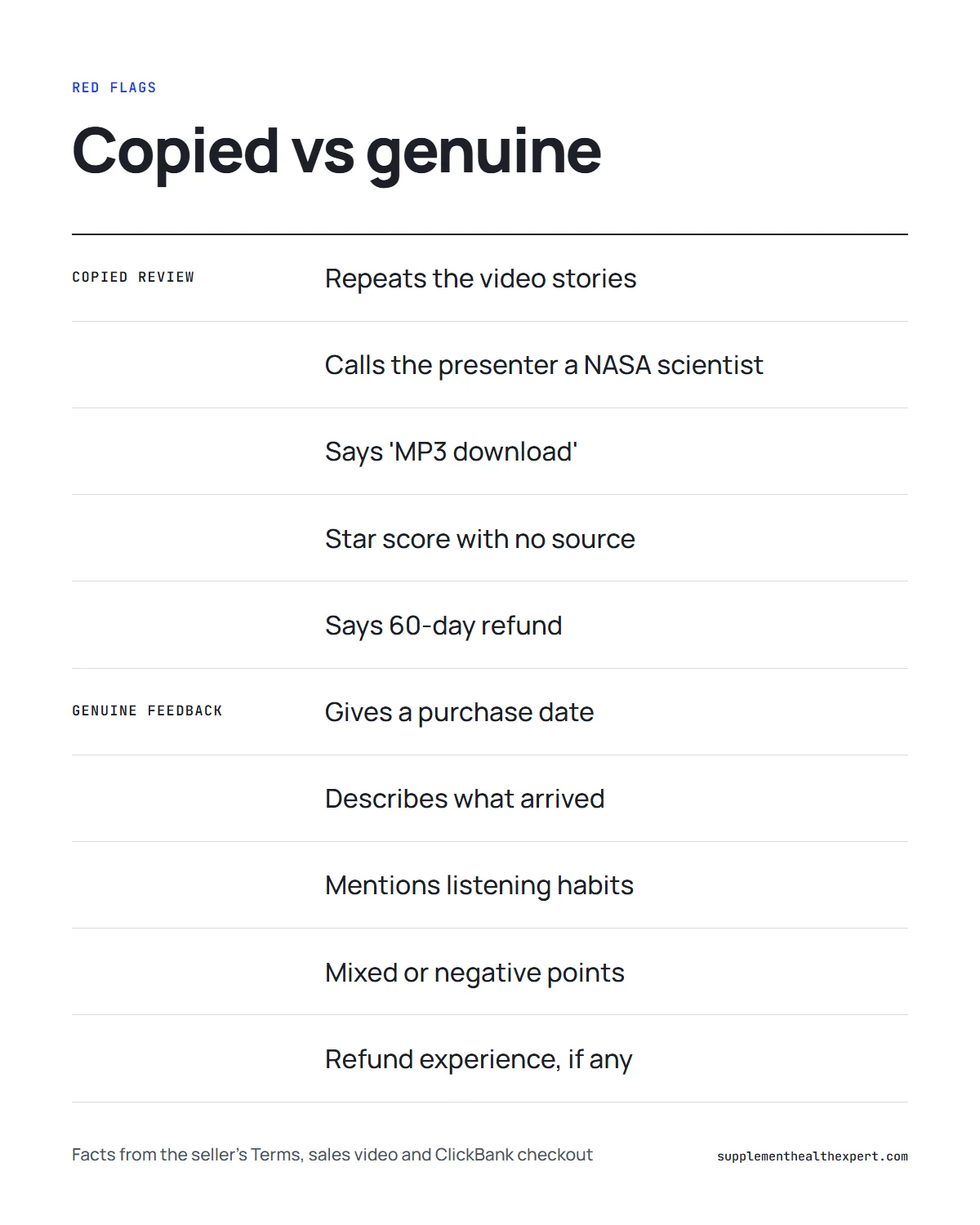
Watch for these tells:
- Credentials stated as fact. The NASA and neuroscientist labels come from sales copy, and the footer disclaimer says the name Robert Lake is a pen name.
- “MP3 download” claims. The seller never states a file format.
- Platform confusion. Mentions of an app, a game, or a Spotify or Amazon listing. The video insists the seller’s website is the one place to buy it.
- A fixed bonus count. The video promises three bonuses and describes four; the /text/ page promises four and lists three. A careful page notes the mismatch.
- Seller numbers repeated as proof. “18,366 Americans helped” or “19,389 Americans” are the seller’s own figures, and they contradict each other.
- Copied urgency. Lines such as “price not guaranteed beyond today” belong to the sales script, not to a review.
- Two products blended. The same seller also sells The Genius Wave, pitched as a 12-minute theta audio. Pages that treat the two as one product have not looked closely.
A fact sheet to test pages against
Use this table to spot-check any page. One or two errors can be honest slips; several usually mean copying.
| Topic | What the seller’s documents show | Typical error on weak pages |
|---|---|---|
| Price | $39 one-time; local currency and tax at checkout | “$49” or “$200 value” stated as the real price |
| What it is | One audio track, about 7 minutes per the seller | An app, a program or a playlist |
| Delivery | Digital; video describes email, /text/ page a portal login | “Instant MP3 download” |
| Bonuses | Up to four, and the list varies by page | A fixed list presented as certain |
| Refund | 90 days via the Terms and ClickBank | 60 days, unopened bottles |
| Presenter | Pen name, per the site’s disclaimer | “Top NASA neuroscientist” |
| Evidence | No study of this track | “Clinically proven” |
Where genuine buyer feedback can turn up
Because the seller sells only through its own site, there is no marketplace listing with open ratings. Genuine accounts are more likely to appear on open discussion forums, in comment threads where critical posts are left standing, or from people you know who have bought it. When you find one, look for specifics:
- a rough purchase date and the country they bought from;
- what arrived: a download link, a portal login, or both;
- how long the track actually runs and what it sounds like;
- how often they listened, and for how many weeks;
- what changed and what did not, in ordinary terms;
- whether they asked ClickBank for a refund, and how it went.
Give extra weight to mixed and negative accounts, and to anyone describing the refund process. Praise is easy to fake; a detailed complaint rarely is.
Writing your own review: a 90-day test
If you would rather judge it yourself, the guarantee makes a fair trial possible.
- Save the paperwork. Keep the ClickBank receipt email with the order number. The charge should read CLKBANK*Genius Song.
- Set a reminder. Put a date well inside the 90-day window in your calendar.
- Listen safely. Our own rules for this kind of audio: low, comfortable volume; never while driving or working with machinery; and if epilepsy, seizures or hearing problems are part of your history, speak to a doctor before the first session.
- Keep simple notes. Date, minutes listened, sleep, mood and anything you notice. Notes beat memory when you decide.
- Decide and act. If it did nothing for you, request a refund through ClickBank (online at clkbank.com, by phone on 1-800-390-6035), not through the stray bottle refund page. A card dispute is the last resort; the FTC explains how it works.
- Mind your inbox. Buying adds you to the seller’s marketing lists, which may promote unrelated offers. Every email carries an unsubscribe link.
What the evidence can and cannot tell a reviewer
A personal review can describe an experience. It cannot prove what caused it. On the research side, gamma rhythms (about 30 to 100 Hz) are real and studied; long-term meditators showed strong gamma activity in a 2004 PNAS paper; and MIT’s 40 Hz light and sound experiments have been run mainly in mice used to study Alzheimer’s, with small early human work. Pooled analyses of binaural beats, such as a 2019 meta-analysis, describe effects that are inconsistent and small. Nobody has published a study of this particular track, and it is not a treatment for any condition. A reviewer who says “it changed my life” is describing a feeling, not a tested effect.
Where the offer lives, and what the link opens
Every button on this page goes through ClickBank to the seller’s domain. Know this before you click: at the moment, the landing page there advertises The Genius Wave, a different audio the seller also markets, and The Genius Song’s own presentation is found on the /video/ page of that site. Confirm that the order form names The Genius Song before you pay. Our quick guide puts the core facts on one page.
Bottom line
Most genius song reviews are advertising wearing a reviewer’s coat. Test pages with the five checks, compare their facts with the table above, and look for detailed, mixed accounts from real buyers. If you want to see where the recycled stories originate, our breakdown of the sales video’s testimonials walks through each one. And if you try it yourself, the 90-day ClickBank refund means your own notes can be the review that counts.
Frequently asked questions
Are there ratings for The Genius Song on Amazon, Spotify or an app store?
There should not be. The seller says in its video that it offers the track only through its own website, and we found no app, game or streaming version. A rating on one of those platforms is about something else.
How can I tell a page copied its testimonials from the sales video?
Look for the names Rachel from Tustin, Michael in Dallas or Hannah from Manhattan, the colleague who met her fiance at Trader Joe's, or the figure 18,366. All of these come from the sales video. A page that presents them as its own readers or as verified buyers is repeating advertising.
Why do so many pages show four or five stars for it?
Most of those pages earn a commission on sales, and many do not say where their stars come from. A star score with no named source, date or sample size tells you nothing. Our own pages use an editorial score that is labelled as ours and explained on our methodology page.
What did the FTC change about fake testimonials in 2024?
The US Federal Trade Commission's final rule on fake reviews and testimonials, announced in August 2024, reaches reviews by people who do not exist or had no real experience with the product, reviews that misstate someone's experience, and insider reviews that hide a material connection, and it allows civil penalties for knowing violations.
What does a genuine buyer report usually include?
Specifics: roughly when they ordered, what the confirmation email contained, whether they got a download or a portal login, how long the track actually ran, how often they listened, what did or did not change, and, if they asked for a refund, how that went.
Which refund period should an honest page mention?
Ninety days. The seller's Terms set that limit for digital purchases and ClickBank's checkout shows the same. A page quoting 60 days or talking about unopened bottles has copied the site's leftover NeuroActivate refund page, which does not fit a digital track.
Should I trust a page that calls the presenter a NASA scientist?
Be careful with it. The NASA and neuroscientist labels come from the sales material, and the site's own footer says the name Robert Lake is a pen name. A page that states those credentials as fact has not read the seller's disclaimer.
Sources
- 01 Federal Trade Commission. Final rule banning fake reviews and testimonials (August 2024).
- 02 FTC. Using credit cards and disputing charges.
- 03 ClickBank order support.
- 04 Garcia-Argibay M, et al. Efficacy of binaural auditory beats in cognition, anxiety, and pain perception: a meta-analysis. Psychol Res 2019.
- 05 Lutz A, et al. Long-term meditators self-induce high-amplitude gamma synchrony during mental practice. PNAS 2004.
genius song reviews · the genius song · fake reviews · clickbank refund · how to read reviews