Supplement Reviews / Guide
The Genius Song Reviews: The Sales Video's Stories, the Seller's Fine Print and What We Could Verify
The genius song reviews examined: Rachel, Michael, Hannah and the other sales video stories, what the seller's Terms admit, and what we could verify.
- Author
- Supplement Health Expert Editorial Team
- Published
- Reading time
- 10 min
- Sources
- 4 cited
Key takeaways
- 01 Almost every Genius Song story you will find online starts in the seller's own 39-minute sales video: three named letters, a set of colleague anecdotes and a list of first names in the question section.
- 02 The seller's Terms say names in its marketing are changed, feedback may be acted out by avatars or actors, some people were compensated or are close to the founders, and the results are exceptional rather than typical.
- 03 The same Terms call the products 'for entertainment purposes only', and the presenter uses the pen name Dr. Robert Lake, according to the site's own disclaimer.
- 04 We confirmed the $39 price, the digital delivery and the 90-day refund route through ClickBank. We could not confirm any person, any customer count or any result.
Type the genius song reviews into a search box and most of what comes back retells a small set of stories from one place: the seller’s own sales video. We watched it in full with its timestamps and laid its stories next to the seller’s Terms of Service, checkout and refund pages. Below: who appears in those stories, what each is said to have experienced, what the fine print says, and which facts held up.
First, who is writing this. Our site is independent and separate from the seller, and this page is our own. The buttons below are affiliate links: if you order through one, we may earn a commission. That arrangement does not change our findings, and anything we were unable to check is marked as such.
Where the genius song reviews come from
The sales video runs 39 minutes and 23 seconds (the order button only appears after about 18). In it the presenter tells three kinds of story: letters he says listeners sent him, results he says his colleagues had while testing the track, and a series of listener questions he answers near the end. The seller’s /text/ page repeats most of it.
This is why so many pages look alike. When five websites quote “Rachel, a nurse from Tustin”, you are reading one advertisement five times over. No independent party gathered these stories, no reader can answer them, and the seller chose which ones made the script.
Rachel, Michael and Hannah: the three named letters
Three listeners are named in the video, each with a city.
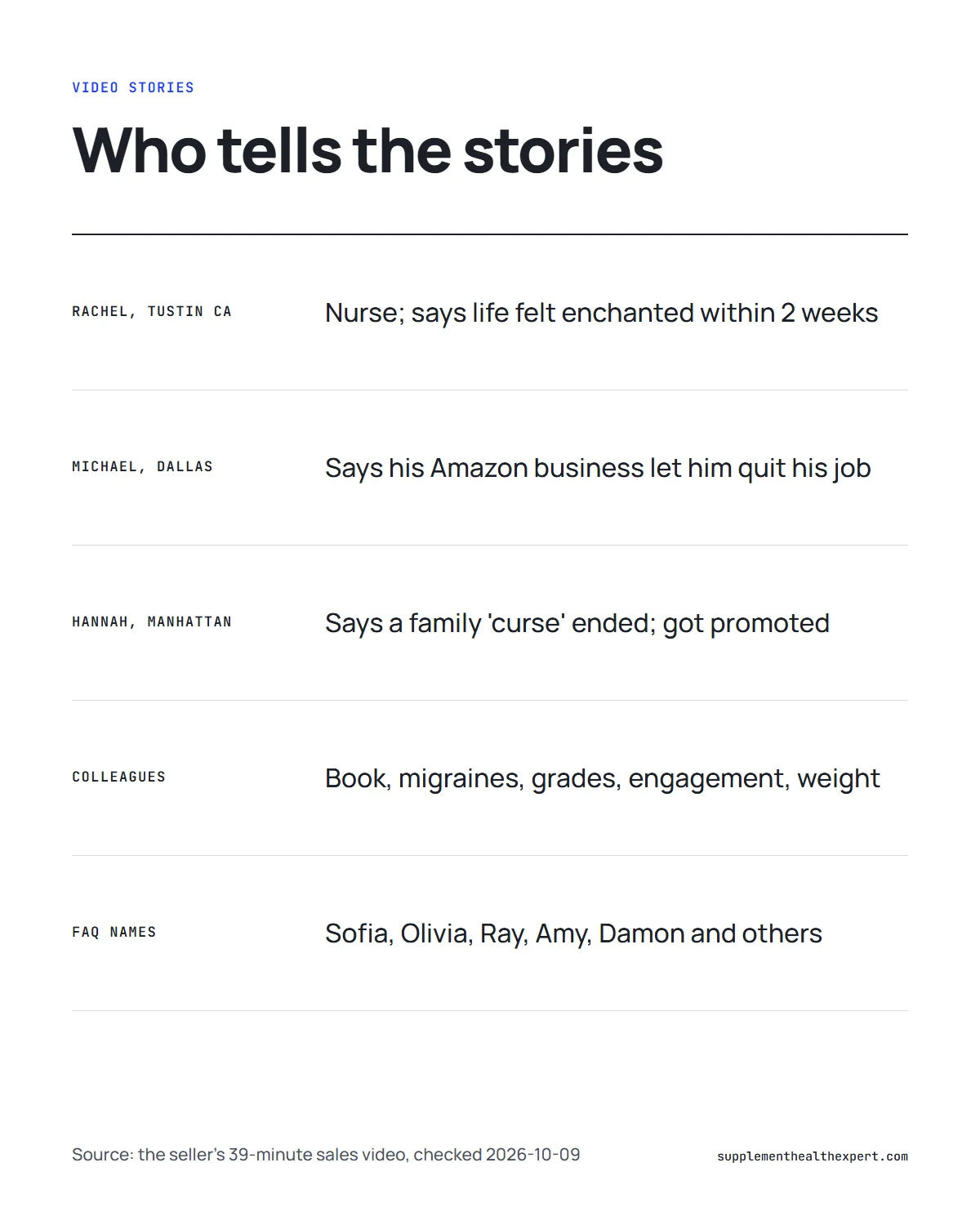
| Name used in the video | Around | What the story says |
|---|---|---|
| Rachel, a nurse from Tustin, California | 12:21 | Felt “at the mercy of events” for years; within two weeks became “a new woman”, kinder to her family and learning French; ends with “Five stars” |
| Michael in Dallas | 13:18 to 14:09 | Wanted it for “the financial aspect”; his wife said he seemed sharper; his Amazon business grew until he quit his job; his children stopped fighting bedtime |
| Hannah from Manhattan | 14:12 | Family thought it had bad luck; her marriage improved, an idea in a team meeting grew her company, then a promotion; the family “curse” ended |
Rachel’s letter ends with “Five stars”, the only rating anywhere in the video, spoken as part of the letter rather than shown on any review platform. Michael’s story is read out in full before his name is given. None of the three comes with a surname, a date or a way to reach them, and under the seller’s own rules, covered below, the names may not be real names anyway.
The colleague anecdotes from early testing
Earlier, from about 09:23 to 10:17, the presenter describes what he says happened when his colleagues listened daily for “a few short weeks”:
- one colleague finally finished a book that had sat half-written on his computer for three years;
- another said his persistent migraines “had just disappeared”, and that his son’s test results rose from a C to an A;
- a divorced colleague bumped carts with a man at Trader Joe’s, and he is now her fiancé;
- another colleague lost sixteen pounds “from his belly”;
- another quit smoking after eleven years, while his wife, who also listened, won a promotion that came with a signing bonus.
These are the presenter’s own reports about people he does not name, with no measurement shown. Three touch health topics, yet the seller’s small print says the product “is not intended to diagnose, treat, cure, or prevent any disease”. We read them as storytelling.
The first names in the question section
Toward the end, the presenter answers questions credited to first names and places: Sofia (spelt Sophia in another spot) in Lakeway, Olivia in Tampa, Ray in Victoria, Amy in Las Vegas, Damon in Raleigh, Brian in Boston, Liz in Frankfurt, Sean, and Russell in Atlanta. It is staged like a mailbag, but the questions belong to the same script, and nothing about the people asking can be checked. If a third-party site quotes Damon from Raleigh or Liz from Frankfurt as a buyer, you now know the source.
What the Terms admit about the stories
The seller’s Terms of Service, last updated on 20 January 2026, say a lot about the people in its marketing.
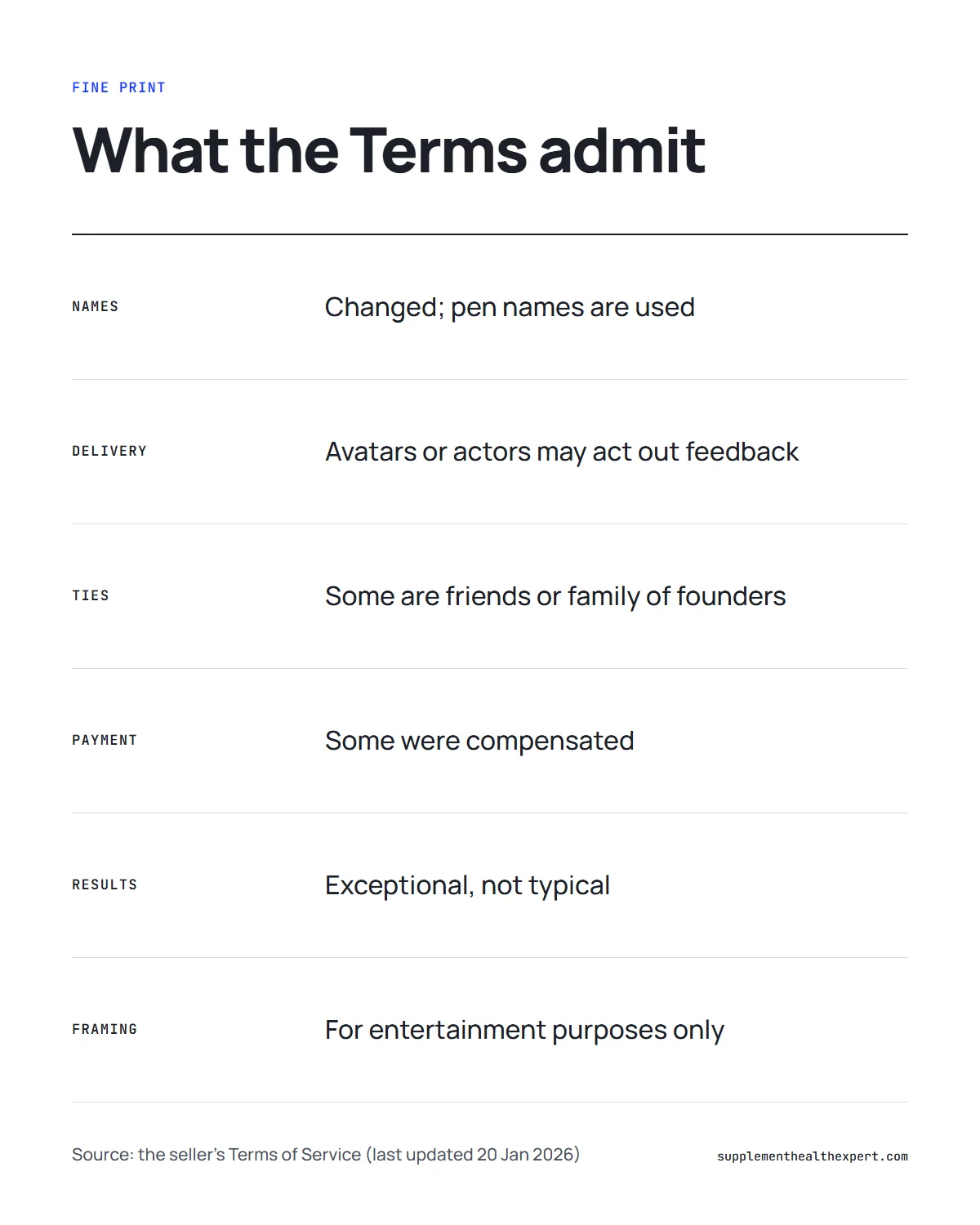
Put plainly, the Terms say:
- The names are changed. “Names of people mentioned in our marketing material have been changed to protect the privacy of those involved. We use pen names for this purpose.” Rachel, Michael and Hannah may be stand-in names.
- Parts are dramatized. The very next sentence reads: “Some aspects of the marketing have been dramatized for entertainment effect.”
- Someone else may speak the words. The seller may use “digital representations, avatars, or actors” to “act out” what users told it.
- Money and relationships are involved. One paragraph says the people whose accounts are highlighted were “compensated”. Another says some testimonial givers “may be early supporters, friends, or family members of the company’s founders”, which the seller discloses as a material connection.
- The outcomes are not typical. Testimonials “are exceptional results and may not reflect the experience of a typical customer”, and readers are told: “do not take these results at face value.”
Two lines in that document point in opposite directions. The Terms say “All accounts come from real people” and that the substance of the results is genuine. They also contain a section called “For Entertainment Purposes Only”, which says: “brain entrainment is not an exact science and we recommend that you do not treat it as such. The products are provided for entertainment purposes only.” We have no way to test the “real people” line or any outcome. What we can say is this: a product its own seller labels as entertainment should not be judged by testimonials the same seller calls exceptional.
US regulators care about this too: the Federal Trade Commission’s 2024 final rule targets testimonials that misstate who gave them or what the person experienced, and insider testimonials that hide a material connection. We are not claiming the seller breaks that rule, only that its disclosures exist for a reason.
The numbers wrapped around the stories
The stories come framed by big numbers.
| Seller figure | Where it appears | Our note |
|---|---|---|
| 18,366 “everyday Americans” helped | Video at 10:27, and the /text/ page body | Unverified |
| 19,389 Americans | Headline of the /text/ page | Contradicts the 18,366 figure |
| “Thousands of five star reviews” | Video at 20:07 | No platform named |
| “Hundreds of emails like this” | Video at 14:56 | None shown |
We treat all four as marketing figures, not data.
Who is telling the stories
Every letter and anecdote reaches you through one narrator, introduced as Dr. Robert Lake. The seller itself admits that is not his real name; its footer disclaimer reads: “Robert Lake is a pen name used with the consent of our leading neuroscientist”. On camera he speaks of a New York practice and a long career in neuroscience; the written pitch adds the label “NASA-Trained”. All of that is sales copy. With the real name withheld, we had no person, licence or clinic to look up.
About a listener’s luck at a casino, he says: “there is, of course, no evidence to support that the genius song caused that.” That caveat fits every other story too.
What we were able to verify
Here is what the seller’s pages and checkout confirm:
- The product. The Genius Song is a digital audio track. The seller says it lasts about 7 minutes and is meant to be played on headphones, eyes closed, once a day. We did not buy it, so the length is the seller’s statement.
- The price. $39, both in the Terms of Sale and in the order box, which also shows “regular” prices of $200, $100 and $49. Outside the US, ClickBank shows the total in local money, with tax added where it applies.
- The delivery. Digital only. The video talks of the track arriving by email for download, while the /text/ page promises a login to a “Private Audio Portal”. We could not tell which one buyers get, or whether it is both, and no file format is named.
- The bonuses. Up to four digital extras are on offer, but the seller’s pages disagree on which. The video says “three” yet names four: The Genius Child (an audio for kids), a classic money book over a century old, a guided visualization by a creator popular on the Calm app, and a 5-habits infographic. On the /text/ page the count is four, but only three appear.
- The refund. The Terms give buyers of digital goods 90 days to ask for their money back, matching the window on ClickBank’s checkout page.
- The channel. There is no app or game version and no listing on Spotify, YouTube or Amazon; the video says it is sold only on the seller’s own site.
Out of reach for us: who the narrator really is, who any person in the stories is, either customer count, the five-star reviews, any study of the track, or any result described.
What research says about the idea behind the stories
Many of the stories rest on the claim that the track “activates gamma”. Fast brain oscillations in the 30 to 100 Hz band, called gamma, do exist and are well documented. MIT researchers in the Tsai lab have tested 40 Hz light and sound stimulation, mostly in mouse models of Alzheimer’s disease with small early human studies; that work says nothing about luck, income or promotions. Long-term meditators have been recorded producing high-amplitude gamma activity (Lutz and colleagues, PNAS, 2004). Reviews of binaural beats and auditory entrainment, including a 2023 systematic review in PLOS ONE, describe the results as mixed and the studies as small. We found no published study of The Genius Song itself, and it is not a treatment for migraines, smoking, weight or any other condition.
Refunds and safe listening
Two practical notes. First, the site’s /TOS/refunds/ page does not belong to this product. It is a leftover policy for NeuroActivate bottles, with 60 days for unopened bottles and an address in Ohio. For a digital track, rely on the 90 days in the Terms and ask for the refund through ClickBank (clkbank.com, or the 1-800-390-6035 number shown at checkout). Keep the receipt email; the charge should appear as CLKBANK*Genius Song.
Second, a few precautions of our own: turn the sound down to a level that feels easy on the ears, skip it entirely behind the wheel or near machinery, and check with a doctor beforehand if you have had seizures, live with epilepsy or have any hearing trouble. The NIDCD explains how loud sound harms hearing over time.
Where to check the offer yourself
All the buttons on this page lead to the seller’s site through ClickBank. Expect a surprise when it opens: right now the home page promotes a sister audio from the same seller, The Genius Wave, and the Genius Song pitch lives on that site’s /video/ page instead. They are sold as separate products (Genius Wave is pitched as a 12-minute theta audio, Genius Song as a 7-minute gamma track). For a one-screen summary of the key facts, see our quick guide.
Our reading of the stories
The stories are vivid, which is why they persuade. They are also unsigned and unchecked, and by the seller’s own Terms they may be renamed, dramatized, acted, paid for or told by people close to the founders. For our full assessment of the product, with the price, the evidence and our editorial score, read our Genius Song review. Our scoring method explains how every product on this site is rated.
If you try it, judge it on your own listening, write down the order date and claim your money back inside 90 days if nothing changes.
Related reading
Frequently asked questions
Is Rachel, the nurse from Tustin, a real Genius Song customer?
We cannot say. Her letter is read out by the presenter at about 12:21 in the sales video, with no surname, date or contact. The seller's Terms say names in its marketing are changed and pen names are used, so even the name may not be hers. Treat the letter as part of the advertisement, not as a customer review.
Who are the colleagues whose results are described early in the video?
They are not named. The presenter says they listened daily during early testing and lists outcomes such as a finished book, migraines gone, a son's grade rising from C to A, an engagement, sixteen pounds lost and a smoker quitting. These are his own unverified reports about unnamed people, and the seller's FDA-style footer rules out any medical use.
Where are the five-star ratings the video talks about?
The video mentions thousands of five star reviews but does not name a platform where they can be read. The only five-star line we found is the end of Rachel's letter, read aloud by the presenter. We found no rating source we could check.
Were the people in the testimonials paid?
The Terms say people whose accounts are highlighted were compensated, and in another paragraph say some testimonial givers are early supporters, friends or family of the founders, most of them unpaid. From the video alone you cannot tell who is who.
Does the seller claim these results are normal?
No. Its Terms describe testimonials and case studies as exceptional results that may not reflect a typical customer's experience, and they ask readers not to take the results at face value.
How many people have really used The Genius Song?
The video says 18,366 everyday Americans have been helped, the text page body repeats 18,366, and the text page headline says 19,389. The seller's figures do not agree with each other and we could not verify either one.
Is Dr. Robert Lake the presenter's real name?
No, according to the seller. The footer disclaimer on its sales pages admits that Robert Lake is a pen name, chosen with the agreement of the neuroscientist it says stands behind the product. The NASA, clinic and neuroscientist descriptions come from the sales material and could not be checked.
Sources
- 01 Federal Trade Commission. Final rule banning fake reviews and testimonials (August 2024).
- 02 Lutz A, et al. Long-term meditators self-induce high-amplitude gamma synchrony during mental practice. PNAS 2004.
- 03 Ingendoh RM, et al. Binaural beats to entrain the brain? A systematic review. PLOS ONE 2023.
- 04 NIDCD. Noise-induced hearing loss.
the genius song reviews · the genius song · genius song testimonials · dr robert lake · clickbank