Supplement Reviews / Guide
The Genius Switch Audio for Brain Claims Decoded: Whole Brain Activation, Hemispheres and the Sperry Nobel
The Genius Switch audio for brain claims explained: whole brain activation, hemisphere syncing, neural sync technology and Sperry's 1981 Nobel, term by term.
- Author
- Supplement Health Expert Editorial Team
- Published
- Reading time
- 9 min
- Sources
- 1 cited
Key takeaways
- 01 'Whole brain activation' is the seller's own phrase. It is not a clinical term, and it does not describe a measurement anyone has published for this track.
- 02 Roger Sperry won the 1981 Nobel Prize for split-brain research. The prize was not for whole brain activation and has no link to this product.
- 03 'Neural sync technology' and the claim that an hour of it fits into 8 minutes come with no technical description we could check.
- 04 The video says the method has nothing to do with brain waves, while the sales page cites 40 Hz binaural-beat studies. The seller's Terms call its products entertainment.
People who search for The Genius Switch audio for brain benefits are usually trying to work out what the sales video is actually saying. It uses a lot of brain vocabulary: “whole brain activation”, syncing the two hemispheres, “neural sync technology”, a Nobel Prize. Some of these words come from real science. Some are marketing language dressed to sound like science. This page takes each term in turn and sorts one from the other, so you can read the pitch with clear eyes.
To be upfront about our position: the seller does not run or approve this explainer, and we write it independently. When you click a button and buy, the affiliate link may earn us a fee. Claims are labelled as claims, and we report only what we could check.
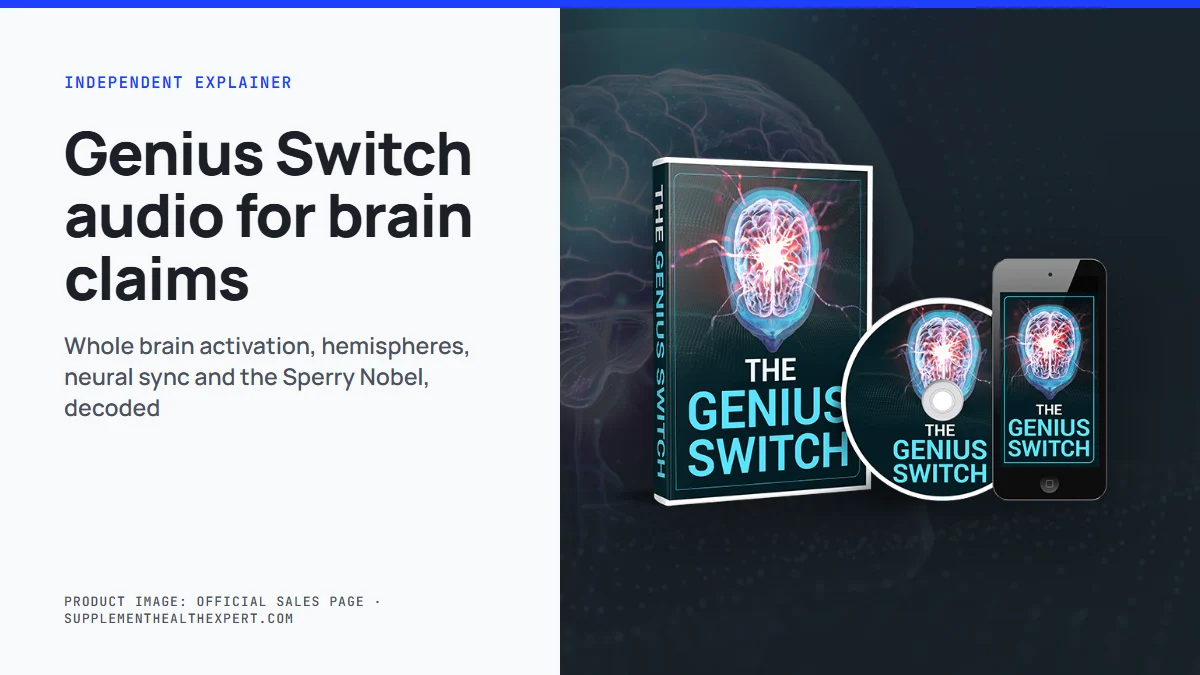
Genius switch audio for brain claims: the glossary
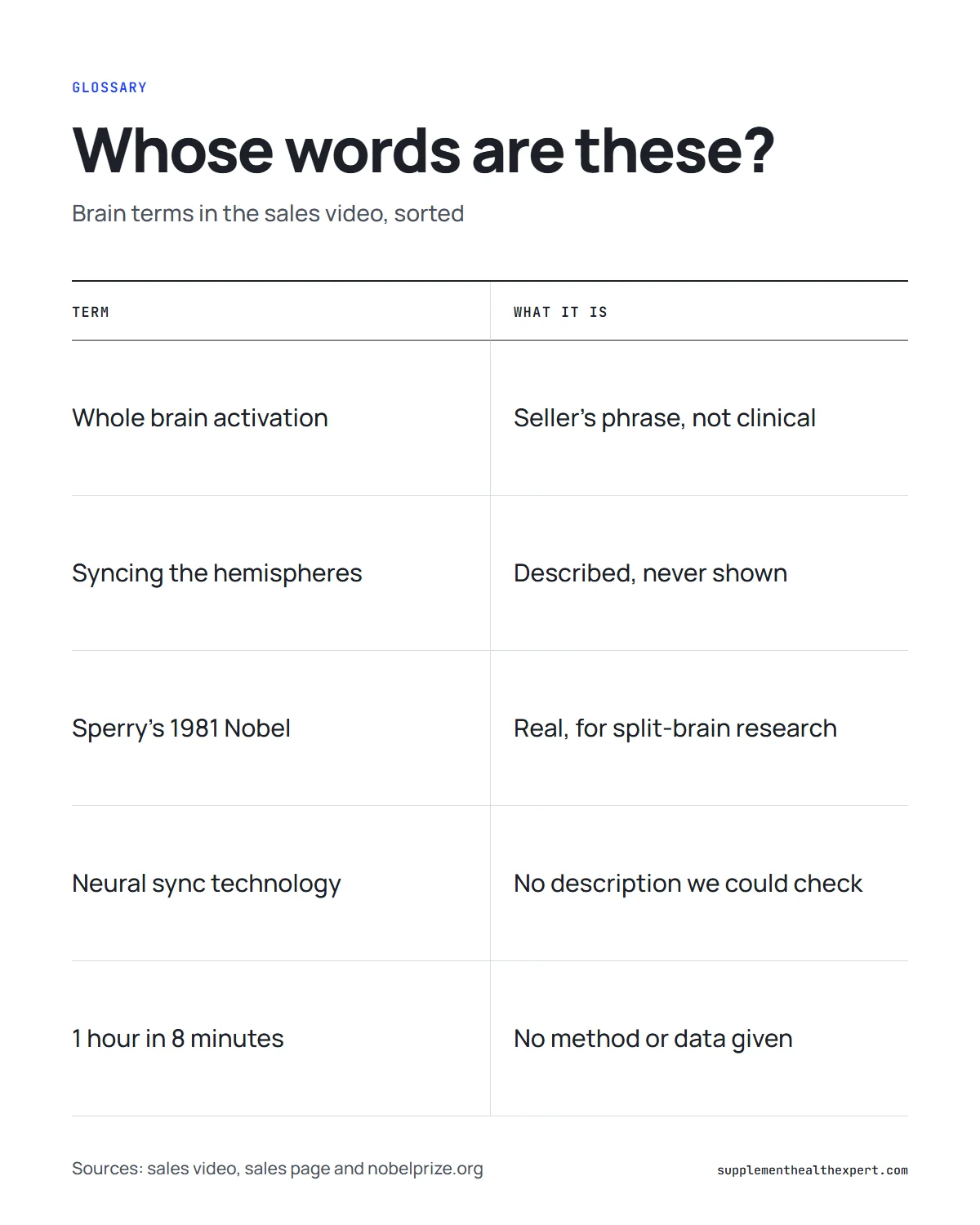
Every brain-related term in the sales material falls into one of three groups: real science, a real fact used out of context, or the seller’s own language. Here is where each one lands.
| Term in the sales material | Where it comes from | What we can say |
|---|---|---|
| Whole brain activation | The seller | Not a clinical term; no published measurement for this track |
| Syncing the two hemispheres | The seller | Described, never demonstrated |
| Roger Sperry’s Nobel Prize | Real history | Awarded in 1981 for split-brain research, not for this idea |
| Neural sync technology | The seller | No technical description we could check |
| One hour compressed into 8 minutes | The seller | No method or data given |
| Targeted auditory sequence | The seller | A name for the 8-minute track |
| 40 Hz binaural beats | Research cited on the sales page | Small studies; evidence mixed |
Put side by side, the terms tell a story. The one well-documented item, the Nobel Prize, is real history about a different subject. The terms that describe what the track supposedly does to your brain all come from the seller.
“Whole brain activation”: a seller’s phrase
This is the central idea of the pitch. The video says the track produces whole brain activation by getting the two halves of the brain working in sync. It sounds like something a scan could show.
But it is not a term you will find used as a diagnosis or a standard measurement. It is the seller’s own phrase. The video does not show a brain scan, a recording or a study of listeners. When a product names an effect but never measures it, the name is doing the persuading.
Syncing the hemispheres, and the Nobel Prize behind the story
The video builds its case on the two hemispheres of the brain and on the work of Roger Sperry. That part of the history is real: in 1981 Sperry received the Nobel Prize in Physiology or Medicine, and the work it honoured was his research on split brains. The Nobel Prize website, listed in our sources, confirms this.
What the video does with that history is the issue. It moves from “a scientist won a Nobel for studying the two hemispheres” to “this track syncs your hemispheres for whole brain activation”. The first statement is true. The second is a claim about this product that Sperry’s work did not test and could not have tested. A real prize does not transfer its credibility to a product built decades later on a different idea.
“Neural sync technology” and the 8-minute compression
According to the video, the track uses “neural sync technology”, and an hour’s worth of that neural sync now fits, it says, into 8 minutes. Those are two claims stacked on each other.
The first names a technology without explaining it. We could not find a technical description, a patent number or a published paper for it on the seller’s pages. The second implies there is a standard dose of neural sync, measured in hours, that can be squeezed into a shorter track. No such standard is described anywhere we looked. Without a definition, neither claim can be tested, which also means neither can be confirmed.
Brain waves: the video says no, the reference list says yes
Here the brain vocabulary contradicts itself. The presenter says the method “has nothing to do with brain waves” and calls sound waves “incomplete”. Yet among the references on the sales page are papers about 40 Hz binaural beats and about gamma stimulation.
We point this out neutrally. It may be that the seller wants to separate its track from free binaural audio while still borrowing that research for support. Whatever the reason, a buyer cannot tell from the materials which mechanism is being claimed. For what the binaural studies actually found, among them a 2020 paper by Ross and Lopez, see our guide to the binaural beats evidence. The short version: a few small trials point to brief shifts in attention or mood, overviews of the field judge the evidence thin and inconsistent, and not one study involves this track.
Clinical-sounding labels around the pitch
Two more labels give the presentation a medical feel.
The first is the presenter. On screen he gives his name as “Dr. Daniel Barone” and says he is a neurologist in New York City, while the sales page headline reads “Top NYC Brain Doctor”. Neither his identity nor his role in the product is something we were able to confirm. The seller’s Terms say testimonials and feedback may be dramatised with avatars or actors, so we do not read the video as a doctor’s endorsement.
The second is the name of the product itself, a “targeted auditory sequence”. It is a description of an audio track, not a medical category. The sales page also uses “Genius Switch Audio Series” as a heading, although what you receive is one 8-minute track.
What the seller says the brain gains
The claimed outcomes go well beyond the brain. The video’s list runs from insights, “eureka moments”, quicker learning and sharper memory to luck, synchronicities, promotions, money and happier relationships, and on to weight loss (one anecdote mentions 17 pounds), giving up smoking, fewer headaches and less joint pain, and children’s grades. It also says the track “starts working the very first time you listen” and that most daily listeners “begin to see results within a couple weeks”.
Every item on that list is a claim made by the seller, and this page promises none of it. On one of them, casino luck, the presenter himself says “there is of course no evidence to support that the genius switch caused that”. That same caution applies to the rest of the list.
How to read brain claims on any audio product
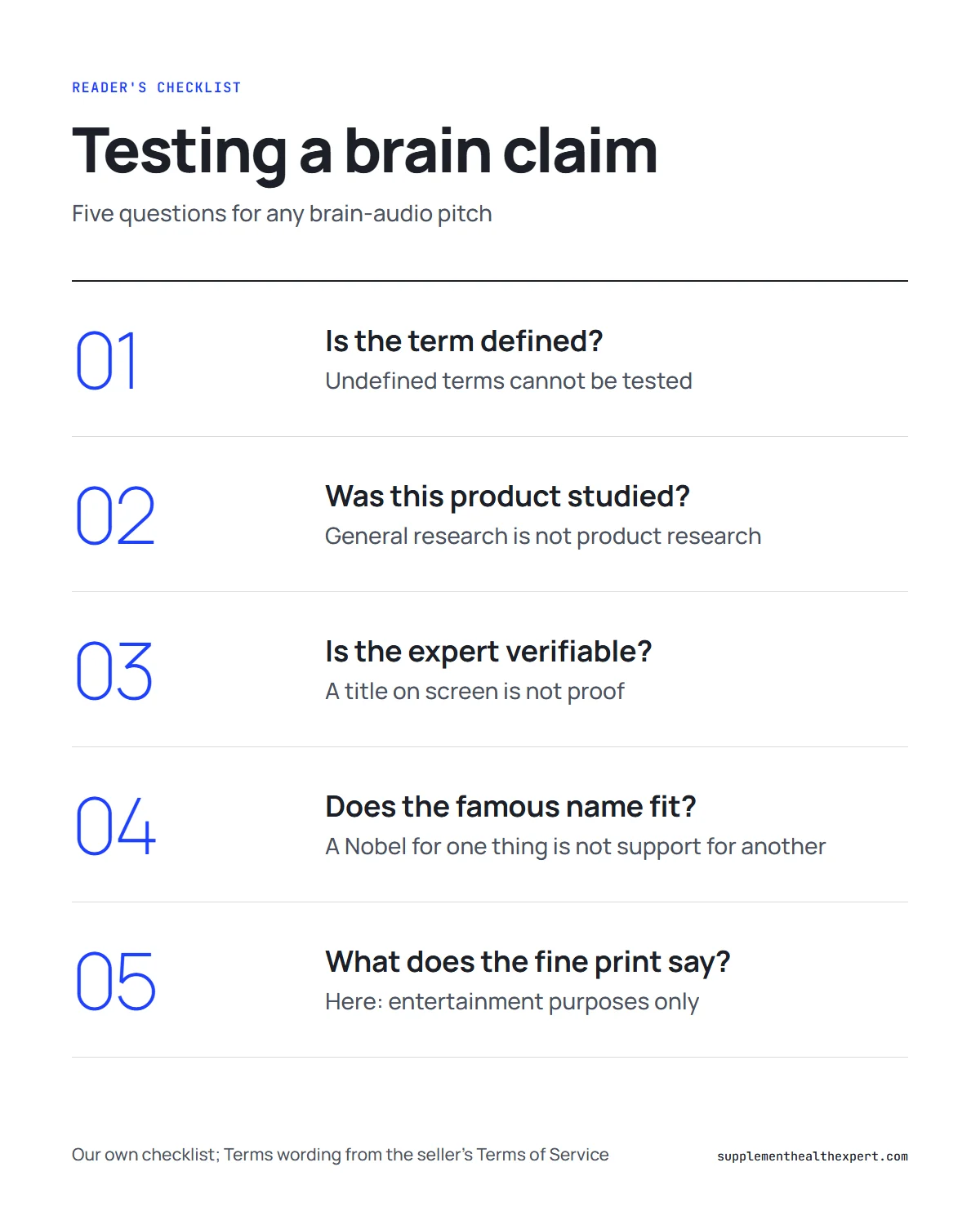
The same questions work whether you are looking at this track or any other.
- Is the term defined? If a phrase like “whole brain activation” is never defined, it cannot be tested.
- Is the study about this product? Research on binaural beats in general is not research on a specific track.
- Is the authority verifiable? A presenter’s title on screen is not the same as a confirmed identity.
- Does the famous name fit the claim? A Nobel Prize for one discovery does not support an unrelated product.
- What does the fine print say? Here, the Terms say “brain entrainment is not an exact science” and call the products entertainment.
If you listen: brain-friendly common sense
The track is not a medical product. The site’s own disclaimer says as much, in the familiar “not intended to diagnose, treat, cure, or prevent any disease” wording. If you have real concerns about memory, focus or mood, a doctor is the right first step.
Should you decide to listen, a few rules of ours apply to any brain-themed audio. Pick a volume that never feels loud. Keep it away from the car and from machinery, because the routine involves shutting your eyes. People living with epilepsy, earlier seizures or hearing loss should check with their doctor beforehand. The purchase itself costs $39 plus local tax, comes by email after a ClickBank checkout, and can be refunded within 90 days.
Our take on genius switch audio for brain claims
Strip out the vocabulary and the pitch rests on three things: a real Nobel Prize for a different discovery, phrases the seller coined without defining, and research on binaural beats that the video simultaneously distances itself from. None of that is evidence that this track changes how your brain works. No published study has tested it.
That does not make it harmful to listen to, and some people may enjoy an 8-minute routine. It does mean the brain language should be read as marketing. If you want the basics without the vocabulary, our plain guide to the 8-minute track and its fine print covers what you get, what it costs and how the refund works.
Frequently asked questions
Did Roger Sperry's Nobel Prize have anything to do with this track?
No. Sperry's 1981 Nobel Prize in Physiology or Medicine recognised his work on split-brain patients. The sales video leans on that prize to frame its idea, but the prize was not awarded for whole brain activation, for audio, or for anything connected to this product.
Is 'whole brain activation' a medical term?
It is the seller's own phrase rather than a clinical one. We found no published measurement of whole brain activation from this track, and the seller does not explain how it would be measured.
What does the seller mean by neural sync technology?
The video uses the phrase to describe how the track supposedly works and says one hour of neural sync was compressed into 8 minutes. It does not explain the technology in a way that can be checked, and we found no independent description of it.
Why does the video say the track is not about brain waves?
In the video, brain waves are dismissed as beside the point and sound waves are called incomplete. Still, 40 Hz binaural-beat and gamma-stimulation research is cited among the sales page references. The two messages point in different directions, and the seller does not reconcile them.
Is the man in the video a brain specialist?
He presents himself as a New York City neurologist named Dr. Daniel Barone, and a headline on the sales page calls him a top NYC brain doctor. We found no way to confirm who he is or what part he plays, and under the seller's Terms its adverts may feature actors or digital avatars.
Can the track help with memory loss or a brain condition?
It should not be used that way. The site's disclaimer rules out any use to diagnose or manage a disease, and its Terms describe the products as for entertainment purposes only. Anyone worried about memory or brain health should speak to a doctor.
Is it safe to play brain-focused audio every day?
Daily listening is a routine, not a risk in itself, but our own precautions still apply: modest volume, never at the wheel or near machinery, and a conversation with your doctor first if you have had seizures, have epilepsy or have trouble with your hearing.
Sources
genius switch audio for brain · the genius switch · whole brain activation · roger sperry · neural sync