Supplement Reviews / Guide
The Genius Switch Audio vs Free Binaural Tracks: What $39 Buys and What Nobody Can Verify
The Genius Switch audio compared with free binaural tracks on YouTube and Spotify: what the $39 buys, what the seller says is different and what can be checked.
- Author
- Supplement Health Expert Editorial Team
- Published
- Reading time
- 9 min
- Sources
- 1 cited
Key takeaways
- 01 The paid track is one 8-minute audio file for $39, emailed after a ClickBank checkout, with four bonuses and a 90-day refund window. Free binaural tracks come with none of those extras.
- 02 The presenter says tracks on YouTube and Spotify are not the same as his, but no published test compares the paid track with any free one, so the difference cannot be verified.
- 03 The video says the method has nothing to do with brain waves, yet the sales page lists 40 Hz binaural-beat studies as references. That leaves the buyer unsure what is supposed to be different.
- 04 If you pay, treat it as a personal experiment: note the purchase date, listen the same way each day and decide well inside the 90 days.
Search for The Genius Switch audio and sooner or later you will ask the obvious question: why pay $39 for an 8-minute track when YouTube and Spotify are full of free binaural audio? The seller has an answer ready. The man presenting the sales video insists that what turns up on those platforms is a different thing from his track. This page looks at that answer honestly: what the money actually gets you, what the seller says is special about the sound, and which of those differences anyone outside the company can check.
Before we start, a word on who runs this page. We are an independent site with no say over the seller’s page or product. Some links here are affiliate links, which means a purchase through them can pay us a commission. Anything we were unable to confirm is flagged as such.
Genius switch audio vs free tracks: the quick comparison
Here is the comparison at a glance. The left column comes from the seller’s pages and checkout. The right column describes free binaural audio on YouTube or Spotify in general, not any particular channel.
| Point | The paid track | Free binaural audio |
|---|---|---|
| Price | $39 plus local tax | Free to play |
| Length | One track of 8 minutes | Varies by upload |
| How you get it | Emailed right after a ClickBank checkout | Streamed on the platform |
| Extras | Four digital bonuses | None from the seller |
| Refund | 90 days, per the Terms and ClickBank | Not relevant, since you paid nothing |
| Published test of the specific track | None we could find | Depends on the track; outside this comparison |
| Seller’s framing | Terms say “for entertainment purposes only” | Depends on the uploader |
On paper, the paid option offers a fixed routine, some extras and a money-back window. The free option costs nothing and lets you stop at any moment. What neither column can show is whether the sound of the paid track does something a free one does not.
What the $39 pays for, line by line
It helps to strip the offer back to what is actually delivered.
- One audio track. The video calls it a “targeted auditory sequence”. It runs for 8 minutes and opens in whatever media player you already use. There is no app or game involved.
- A daily routine. The seller asks for one 8-minute session daily, with headphones and closed eyes, and says a skipped day is okay.
- Four bonuses. A guided visualisation (its creator is billed as top-rated on the Calm app), a shopping guide on foods the seller ties to brain fog, a classic on attracting financial success that is more than a century old, and a one-page printable of five habits.
- A personal copy. The Terms of Sale call the purchase “a copyrighted digital article for personal use”. You keep the file; you may not pass it on.
- A refund window. You have 90 days from the first purchase; the Terms and the ClickBank checkout agree on that.
One heading on the sales page says “Genius Switch Audio Series”; still, every other description we read points to a single track. Our separate guide explains how to listen to the 8-minute track step by step, so we will not repeat the routine here.
The seller’s case that free tracks are different
The presenter, who introduces himself as “Dr. Daniel Barone”, makes three arguments that bear on the free-versus-paid question. We have no way to confirm who he is, and the Terms allow the marketing to use avatars or actors, so we read these as sales statements rather than expert testimony.
First, he says that what you find on YouTube and Spotify is not the same as his product, and that the track is not sold on those platforms or on Amazon. Second, he says the method “has nothing to do with brain waves” and describes sound waves as “incomplete”. Third, he says the track uses “neural sync technology”, with one hour of neural sync compressed into 8 minutes.
Taken at face value, that is an argument that the paid track is a different kind of audio altogether, not just a better binaural beat. The trouble is that the seller never shows what that difference is. No waveform, no measurement, no comparison test. And the sales page undercuts the second point: its reference list includes research on 40 Hz binaural beats and on gamma stimulation.
What can be checked about the difference, and what cannot
So what can a buyer actually confirm? Less than the video implies.
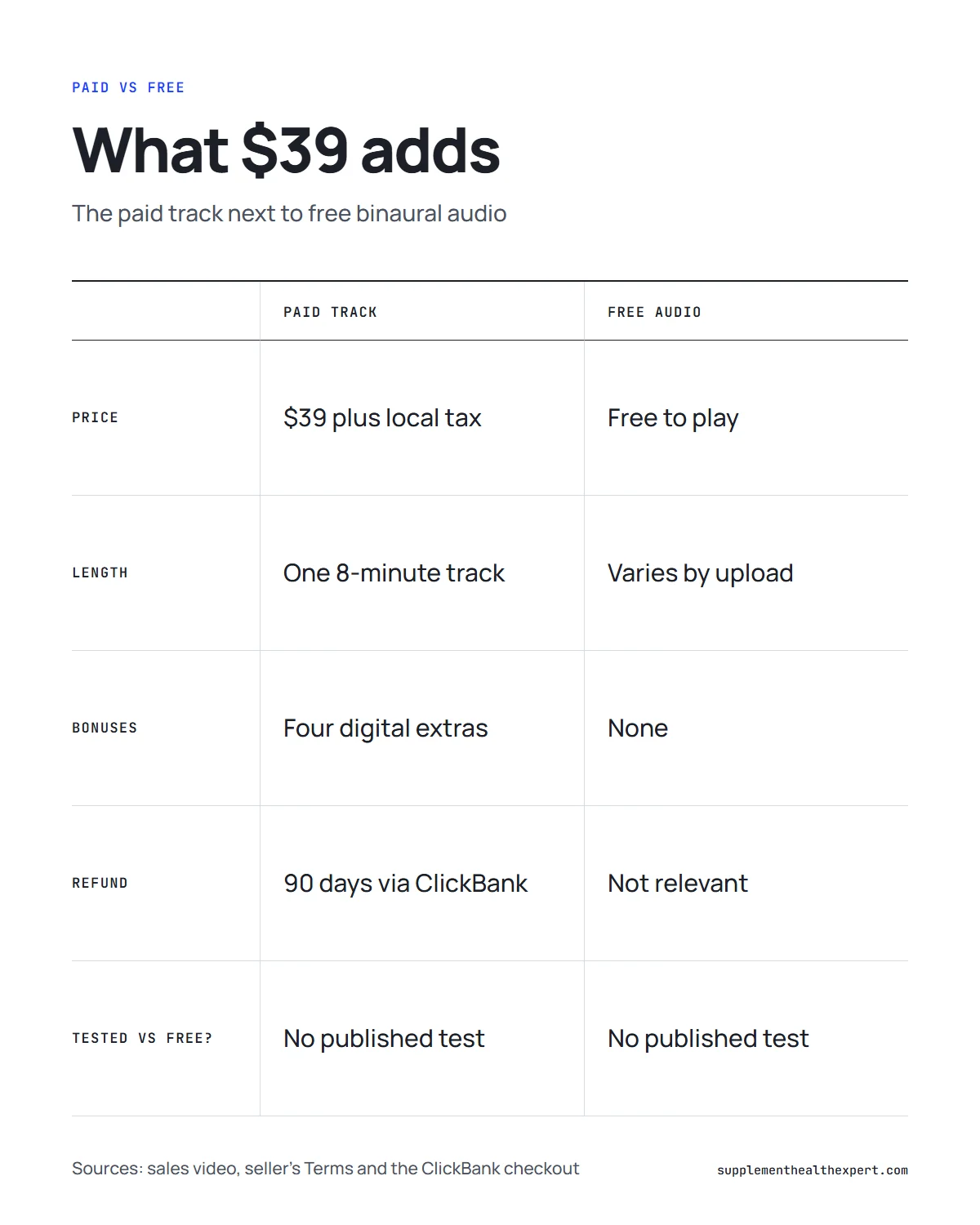
Documented and checkable: the price, the 8-minute length, delivery by email after a ClickBank payment, the four bonuses named in the video, the personal-use wording in the Terms and the 90-day refund period.
Claimed but not checkable: that the sound differs in some meaningful way from free tracks, that “neural sync technology” exists as described, that an hour of it fits into 8 minutes, and that results start “the very first time you listen”. Add the seller’s own figures to that list: “18,456 everyday Americans” helped and “stacks of five star reviews”. Neither comes with a source we could check.
In short, every difference you can verify is about the offer around the track. None of them is about the sound.
What the research covers, for paid and free alike
There is a modest research literature on binaural beats. A handful of small studies have found brief changes in attention or mood; the sales page itself points to one, a 2020 paper by Ross and Lopez that looked at 40 Hz beats and a measure called the attentional blink. Reviews of the field rate the evidence as mixed and based on small samples.
Those studies were not run on The Genius Switch track. That cuts both ways. The research cannot tell you that the paid track does more than a free one, and it cannot tell you that it does less. It simply does not address this product. Our article on the binaural beats question and the research behind it goes deeper into those studies and the contradiction in the seller’s messaging.
The seller’s own legal pages are modest. The Terms say brain entrainment “is not an exact science” and that the products are “provided for entertainment purposes only”. The site also states the track is “not intended to diagnose, treat, cure, or prevent any disease”. Paid or free, audio of this kind should never stand in for a doctor’s care.
A fair way to compare them yourself
If you want to settle the question for yourself, the 90-day window gives you room to do it properly. This is our own suggestion, not the seller’s.
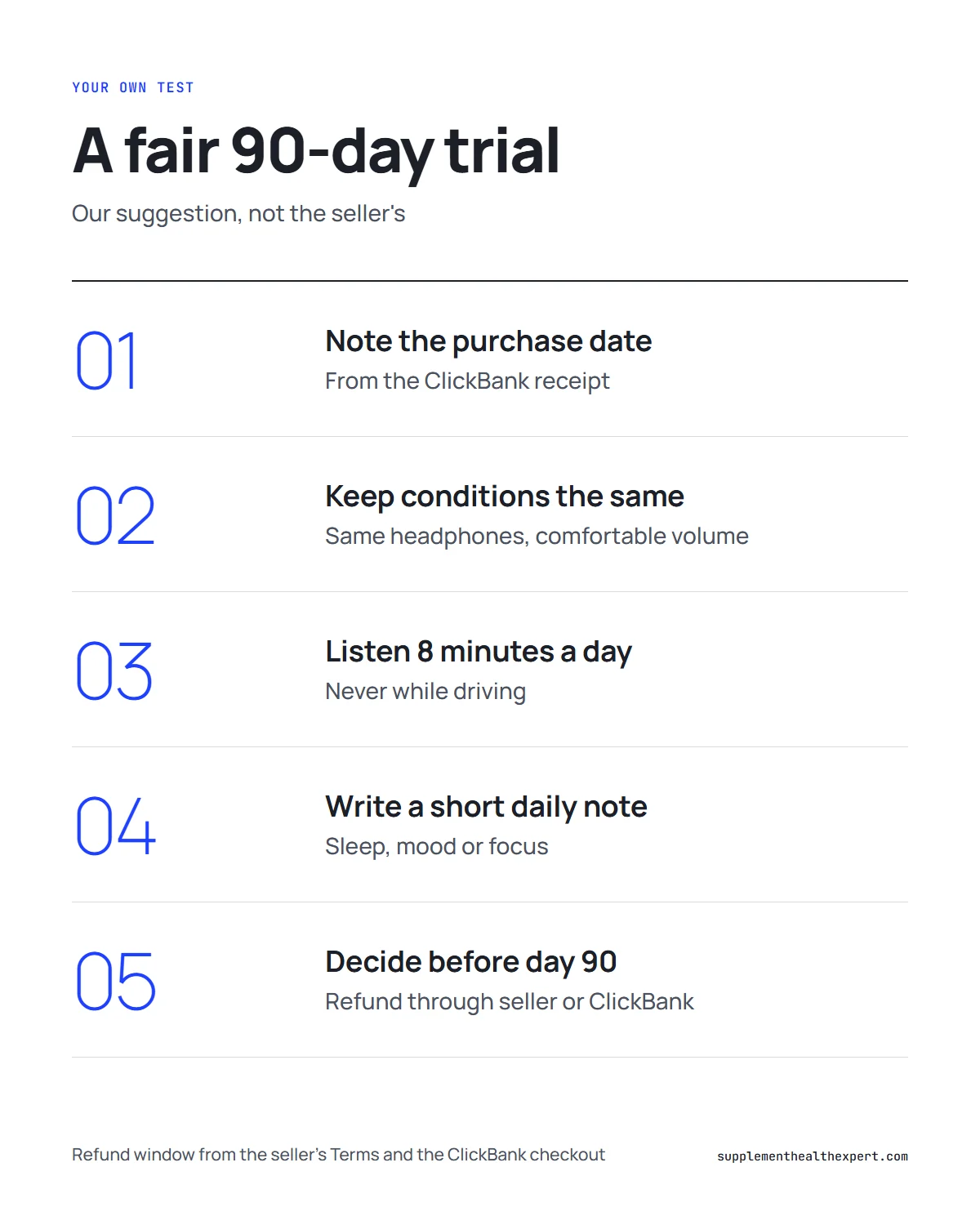
- Write down the purchase date from your ClickBank receipt, and the date 90 days later.
- Keep conditions the same. Same headphones, same comfortable volume, same time of day.
- Listen for 8 minutes daily, as the seller suggests, for a couple of weeks. The video says most people “begin to see results within a couple weeks”.
- Keep a short note each day on sleep, mood or focus, written before you think about whether it worked.
- Decide well before day 90. If you notice nothing you value, request the refund through the seller or ClickBank.
A personal test like this cannot prove anything scientifically, since you know what you are listening to. It does stop the sales video from making the decision for you.
Safety, whichever audio you choose
These rules are ours, and they hold for paid and free tracks alike. Turn the volume down to a level that feels easy. Do not listen behind the wheel or while using machinery. Anyone with epilepsy, past seizures or hearing trouble should get a doctor’s view before starting.
Who should pay, and who should stick with free audio
| Paying may make sense if | Free audio is probably enough if |
|---|---|
| You want a fixed 8-minute routine and the bonuses | You only want background sound to relax or focus |
| You are willing to claim the 90-day refund if nothing changes | You do not want to track dates or request refunds |
| You accept that the difference from free tracks is unproven | You need evidence before paying for a sound file |
| You can treat $39 as a small experiment | The $39 would be a stretch for your budget |
Our view on genius switch audio vs free tracks
Here is the honest summary. The paid track comes with things free audio does not: a fixed routine, four bonuses, a file you keep and a 90-day refund window. The one thing buyers most want to know, whether the sound itself works better, is exactly the thing nobody has shown. The presenter says free tracks are not the same, the video says brain waves are not the point, and the reference list cites binaural-beat studies anyway.
If you are curious, the refund window makes a careful trial low-risk. If you only want relaxing audio, free tracks will do that job. And if you are still unsure what the product is in the first place, our plain guide to the track, its bonuses and fine print is a good next read.
Frequently asked questions
Why pay $39 when binaural tracks are free on YouTube?
The $39 buys the seller's own 8-minute track, four digital bonuses, a personal-use copy you keep and a 90-day refund window through ClickBank. What it does not buy is any proof that the sound itself works better than free audio. No published study tests the paid track, against free tracks or on its own.
Has anyone tested the paid track against a free one?
Not that we could find. According to the presenter, what YouTube and Spotify offer is different from his track, but the seller offers no measurement or trial to back that up. Small studies on binaural beats in general exist, and reviews call that evidence mixed and small-scale.
Does the $39 include anything besides the 8-minute track?
Yes. The video promises four extras alongside the track: a guided visualisation by someone it bills as a top-rated Calm app creator, a grocery shopping guide, a classic money book first published over a century ago, and a printable page listing five habits.
What if the paid track sounds no different from free audio to me?
Then ask for your money back. Refunds on digital products are allowed for 90 days after the first purchase under the seller's Terms, and ClickBank's checkout repeats that period. No technical reason is needed. Hold on to the receipt email, since the order number is on it.
Is the $39 really a discount from $200?
The $200, $100 and $49 figures are the seller's own reference prices on the sales page. The video also says the $39 offer is not guaranteed beyond today. Read them as sales pressure and weigh the $39 by itself. Checkout adds local tax or currency, so your total can differ.
Is listening to free binaural audio any safer than the paid track?
Neither is safer by default; the same precautions, which are our own advice, cover both. Keep the sound at an easy level, skip it when driving or working with machinery, and speak to a doctor beforehand if epilepsy, seizures or hearing problems are part of your history.
Sources
genius switch audio · the genius switch · binaural beats · free binaural tracks · clickbank