Ingredients / Guide
Glucotide Ingredients: The Label, the 82 mg Blend and Roles
Glucotide ingredients explained: seven labelled nutrients with amounts, an 82 mg blend of twelve ingredients, and what each is generally known for.
- Author
- Supplement Health Expert Editorial Team
- Updated
- Reading time
- 8 min
- Sources
- 0 cited
Key takeaways
- 01 Two capsules supply seven labelled nutrients: vitamins C and E, biotin, magnesium, zinc, manganese and chromium.
- 02 An 82 mg proprietary blend adds twelve ingredients, and the label gives no amount per ingredient.
- 03 The seller's page highlights six nutrients, while the full label also lists manganese and the blend.
- 04 Chromium is 76 mcg and magnesium is 125 mg per serving of two capsules.
- 05 Ask your doctor first and keep taking your prescribed medicines.
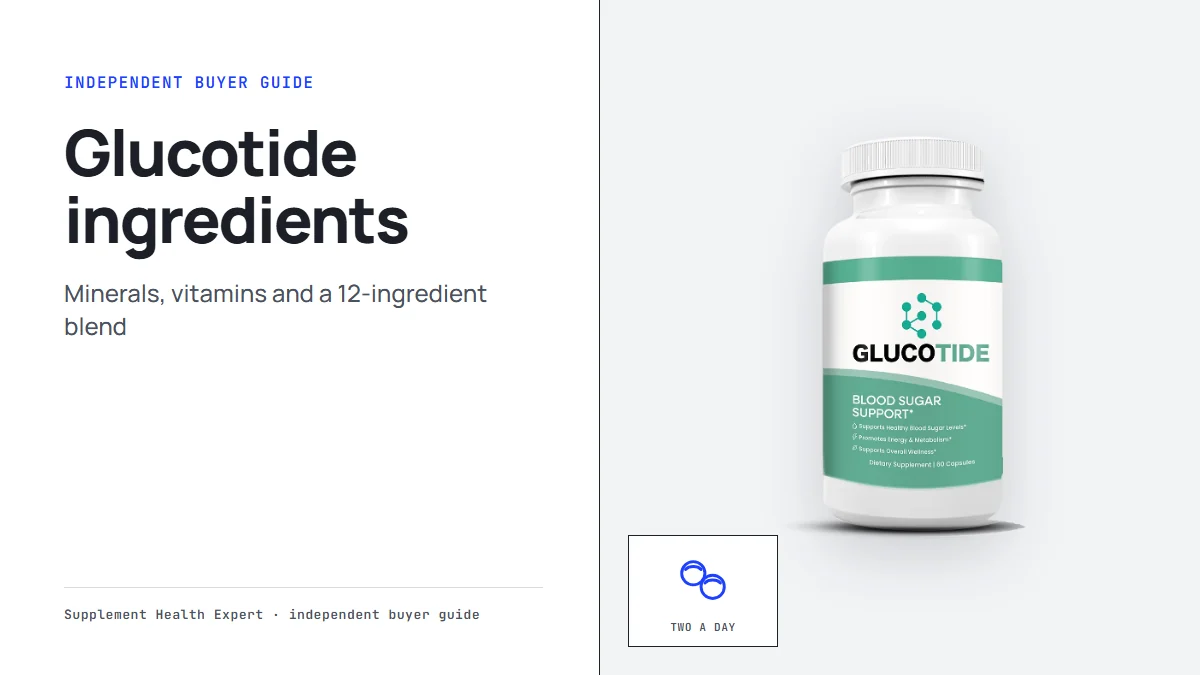
You should see what is inside a capsule before it joins your day. The Glucotide ingredients are a short run of familiar vitamins and minerals plus a blend of twelve ingredients. A serving of two capsules supplies seven labelled nutrients with real amounts, and 82 mg of the blend. Per the seller, the formula is designed to support healthy blood sugar levels that are already in the normal range, plus glucose metabolism and steady energy. Below we read the label line by line and keep each role modest and general.
Two Lists, One Formula
The seller’s page spotlights six nutrients: magnesium, vitamin C, vitamin E, zinc, chromium and biotin. The Supplement Facts panel goes further, adding manganese and the proprietary blend. Both lists describe the same capsule, so we cover the whole label.
Glucotide Ingredients, Amount by Amount
| Per 2 capsules | Amount | General role |
|---|---|---|
| Vitamin C | 53 mg | Antioxidant vitamin |
| Vitamin E | 16 mg | Fat-soluble antioxidant vitamin |
| Biotin | 315 mcg | B vitamin tied to energy use from food |
| Magnesium (oxide) | 125 mg | Mineral used in many body processes, including glucose metabolism |
| Zinc (oxide) | 8 mg | Trace mineral used by many enzymes |
| Manganese (sulfate) | 1 mg | Trace mineral used by enzymes |
| Chromium (amino acid chelate) | 76 mcg | Trace mineral studied for glucose metabolism |
| Proprietary blend | 82 mg total | Twelve ingredients, listed below |
One serving is a pair of capsules, so a 60-capsule bottle gives 30 servings.
The Seven Labelled Nutrients
Chromium draws the most attention in this category. Researchers have studied this trace mineral in connection with glucose handling, and the label lists 76 mcg as an amino acid chelate.
Magnesium carries the biggest mineral amount, 125 mg, in the oxide form. The body draws on it for a long list of processes, glucose metabolism among them.
Zinc (8 mg) and manganese (1 mg) are trace minerals that work inside enzymes. Small amounts suit minerals of this kind.
Vitamin C (53 mg) and vitamin E (16 mg) are the formula’s antioxidant vitamins, one water-soluble and one fat-soluble.
Biotin (315 mcg) is a B vitamin linked with turning food into usable energy, which echoes the seller’s “steady energy” theme.
None of these amounts is a claim about what the capsule will do for you. They are simply what the label states.
The 82 mg Twelve-Ingredient Blend
The panel shows a proprietary blend of 82 mg in total. Its contents, in label order:
- Licorice root extract
- Juniper berry
- Guggul gum resin
- Alpha lipoic acid
- Bitter melon fruit extract
- Cayenne pepper
- Cinnamon bark
- Banaba leaf extract
- White mulberry leaf
- Yarrow flower
- Taurine
- Gymnema sylvestre leaf
The label gives only the 82 mg total, so we cannot say how much of any single ingredient a capsule holds. What we can say is that bitter melon, gymnema and cinnamon, like the chromium on the main panel, are studied for glucose support, which is why the doctor-first note matters if you take diabetes medicines. Alpha lipoic acid is an antioxidant compound, and taurine is an amino acid often found in supplements. The remaining items are botanicals, and the label does not state a purpose for any of them.
Reading Milligrams and Micrograms
Two units appear on the panel. A milligram (mg) is a thousandth of a gram, and a microgram (mcg) is a thousandth of a milligram. That makes 76 mcg of chromium equal to 0.076 mg, and 315 mcg of biotin equal to 0.315 mg. Tiny figures like these are normal for trace minerals and B vitamins, while magnesium is simply labelled in larger numbers.
A Three-Step Way to Read Any Supplement Label
- Begin with the serving size. Here it is two capsules, so each amount belongs to a pair.
- Tell single nutrients from blends. Singles carry their own amounts; a blend carries one total.
- Scan the other ingredients at the bottom for anything you avoid, such as gelatin.
Try it on any bottle in your cupboard and labels get faster to read. When you want to compare, the Glucotide hub keeps this label beside the offer.
How the Pieces Fit Together
Picture the formula in two layers. The base is vitamins and minerals with measurable amounts. On top sits the blend, which adds the botanicals shoppers in this category look for. Combining both in one serving is the seller’s way of keeping things simple: one step with a meal, no sorting through several bottles.
Why Two Capsules Rather Than One
The panel amounts are reached with a serving of two capsules, which leaves room for the vitamins, the minerals and the 82 mg blend in a single sitting. The practical result is a habit you can attach to breakfast or lunch. For the cost side of that habit, see our price guide and the money-back guide.
Comparing This Label With Another Bottle
Standing in a shop with two bottles, it is easy to compare the wrong numbers. Check the serving size first, because a label built around one capsule and a label built around two are not directly comparable. Then match units: milligrams against milligrams, micrograms against micrograms. Finally, see whether a blend gives a total or a list of amounts. Glucotide gives seven individual figures and one blend total, which makes its half of the comparison easy to complete.
What Else Is in the Capsule
Listed as other ingredients are microcrystalline cellulose, gelatin for the shell, magnesium stearate and silicon dioxide, all ordinary capsule-making items. The seller adds that production is in the USA, in an FDA-registered facility, with naturally derived ingredients. That is the seller’s description, not an agency approval.
How People Use It
The directions: two capsules each day, with a meal and an 8 oz glass of water, at breakfast or lunch. A bottle therefore lasts 30 days. On the 6-bottle package at $49 a bottle, a day costs $1.63; on three bottles at $69 it is $2.30; on two at $79 it is $2.63, or about $2.80 once shipping is spread across 60 days.
A Word on Quality Claims
The seller says Glucotide is made in the USA in an FDA-registered facility, which describes where it is produced and nothing more. Whatever the packaging says, the most useful quality check you can run yourself is to compare the bottle in your hand with the Supplement Facts printed here: the same seven amounts, the same 82 mg blend and the same list of other ingredients.
Questions to Bring to Your Doctor or Pharmacist
Print the panel, or open the photo on our Glucotide ingredients page, and bring it along. Good questions are short. Does anything here overlap with what I already take? Is the blend right for me? When should I start? Our safety page gathers the cautions, and our side effects guide explains them in plain language.
Why the Guarantee Matters for an Ingredient Decision
A label shows what is in the capsule, not how it will suit you; that takes a few weeks of routine. The seller’s refund promise runs 60 days from purchase, and its FAQ suggests at least 30 days of use first. So you can read the label, order and let your own routine be the test. The full price ladder lives in the Glucotide hub.
Our Take
We like a label that gives seven nutrients real numbers and is upfront that the blend is a single total. Across ingredients, evidence, transparency, value, guarantee and ordering, Glucotide lands at 9.2/10 in our editorial score. For an easy two-capsule routine with measurable vitamins and minerals, it earns a spot on your shortlist.
Ready to Try It?
Show the label to your doctor, then order the package that suits your plan.
Frequently asked questions
What are the Glucotide ingredients?
Per two capsules: vitamin C 53 mg, vitamin E 16 mg, biotin 315 mcg, magnesium 125 mg, zinc 8 mg, manganese 1 mg, chromium 76 mcg and an 82 mg blend.
Which ingredients are in the blend?
Licorice root extract, juniper berry, guggul gum resin, alpha lipoic acid, bitter melon fruit extract, cayenne pepper, cinnamon bark, banaba leaf extract, white mulberry leaf, yarrow flower, taurine and gymnema sylvestre leaf.
How much of each plant is in a capsule?
The label lists only the 82 mg total for the blend, so individual amounts are not given.
Why does the seller list six nutrients when the label shows more?
The seller page highlights magnesium, vitamin C, vitamin E, zinc, chromium and biotin, and the full panel adds manganese and the blend.
What else is in the capsule?
Microcrystalline cellulose, gelatin for the capsule shell, magnesium stearate and silicon dioxide.
Should I check with a doctor before taking it?
Yes. Show the label to your doctor, especially if you take diabetes medicines, and keep taking what you have been prescribed.
glucotide ingredients · glucotide supplement facts · glucotide chromium · glucotide proprietary blend · glucotide label · glucotide gymnema · glucotide cinnamon bark