Everyday Wellness / Guide
Is FemiCore a Health Supplement? How It Is Classified and What That Means for You
Is FemiCore a health supplement? Yes: a dietary supplement, not a drug. What the FDA checks and does not, what GMP means, and how to read its label honestly.
- Author
- Supplement Health Expert Editorial Team
- Published
- Reading time
- 9 min
- Sources
- 5 cited
Key takeaways
- 01 FemiCore is a dietary supplement, not a prescription or over-the-counter drug. It has not been approved by the FDA, because supplements do not go through FDA pre-market approval.
- 02 The official website describes it as non-GMO and stimulant-free and displays GMP Certified and FDA registered facility seals. All US supplement makers must follow the FDA's manufacturing rules; that is a legal minimum, not an endorsement.
- 03 As a supplement it may say it supports bladder control, but it cannot legally claim to treat, cure or prevent incontinence or infection.
- 04 Its label names all nine ingredients but hides the amounts inside a proprietary blend, which is legal for supplements and limits what you can judge.
Is FemiCore a health supplement? Yes. In legal terms it is a dietary supplement: a once-daily capsule for women, sold to support bladder control and urinary health. It is not a drug, it has not been approved by the FDA, and it is not designed to diagnose or treat any condition.
That classification sounds like a technicality, but it shapes almost everything about the product: who checks it, what the label is allowed to say, what the label is allowed to leave out, and how much you should expect from it. This guide walks through each of those points so you can read FemiCore, and any similar product, with clear eyes.
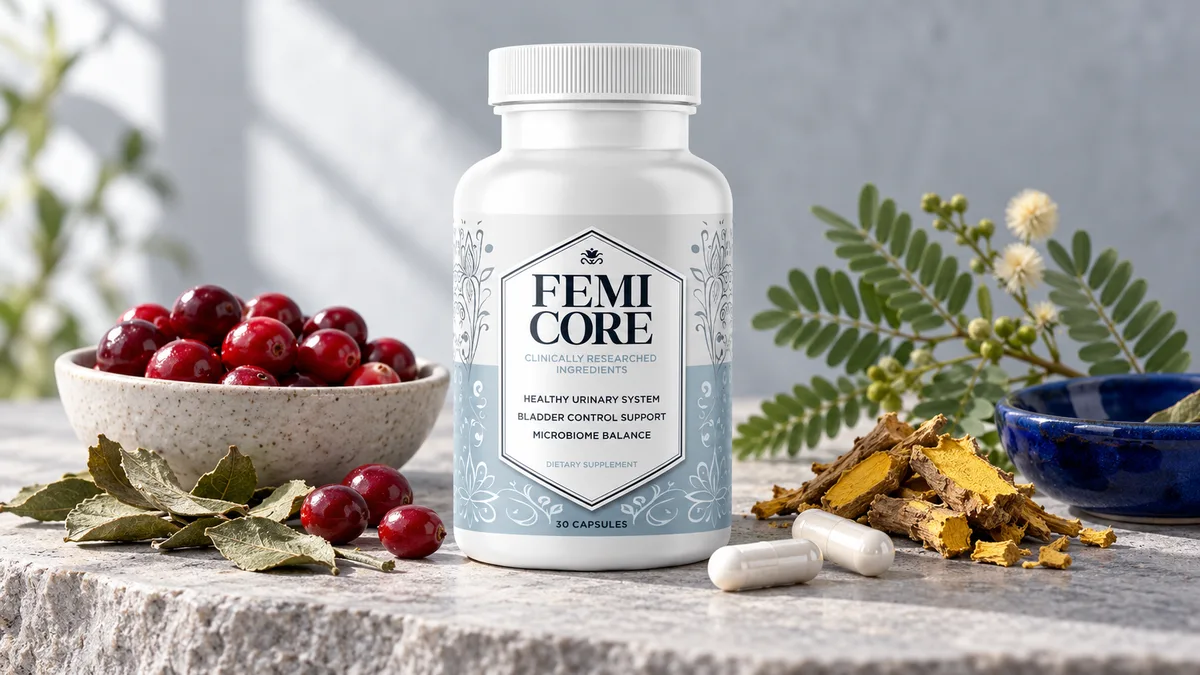
Is FemiCore a health supplement? The legal answer
In the United States, products like FemiCore fall under the Dietary Supplement Health and Education Act of 1994. That law treats supplements as a special category of food, not as medicine. A product qualifies when it is taken by mouth, is labelled as a supplement and contains “dietary ingredients” such as vitamins, minerals, herbs, botanicals, amino acids or other substances used to add to the diet.
FemiCore fits that description neatly. Each capsule contains nine ingredients: four botanicals (Mimosa Pudica, Bearberry leaf, Cranberry Extract and Granular Berberine) and five probiotic bacteria (Lactobacillus crispatus, L. acidophilus, L. plantarum, L. gasseri and L. casei). All of them are recognised supplement ingredients. None of them is a prescription drug.
So when people ask whether FemiCore is a “health supplement”, the accurate answer is that it is a dietary supplement aimed at urinary health. It sits on the same regulatory shelf as a cranberry capsule or a women’s probiotic, not alongside bladder medicines your doctor might prescribe.
Dietary supplement vs prescription drug
The difference between the two categories is bigger than most buyers realise. A drug has to prove it works before it can be sold. A supplement does not.
| Dietary supplement (FemiCore) | Prescription drug | |
|---|---|---|
| Approval before sale | Not required | FDA approval required |
| Proof of effectiveness | Not required by law | Controlled clinical trials required |
| Who is responsible for safety | The manufacturer | Manufacturer, with FDA review before launch |
| Allowed claims | Structure/function, e.g. “supports bladder control” | Can claim to treat a named disease |
| Dose disclosure | Proprietary blends may hide individual amounts | Exact strength of each active ingredient on the label |
| How you get it | Sold directly, no prescription | Prescribed and dispensed by a pharmacy |
Neither column is “good” or “bad” in itself. Drug approval is slow and expensive, which is why it is reserved for products that claim to treat disease. Supplements are faster to market and easier to buy, but the trade-off is that the burden of judging them shifts to you.
Where bladder medicines sit
For comparison, the bladder medicines a clinician might discuss for urgency, such as anticholinergics or mirabegron, are prescription drugs. They had to show an effect in trials before approval, and they carry known side effects. FemiCore has no equivalent trial of the finished product. That does not make it useless, but it does mean the two are not interchangeable.
What the FDA does and does not check
This is where most confusion starts. People see “FDA” on a supplement website and assume the agency has looked at the product. It usually has not.
What the FDA does:
- Requires facilities that make supplements to register with the agency.
- Sets Current Good Manufacturing Practice (cGMP) rules for how supplements are made, tested and stored, and can inspect facilities.
- Collects adverse event reports from consumers and doctors.
- Can take action, including warning letters and recalls, against products that are unsafe, contaminated or mislabelled once they are on the market.
- Requires new dietary ingredients (those not sold before 1994) to be notified before use.
What the FDA does not do:
- Approve a supplement before it goes on sale.
- Test each product to confirm it contains what the label says.
- Check whether a supplement actually works for its stated purpose.
- Review the marketing website. Advertising claims fall mainly under the Federal Trade Commission.
In short, the FDA polices supplements after the fact. The manufacturer carries the responsibility for safety and labelling at the start.
Non-GMO, stimulant-free and GMP: what applies to FemiCore
The official FemiCore website describes the product as non-GMO and free of stimulants. It also displays certification seals that read “GMP Certified”, “Made in an FDA registered facility” and “Manufactured in USA with imported ingredients”. These appear on the website; we have not verified them. Here is what each of these terms can and cannot tell you.
Facility registration. In the United States, facilities that make dietary supplements must register with the FDA. Registration is a legal requirement, not an award, so it would not set any product apart even where it is stated.
Good Manufacturing Practice. Every US supplement maker must follow the FDA’s Current Good Manufacturing Practice rules on cleanliness, ingredient identity checks, batch records and quality control. A GMP seal suggests the maker says it meets those rules; independent third-party testing of the finished product, such as USP or NSF, goes further, and FemiCore does not show one. Neither would tell you whether the doses in the capsule are effective.
Non-GMO and stimulant-free are product attributes. They are useful if you avoid genetically modified ingredients or caffeine-type stimulants, but they say nothing about how well the product supports bladder health.
Reading FemiCore’s label as a supplement
A supplement label has a standard layout: a Supplement Facts panel showing the serving size and ingredients, followed by any “other ingredients” such as the capsule shell. FemiCore’s serving is one capsule a day, and each bottle holds 30 capsules, so one bottle lasts a month. For a full walk-through of the panel itself, see our FemiCore supplement facts guide.
The key feature of FemiCore’s label is the proprietary blend. All nine ingredients sit inside a single blend, and the label does not disclose:
- the amount of each botanical,
- the probiotic count (CFU), or
- the strain identifiers for the five Lactobacillus species.
Supplement law allows this. A blend only has to list its ingredients and the total weight of the blend. Drug labels have no such option. For you, the practical effect is that you cannot check FemiCore’s doses against the amounts used in published studies. Our FemiCore ingredients list explains what each ingredient is and what the research behind it used.
Structure/function claims: what FemiCore can and cannot say
Because it is a supplement, FemiCore is limited to what regulators call structure/function claims. These describe how a product is meant to support a normal body function. Disease claims, which say a product treats, cures or prevents a disease, are reserved for drugs.
| Allowed for a supplement | Not allowed for a supplement |
|---|---|
| “Supports bladder control” | “Cures urinary incontinence” |
| “Designed to support urinary health” | “Treats urinary tract infections” |
| “Supports a healthy balance of bacteria” | “Prevents bladder infections” |
| “Formulated for women” | “Replaces your bladder medication” |
Supplements that make structure/function claims are also required to carry a standard notice saying the statement has not been evaluated by the FDA and that the product is not intended to diagnose, treat, cure or prevent any disease. If you see that notice on FemiCore’s materials, it is not a warning about this product specifically. It is the legal wording every supplement of this kind uses.
A useful rule of thumb: if any website promises that FemiCore will cure incontinence or clear an infection, that site has stepped outside what a supplement may legally claim.
What supplement status means for your expectations
Knowing FemiCore is a supplement should reset what you expect from it in four practical ways.
Expect support, not a fix. Supplement ingredients are chosen to nudge normal function. The strongest evidence behind FemiCore’s ingredients, for L. crispatus and cranberry, relates to urinary infections rather than leaks, and the product as a whole has no published trial. Our overall evidence grade for it is C (Limited).
Expect a slower timeline. The manufacturer suggests 60 to 90 days of daily use before judging the result. Drugs are usually expected to show an effect much sooner.
Expect to do your own checking. Without dose disclosure or a product trial, your own careful trial, with notes on night-time trips and urgency, is the main evidence you will get. The 60-day money-back guarantee on official orders exists partly to make that trial less risky.
Expect interactions to matter. “Natural” does not mean inert. Berberine can interact with medicines processed by several liver enzymes, and bearberry is advised for short courses in European guidance. Our FemiCore review grades each ingredient and covers these cautions in detail.
Health supplement or medical care: where FemiCore fits
A supplement can sit alongside medical care, but it should not come before it. Bladder symptoms have many causes, from pelvic floor weakness to infection, prolapse, medication effects or nerve problems. Only a clinician can tell them apart.
For many women with leakage, pelvic floor muscle training is the first-line approach, supported by a Cochrane review of randomised trials. A supplement like FemiCore is, at best, an addition to that kind of plan, not a substitute for it.
Before adding any supplement, it is worth confirming that it suits you personally. Our guide to who should use FemiCore covers pregnancy, kidney disease, medications and the symptoms that need a doctor rather than a capsule.
The bottom line
FemiCore is a health supplement in the precise, legal sense: a dietary supplement, not a drug. Its maker must follow the FDA’s manufacturing rules like every supplement company, but it has not been approved or tested for effectiveness by the FDA, and no supplement is. Its label lists nine recognised ingredients while keeping their amounts private, which is legal but limits what you can verify.
Treat it as what it is: a low-stakes, once-daily support product that may or may not help, best tried after a medical check, for a full 60 to 90 days, with the official refund window as your safety net.
Frequently asked questions
Is FemiCore a health supplement or a medicine?
FemiCore is sold as a dietary supplement, which is a different legal category from a medicine. It is a once-daily capsule designed to support bladder control and urinary health. It is not a prescription or over-the-counter drug and has not been through drug-style clinical trials.
Is FemiCore FDA approved?
No. The FDA does not approve dietary supplements before they are sold, so no supplement is FDA approved. All US supplement manufacturers must follow the FDA's Current Good Manufacturing Practice rules, which is a legal minimum for the factory, not an approval of the product.
Does the FDA check what is inside FemiCore?
Not before it goes on sale. The manufacturer is responsible for making sure the product is safe and that the label is accurate. The FDA can inspect facilities, review adverse event reports and act against products that are unsafe or mislabelled after they reach the market.
Why does the FemiCore label not show ingredient amounts?
The nine ingredients are listed as one proprietary blend. Supplement rules allow a blend to show its total weight while hiding how much of each ingredient it contains. That is legal, but it means you cannot compare the doses with those used in research.
Can FemiCore replace treatment from my doctor?
No. A dietary supplement is not designed to diagnose or treat a medical condition. If you have bladder leaks, urgency, pain, blood in your urine or a fever, see a clinician first. Pelvic floor muscle training is the first-line approach for many types of leakage.
Does being a supplement mean FemiCore is safe for everyone?
No. Supplement status says nothing about whether a product suits you. FemiCore contains berberine, which can interact with several medicines, and bearberry, which is meant for short courses only. Ask a doctor or pharmacist before taking it if you are pregnant, breastfeeding or on regular medication.
Sources
- 01 U.S. Food and Drug Administration. Dietary supplements.
- 02 U.S. Food and Drug Administration. Questions and answers on dietary supplements.
- 03 NIH Office of Dietary Supplements. Dietary supplements: what you need to know.
- 04 U.S. Food and Drug Administration. Tips for dietary supplement users: making informed decisions.
- 05 Dumoulin C, et al. Pelvic floor muscle training versus no treatment, or inactive control treatments, for urinary incontinence in women. Cochrane Database Syst Rev. 2018.
is femicore a health supplement · femicore · dietary supplement regulation · fda and supplements · gmp certified · supplement labels · bladder support