Ingredients / Guide
Java Burn Ingredients: The Six Names on the Order Page, in Plain Words
Java Burn ingredients explained: chlorogenic acid, green tea, chromium, L-carnitine, L-theanine and a vitamin complex, with what each one is in plain words.
- Author
- Supplement Health Expert Editorial Team
- Updated
- Reading time
- 7 min
- Sources
- 0 cited
Key takeaways
- 01 The order page names six ingredients: chlorogenic acid from green coffee, green tea, chromium, L-carnitine, L-theanine and a vitamin complex.
- 02 The page prints no amounts, so this guide states none and describes each name by what it is.
- 03 The seller's aim applies to the formula as a whole: designed to support metabolism and calm, steady energy when added to coffee.
- 04 The seller calls Java Burn a liquid that is plant-powered, non-GMO, and free of soy and dairy.
- 05 Bring the six names to your doctor and keep taking prescribed medicines.
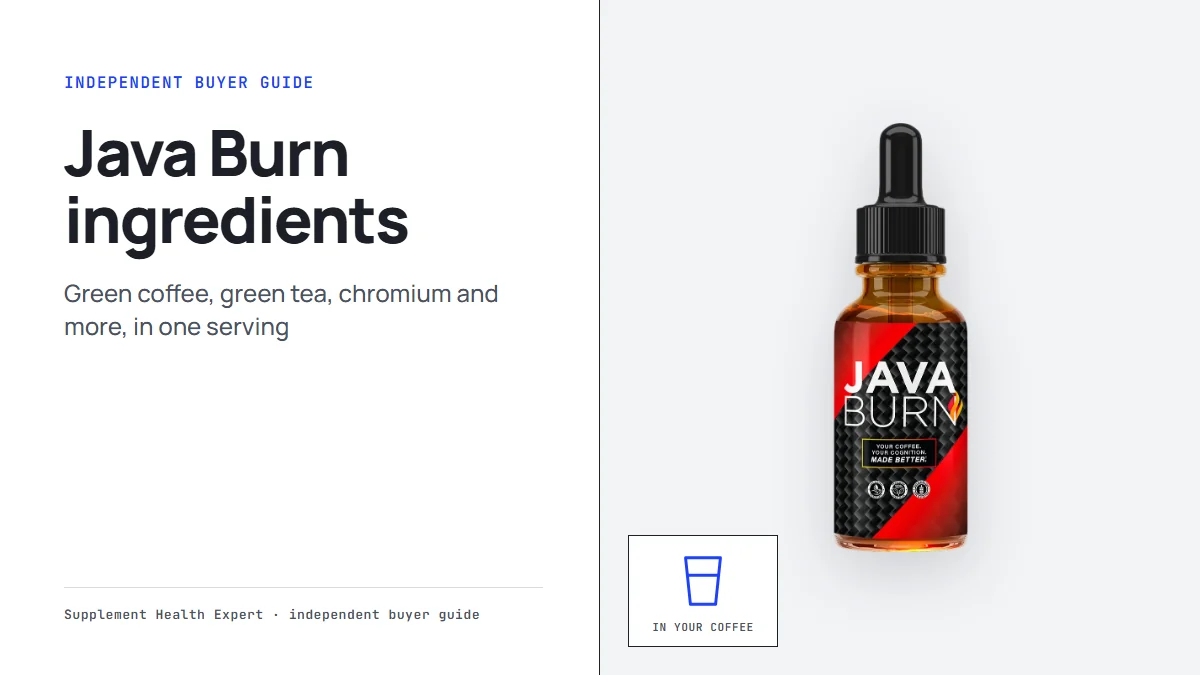
Anything that joins your daily cup deserves a proper look at its label. The Java Burn ingredients list is short enough to read over a single coffee: six named items, each one familiar from the supplement aisle or the tea shelf. Below we say what each name is, keep our claims modest and leave the bigger promises to the seller, who describes the formula as designed to support metabolism and calm, steady energy when it is added to coffee.
Java Burn Ingredients at a Glance
The order page names six items. It prints no amounts for any of them, and we respect that by giving none. What we can say honestly is what each name refers to.
| Ingredient | What it is |
|---|---|
| Chlorogenic acid (from green coffee) | A compound found in green coffee beans |
| Camellia sinensis (green tea) | The tea plant behind green tea |
| Chromium | A trace mineral |
| L-carnitine | An amino acid derivative |
| L-theanine | An amino acid found in tea leaves |
| Vitamin complex | A group of vitamins |
Notice that three of the six trace back to the same two drinks you already know. Coffee beans and tea leaves are everyday foods, which is part of why the list reads as approachable.
The Six Names, One at a Time
Chlorogenic acid. A compound that occurs naturally in green coffee beans, which are coffee beans before roasting. The order page gives it as “from green coffee”.
Camellia sinensis. The botanical name of the tea plant. Green tea is made from its leaves, and the page uses both names for the same ingredient.
Chromium. A trace mineral, meaning one the body needs only in very small quantities. It turns up in many multivitamins.
L-carnitine. An amino acid derivative, a close relative of the building blocks of protein. The “L” is a chemical form marker and nothing more.
L-theanine. An amino acid found in tea leaves. You will see its name on the labels of teas and tea-based drinks.
Vitamin complex. The page uses this umbrella term for a group of vitamins.
We stop at “what it is” on purpose. Attaching an effect to a single item would turn a label into a promise, and the seller’s aim belongs to the formula as a whole.
What the Formula Is Aiming For
According to the seller, Java Burn is designed to work with the coffee you already drink, to support metabolism and calm, steady energy, plus overall health. Read that sentence as an aim for the six items working together. It describes intent, and experiences differ from person to person. A supplement also sits alongside your own habits, such as how you eat and how you move, and does not replace them.
Why the Seller Chose a Liquid
The seller points to the dropper bottle as a design choice. In its words, a liquid absorbs faster than a powder and has no flow agents, the additives that keep dry mixes from clumping. We repeat those as the seller’s claims. The practical side is easy to see: the liquid is described as tasteless, so it should leave the flavor of your cup alone, and it goes into hot or iced coffee alike.
Plant-Powered, Non-GMO, Soy- and Dairy-Free
The seller calls Java Burn plant-powered and non-GMO, and states that it is free of soy and dairy. The seller also describes it as non-habit forming. Those are the seller’s statements about its own product, and they are worth confirming on the order page before you decide. If you follow a particular diet, they are the lines to check first.
Reading the Names in Everyday Terms
It helps to sort the six names into a few familiar buckets. Two come from drinks: green coffee and green tea. Two are amino acid items: L-carnitine and L-theanine. One is a mineral, chromium, and one is a group of vitamins. That simple sort makes the list far less intimidating, and it is a handy way to describe the product to a friend or a pharmacist in a single breath.
How Long One Bottle Lasts
One bottle covers 30 days, because you use one serving a day. That makes the packages easy to picture as calendars: two bottles for 60 days, three for 90 and six for 180. At $294, the six-bottle package works out to about $1.63 a day, and the three-bottle package at $207 comes to $2.30 a day before shipping.
What “Plant-Powered” Does and Does Not Tell You
The phrase is the seller’s way of describing the formula, and it sits alongside the non-GMO and soy-free, dairy-free lines. It tells you how the seller wants to position the product. It does not replace the ingredient names, which remain the part of the label to read most closely. If you are choosing between two bottles, compare the names, and read the positioning phrases as context.
Four Things to Look For on Any Supplement Page
When you compare Java Burn with another bottle, run through the same short list. Is the serving described? Are the ingredient names clear? Is the full list printed in one place? Is the directions line short enough to follow every morning? Java Burn answers each of these plainly and keeps its list short. For how the formula sits beside the pricing, the Java Burn hub gathers everything on one page, and the ingredients page in the hub goes through the formula once more in its own layout.
Sorting Fact From Sales Language
Keep the ingredient list apart from the wording around it. The list is a fact about the bottle. The talk of metabolism and steady energy is the seller’s description of intent. If you hold the two in separate hands, a label is easy to read and no claim sneaks in disguised as a name. Our buyer review uses the same six names in its verdict.
A Five-Minute Routine for Reading the Page
You do not need a chemistry background to read this label well. Here is a quick routine that works for Java Burn and for any other bottle.
- Read the six names once, aloud if it helps.
- Match each to the table above, so every name has a plain description.
- Circle anything that is new to you and look it up with your pharmacist.
- Read the seller’s claims, such as plant-powered and non-GMO, as claims.
- Check the directions line, one serving in your coffee once a day.
Five steps, five minutes, and you will know the label well.
Hot or Iced, the Same Six Names
The seller says the liquid dissolves whether your coffee is hot or iced, and that it has no taste of its own. That makes the ingredient list the whole story of what changes in the cup. Your beans, your milk and your sweetener stay your choice. Nothing in the directions asks you to change how you brew, which keeps the routine easy to picture.
Using It
The directions are short: add one serving to your coffee once a day, hot or iced, and drink it as usual, with or without food. The seller says the morning cup is best. Because Java Burn is a dietary supplement, ask your doctor before you begin, and keep taking any medicine you are prescribed.
Take the List to Your Doctor
A short list makes an appointment easier. Write the six names on a card or save a photo of the order page, mention your current medicines and let your doctor judge how Java Burn fits your situation. The visit costs nothing and keeps your records complete. Our side effects guide covers what to raise there.
Who This Formula Suits
Java Burn suits adults who drink coffee most mornings, like a short ingredient list and want a simple routine with 60 days to decide. If you enjoy knowing what each name means before it goes into your cup, this is a pleasant list to read. For where to order, our where to buy guide shows the route.
Our Take
The list is brief and readable, and it reaches for familiar names: coffee, tea, a mineral, two amino acid items and a group of vitamins. We give Java Burn an ingredients score of 9 inside our overall 9.2/10.
Frequently asked questions
What are the Java Burn ingredients?
The order page names chlorogenic acid (from green coffee), Camellia sinensis (green tea), chromium, L-carnitine, L-theanine and a vitamin complex.
Does the order page list amounts for each ingredient?
No, it prints names only. We state no amounts, because any figure we gave would be a guess.
What is Camellia sinensis?
It is the tea plant, the source of green tea. The seller lists it as the green tea ingredient.
What does the seller say the formula is designed to do?
According to the seller, it is designed to work with coffee to support metabolism and calm, steady energy, plus overall health. That aim describes the formula as a whole and not any single ingredient.
Is Java Burn plant-powered and non-GMO?
That is how the seller describes it, along with soy-free and dairy-free. The seller also states that it is non-habit forming.
Should I show the ingredient list to my doctor?
Yes. Ask your doctor before you start, bring the six names with you and keep taking any medicine you are prescribed.
java burn ingredients · java burn formula · java burn chlorogenic acid · java burn green tea · java burn chromium · java burn l-carnitine · java burn l-theanine · java burn vitamin complex