Buying Guides / Guide
The Last Wish Manifestation: Evidence-Based Ways to Work Toward a Goal and Where a Nightly Routine Fits
The Last Wish manifestation in practice: process simulation, mental contrasting and if-then plans toward a goal, and where a quiet nightly listen fits.
- Author
- Supplement Health Expert Editorial Team
- Published
- Reading time
- 9 min
- Sources
- 5 cited
Key takeaways
- 01 Research supports planning toward a goal: picturing the steps (process simulation), picturing the obstacle (mental contrasting) and writing an if-then plan. It does not show that wishes cause money to arrive.
- 02 These techniques ask you to act, which is the opposite of the product's promise that no hard work is needed. They are also free.
- 03 A quiet, dark nightly routine can be relaxing, and that is where a recording like this could fit. Keep it as a wind-down habit, separate from your goal plan.
- 04 The seller's Terms say 'For Entertainment Purposes Only'. Income stories in its video are unverified, and no published study tests the recordings.
The Last Wish manifestation promises that a nightly recording will bring you wealth and abundance with no hard work. If you came here wanting to move toward a real goal, there is a different and better-tested route, and this page shows it. You will find three techniques with research behind them, a worked example, a side-by-side comparison with the product’s promise and a fair place for a quiet listening routine.
No one at the seller reviews or edits this page. Its order buttons use affiliate tracking, so a sale that starts from one earns us a fee. The research behind the seller’s claims is in our longer piece on the manifestation claims, the contents of the package are in our plain description, and the evidence on money, luck and love outcomes is in our check of the reviews and claims.

Last Wish manifestation versus a practical goal plan
The product’s promise is simple: listen, and you “just receive”. The techniques below ask for more from you, but they have been studied. The table shows the contrast.
| Question | The product’s promise | Evidence-based goal planning |
|---|---|---|
| What do you do? | Listen to recordings, no hard work | Picture steps, spot obstacles, take action |
| What is the aim? | Wealth and abundance | A specific goal you choose |
| Is it studied? | No published study of the recordings | Published studies on simulation and contrasting |
| What does it cost? | $37.44 plus optional extras | Free |
| What is the risk? | Spending money and being emailed offers | Time and effort |
Start with one concrete goal
Vague wishes are hard to act on. “Be wealthier” gives you no first step, while “set aside a fixed amount from each paycheck” does. Choose a goal that is small enough to start this week, specific enough to know when you have done it and within your own control. A job application, a savings habit, a conversation you have been avoiding and a regular exercise slot all qualify.
Process simulation: picture the steps, not the prize
Process simulation means rehearsing in your mind the sequence of actions that lead to the goal. Taylor and her co-authors (American Psychologist, 1998) described people who mentally ran through the steps toward a goal and made more headway than people who did not. Picturing only a successful result, a familiar self-help tip, gave no such lift.
How to try it in a few minutes:
- Sit quietly and name the goal.
- Picture the very first action, in concrete detail: where you are, what you open, what you say.
- Move to the next action, and the next, until you reach the end.
- Note any step that feels unclear, and write down what you need to find out.
Mental contrasting and if-then plans
Mental contrasting was developed by Gabriele Oettingen and colleagues and is often taught as WOOP: Wish, Outcome, Obstacle, Plan. You name the wish, picture the best outcome briefly, then picture the main obstacle inside you that could stop you, and finish with an if-then plan.
An if-then plan has a fixed shape: “If [obstacle appears], then I will [specific response].” For example, “If I feel too tired to start, then I will do just five minutes.” It is a short sentence written before you need it.
Valshtein, Oettingen and Gollwitzer ran two randomised trials with students (Psychology & Health, 2020). Mental contrasting combined with if-then plans raised commitment to reducing bedtime procrastination and cut the average minutes students lost to it. The studies were short and used students, so they are an encouraging example, not a guarantee for everyone.
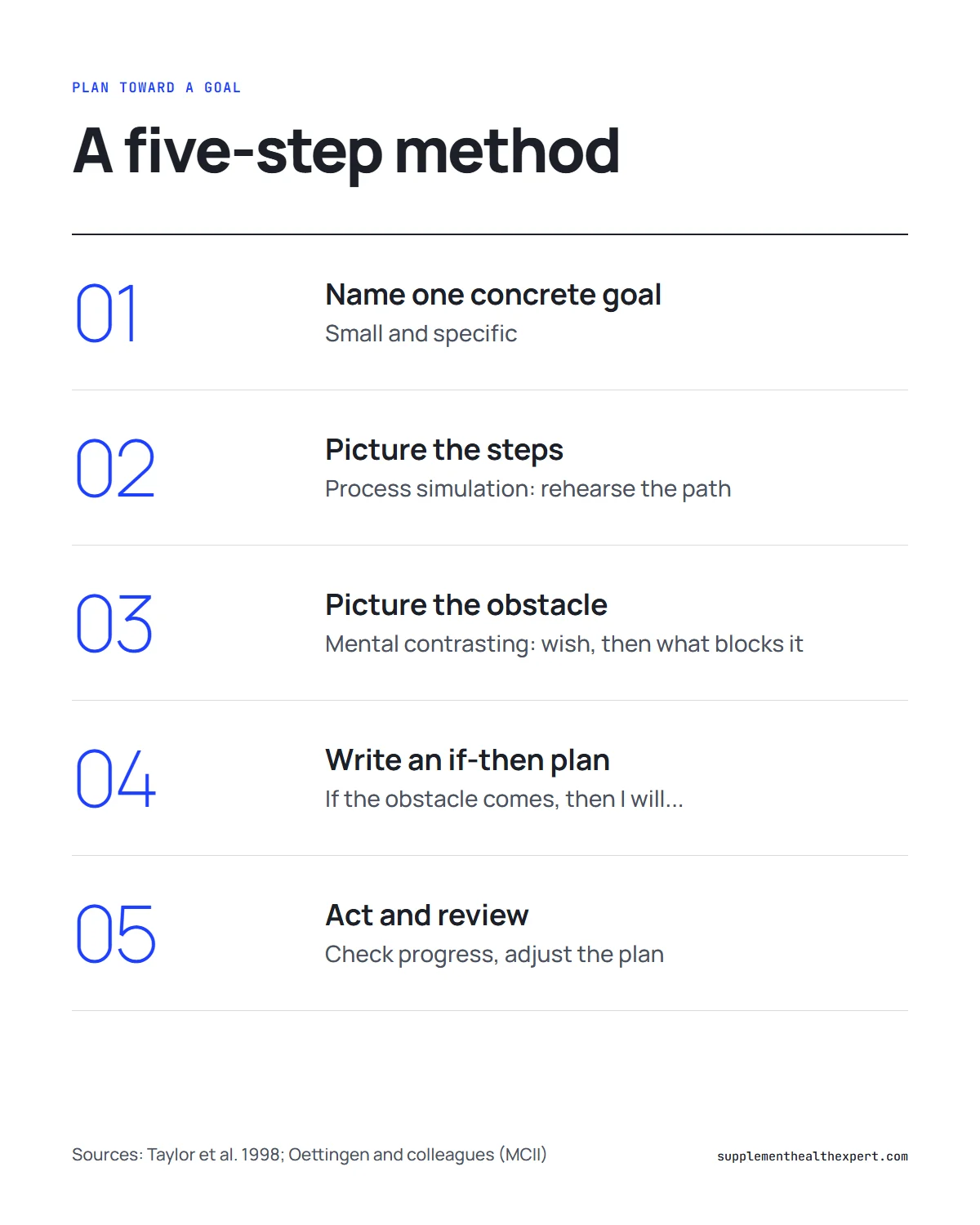
A worked example: building a small cushion
Suppose your goal is to set aside a small emergency amount over the next few months. In plain terms, the five steps look like this:
- Goal. Move a fixed sum into a separate account on each payday.
- Picture the steps. Opening the account, setting the transfer, checking the balance monthly.
- Picture the obstacle. An unplanned bill arrives and the transfer feels impossible.
- If-then plan. “If a bill lands before payday, then I will still move a smaller amount and note it in my budget.”
- Review. Look at progress each month and adjust the amount.
Nothing in this example needs belief in anything unusual, and it asks for steady effort. That effort is what the research is about.
How these methods differ from the product’s promise
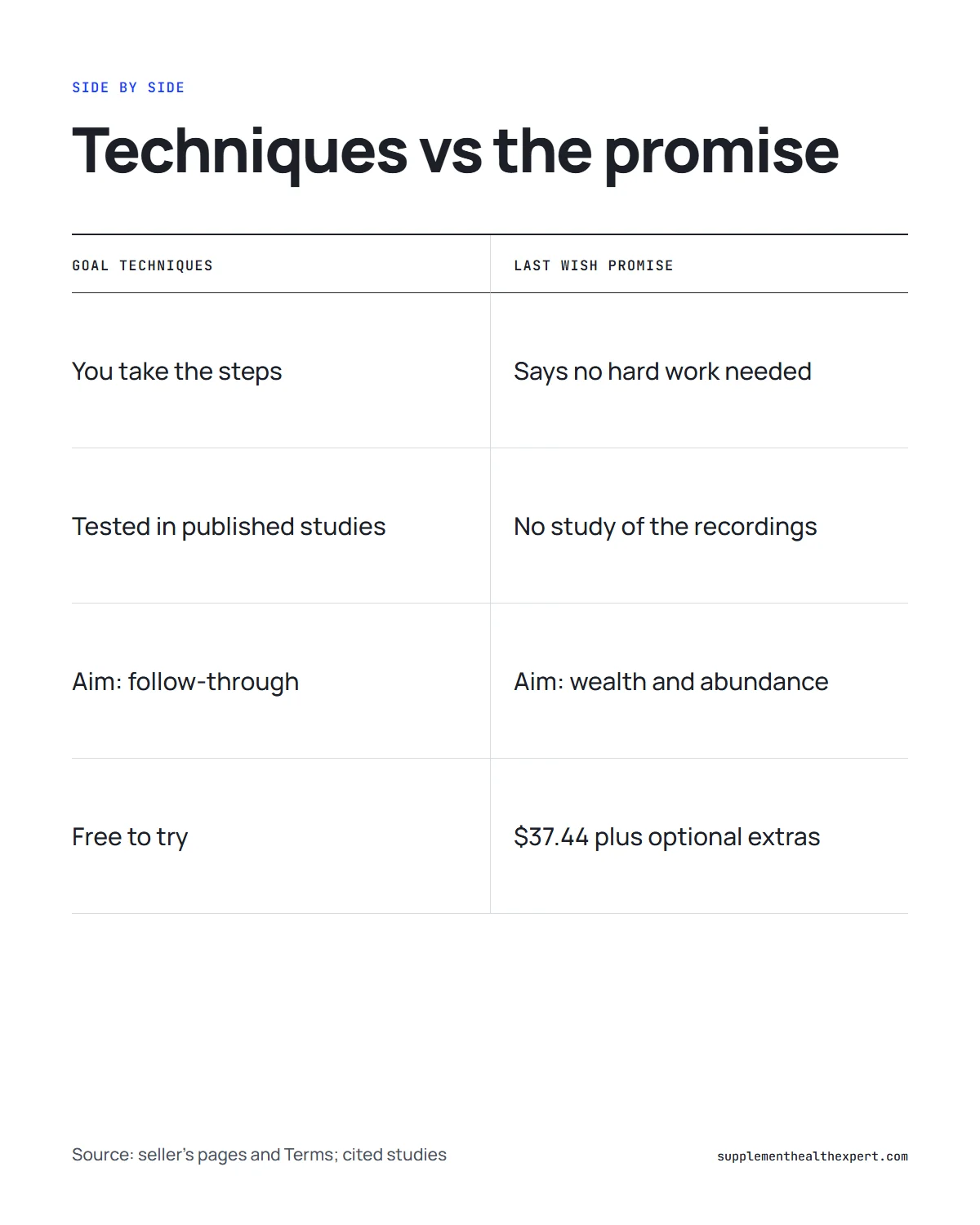
Three differences matter most.
Who does the work. The video says the method works without prayer, meditation, visualization or hard work. Goal techniques depend on you taking the steps. That is a smaller promise, and a more honest one.
What has been tested. Process simulation and mental contrasting have published studies behind them. The recordings do not, and the seller’s pineal gland explanation is not supported either: the gland is mainly known for melatonin and the body clock, and we found no evidence that sound “activates” it or that it affects money. The order page’s mention of research from two universities names no study.
What you can lose. Trying the techniques costs a few minutes. Buying the product costs money, plus the chance of being subscribed to email lists that may include third-party offers and of meeting optional add-ons and upsells.
Common mistakes with goal techniques
Even good methods go wrong in familiar ways, so a few cautions are worth having.
- Picturing only the win. The research point above is that outcome-only imagery lacked the benefits of picturing the steps. Spend most of the time on the path.
- Making the goal too big. “Become rich” gives no first action. Cut it down until the first step fits in an afternoon.
- Skipping the obstacle. It feels gloomy to think about what might block you, but that is the part that makes the plan work when things get hard.
- Writing the if-then line too loosely. “If I am tired, I will try” is weak. “If I am too tired, I will do five minutes” is something you can actually do.
- Never reviewing. A plan you never check cannot be improved. Look at it weekly and change what is not working.
None of these needs money, belief or special equipment, only a little honesty about what usually gets in the way.
Where a quiet nightly routine might fit
None of this means a nightly recording has no place. A fixed, calm slot before sleep can be relaxing, in the way many wind-down habits are. In the video the setup is headphones, darkness and 11 minutes a night. NCCIH, the US government’s complementary health center, notes that melatonin rises as it gets dark, so a dim room is a sensible place to unwind.
A sensible arrangement keeps the two parts separate:
- Daytime or early evening: your goal plan, with its steps, obstacles and if-then lines.
- Bedtime: a short quiet listen, if you enjoy it, as relaxation and reflection.
Use a low volume, keep it away from any task that needs your attention, and see a doctor about sleep problems that persist. The seller’s own Terms tell you not to treat its content as a stand-in for professional medical, financial or legal advice.
If you decide to buy it anyway
Go in with clear eyes. Expect to pay $37.44 according to the seller’s Terms (“normally $309.77” is the seller’s own reference figure), with an add-on and two upsells on offer but optional. Sixty days is the refund period named by the Terms and by ClickBank. Two further numbers float around: a 365-day badge that has no wording behind it, and a 90-day, condition-heavy version on another company’s site (abundant-life.co). Stick with the 60 days, hold on to the receipt, and contact ClickBank (clkbank.com, 1-800-390-6035) if you need help. Its countdown and “Today Only” lines are sales tactics.
If money worry is what pushed you here, a budget and a nonprofit credit counselor come first.
The practical takeaway
Work toward a goal with a clear first step, a picture of the path and an if-then plan for the obstacle. That is what the research supports, and it costs nothing. If you also like a quiet nightly listen, treat it as relaxation and let your plan do the heavy lifting.
Frequently asked questions
What is process simulation in plain words?
It means imagining, in order, the actions you will take to reach a goal, such as what you will do first and what comes next, rather than imagining the happy ending. A 1998 paper by Taylor and colleagues reported that this kind of rehearsal helped people make progress.
What is an if-then plan?
It is a sentence that links a likely obstacle to a response: if this gets in the way, then I will do that. You write it in advance, so you do not have to decide in the moment.
Do these goal techniques guarantee success?
No. Studies suggest they help people follow through, not that any goal is certain. They also work through your own actions, so they cannot replace money, time or support you do not have.
Do I need to buy anything to use them?
No. A pen, paper and a few quiet minutes are enough, which sets it apart from paying $37.44 for audio.
Is it wrong to think positively about my goal?
Not at all. Hope helps people begin. The research point is narrower: imagining only the happy outcome did not give the benefits that picturing the steps did, so pair the hope with a plan.
Can I play the recordings while I follow a goal plan?
Some people might like a calm listening slot before bed alongside a daily plan. Treat it as relaxation only, keep the volume comfortable and never listen while driving.
What if my goal is about money problems?
Start with a budget and consider a nonprofit credit counselor. According to the CFPB, a credit counselor can draw up a budget with you and arrange a debt management plan. That is a more dependable step than any audio.
Sources
- 01 Taylor SE, Pham LB, Rivkin ID, Armor DA. Harnessing the imagination: Mental simulation, self-regulation, and coping. American Psychologist, 1998.
- 02 Valshtein TJ, Oettingen G, Gollwitzer PM. Using mental contrasting with implementation intentions to reduce bedtime procrastination: two randomised trials. Psychology & Health, 2020.
- 03 National Center for Complementary and Integrative Health. Melatonin: What You Need To Know.
- 04 Consumer Financial Protection Bureau. What is credit counseling?
- 05 ClickBank order support (order lookup and refund requests).
last wish manifestation · process simulation · mental contrasting · if-then planning · woop method · nightly wind-down routine