Supplement Reviews / Guide
The Last Wish Reviews: Money, Luck and Love Claims Checked Against the Evidence
The Last Wish reviews keep quoting money, luck and love. We map each outcome to the evidence, treat income stories as unverified and cover the FTC 2024 rule.
- Author
- Supplement Health Expert Editorial Team
- Published
- Reading time
- 9 min
- Sources
- 5 cited
Key takeaways
- 01 The outcomes quoted around this product are money, luck and love; none of them has evidence behind it that we can find, and the seller's Terms say entertainment purposes only.
- 02 The narrator's income anecdotes (a $3,617 day, a $10,137 tax refund, a $2,000 scratch-off) are unverified seller stories and not results any buyer should expect.
- 03 Research supports planning the steps toward a goal and contrasting a wish with obstacles; it does not support wishes or sounds causing money.
- 04 The FTC's 2024 final rule bans fake and bought reviews and requires insiders to disclose connections; a page can still be one-sided without breaking it.
- 05 Copied review pages are easy to spot with a few checks, and the refund that matters is ClickBank's 60 days.
The Last Wish reviews tend to repeat the same three promises: more money, better luck and more love. This page takes each one in turn and sets it beside what we can actually check. We worked from the seller’s saved order page, video page, Terms and ClickBank checkout (2026-10-09), and from published research. We also cover the FTC’s 2024 rule on fake and paid reviews and give you a short method for spotting copied review pages.
Think of this as a third-party analysis: the seller has no say in it. Orders placed through our affiliate buttons may earn us a commission.
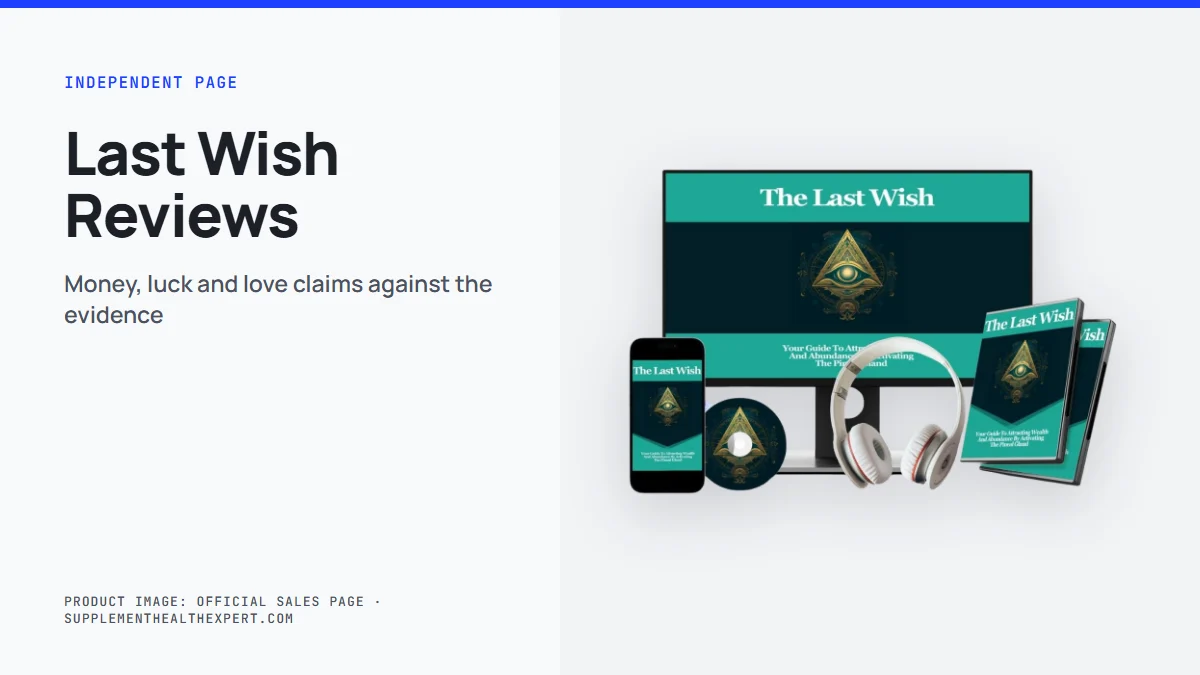
Last Wish reviews and the three outcomes people quote
Before the details, here is the overview. The wording of each outcome comes from the seller’s video and order page. The right-hand column is our reading, not the seller’s.
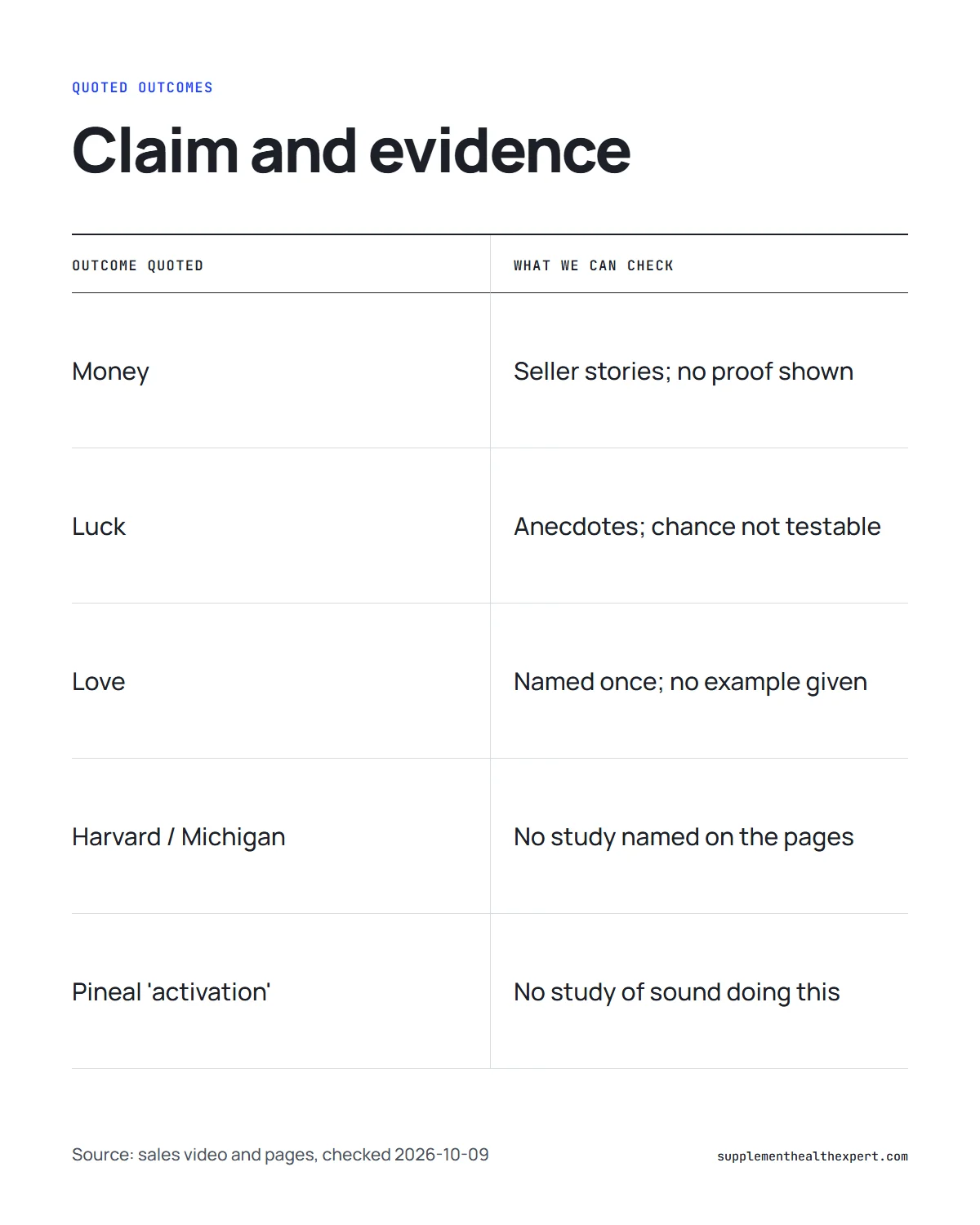
| Outcome quoted | Where it comes from | What we can check |
|---|---|---|
| Money and “effortless wealth” | Video and order page | Only the narrator’s anecdotes; no study of the recordings |
| Luck | Video | Anecdotes; luck cannot be tested this way |
| Love | One line in the video | Named once, with no example |
| “Backed by research” | Order page | No study, author or link named |
| Pineal gland “activation” | Video and gifts | No published evidence that sound does this |
The seller’s own Terms open with “For Entertainment Purposes Only” and describe brain entrainment techniques as “not exact sciences”. That framing is the best guide to how seriously the outcomes should be taken.
Outcome one: the money stories
The video’s central examples are all income stories. The narrator says he made $3,617 in commissions in one day, received a $10,137 refund from the IRS for overpaid tax two years earlier, and won $2,000 on a scratch-off ticket. We list them only so you know what is being claimed. They are unverified seller stories, told by a narrator who calls himself Danny Kelly, and the site’s Terms add that names “may be changed or represented by pen names” and that “some scenarios may be dramatized”. We would not read any of them as a result a buyer can expect, and neither should a review.
Look at the logic too. A tax refund depends on whether you overpaid. A commission day depends on your job and your customers. A scratch-off prize depends on chance. None of these has a plausible link to listening to an audio file, and the seller offers no records that would let anyone check.
If money is tight for you right now, we would rather you did not rely on any of this. Tracking your spending and talking to a nonprofit counselor are well-trodden routes. The CFPB’s page helps you weigh a credit counselor against a debt settlement firm, and the $37.44 is probably better held back for bills you know are coming.
Outcome two: luck
The video says near the start that the secret has nothing to do with luck and, later, that “it wasn’t luck at all”. Yet its story is full of events that look like chance: a flat tire and an IRS letter in the early days, then a refund and a scratch-off win later. Ups and downs like these happen to people constantly. When a story is told backward, with the good days credited to a nightly listen and the bad days left out of the explanation, it can feel persuasive without proving anything.
Researchers have examined what mental habits do help. A well-known set of studies by Taylor and colleagues found that imagining the process of reaching a goal produced progress, while picturing the finished success did not. Nothing in that work suggests wishes, sounds or “activation” change the odds of a windfall.
Outcome three: love
Love is the thinnest of the three. In the video it appears once, in the list “money, opportunity, love or something else”, and the narrator also mentions that he kept the love of his wife. There is no case study, no detail and no method that speaks to relationships. If you want better relationships, the dependable inputs are time, honesty and, where needed, a counselor, not a recording.
What research does support, in plain terms
Two practical findings keep turning up. First, planning the steps works better than daydreaming the result. Second, pairing a wish with a realistic look at the obstacles, then deciding in advance what you will do, helps people act. Oettingen and colleagues have also reported that positive fantasies about the future predicted more depressive symptoms over time, so enthusiasm alone is not harmless. A calm nightly wind-down in a dark room may feel relaxing, which is a modest and fair benefit. It is not evidence that money arrives.
The order page also says the audio is “Backed By Research From Harvard and University of Michigan”. It names no study, and we could not find one linked to this product, so treat the line as a marketing claim.
The FTC’s 2024 rule on fake and paid reviews
In August 2024 the U.S. Federal Trade Commission announced a final rule against fake reviews and testimonials. As summarized in its announcement, the rule:
- bans fake or false reviews, including AI-generated ones and reviews by people who never used the product;
- bans buying reviews, or offering incentives tied to a positive or negative sentiment;
- requires insider reviews to disclose the writer’s material connection to the business;
- bars businesses from posing as independent review sites that they control;
- bans using threats or intimidation to suppress negative reviews;
- bans buying fake followers or views for commercial influence; and
- lets the FTC seek civil penalties from knowing violators.
For you as a reader, the useful points are the disclosure and independence ones. The seller’s Terms say some testimonials “may have been compensated or incentivized in line with guidelines on consumer endorsements” and that testimonials are not verified. We are not saying anything has been breached. We are saying a testimonial on a sales page is a different kind of evidence from an independent account, and a page that hides a financial connection deserves less trust. That includes ours: we earn a commission, and we tell you so.
How to spot copied review pages
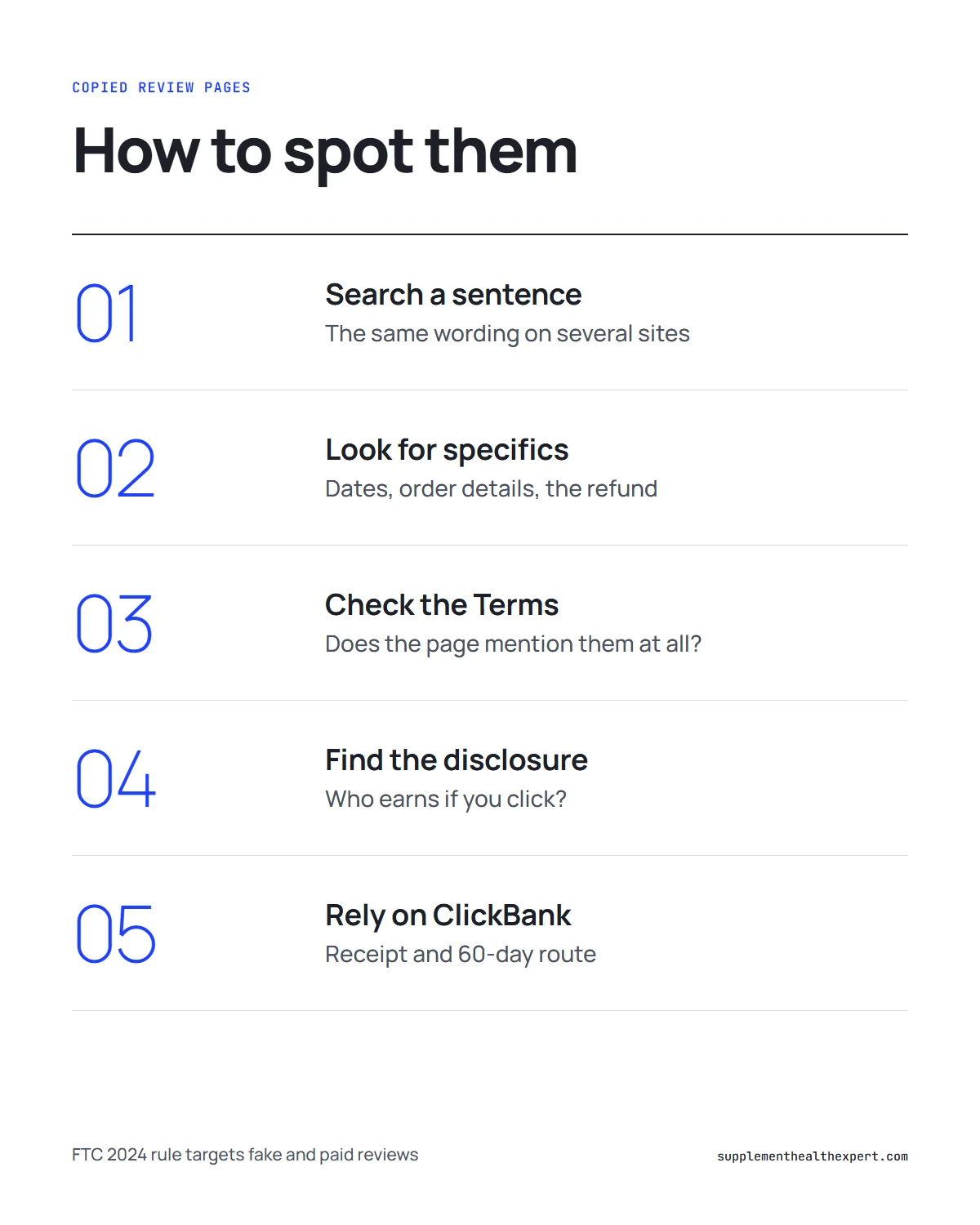
Many review pages are assembled from the seller’s own copy. These checks take a couple of minutes.
- Search a sentence. Paste a distinctive line from the page in quotation marks. If the same wording appears on several sites, it probably came from one source.
- Look for specifics. A real account names a date, what arrived and how the refund process worked. Copied pages repeat prices, gift names and urgency lines.
- Check the Terms. Does the page mention the entertainment wording, the pen names or the refund conflicts? Copies of the sales pitch usually skip them.
- Find the disclosure. Who earns money if you click? Pages should say so near the top.
- Fall back on paper. ClickBank is the retailer, the Terms and checkout give 60 days, and your receipt matters more than any review.
The refund conflict in one line
A “365-DAY MONEY BACK GUARANTEE” badge shows on the sales pages with no text behind it, and the video page’s footer links to another company’s terms (abundant-life.co) with a 90-day window, 30 days of proof of use and a “final and binding” decision. Build your plans on the 60 days, hold on to the receipt, and reach ClickBank at 1-800-390-6035 or clkbank.com if you need a refund.
Why these outcomes are so hard to test
A claim is only useful if someone could, in principle, show it wrong. “You will simply receive whatever you desire” fails that test, because any good event can be counted as proof and any bad one as a delay. The video itself builds this in: it says benefits grow from day three to day ten to day 30, and that how much you receive is up to you. If nothing happens, the fault can always be placed on how you listened.
A fair test would need a few things the seller does not offer. It would define the outcome beforehand, for instance a specific income figure over a set period. It would record a baseline. It would compare people who listened with people who did not, ideally without knowing which group they were in. And it would be published with its method. No study like that has been shown for these recordings, and the “Harvard and University of Michigan” line points to none.
Until such a test exists, the sensible stance is the one the Terms themselves take: entertainment, not an exact science, and no substitute for professional advice in money, health or law. You can enjoy a nightly ritual and still keep your financial decisions on solid ground.
A calmer way to test it yourself
If you still want to see for yourself, treat it as a personal experiment with a clear exit. Note your starting point, listen as the seller describes (headphones, dark room, once a night), write down one concrete goal with its first steps, and decide your refund date in advance. Listen at a comfortable volume and never while driving. This is not medical, financial or legal advice. For the scored verdict, see our independent verdict, and for a guide to reading seller-side feedback, our look at what reviews exist.
Frequently asked questions
Do people really get money after listening?
The only money stories we can point to come from the seller's own video, told by a narrator who calls himself Danny Kelly. We cannot verify them, and the Terms allow pen names and dramatized scenarios, so we do not treat them as results.
Is there evidence for the luck claim?
No. Windfalls such as a tax refund or a small lottery prize happen to some people anyway, and there is no way to show that a recording caused them. The video also says the method has nothing to do with luck, while its story includes a scratch-off win.
What about the love outcome?
Love is named once as something you may simply receive, alongside money and opportunity. No example, study or detail is given for it.
What does the FTC's 2024 rule change for reviews?
It bans fake or AI-generated reviews, bought positive or negative reviews, undisclosed insider reviews and fake social media followers, and it lets the FTC seek civil penalties from knowing violators.
How can I tell if a review page was copied?
Search a sentence in quotation marks, look for identical headings across sites, and check whether the page offers any detail the sales page does not. Pages that repeat the same claims, prices and urgency lines word for word are usually copies.
Are the Harvard and Michigan mentions proof?
No. The order page invokes research from those two universities without citing anything specific, and our own search found no study connected to this product.
Is a 365-day guarantee really offered?
A badge says so, but the seller's Terms and the ClickBank checkout both give 60 days, and another company's pages in the funnel give 90. Plan around the 60 days.
What should I do if I am struggling with money?
Start with a budget and a nonprofit credit counselor rather than a recording. The CFPB explains how to choose between a credit counselor and a debt settlement company.
Sources
- 01 U.S. Federal Trade Commission. Final rule banning fake reviews and testimonials (August 2024).
- 02 Oettingen G, Mayer D, Portnow S. Pleasure now, pain later: positive fantasies about the future predict symptoms of depression. Psychological Science, 2016.
- 03 Taylor SE, Pham LB, Rivkin ID, Armor DA. Harnessing the imagination: mental simulation, self-regulation and coping. American Psychologist, 1998.
- 04 Consumer Financial Protection Bureau. Debt collection and credit counseling resources.
- 05 ClickBank customer service: order lookup and support.
last wish reviews · manifestation claims · ftc fake reviews rule · income claims · copied review pages