Supplement Reviews / Guide
The Last Wish Review: Our Independent Verdict, Price, Refund Promises and 3.8/10 Score
Our independent The Last Wish review: what you get for $37.44, claims versus evidence, four conflicting refund promises and a 3.8/10 editorial score.
- Author
- Supplement Health Expert Editorial Team
- Published
- Reading time
- 10 min
- Sources
- 4 cited
Key takeaways
- 01 You pay $37.44 for digital audio recordings plus three gifts: a guide, a pineal gland plan and scripts. The number and length of the recordings are not stated.
- 02 The sales story (a dying man, a priest, a Vatican parchment) is unverified, and the site's Terms allow pen names and dramatized scenarios.
- 03 The headline claims are not supported by any study we can find, and the Terms describe the products as entertainment only.
- 04 Four different refund promises appear across the funnel. Go by the 60 days in the Terms and ClickBank checkout, and keep the receipt.
- 05 Our editorial score is 3.8/10: a cheap, low-risk nightly routine, wrapped in marketing that overreaches.
This is our The Last Wish review, written after reading the seller’s order page, video page, Terms and ClickBank checkout (all saved 2026-10-09) and watching the 25-minute sales video. In short: you get a short digital audio routine for $37.44, sold with a dramatic origin story, income anecdotes and a “pineal gland” theory that nothing we can find supports. It is cheap and the refund window is real, which keeps the score from sinking lower than 3.8 out of 10.
We run this site on our own, separate from the seller. The order buttons carry our affiliate tracking and can earn us a commission, which is worth keeping in mind as you read the score.

The Last Wish review in one minute
| Question | Short answer |
|---|---|
| What is it? | Digital audio recordings, listened to with headphones in a dark room |
| Price | $37.44 per the Terms and order page; the video page shows 37.11 |
| Gifts | A guide, a pineal gland plan and wealth scripts |
| Evidence | None tested on these recordings; the Terms say entertainment only |
| Refund | 60 days (Terms and ClickBank), with conflicting versions elsewhere |
| Our editorial score | 3.8/10 |
What you get for your money
The product is called “The Last Wish”, and the narrator says “I call these recordings the last wish”. The sales page describes it as “The First Pineal Gland-Activating Audio Recording”. Here is what is on offer, with our notes.
- The recordings. The seller wants you wearing headphones, seated in the dark, once per night, and the video puts a session at 11 minutes. The order page offers a different figure, “under 7 minutes”, and its headlines use “7-Sec Ritual” and “2:11s”. Because we could confirm neither the number of recordings nor their lengths, we state no track count and no total runtime.
- Gift 1, The Last Wish Official Guide. A how-to booklet for using the audio well.
- Gift 2, The Pineal Gland Decalcification Plan. Practical steps the seller links to the gland, and through it to wealth.
- Gift 3, The Wealth Scripts. Scripts to read while you listen.
Delivery is digital and access is immediate once payment is approved, according to the checkout, though the order page does not say whether files come by email or a members area. The disc and DVD cases drawn on the mockup are decoration.
The story and the claims, checked
The narrator calls himself Danny Kelly. He says his time is near, and that about 20 years ago a priest told him of a parchment in the Vatican archives. None of that can be checked. The seller’s own Terms say that “Names and details in marketing materials may be changed or represented by pen names” and that “Some scenarios may be dramatized for entertainment purposes”. On that basis we do not present the priest, the parchment or the dying-man framing as fact. One small fact for context: the archive he names has been called the Vatican Apostolic Archive since 2019.
| What the seller says | What we can say |
|---|---|
| Sound makes calcite crystals in the pineal gland vibrate and “activate” it | No published evidence of this, and none for these recordings |
| The pineal gland “has a retina” | The human pineal gland has no retina; light reaches it indirectly via the eyes |
| “Cherubim” and “cerebrum” share a root | “Cherub” is Hebrew and “cerebrum” is Latin |
| The product is “backed by research from Harvard and University of Michigan” | No study, author or link is given on the pages |
| Recordings bring money, opportunity or love | Unproven; the Terms say “For Entertainment Purposes Only” |
What science does say is modest. The pineal gland makes melatonin and helps set sleep timing, and the NCCIH describes melatonin as a hormone the brain produces in response to darkness, and says light at night can block it. So a dim, quiet bedtime can support a sleep routine. Studies of mental techniques point the same way: imagining the steps toward a goal, as in Taylor and colleagues’ work, led to progress, while picturing only a rosy outcome did not. Positive fantasies about the future have been linked in Oettingen’s studies to more depressive symptoms over time, with low success as part of the pattern. Nothing shows that wishing causes money.
The video’s income stories (a $3,617 day, a $10,137 tax refund, a $2,000 scratch-off) are the narrator’s own claims, unverified, and not results anyone can expect.
Price and what shows up at checkout
The base price is $37.44, one time, per the Terms of Sale and the order page. The video page’s 37.11 is a small mismatch, and “Normally $309.77” is the seller’s reference price rather than a verified past price. ClickBank handles the payment, shows local currency plus tax, and the charge appears as CLKBANK*TheLastWish. An optional add-on, The Wealth Wave Technique, is offered at checkout (its image is labeled “Wealth Miracle: The Guided Recordings”). The Terms also name two further offers, priced at $97.19 (The Abundance Brain Accelerator) and $47.19 (The Abundance Sequence). Both are optional. The countdown timer, “Today Only” and “could be taken down” lines are sales tactics, not deadlines. Buyers may also be added to email lists that carry third-party offers, with an unsubscribe link in each message.
The refund promises, side by side
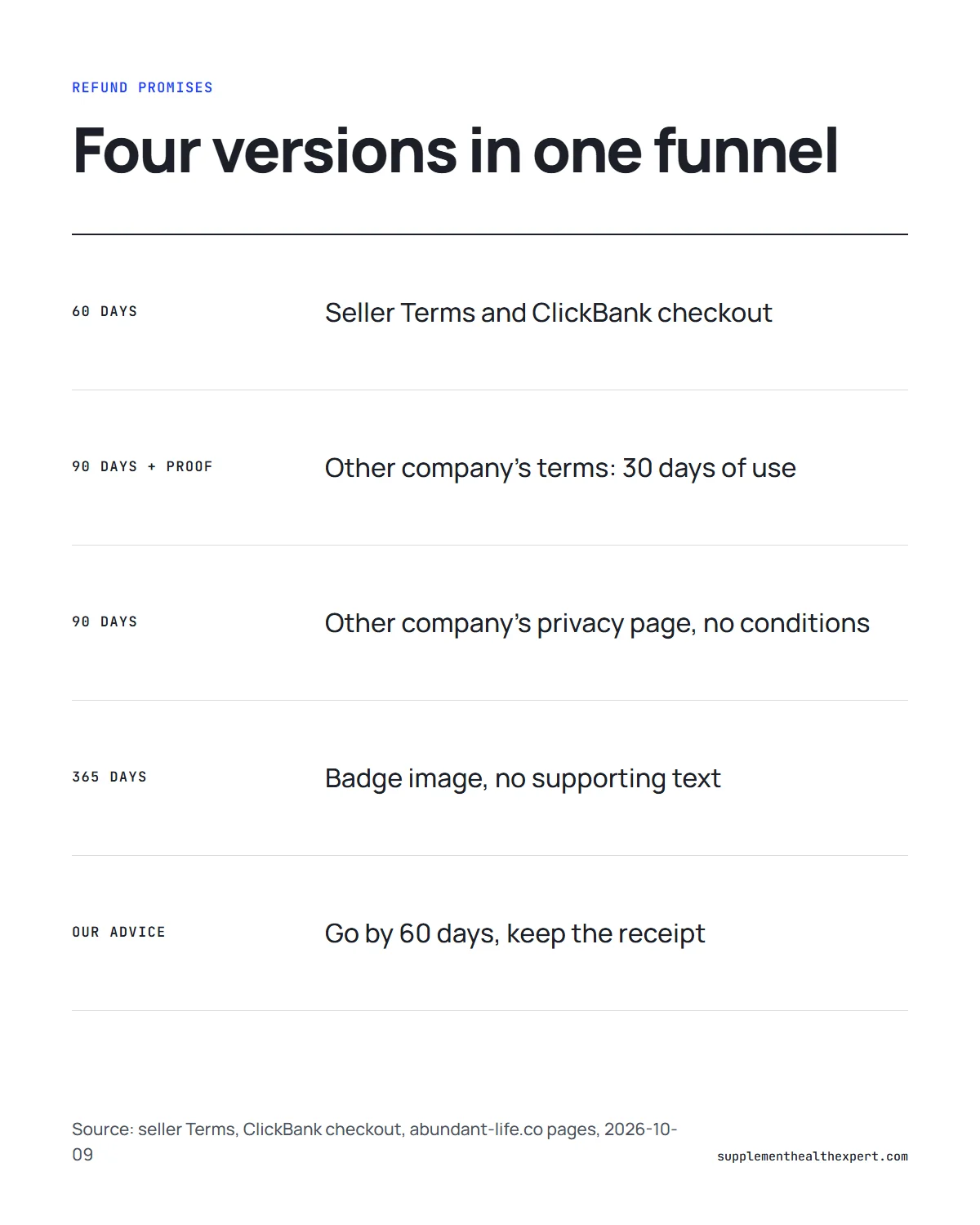
This is where the funnel is messiest. We found four versions:
- 60 days. The seller’s Terms say a refund can be requested within 60 days of purchase, and the ClickBank checkout allows return or replacement within 60 days.
- 90 days with proof of use. A footer link on the video page goes to terms on abundant-life.co. They ask for 30 consecutive days of use, documented proof and a request inside 90 days, and call the company’s ruling “final and binding”.
- 90 days, no conditions. The privacy page on that same domain promises a full refund within 90 days.
- 365 days. A guarantee badge on the sales pages, with no text behind it.
Our advice is to go by the 60 days, because ClickBank is the retailer and processes refunds under its own policy. Keep the confirmation email, and contact ClickBank at 1-800-390-6035 or through clkbank.com. Do not wait until day 59.
How we score The Last Wish: 3.8/10
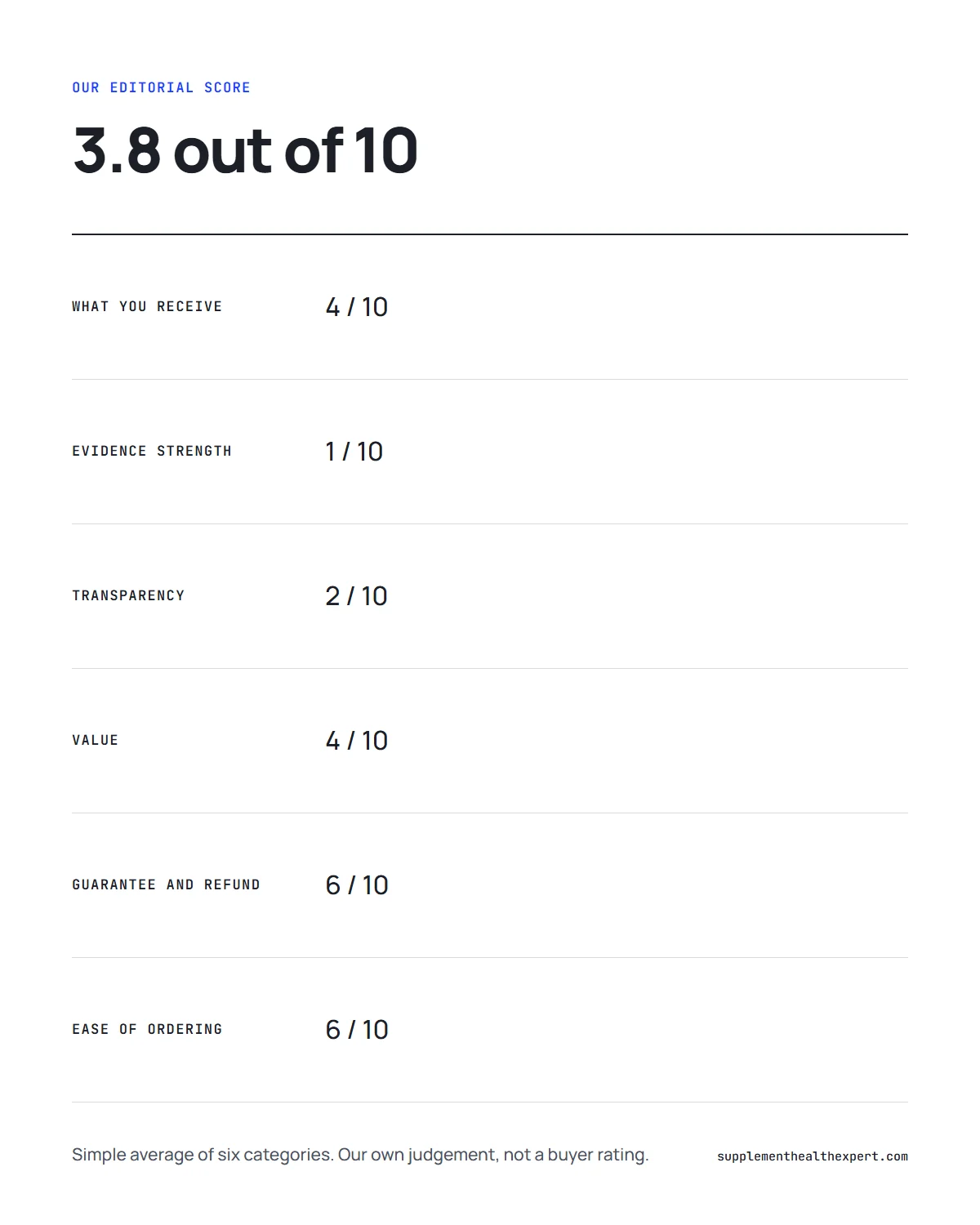
The overall figure is the simple average of six categories, as explained in our methodology. It is our editorial score, not a buyer rating.
What you receive: 4/10
A digital audio routine and three guides is a thin package, and the key facts (count, length, delivery method) are not disclosed. The gifts are described mostly in terms of the wealth claims.
Evidence strength: 1/10
No study tests these recordings, the “Harvard and University of Michigan” line names nothing, and the pineal “activation” mechanism has no support. The Terms themselves say entertainment purposes only.
Transparency: 2/10
An unverifiable narrator, pen names, dramatized scenarios, income anecdotes, urgency tactics and a mismatch in the price all push this down. Credit goes to the Terms for stating the entertainment framing.
Value: 4/10
$37.44 is not much money, but there is nothing to measure it against, and the “$309.77” comparison is unverified.
Guarantee and refund: 6/10
A real 60-day route through ClickBank is a strong point. It loses marks because three other promises contradict it.
Ease of ordering: 6/10
Checkout is a standard ClickBank page with card and PayPal logos, immediate digital access and no subscription shown. It loses points for optional extras, email-list signup and unclear delivery.
Who it suits, and who should pass
It may suit a reader who enjoys a brief evening ritual, is drawn to spiritual-themed audio, is content to treat it as entertainment and can spare $37.44 without strain. Pair it with a written goal and some real steps toward it, and the routine becomes a reason to sit with your plans for a few minutes. Our companion page on what reviews exist covers how to read any feedback you meet.
It does not suit anyone expecting income, anyone short of money (a spending plan and a nonprofit counselor are better uses of your time; the CFPB lays out the options), or anyone who would be hurt by a product that promises effortless wealth. Keep the volume gentle, skip headphones behind the wheel, and leave health, money and legal questions to qualified professionals.
How the score compares with the sales pitch
The gap between our number and the sales page is the story of this product. The seller’s pages present wealth and abundance as the expected result, and they stack urgency on top: a timer, “Today Only” and the warning that the video could vanish. Our score looks at what can be shown. A checkout that works, a refund route through a large retailer and a modest price earn real points. A story that cannot be checked, a mechanism with no support and refund promises that contradict each other lose them.
If you want to move the number up in your own mind, ask what would change it. A named study of these recordings would lift the evidence score. Printed track counts and running times would lift what you receive and transparency. One refund statement repeated everywhere would lift the guarantee score. Until then, 3.8 is a fair summary of a product that costs little and promises a great deal.
Our bottom line
The Last Wish is a low-cost, low-risk purchase if you read the Terms, trust the 60-day route and expect a calm routine rather than riches. It is not low-risk if you believe the marketing. For a faster overview, see our quick guide.
Related reading
Frequently asked questions
What do I actually receive after paying?
Digital audio recordings, plus three gift items the seller lists: The Last Wish Official Guide, The Pineal Gland Decalcification Plan and The Wealth Scripts. How many tracks there are, how long they run and how they are delivered is not shown before you buy.
Does it work?
The seller says it can bring wealth and abundance, but we found no study of these recordings and its own Terms call its content entertainment only. At most, a quiet listening habit may feel relaxing.
How is the 3.8/10 worked out?
It is the simple average of six categories we score from 0 to 10: what you receive, evidence strength, transparency, value, guarantee and refund, and ease of ordering. It is our editorial opinion, not a buyer rating.
Why is the price shown as both 37.44 and 37.11?
The order page and the Terms say $37.44, while the video page shows 37.11 for the same offer. We use the Terms figure, and your checkout may show local currency plus tax.
What is the 'Normally $309.77' price?
It is the seller's reference price. We have no evidence that the product has ever sold at that level, so treat the saving as marketing.
Will I be pushed to buy more at checkout?
There is an optional add-on called The Wealth Wave Technique, and the Terms name two upsells, The Abundance Brain Accelerator at $97.19 and The Abundance Sequence at $47.19. All are optional; the base purchase works without them.
Who should avoid it?
Anyone who needs a guaranteed outcome, anyone short of money, and anyone who would feel cheated by a product that is sold as entertainment. Nobody should skip medical or financial help because of it.
Sources
- 01 NCCIH. Melatonin: What You Need To Know.
- 02 Taylor SE, Pham LB, Rivkin ID, Armor DA. Harnessing the imagination: mental simulation, self-regulation and coping. American Psychologist, 1998.
- 03 Oettingen G, Mayer D, Portnow S. Pleasure now, pain later: positive fantasies about the future predict symptoms of depression. Psychological Science, 2016.
- 04 ClickBank customer service: order lookup and support.
the last wish review · the last wish score · pineal gland audio · manifestation recordings · clickbank refund