Ingredients / Guide
LeanBiome Ingredients: The Full Label, Line by Line, Explained
LeanBiome ingredients in plain English: every Supplement Facts line per two capsules, 20 billion CFU by our sum and the capsule materials.
- Author
- Supplement Health Expert Editorial Team
- Updated
- Reading time
- 8 min
- Sources
- 0 cited
Key takeaways
- 01 Two delayed-release capsules make one serving, and a 60-capsule bottle holds 30 servings.
- 02 Nine bacteria species supply 20 billion CFU, which is our sum of the three printed probiotic figures.
- 03 The seven blend strains share one 10 mg figure, while every label line carries a dose.
- 04 Inulin, a decaffeinated green tea phytosome, Sphaeranthus indicus and mangosteen complete the panel.
- 05 The seller says the delayed-release capsule helps the live bacteria reach the gut.
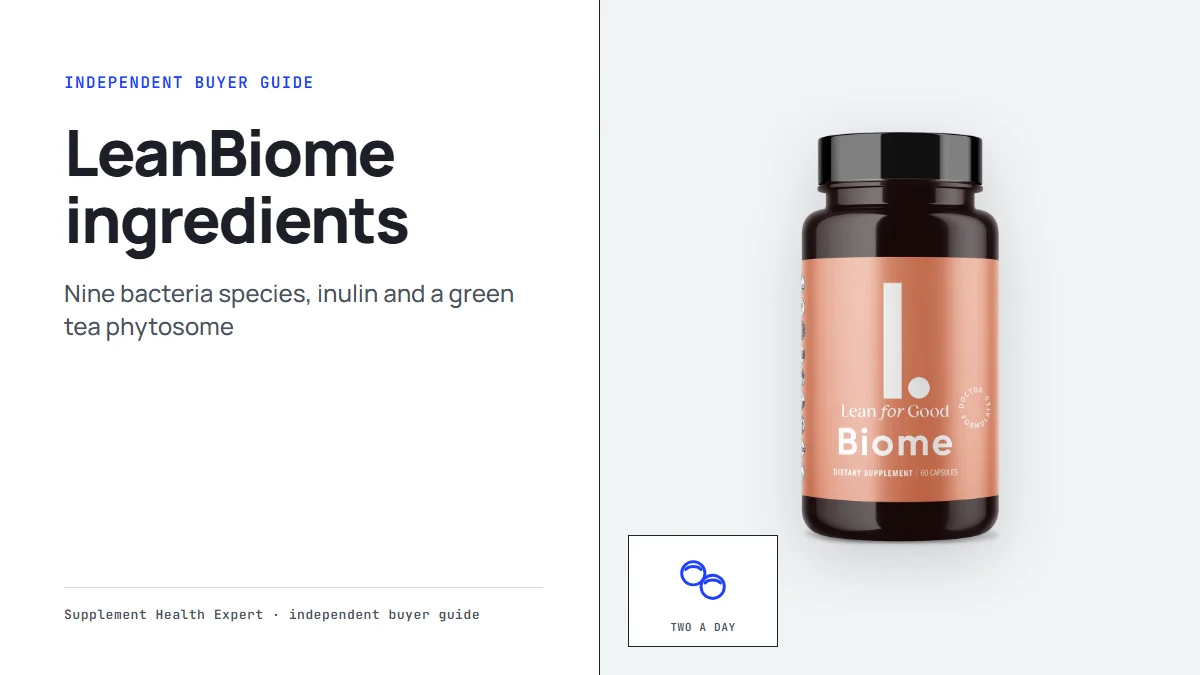
The best way to judge a capsule is to read what is printed on it, so here are the LeanBiome ingredients exactly as the Supplement Facts panel lists them. The panel is compact, with seven lines and a dose beside each, and below we say what every line is in plain words. Any purpose we mention belongs to the seller or to traditional use, never to us.
The LeanBiome Supplement Facts Panel
A serving is two delayed-release capsules, so a bottle of 60 gives you 30 servings. Figures below are per serving.
| Ingredient | Per 2 capsules |
|---|---|
| Lactobacillus gasseri | 25 mg (10 billion CFU) |
| Lactobacillus rhamnosus | 10 mg (5 billion CFU) |
| Proprietary blend: L. fermentum, L. paracasei, L. plantarum, Bifidobacterium bifidum, B. lactis, B. longum, B. breve | 10 mg (5 billion CFU) |
| Inulin (chicory root) | 200 mg |
| Green Tea Phytosome (decaffeinated green tea leaf extract with sunflower phospholipid) | 300 mg |
| Sphaeranthus indicus | 300 mg |
| Garcinia mangostana (mangosteen pericarp) | 100 mg |
The label sets no Daily Value for these lines. Our own arithmetic adds the three bacteria entries to 20 billion CFU, since no grand total is printed. Seven strains in the blend share a single 10 mg figure.
The Live Bacteria, Line by Line
Lactobacillus gasseri (10 billion CFU). This opens the panel and carries the biggest count, half of our 20 billion. It is a Lactobacillus species that shows up regularly in probiotic research.
Lactobacillus rhamnosus (5 billion CFU). A second Lactobacillus species, widely used in probiotic products. It takes the second line.
The seven-strain blend (5 billion CFU). Three Lactobacillus strains (fermentum, paracasei, plantarum) and four Bifidobacterium strains (bifidum, lactis, longum, breve) sit together here. The label prints one total for the group, which is why we describe the blend as sharing one figure while the panel still gives a dose on every line.
Counted together, that is nine species. CFU means colony-forming units, the usual way to count live bacteria, and that is why these lines read in billions while the plant lines read in milligrams.
The Plant and Fiber Lines
Inulin, 200 mg. A soluble fiber found in chicory root. People often call inulin a prebiotic, meaning a food that gut bacteria can use, so it makes a natural partner for the live cultures beside it.
Green Tea Phytosome, 300 mg. A decaffeinated extract of green tea leaf (Camellia sinensis) joined with a phospholipid from sunflower. A phytosome is simply a plant extract combined with a phospholipid. The seller calls its version Greenselect Phytosome.
Sphaeranthus indicus, 300 mg. A herb with a long record of traditional use in South Asia. It shares the largest weight on the panel with the green tea line.
Garcinia mangostana, 100 mg. Mangosteen, a tropical fruit with a thick purple rind. The label specifies the pericarp, meaning that rind, and the fruit has a place in traditional Southeast Asian practice.
What the Seller Says the Formula Is For
In the seller’s words, LeanBiome is meant to support a balanced gut microbiome inside a weight-management routine. That aim describes the product overall and does not claim a result for any single line. Lean for Good also credits the acid-resistant capsule with helping its bacteria arrive in the gut. Both are the seller’s statements, and the LeanBiome hub keeps them beside the rest of the product facts.
Other Ingredients
Five materials make up the capsule: hydroxypropyl methylcellulose, microcrystalline cellulose, magnesium stearate, silicon dioxide and gellan gum. Lean for Good describes the product as vegan friendly, free of gluten, dairy, egg, soy, nuts, crustaceans, GMOs and BPA, and made in an FDA-inspected, cGMP-certified US facility. All of that comes from the seller. Allergy or diet rules? Read the panel on your own bottle.
The Delayed-Release Capsule
Live bacteria face a tough journey, because stomach acid is not friendly to them. The seller says LeanBiome’s acid-resistant, delayed-release capsule is built to help the bacteria get through to the gut. It is a seller statement, and we pass it on as one. Practically, that is why the capsules are swallowed whole, and why the seller leans toward a morning dose.
How the Pieces Fit Together
Read top to bottom, the panel follows a simple idea. The first three lines are the live bacteria. Inulin comes next as a fiber that bacteria can use. Then three plant lines finish the formula: a decaffeinated green tea phytosome, Sphaeranthus indicus and mangosteen. Lean for Good presents the whole as a single daily step designed to support a balanced gut microbiome within a weight-management routine. Whether that suits you is a personal call, and the label gives you what you need to make it.
Reading the Panel by Weight
Milligrams tell a different story from CFU, so here is the same label sorted by weight.
| Ingredient | Weight per serving | Position |
|---|---|---|
| Green Tea Phytosome | 300 mg | Joint heaviest |
| Sphaeranthus indicus | 300 mg | Joint heaviest |
| Inulin | 200 mg | Third |
| Garcinia mangostana | 100 mg | Fourth |
| L. gasseri | 25 mg | Largest bacteria line |
| L. rhamnosus | 10 mg | Second bacteria line |
| Seven-strain blend | 10 mg in total | Shared by seven strains |
Bacteria weigh very little, so the probiotic lines look small next to the plant extracts, even though they carry the billions.
How to Take It
Take two capsules daily with water, morning and pre-breakfast being the seller’s preference. One bottle is a month, which makes two bottles 60 days, three 90 days and six 180 days. Three to six months is the seller’s suggestion, and no one can say when a change might appear. Our LeanBiome review explains how we scored the offer 9.0/10, with 9.2 for ingredients.
A Note on Strain Names
Probiotic names look intimidating, yet they follow a simple pattern: a genus, a species and sometimes a strain code. Lactobacillus and Bifidobacterium are the two genera on this label, and the abbreviated forms in the blend (L. for Lactobacillus, B. for Bifidobacterium) save space on the panel. The blend does not print strain codes, so we describe only what is printed. Our price guide shows what each package costs if you decide the label suits you.
What Makes This Label Easy to Use
You do not need a chemistry degree to work through this panel. Find the serving, read down the seven lines, note which ones are live bacteria and which are plant or fiber ingredients, and finish with the capsule materials. In about two minutes you will know what you are swallowing each morning, and you can ask a pharmacist about anything that raises a question.
Handy Questions for a Pharmacist
A short list to carry along if you want a professional to look the label over:
- Does any line overlap with other supplements I take?
- Is this suitable while I am pregnant, nursing or on medicine?
- Does my immune status change how I should start a probiotic?
Keep taking prescribed medicines. A pharmacist can read a Supplement Facts panel in a couple of minutes.
Why a Short Label Helps You
A compact panel invites comparison. You can set LeanBiome beside anything else on your shelf and match the lines yourself. The LeanBiome overview puts the label next to the packages, the ingredients fact sheet has a second view of it, and the safety notes cover how to start.
Choosing a Package
Six bottles come to $294: that is $49 each, about $1.63 a day, with no US shipping charge and free digital bonuses (a 21-recipe smoothie eBook among them). Three bottles are $207, or $2.30 a day. Two are $158, roughly $2.63 a day. Guarantee cover is the same on all three, 180 days from the order date. Shipping is excluded from the daily figures.
Frequently asked questions
What are the main LeanBiome ingredients?
Lactobacillus gasseri, Lactobacillus rhamnosus, a blend of seven more strains, inulin, a green tea phytosome, Sphaeranthus indicus and Garcinia mangostana.
How many bacteria species are in LeanBiome?
Nine: the two named Lactobacillus species plus the seven strains in the blend.
How many CFU does a serving hold?
The label prints 10 billion, 5 billion and 5 billion CFU for the three probiotic lines. Adding them gives 20 billion CFU, our own sum.
Is the green tea decaffeinated?
The label describes a decaffeinated green tea leaf extract paired with sunflower phospholipid. The seller calls it Greenselect Phytosome.
What is the capsule made from?
The other ingredients are hydroxypropyl methylcellulose, microcrystalline cellulose, magnesium stearate, silicon dioxide and gellan gum.
Should I show the label to my doctor?
It is a sensible step if you are pregnant, nursing, on medicine or living with a medical condition. The label itself asks you to consult a physician in those cases.
leanbiome ingredients · leanbiome supplement facts · leanbiome label · lactobacillus gasseri · green tea phytosome · sphaeranthus indicus · garcinia mangostana