Ingredients / Guide
NeuroPrime Ingredients: The Nine Plants in the Bottle Explained
NeuroPrime ingredients in plain words: moringa, pine bark, ginkgo, tamarind, lion's mane, chlorella, bacopa, spirulina and neem in one daily liquid.
- Author
- Supplement Health Expert Editorial Team
- Updated
- Reading time
- 8 min
- Sources
- 0 cited
Key takeaways
- 01 The seller names nine plant ingredients: moringa, pine bark extract, ginkgo biloba, tamarind, lion's mane mushroom, chlorella, bacopa monnieri, spirulina and neem.
- 02 The order page prints no amount for any ingredient, so we quote none.
- 03 The seller describes the formula as plant based, non-GMO, free of stimulants and chemicals, and tested for purity and contaminants.
- 04 NeuroPrime is a liquid in a 2 fl oz dropper bottle, taken once a day.
- 05 Ask your doctor first and keep taking prescribed medicines.
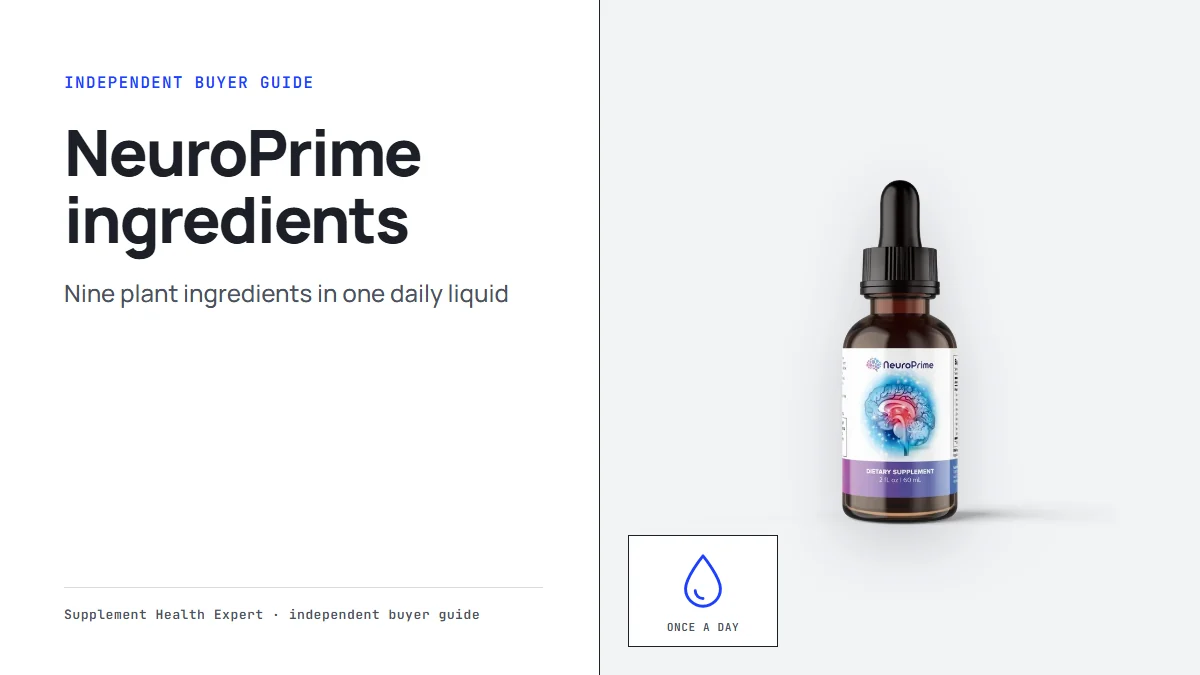
If you like to know what goes into a bottle before it goes into you, the NeuroPrime ingredients list is a short and easy read. The seller names nine plants, from a leafy tree to a freshwater alga, and blends them into a liquid sold in a 2 fl oz dropper bottle. This guide walks through each name in plain language, flags what the order page does not say, and shows how to use the label as your guide.
The Formula at a Glance
The seller presents NeuroPrime as a natural formula, designed to help support memory function. It is a once-a-day liquid, and one bottle is a 1-month supply. Instead of a long list of unfamiliar compounds, the page leads with plants that have been eaten or used traditionally for a long time.
Two facts frame everything that follows. First, the page names the ingredients but prints no amount for any of them, so we cannot give you a figure and will not guess one. Second, the seller speaks about the formula as a whole. Nothing on the page ties a specific result to a specific plant, and neither do we.
NeuroPrime Ingredients, One by One
| Ingredient | What it is |
|---|---|
| Moringa | A leafy tree native to South Asia |
| Pine bark extract | An extract from pine bark |
| Ginkgo biloba | A tree leaf used in traditional practice |
| Tamarind | A tropical fruit |
| Lion’s mane mushroom | An edible mushroom |
| Chlorella | A freshwater alga |
| Bacopa monnieri | An herb from Ayurvedic tradition |
| Spirulina | A blue-green alga |
| Neem | A tree from the mahogany family |
Four of the nine come from trees, two are algae, one is a mushroom, one is a fruit and one is an herb. That spread is the whole story the table tells: a plant-only lineup.
What the Seller Says About Quality
The order page makes several statements about the formula, and we pass them along as the seller’s own words.
- Natural and plant based. All nine named ingredients come from plants, algae or fungi.
- Non-GMO. The seller describes the formula that way.
- No stimulants. The seller says the formula contains none.
- No chemicals. Another seller claim, stated plainly on the page.
- Tested for purity and contaminants. The seller says its ingredients go through testing.
Our reading stays with the seller’s own wording. Our safety page covers who should check with a doctor before starting.
Why a Liquid?
The seller chose a dropper bottle rather than something to swallow whole, and the routine reflects it. You shake the bottle, take the serving straight or stir it into tea, coffee, juice or any drink, and carry on with your morning. For adults who dislike swallowing large pieces, a liquid is a practical format. For everyone else, it is simply another way to build a habit, and the habit matters more than the packaging.
How to Read the Label on Your Bottle
The page gives names without amounts, so the bottle itself becomes the reference. When it arrives, use this short routine.
- Find the serving instructions and follow them exactly.
- Read the full ingredient list and compare it with the nine names above.
- Check the bottle size, 2 fl oz (60 mL).
- Note any allergy warnings printed on the label.
- Keep the label or a photo of it with your order record.
A label is the product’s final word about itself. If anything on it surprises you, ask your doctor or pharmacist before the first serving.
Plant Allergies and Personal History
Every plant on the list is an ordinary botanical, yet any plant can disagree with a particular person. If you know you react to a specific herb, fruit, mushroom or alga, check the nine names against your own history first. A pharmacist or doctor can go through the list with you in a few minutes. Keep taking the medicines you have been prescribed, and let your doctor decide whether a new supplement fits alongside them.
Making Sense of “Natural”
“Natural” is a marketing word more than a measurement, and it tells you where an ingredient came from rather than how much is present or how you will respond. We mention it because the seller uses it. The useful information lives in the specifics: the nine named plants, the liquid format, the stated testing and a bottle label you can read yourself.
The Formula Beside the Routine
An ingredient list is only part of any supplement plan. The seller suggests one serving a day, preferably in the morning. Pair it with ordinary good habits and a doctor who knows your history, and keep realistic expectations: nobody can promise when results will appear, and they differ between people. Our review looks at the whole product, and the side effects guide covers cautions in detail.
Prices for the Nine-Plant Liquid
| Package | Each | Total | Shipping |
|---|---|---|---|
| 1 bottle | $59 | $59 | shown at checkout |
| 3 bottles | $49 | $147 | shown at checkout |
| 6 bottles | $39 | $234 | free |
Each bottle lasts a month, so six bottles work out to $1.30 a day. Every package is covered by the 365-day money-back guarantee: write to the seller within 365 days, and per the seller’s FAQ you can return what you have not used for a full refund. See the NeuroPrime hub for the full offer.
Questions to Bring to Your Doctor
A short list makes the appointment productive.
- Here are the nine ingredients, are any a concern for me?
- Does this fit with my current prescriptions?
- How should I judge whether it is working for me?
Write the answers beside the label photo and you have a record you can return to.
Reading a Plant List Without Hype
A list of plant names can feel impressive on its own, so it helps to keep three simple questions in mind. What is each ingredient, in ordinary terms? How much is in a serving? And what does the seller actually say about it? For NeuroPrime, the first question has a short answer in the table above, the second has no answer on the order page, and the third is a single statement about the whole formula: it is designed to help support memory function. Holding to those three questions keeps a plant list from sounding like a promise.
Where the Plants Come From
The nine names span several kinds of source. Moringa, tamarind, ginkgo, neem and pine bark come from trees. Chlorella and spirulina are algae, one from fresh water and one blue-green. Lion’s mane is an edible mushroom, and bacopa is an herb with roots in Ayurvedic tradition. Seeing the lineup grouped this way makes it easier to remember, and it helps when you describe the formula to your doctor or pharmacist. The product hub shows how the formula sits within the whole offer.
Comparing the Seller’s Wording With Your Label
When your bottle arrives, put the label beside the order page and check one thing at a time. Do the nine names match? Does the serving direction agree with the once-a-day routine? Is the bottle size 2 fl oz (60 mL)? Those small checks take two minutes, and they leave you with a record you can rely on. If anything differs, contact the seller through its contact page or ask ClickBank about the order.
Our Take
NeuroPrime keeps its ingredient story simple: nine named plants, a liquid you take once a day and clear seller statements about natural, plant-based, non-GMO and tested ingredients. The missing amounts are the one gap, and the 365-day guarantee softens it by letting you try the bottle in your hands. We give NeuroPrime 8.6/10 on our editorial scale.
Frequently asked questions
What are the NeuroPrime ingredients?
The seller names nine plants: moringa, pine bark extract, ginkgo biloba, tamarind, lion's mane mushroom, chlorella, bacopa monnieri, spirulina and neem.
How much of each ingredient is in NeuroPrime?
The order page prints no amounts, so we state none. Follow the label on the bottle for the serving.
Is NeuroPrime plant based?
That is how the seller describes it, along with non-GMO, free of stimulants and chemicals and tested for purity and contaminants.
What form does NeuroPrime come in?
A liquid in a 2 fl oz (60 mL) dropper bottle. Shake it well, then take it directly or mix it into a drink.
What is NeuroPrime designed to do?
According to the seller, the formula is designed to help support memory function. Results differ from person to person.
Should I ask a doctor about the ingredients?
Yes. Ask your doctor before you start, and keep taking any medicine you are prescribed.
neuroprime ingredients · neuroprime formula · neuroprime ginkgo biloba · neuroprime lion's mane · neuroprime bacopa · neuroprime moringa · neuroprime plant based · neuroprime label