Ingredients / Guide
Phytomem One Ingredients: All Ten Ingredients, the Role the Seller Gives Each and the Research Behind Them
Phytomem One ingredients explained: saffron, fucoxanthin, berberine, Morosil and six more, each with the seller's stated role and links to the research.
- Author
- Supplement Health Expert Editorial Team
- Updated
- Reading time
- 9 min
- Sources
- 4 cited
Key takeaways
- 01 The label names ten ingredients inside a 458 mg proprietary blend per tablet, with no amount published for each.
- 02 The seller sorts them into Cellular Defense Matrix, Brain Fuel & Vitality Complex and Neural Amplifier System.
- 03 Every role described here is the seller's own, and we attribute each one to the seller.
- 04 The research we cite is general ingredient and context research, not a trial of Phytomem One.
- 05 The label asks people with a medical condition, and anyone pregnant, nursing or under 18, to ask a doctor first.
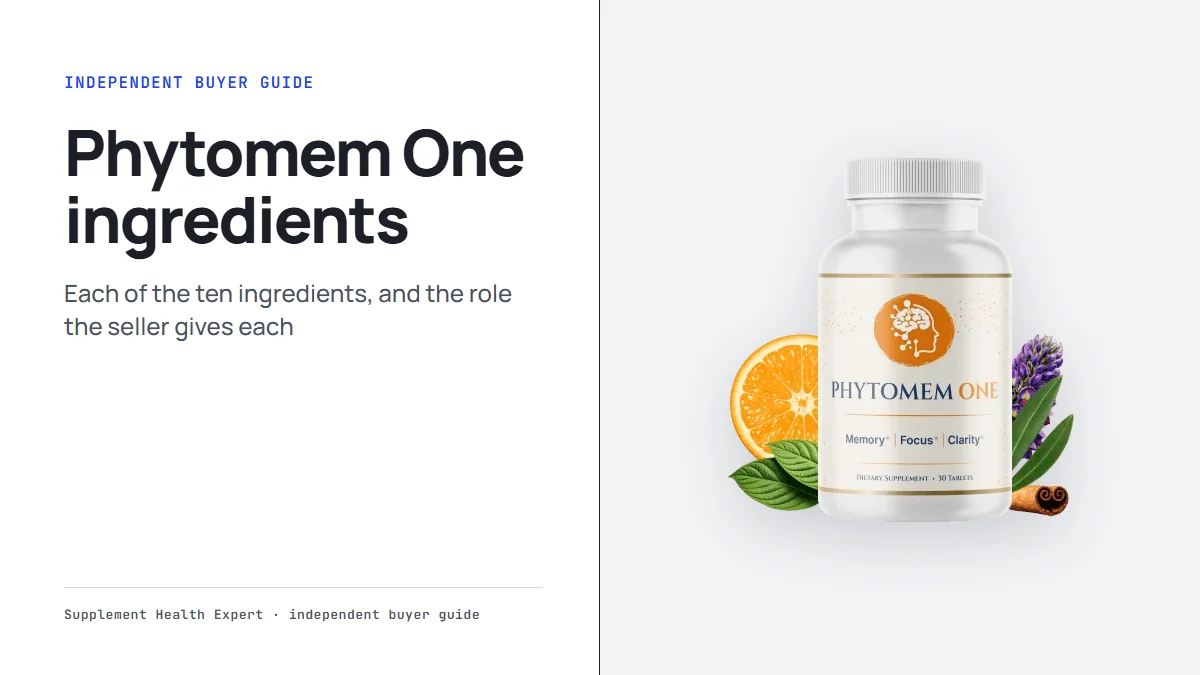
A label is only useful if you can understand it, so this guide treats the Phytomem One ingredients the way a curious shopper would: what is each one, where does it come from and what job does the seller give it? All ten are named on the bottle. The jobs come from the seller’s own pages, and we flag them as such every time, because a seller’s description of an ingredient is not proof of what a product will do for you personally.
Phytomem One Ingredients: The Three Complexes
The seller arranges the ten ingredients into three teams. We list each team’s members alphabetically here, which is not the order on the seller’s page, only a tidy way to find a name quickly.
| Complex | Members, A to Z |
|---|---|
| Cellular Defense Matrix | Fucoidan, fucoxanthin, oleuropein, saffron extract |
| Brain Fuel & Vitality Complex | Berberine HCl, Ceylon cinnamon, corosolic acid, kudzu flower extract |
| Neural Amplifier System | Morosil, xylitol |
On the label, all of this sits inside a single blend that weighs 458 mg per tablet and is marked proprietary. No milligram figure is printed for any one member, so none appears in this article.
Where the Seller Says the Idea Came From
The seller explains that the formula grew out of research on everyday environmental stressors and on the way the brain fuels itself with glucose. That produced a two-pronged plan: shield cells with antioxidants, and keep glucose use healthy so that brain cells stay energized. A third group rounds things out with metabolic and nutrient support. Treat this as the seller’s framing. It is a clear story, but it is a story about intent, not a promise of outcome.
Ingredients the Seller Links to Antioxidant Support
Four of the ten are described mainly in terms of antioxidants.
Saffron extract. Made from the bulb of Crocus sativus L. The seller presents it as an antioxidant-rich extract, links it to a balanced inflammatory response and says it helps brain cells cope with the wear of daily oxidative stress. For research flavor, a 2020 placebo-controlled trial examined saffron and its effect on mood and food craving in overweight women.
Fucoidan. Drawn from the sea kelp Laminaria japonica. In the seller’s telling it has a potent antioxidant profile and helps shield brain tissue from everyday oxidative challenges.
Oleuropein. An extract of olive leaf. The seller describes it as a whole-body antioxidant that also supports blood sugar already in the normal range.
Morosil. A Moro blood orange extract (Citrus sinensis) grown on the slopes of Mount Etna in Sicily. The seller adds antioxidant defense to its list, alongside healthy metabolic function and nutrient absorption. A 2022 randomized trial in Nutrients looked at Moro blood orange extract and weight loss in overweight adults.
Ingredients the Seller Links to Healthy Glucose Use
This is the busiest group, with five names across two complexes.
Berberine HCl. Per the seller, it activates an enzyme called AMPK, nicknamed the “metabolic master switch”, and so encourages optimal glucose use. A 2024 systematic review and meta-analysis in Frontiers in Pharmacology covers berberine for blood sugar in type 2 diabetes, a hint of why the ingredient is so widely discussed.
Ceylon cinnamon. Bark of Cinnamomum verum. In the seller’s pitch it backs a healthy insulin response and steady glucose balance, and it is positioned as berberine’s partner.
Corosolic acid. Obtained from banaba leaf extract, and described by the seller as helping glucose travel to the brain cells that are working hardest.
Kudzu flower extract. From Pueraria montana. The seller points to its isoflavones as support for healthy glucose uptake in cells.
Xylitol. Placed by the seller in the Neural Amplifier System and described as clean cognitive fuel that avoids sudden blood sugar spikes.
The One Linked to Neural Communication
Fucoxanthin. A pigment from the same sea kelp as fucoidan. Of all ten, it is the one the seller ties most directly to the nervous system, describing it as “studied for healthy neural communication, cognitive flexibility”.
How to Read a Proprietary Blend
A proprietary blend means the maker lists the ingredients and the combined weight, but not each ingredient’s share. Phytomem One follows that pattern. You know that ten ingredients are in the tablet, and that together they weigh 458 mg, but the split among them is not printed. Because the split is not printed, we make no claims about proportions.
What you can do with that information is compare names rather than amounts. If one of the ten does not suit you, because of an allergy or a medicine you take, you can spot it immediately and decide with your doctor. That is the real benefit of full disclosure of names, even when the amounts stay private.
Questions Shoppers Ask About Individual Ingredients
Is there a stimulant in it? Stimulant-free is among the seller’s quality badges, next to non-GMO.
Where do the sea kelp ingredients come from? Both fucoxanthin and fucoidan are listed as coming from Laminaria japonica.
Are the ingredients grown anywhere special? Only one has a stated place of origin: Morosil comes from Moro blood oranges grown on Mount Etna in Sicily.
Why xylitol? The seller describes it as clean cognitive fuel without sudden blood sugar spikes, and places it in the Neural Amplifier System with Morosil.
What Else Is in the Tablet
Beyond the blend, the label lists the supporting ingredients that turn it into a chewable: stevia (Reb A), plus stearic acid, magnesium stearate, silicon dioxide and flavors. For the whole label laid out as one table, see our Phytomem One ingredients list.
Reading the Research With Care
The four studies linked at the bottom of this page are general background about ingredients and context, and none of them tested Phytomem One. One of them, a 2025 Nature Medicine paper titled Bioaccumulation of microplastics in decedent human brains, measured microplastics in human brain tissue, which is the sort of background the seller points to. The other three concern berberine, Moro orange extract and saffron in their own settings. They explain the interest in these ingredients, and they stop well short of proving a result for the tablet.
Safety Notes Worth Repeating
Berberine is in the blend, so anyone on medicines for blood sugar should check with a doctor before starting. The label also advises asking a doctor first if you are expecting a baby or nursing, are younger than 18 or live with a medical condition, and it warns against exceeding the dose. Our Phytomem One safety page goes further.
The Formula in One Sentence
Ten named ingredients, three themes and a single chewable tablet a day, with non-GMO and stimulant-free badges: that is the whole formula, and the clarity is a large part of its appeal. For the wider picture, our main Phytomem One review puts the formula next to the price, the bonuses and the guarantee.
Our Take
A fully named, neatly grouped formula is easy to appreciate. We score Phytomem One 9.2/10, our editorial score. If the formula appeals to you, the order page lists the packages, with a 60-day guarantee that starts on arrival.
Where to Go Next
To set the formula inside the whole offer, the Phytomem One product hub shows the packages, bonuses and guarantee around it.
Readers who want to compare cost can use our price breakdown, and those curious about how the formula is meant to work can read our guide on whether Phytomem One really works.
For the whole product around the formula, the Phytomem One hub brings the packages, bonuses and guarantee together, and our ingredients page on the hub carries on from this guide.
Frequently asked questions
What are the Phytomem One ingredients?
Ten, grouped by the seller into three complexes: four in the Cellular Defense Matrix, four in the Brain Fuel & Vitality Complex and two in the Neural Amplifier System.
How much of each ingredient is in a tablet?
The label shows a proprietary blend of 458 mg per tablet and does not publish individual amounts.
What are the three complexes?
Cellular Defense Matrix, Brain Fuel & Vitality Complex and Neural Amplifier System, which is how the seller groups the ten ingredients.
Which ingredient comes from sea kelp?
Fucoxanthin and fucoidan, both from Laminaria japonica, according to the label.
What is Morosil?
A Moro blood orange extract from Mount Etna in Sicily, per the seller.
Does the formula contain stimulants?
The seller lists stimulant-free as a quality badge, alongside non-GMO.
Sources
- 01 Nihart AJ et al. Bioaccumulation of microplastics in decedent human brains. Nature Medicine, 2025
- 02 Berberine for blood sugar in type 2 diabetes: systematic review and meta-analysis. Front Pharmacol, 2024
- 03 Moro blood orange extract and weight loss in overweight adults: RCT. Nutrients, 2022
- 04 Saffron (Crocus sativus) on mood and food craving in overweight women: placebo-controlled RCT. J Clin Pharm Ther, 2020
phytomem one ingredients · phytomem one formula · phytomem one saffron · phytomem one berberine · phytomem one morosil · phytomem one cellular defense matrix · phytomem one brain fuel vitality complex