Ingredients / Guide
Protoflow Ingredients: All 14 Label Lines and Doses Explained
Protoflow ingredients line by line: 14 doses per two capsules, from saw palmetto to niacin, plus the other ingredients, including gelatin and soy.
- Author
- Supplement Health Expert Editorial Team
- Updated
- Reading time
- 8 min
- Sources
- 0 cited
Key takeaways
- 01 The panel is written for two capsules and has 14 lines, each with its own printed dose.
- 02 Vitamin E is 13 mg (87% of the Daily Value) and niacin is 75 mg (469%); the other lines run from 250 mg down to 20 mg.
- 03 The other ingredients are rice flour, gelatin, magnesium stearate, silicon dioxide, maltodextrin, soy protein concentrate and water.
- 04 The label says anyone taking medication should consult a physician before use, and not to exceed the suggested use.
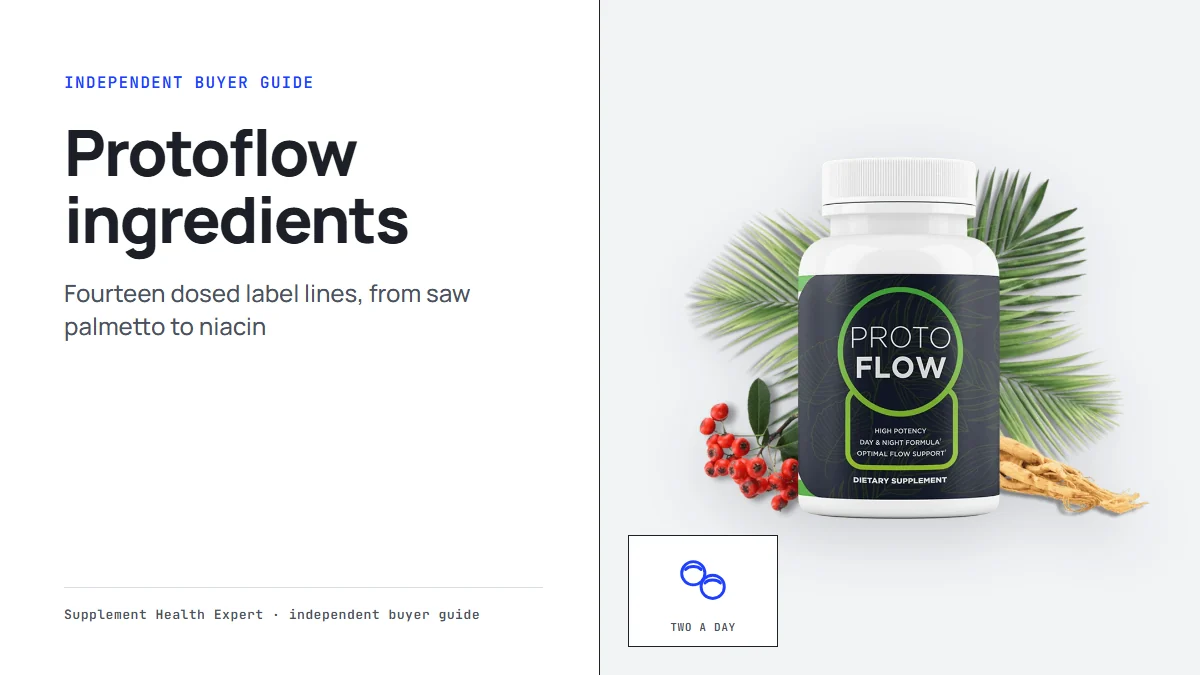
Protoflow ingredients are easy to study because the Supplement Facts panel hides nothing: the serving is two capsules, and each of the fourteen lines names its own amount. We copied the panel into a table below, added a short, soft note on what each one is, and listed the capsule ingredients that follow. Read it once and you will know exactly what you are putting in your daily routine.
The Full Protoflow Label
All amounts are per serving of two capsules. A bottle holds 30 servings. The last column is general background on each ingredient, not a promise of any result.
| Ingredient | Amount per serving | % Daily Value | Background (not a promise) |
|---|---|---|---|
| Vitamin E (d-alpha tocopheryl succinate) | 13 mg | 87% | A fat-soluble vitamin |
| Niacin (vitamin B3) | 75 mg | 469% | A water-soluble B vitamin |
| Hawthorn fruit | 250 mg | Not listed | A red berry from European herbal tradition |
| Epimedium sagittatum, whole plant | 250 mg | Not listed | A plant from East Asian herbal tradition |
| Damiana leaf | 200 mg | Not listed | A leaf from Central American herbal tradition |
| Muira puama root | 200 mg | Not listed | A root from Amazon folk herbalism |
| Ginkgo biloba leaf | 120 mg | Not listed | A leaf from an ancient tree species |
| Chinese ginseng root | 120 mg | Not listed | A root from East Asian herbal tradition |
| Tribulus fruit | 120 mg | Not listed | A spiny fruit used in Ayurvedic and Chinese herbalism |
| Catuaba bark | 84.5 mg | Not listed | A bark from Brazilian folk herbalism |
| Saw palmetto fruit | 84.5 mg | Not listed | The berry of a small palm, familiar in prostate-support products |
| Inosine | 50 mg | Not listed | A compound the body also makes |
| Oat straw stalks | 32 mg | Not listed | The green stalks of the oat plant |
| Cayenne fruit | 20 mg | Not listed | A hot pepper |
Other ingredients: rice flour, gelatin, magnesium stearate, silicon dioxide, maltodextrin, soy protein concentrate and water.
How to Read the Panel
Fourteen lines, fourteen numbers. Adding them gives 1,619 mg of listed material per serving, of which the two vitamins account for 88 mg and the plant and inosine lines for 1,531 mg. The two largest herbal lines, hawthorn and epimedium, make up 500 mg together. Because no line is tucked inside a blend total, you can compare any single dose with another label on your shelf in seconds.
The seller’s aim for the formula as a whole is stated simply: a daily capsule designed to support the normal function of the bladder, prostate and reproductive system. That is the seller’s description of the aim, and we do not attach a result to any individual ingredient.
The Two Vitamins
Vitamin E is listed in the form d-alpha tocopheryl succinate, 13 mg, which the label gives as 87% of the Daily Value. Niacin, also known as vitamin B3, is 75 mg and 469% of the Daily Value. A percentage far above 100 is not unusual for a B vitamin in a supplement, but it is a good reason to mention the label to a pharmacist if you already take a multivitamin.
The Herbal Lines
Hawthorn and epimedium lead at 250 mg each. Damiana and muira puama follow at 200 mg. Ginkgo, Chinese ginseng and tribulus sit together at 120 mg. Catuaba and saw palmetto share 84.5 mg, and the last three lines, inosine, oat straw and cayenne, step down through 50, 32 and 20 mg. Most of these names are old ones in herbal practice, which is the context the Background column gives. The seller does not publish studies on this particular combination that we can point to, and we make no claim beyond the label.
The Capsule Itself
The closing list is where allergies and diets come in. Gelatin is an animal-derived ingredient, which means Protoflow is not suitable for anyone who avoids animal products. Soy protein concentrate is a soy ingredient, so it matters to anyone with a soy allergy or sensitivity. Rice flour, maltodextrin, magnesium stearate, silicon dioxide and water complete the list. If either gelatin or soy affects you, check this line first, and ask your doctor or pharmacist if you are unsure.
What the Seller Adds
On its order page the seller displays non-GMO and gluten-free badges. We pass these on as the seller’s statements. The parts you can inspect without taking anyone’s word are the doses, the Daily Value percentages and the ingredient list above.
Why a Printed Dose Matters
Some supplement labels group several plants under one total, so you can see the weight of the group but not of any single plant. Protoflow does the opposite: it gives each line its own number. That has two practical uses. You can compare any single dose, such as 84.5 mg of saw palmetto or 120 mg of ginkgo, against another product you already own. And you can give your pharmacist the exact figure for the line they ask about instead of a vague description. When we say the label prints every dose, this is what we mean, and it is the main reason we rate the formula’s transparency so highly.
Two Capsules in Practice
The routine takes a few seconds: two capsules a day with water. Because a bottle holds 60, the second bottle is only needed after a month, which makes the six-bottle package an easy rhythm to follow. Open one bottle at a time and leave the others sealed in the box. The seller says some people take longer to respond than others, so we promise no timeline, and the capsule is meant as a daily habit rather than a quick fix.
Questions for Your Pharmacist
Because the panel is so specific, a short conversation is easy. Take the table along and ask about these lines:
- Ginkgo and Chinese ginseng, if you take blood thinners.
- Hawthorn, if you use heart or blood-pressure medicine.
- Niacin at 75 mg and ginseng, if you manage diabetes with medication.
- Saw palmetto, if you use another prostate-minded product.
- Cayenne, if your stomach is sensitive.
- Gelatin and soy protein concentrate, for allergies or dietary rules.
The label itself asks anyone taking medication to consult a physician before use and not to exceed the suggested use. Keep taking prescribed medicines. Our side-effects guide lists the full set of points to check.
Dose and Daily Cost
The directions are two capsules a day with water, so one bottle is a 30-day supply. Six bottles for $294 work out to about $1.63 a day, three bottles for $177 to about $1.97 and two bottles for $158 to about $2.63 before shipping. The price guide has the full grid, and the ingredients page on our hub holds the same panel in a compact form. Back on the Protoflow hub, every page sits side by side.
A Habit Worth Keeping
Whatever supplement you pick, a label with a number beside every line is the best kind to start with, because it gives you something to ask a professional about. Protoflow’s panel does that. You can print the table, tick the lines your doctor mentions and decide with facts in hand.
Where to Go From Here
The panel is open, the amounts are printed and the capsule ingredients are named. If that suits you, the Protoflow hub lines up the packages, and the 60-day guarantee takes back unopened, undamaged bottles, so open one bottle at a time.
Frequently asked questions
What are the Protoflow ingredients?
For two capsules: vitamin E 13 mg, niacin 75 mg, hawthorn fruit 250 mg, Epimedium sagittatum 250 mg, damiana leaf 200 mg, muira puama root 200 mg, ginkgo biloba leaf 120 mg, Chinese ginseng root 120 mg, tribulus fruit 120 mg, catuaba bark 84.5 mg, saw palmetto fruit 84.5 mg, inosine 50 mg, oat straw stalks 32 mg and cayenne fruit 20 mg.
How much saw palmetto is in Protoflow?
The label prints 84.5 mg of saw palmetto fruit per serving of two capsules.
Is there a hidden blend on the label?
No. All 14 lines carry their own amount, so the label prints every dose.
What does the capsule contain besides the active lines?
Rice flour, gelatin, magnesium stearate, silicon dioxide, maltodextrin, soy protein concentrate and water.
Does Protoflow contain soy or gelatin?
Yes, both appear in the other ingredients. If you have an allergy or follow a dietary restriction, read the panel before ordering and ask a doctor or pharmacist.
Which lines should I mention to my pharmacist?
Ginkgo, ginseng, hawthorn, saw palmetto, cayenne and the 75 mg of niacin, especially if you take blood thinners or blood-pressure, heart or diabetes medicine.
protoflow ingredients · protoflow supplement facts · protoflow label · protoflow saw palmetto · protoflow niacin · proto flow ingredients · protoflow hawthorn