Ingredients / Guide
Ikaria Lean Belly Juice Ingredients: Four Blends, Label by Label
Ikaria Lean Belly Juice ingredients, label by label: the metabolic, polyphenol and digestive blends, nine probiotic strains and what each name is known for.
- Author
- Supplement Health Expert Editorial Team
- Updated
- Reading time
- 8 min
- Sources
- 0 cited
Key takeaways
- 01 The label prints four blocks: a 1,000 mg metabolic blend, a 1,000 mg polyphenol blend, a 325 mg digestive blend and a 125 mg probiotic.
- 02 The probiotic holds nine strains, six Lactobacillus and three Bifidobacterium, at 3 billion CFU at the time of manufacture.
- 03 Only block totals are printed, so no single ingredient has a stated amount.
- 04 Green tea extract brings a trace of caffeine, under 1% on the label.
- 05 Ask your doctor first and keep taking prescribed medicines.
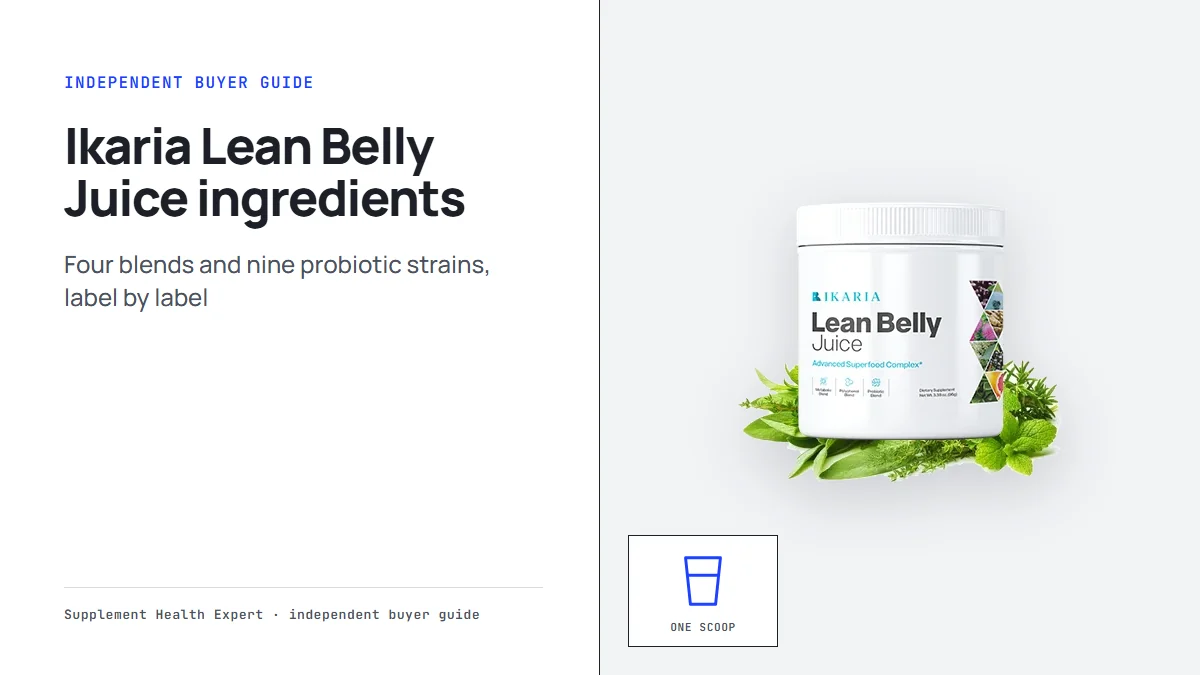
Supplement labels tend to read like a wall of Latin names, so a translation helps. This guide to the Ikaria Lean Belly Juice ingredients walks through the Supplement Facts panel one block at a time, says what each name is known for and keeps its claims modest. The serving is a single 3.2 g scoop, and a tub holds 30 of them.
The Label at a Glance
| Block | Printed total | Contents |
|---|---|---|
| Metabolic | 1,000 mg | Nine plant ingredients, from dandelion to knotweed |
| Polyphenol | 1,000 mg | Eleven fruit, berry and beet powders |
| Digestive | 325 mg | Inulin plus oat fiber |
| Probiotic | 125 mg | Nine strains, 3 billion CFU when made |
None of the blocks has a Daily Value. Since only totals are printed, we put no amount on any single ingredient, and nothing below should be read as one. As the seller tells it, the formula as a whole is aimed at supporting a healthy metabolism, energy and digestion next to balanced meals and movement.
Ikaria Lean Belly Juice Ingredients: The Metabolic Blend
This block has the widest variety, with nine named ingredients. Where an extract is rated on the label, we note the rating.
- Dandelion root powder. A root with a long history in traditional herbal drinks.
- Turmeric root powder. The golden kitchen spice, also a staple of herbal traditions.
- Citrus pectin. A soluble fiber from citrus peel.
- Green tea leaf extract. Rated 98% polyphenols, 50% EGCG and 80% catechins, with caffeine below 1%. Of the catechins, EGCG is the one researchers mention most often.
- Kelp extract. A brown seaweed extract rated at 10% fucoxanthin, the pigment that colors the seaweed.
- Milk thistle seed extract. Rated at 80% silymarin, the group of compounds traditionally linked with the plant.
- Panax ginseng root powder. A root used in traditional herbal practice for centuries.
- Black pepper fruit extract. Rated at 95% piperine, the compound that makes pepper pungent.
- Japanese knotweed root extract. Rated at 98% resveratrol, a plant polyphenol that grapes also contain.
Those ratings describe how each extract was prepared. They are not the amount in your glass.
The Polyphenol Blend
Polyphenols are the plant pigments behind the deep colors of berries and beets, and this block gathers eleven sources. Seven are red and purple fruits: strawberry juice powder, acai juice powder, black currant, blueberry, cranberry, pomegranate and raspberry. The other four are beet root, hibiscus flower, African mango seed extract and grapefruit. Together they supply the tangy, fruity side of the drink, and the seller offers the block as part of the superfood profile named on the tub front. Think of it as color and flavor with a plant-pigment story, sitting beside the seller’s aim of support for a healthy metabolism.
The Digestive Blend
Two ingredients share 325 mg.
- Inulin. A fiber from Jerusalem artichoke root, often called a prebiotic because it feeds friendly gut bacteria.
- Oat fiber. A mild, plain fiber from oats.
The pair gives the panel its digestion-minded character, in step with the digestion part of the seller’s aim.
The 9 Strain Probiotic
The last block is a 125 mg probiotic that provides 3 billion CFU at the time of manufacture. CFU means colony-forming units, the usual measure of live cultures. The nine strains come from two families.
- Lactobacillus, six strains: acidophilus, salivarius, plantarum, rhamnosus, fermentum and reuteri.
- Bifidobacterium, three strains: lactis, bifidum and longum.
These two families are the best-known names in probiotic products, the same ones you meet on yogurt cups and gut-minded supplements. Note that the count is given for the day of manufacture, not the day you open your tub.
Why a Blend Label Reads the Way It Does
A blend label prints one total for the whole group, then lists the members. That format is common in drink mixes, and it keeps the panel short enough to fit on a tub. For you, the practical meaning is simple: you can see exactly which ingredients are present and how heavy each block is, while the split inside each block stays with the maker. It is a good reason to lean on the seller’s stated aim and your own experience, not on dose arithmetic.
Other Ingredients
Beyond the four blocks, the label lists maltodextrin, natural flavors, citric acid and stevia leaf extract. They shape the taste and help the powder dissolve evenly: stevia sweetens, citric acid adds a bright edge and natural flavors fill in the rest. On the seller’s own account, it is made in the USA in an FDA-registered facility that follows GMP, and is free of gluten, dairy, soy, wheat, barley and animal products.
A Note on Caffeine
Green tea leaf extract is the only caffeine source on the label, listed at under 1%. Think of it as a trace. If you are careful about caffeine, or you have been told to limit it, mention it to your doctor or pharmacist before you start. Our side effects guide covers the wider safety picture.
Three Ways to Think About the Label
Reading a long list is easier with a frame. Here are three that we find helpful.
- By source. Roots and leaves, such as dandelion, turmeric, ginseng and green tea, sit in the metabolic blend. Fruits and flowers, such as acai, blueberry and hibiscus, sit in the polyphenol blend. Fibers and cultures round it out.
- By role in the drink. Some ingredients mainly bring color and flavor, others fiber, and others live cultures.
- By the seller’s aim. The whole formula is described as designed to support a healthy metabolism, energy and digestion, and that aim guides how the blocks are grouped.
None of these frames promises a result. They simply help you read the panel the way a label is meant to be read.
How the Ingredients Connect to the Routine
The routine is deliberately small: one scoop in about six ounces of water, or a favorite drink, in the morning, roughly an hour after breakfast. The powder mixes with the fruit powders into a colorful glass, which is part of the appeal for people who dislike swallowing a handful of supplements. Nothing on the label asks for counting, and each tub covers 30 mornings. The Ikaria Lean Belly Juice ingredients page keeps the same list in fact-sheet form, the Ikaria Lean Belly Juice hub links to the rest of our coverage, and our buyer review puts it in context.
Reading the Totals Sensibly
Block totals are printed, while the split inside each block is not. That is why we describe roles in general terms, such as traditionally used or often studied, and why we stay with the seller’s modest aim instead of promising anything. When you want to judge the drink for yourself, the 180-day money-back guarantee gives you half a year to do it.
Our Take
For a drink mix, the label is easy to like: nine named plant ingredients, eleven fruit and beet powders, two fibers and nine named probiotic strains in one scoop. Our editorial score gives ingredients 9.0/10 and evidence 8.2/10, because the blocks are readable while the amounts per ingredient stay private. Six bottles at $39 each is the best value package, with free US shipping and three bonuses. The full range of pages is on the product hub.
Frequently asked questions
What are the Ikaria Lean Belly Juice ingredients?
Four label blocks: a metabolic blend of nine plant ingredients, a polyphenol blend of eleven fruit and beet powders, a digestive blend of inulin and oat fiber, and a probiotic of nine strains. Other ingredients are maltodextrin, natural flavors, citric acid and stevia leaf extract.
How much of each ingredient is in a scoop?
Only block totals are printed: 1,000 mg, 1,000 mg, 325 mg and 125 mg. Amounts for single ingredients are not published, so we do not quote any.
Which probiotic strains are in it?
Six Lactobacillus strains (acidophilus, salivarius, plantarum, rhamnosus, fermentum, reuteri) and three Bifidobacterium strains (lactis, bifidum, longum), 3 billion CFU at the time of manufacture.
Does Ikaria Lean Belly Juice contain caffeine?
A trace, from the green tea leaf extract. The label gives under 1% caffeine for that extract.
What does the seller say about how it is made?
The seller says it is made in the USA in an FDA-registered facility that follows GMP, and is free from gluten, dairy, soy, wheat, barley and animal products.
Should I check with a doctor about the ingredients?
Yes, especially if you are pregnant, nursing or take regular medicine. Keep taking your prescribed medicines.
ikaria lean belly juice ingredients · ikaria juice ingredients · lean belly juice ingredients · ikaria lean belly juice label · ikaria lean belly juice probiotic · ikaria lean belly juice supplement facts · ikaria lean belly juice green tea