Supplement Reviews / Guide
Reviews on the Genius Song: Luck, Money, Memory and Migraines Checked Against the Evidence
Reviews on the Genius Song promise luck, money, memory, weight loss and better grades. We map each outcome to the evidence and explain the FTC fake review rule.
- Author
- Supplement Health Expert Editorial Team
- Published
- Reading time
- 9 min
- Sources
- 6 cited
Key takeaways
- 01 The outcomes credited to The Genius Song (luck, money, memory, weight loss, fewer migraines, better school grades) come from stories in the seller's video, not from independent reviews.
- 02 For each of those outcomes we found no study of this track; the closest research is small, mixed, or done in mice and meditators.
- 03 The seller's Terms say testimonials may be acted out by avatars or actors, may come from friends or family of the founders, and are exceptional rather than typical.
- 04 The FTC's 2024 final rule bans fake reviews and testimonials, sentiment-linked paid reviews and undisclosed insider reviews, a useful lens for anything you read.
- 05 If you try the $39 track anyway, the 90-day refund through ClickBank is your safety net.
Read enough reviews on the Genius Song and you will notice they promise a lot more than better focus. Lucky breaks, pay rises, a sharper memory, lost belly fat, migraines that fade, a child jumping from a C to an A. This page takes those outcomes one at a time and asks a narrow question: what can the evidence actually support? We also explain the US Federal Trade Commission’s 2024 rule on fake and paid reviews, because it changes how you should read testimonials of every kind.
Disclosure up front: we run this site independently of the people who sell the track. If you order through one of our affiliate links we may be paid a commission. Nothing on the page depends on whether you do.
Where reviews on the Genius Song come from
The product is a single digital recording, about seven minutes long according to the seller, priced at $39. Its sales video runs for 39 minutes and does most of the talking. It is narrated by a man calling himself Dr. Robert Lake, a name the footer disclaimer on the seller’s pages describes as a pen name: “Robert Lake is a pen name used with the consent of our leading neuroscientist”. The NASA and New York clinic credentials attached to him come from the same sales material and cannot be checked.
The “reviews” in circulation come in three layers. First, named customer stories: “Rachel, a nurse from Tustin, California”, Michael in Dallas who left his job to run an Amazon business, and Hannah from Manhattan, who credits the track with a promotion and an end to a family “curse”. Second, colleague anecdotes the presenter recounts: a finished book, a son’s grades, an engagement after a cart collision at Trader Joe’s, a promotion with a signing bonus, 16 pounds lost, a smoking habit dropped. Third, listener questions credited to first names and towns.
The seller’s Terms tell you how to read all three. Names “have been changed”; the company says “We use pen names”; “Some aspects of the marketing have been dramatized”; feedback may be performed by “digital representations, avatars, or actors”; some speakers “may be early supporters, friends, or family members of the company’s founders”; some were compensated; and testimonials “are exceptional results and may not reflect the experience of a typical customer”. A separate section is headed “For Entertainment Purposes Only” and states: “The products are provided for entertainment purposes only.” These are marketing stories, so we treat them as claims, not as reviews. (We go through each named story in our look at the video’s testimonials.)
Outcome by outcome: what the evidence can support
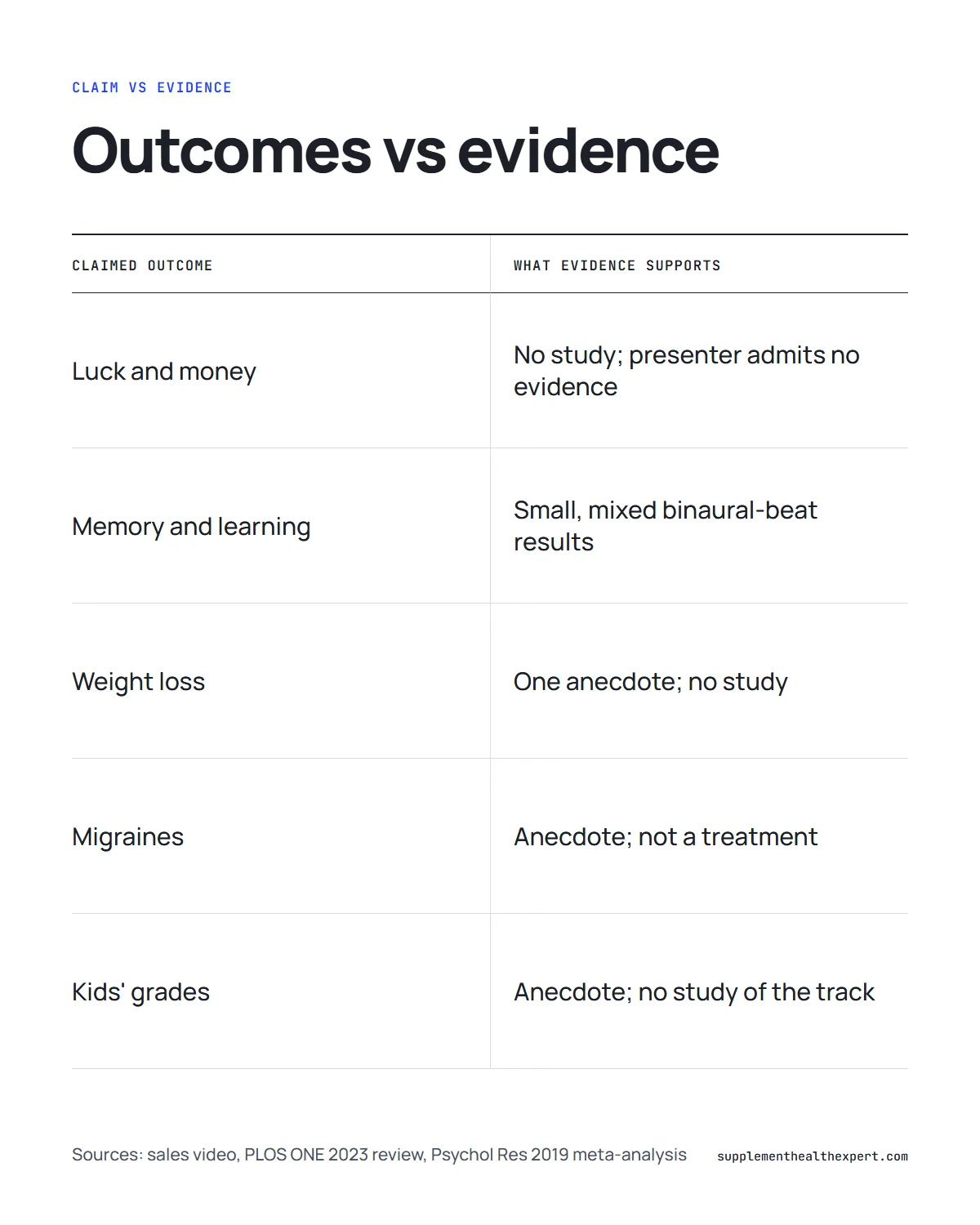
| Outcome claimed | Where it comes from | What the evidence can support |
|---|---|---|
| Luck and synchronicity | Opening hook; casino question | Nothing; the presenter concedes there is no evidence |
| Money, promotions, careers | Michael, Hannah, colleague stories | No study links any audio track to income |
| Memory and learning | “Deep learning happens in Gamma” | Small, short-term, inconsistent lab effects for binaural beats |
| Weight loss and smoking | Two colleague anecdotes | No study; not a treatment |
| Migraines and joint pain | Colleague anecdote; FAQ answer | No study; not a treatment |
| Children’s grades and bedtime | Son’s C to A; Genius Child bonus | No study in children of this or similar tracks that we know of |
Luck and synchronicity
The very first line of the video says “MIT found that all lucky, wealthy, successful people have this one brain wave”. We found no published study saying anything of the kind. The 40 Hz light-and-sound experiments run at MIT were largely about Alzheimer’s in mice, plus a few small pilot studies in humans. Asked by a listener whether the track helps at the casino, the presenter replies that “there is, of course, no evidence to support that the genius song caused that.” That honest sentence applies to luck in general.
Money, promotions and careers
Michael’s new business, Hannah’s promotion and a colleague’s wife with a signing bonus are the money stories. Careers turn on many things, and none of them can be pinned on a recording without a controlled comparison. No such comparison exists. The Terms also warn that their information “must not be used as professional financial or investment advice”.
Memory and learning
This is the outcome with the most research nearby, which is why it deserves care. Gamma is a real family of brain rhythms, roughly 30 to 100 Hz, tied in studies to attention and memory processing. Experienced meditators can produce strong gamma synchrony (Lutz and colleagues, PNAS, 2004). A 2020 Scientific Reports study by Ross and Lopez found that 40 Hz binaural beats helped volunteers during training on a lab attention task called the attentional blink. Pooled analyses (Garcia-Argibay’s group in 2019, Ingendoh’s team in 2023) describe binaural-beat effects on cognition as small and inconsistent. Leaping from there to “I remember everything” is a stretch, and nothing has tested this particular recording.
Weight loss and quitting smoking
One colleague is said to have lost “sixteen pounds from his belly”; another quit after eleven years of cigarettes. These are single stories without any detail on diet, other changes or follow-up. The seller’s own footer says as much: “This product is not intended to diagnose, treat, cure, or prevent any disease.” Anyone trying to lose weight or stop smoking deserves proven help from a doctor or a quit service.
Migraines and joint pain
The video reports a colleague whose “persistent migraine headaches had just disappeared”, and later suggests joint pains “can start to go away”. Persistent headaches and joint pain can have causes that need a medical look. A sound file is not a treatment for either, and we would never suggest using one in place of care.
Children’s grades and bedtime
The grade story is a colleague’s son going from a C to an A within a week, and the video’s bonus list includes The Genius Child, an audio for kids’ focus. We know of no study testing such tracks on children’s school results. If your child struggles at school, their teacher or doctor is the right first call.
Timelines the seller gives
The video offers three speeds of result. It “starts working the very first time you listen to it”; “many of our customers start to notice a difference” within “the first two to three days”; and most daily listeners “begin to see results within a couple weeks”. None of these timelines is backed by numbers we could see, and the Terms’ description of testimonials as exceptional rather than typical sits awkwardly beside them.
What the FTC’s 2024 rule says about fake and paid reviews
Fake reviews and testimonials became the subject of a final FTC rule, which the US regulator unveiled on 14 August 2024. It does not name any product, and we are not claiming any seller has broken it. It is simply a good map of the ways reviews can mislead.
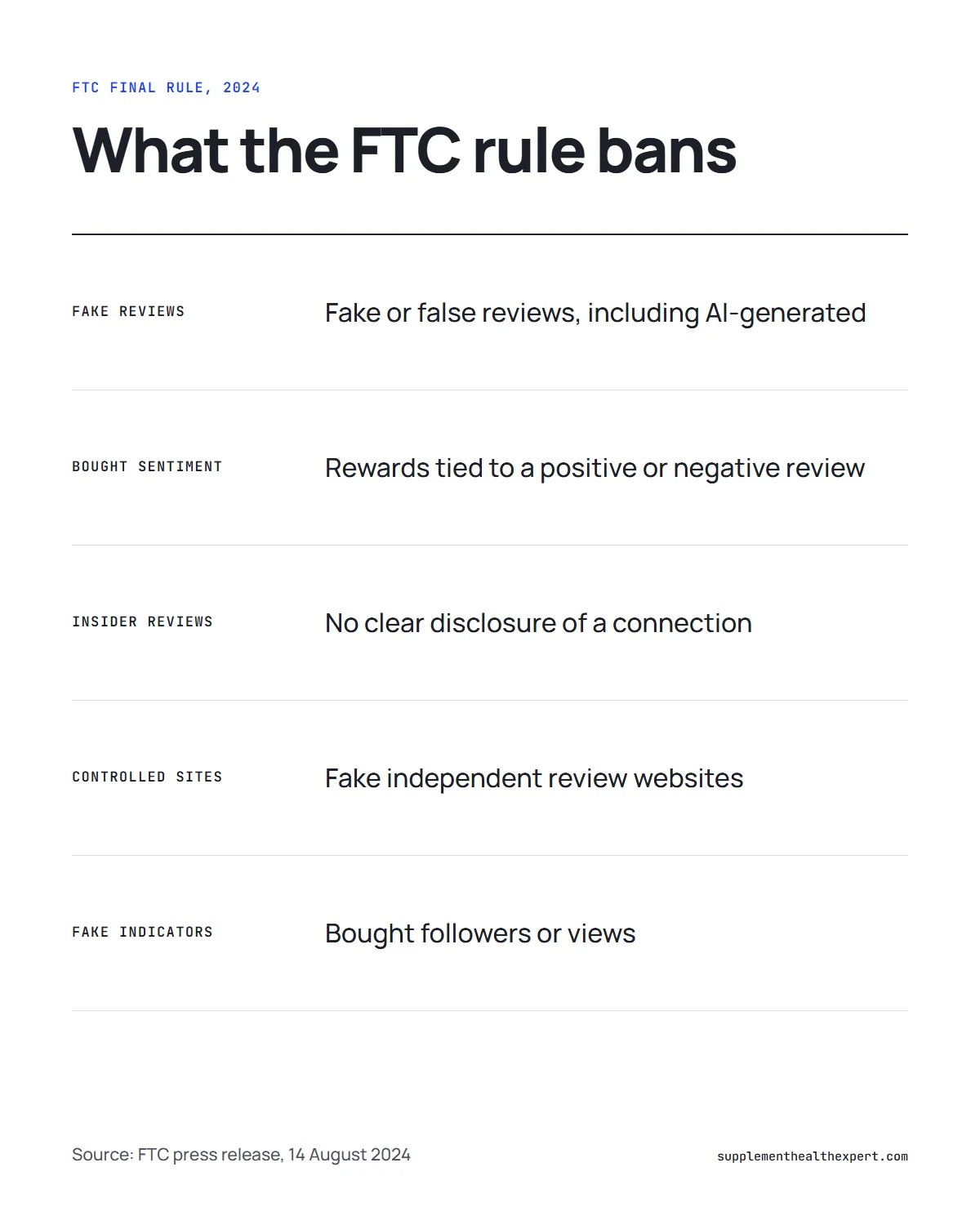
According to the FTC’s announcement, the rule targets:
- Fake or false reviews and testimonials, including ones generated by AI, and buying or spreading them when a business knew or should have known they were false.
- Buying positive or negative reviews, meaning compensation tied to a review saying something in particular.
- Insider reviews and testimonials posted without clearly disclosing the person’s connection to the business.
- Company-controlled review websites presented as independent.
- Review suppression through threats, intimidation or groundless legal claims.
- Fake social media indicators, such as bought followers or views used to look more influential.
Hold the seller’s Terms up against that list. They disclose that some speakers are friends or family of the founders, that some were paid, and that stories may be acted. Disclosure in a Terms page is better than none, but most viewers never open it, so the burden falls on you to read the small print before trusting a story.
How to weigh what you read
- Look for open platforms. Places where buyers can post a bad experience and it stays visible are worth more than any sales page.
- Prefer specifics. Useful accounts mention when someone bought, what arrived, how long they listened and whether a refund went through.
- Spot recycled names. Pages repeating Rachel, Michael or Hannah as their own customers are reusing sales material.
- Distrust stars without a source. We publish no star ratings here. Our editorial score, 4.7 out of 10, is our own judgement, explained on our methodology page.
- Check the figures. The seller says the track has helped 18,366 Americans in the video and 19,389 in the text page headline, and claims “thousands of five star reviews”. None of those numbers can be verified, and the first two do not even agree.
Buying, refunds and where the link goes
If you still want to try it, a few facts help. The order costs $39 once, charged through ClickBank in your local currency plus tax, and appears on statements as “CLKBANK*Genius Song”. The recording is delivered digitally; one seller page talks of an email with the file and another of a Private Audio Portal login, and the format is never stated. Bonuses differ by page too, with up to four digital extras named depending on where you look. It is not an app or game and is not sold on Spotify, YouTube or Amazon.
Our buttons, like every affiliate link for this product, pass through ClickBank to the seller’s front page. Right now that page advertises The Genius Wave, a related 12-minute audio from the same seller, while the Genius Song presentation is on the /video/ page of that site. They are different products, so check the item name at checkout.
The Terms allow refunds on digital purchases requested within 90 days of buying, and the ClickBank checkout repeats that window. ClickBank handles the request (its site is clkbank.com; the phone line is 1-800-390-6035), so hang on to your receipt. Disregard the /TOS/refunds/ page, a leftover from a supplement called NeuroActivate that talks about 60 days, unopened bottles and an Ohio address.
Listening safely
Some practical cautions of our own for this kind of audio. Turn the volume down to a level you could talk over, since long exposure to loud sound harms hearing (NIDCD explains why). The routine asks you to close your eyes, so never use it while driving or operating machinery. If you have epilepsy or have had seizures, or you live with a hearing problem, check with your doctor before trying it.
Our verdict on the claimed outcomes
Line the promised results up against the research and the gap is wide. Memory and attention have some small, mixed lab findings nearby; luck, money, weight, migraines and children’s grades have nothing but stories, and the seller’s own Terms call those stories exceptional and possibly acted. If a $39 relaxation experiment with a 90-day refund appeals to you, that is a fair way to see it. For our scorecard, pros and cons, read the quick Genius Song verdict, and for how the seller’s pages look this year, see the 2026 picture of the offer.
Frequently asked questions
Can a song make you luckier?
No evidence says so. The video opens with a claim that MIT found all lucky, wealthy people share one brain wave; no research we know of backs that up. Asked about casino wins, the presenter himself answers that "there is, of course, no evidence to support that the genius song caused that."
Will listening improve my memory or my child's grades?
Nobody has tested this recording for either. Studies of binaural beats report small, inconsistent effects on attention and memory in adults, and the grade story in the video (a colleague's son going from C to A) is an anecdote with no data behind it.
Can it help with migraines, weight loss or quitting smoking?
Those outcomes appear only as colleague anecdotes in the video. No condition is treated by this recording, and the sales pages themselves carry the standard line that rules out any diagnostic or curative use. Speak to a doctor about any of these problems.
Does the FTC rule mean the seller did something wrong?
Not by itself. The rule sets out banned practices for every business; we make no finding about this seller. What the rule does is show why disclosures matter, and the seller's Terms disclose that stories may be acted, changed or come from people linked to the founders.
What does the FTC rule on fake reviews ban?
Announced on 14 August 2024, it bans fake or false reviews and testimonials (including AI-generated ones), rewards for reviews of a particular sentiment, insider reviews without a clear disclosure, company-controlled sites posing as independent, review suppression, and bought social media indicators.
How soon does the seller say results appear?
Three, all from the presenter: right from the first session, after two or three days for many buyers, and inside a fortnight for most people who listen daily. We saw no data behind any of them.
What should I do if it does nothing for me?
Ask ClickBank for a refund within 90 days of buying, which is the window both the seller's Terms and the checkout state. Keep the receipt email; it carries the order number ClickBank will ask for.
Sources
- 01 FTC. Federal Trade Commission announces final rule banning fake reviews and testimonials (August 2024).
- 02 Ross B, Lopez MD. 40-Hz binaural beats enhance training to mitigate the attentional blink. Scientific Reports, 2020.
- 03 Ingendoh RM, et al. Binaural beats to entrain the brain? A systematic review. PLOS ONE, 2023.
- 04 Garcia-Argibay M, et al. Efficacy of binaural auditory beats in cognition, anxiety, and pain perception: a meta-analysis. Psychological Research, 2019.
- 05 Lutz A, et al. Long-term meditators self-induce high-amplitude gamma synchrony during mental practice. PNAS, 2004.
- 06 NIDCD. Noise-induced hearing loss.
reviews on the genius song · the genius song · genius song claims · genius song evidence · ftc fake reviews rule