Supplement Reviews / Evidence C · Limited
What Are the Benefits of FemiCore? Each Claimed Benefit Matched to Its Ingredient and Evidence
What are the benefits of FemiCore? We match each claimed benefit to the ingredient behind it and label the evidence honestly, from moderate to preclinical.
- Author
- Supplement Health Expert Editorial Team
- Published
- Reading time
- 10 min
- Sources
- 6 cited
Key takeaways
- 01 FemiCore is marketed for fewer sudden urges, fewer leaks, fewer night-time bathroom trips, urinary tract comfort and a healthier bladder microbiome.
- 02 The best-supported ingredient benefit is urinary tract infection defence: cranberry (Cochrane 2023) and L. crispatus (one phase 2 trial, given vaginally) both grade B for that use.
- 03 No ingredient, and not the product itself, has a trial showing fewer leaks or less urgency, so those headline benefits grade D on current evidence.
- 04 All doses sit in an undisclosed proprietary blend, which is why the overall product evidence grade is C (Limited).
- 05 The 60-day money-back guarantee is the practical way to test whether any benefit shows up for you.
What are the benefits of FemiCore? Read the sales page and you get a tidy list: calmer urges, fewer leaks, better sleep without bathroom trips, a “cleaner” urinary tract and a rebalanced bladder microbiome. What the sales page does not tell you is which of the nine ingredients is supposed to deliver each one, or how much research stands behind it.
This article does that job. We take each benefit the manufacturer markets, name the ingredient (or ingredients) meant to produce it, and give the evidence an honest strength label using the same A to D scale we use across the site. Where the honest answer is “this has not been tested in people”, we say so. The aim is not to talk you into or out of FemiCore, but to let you see which benefits are realistic expectations and which are hopes.
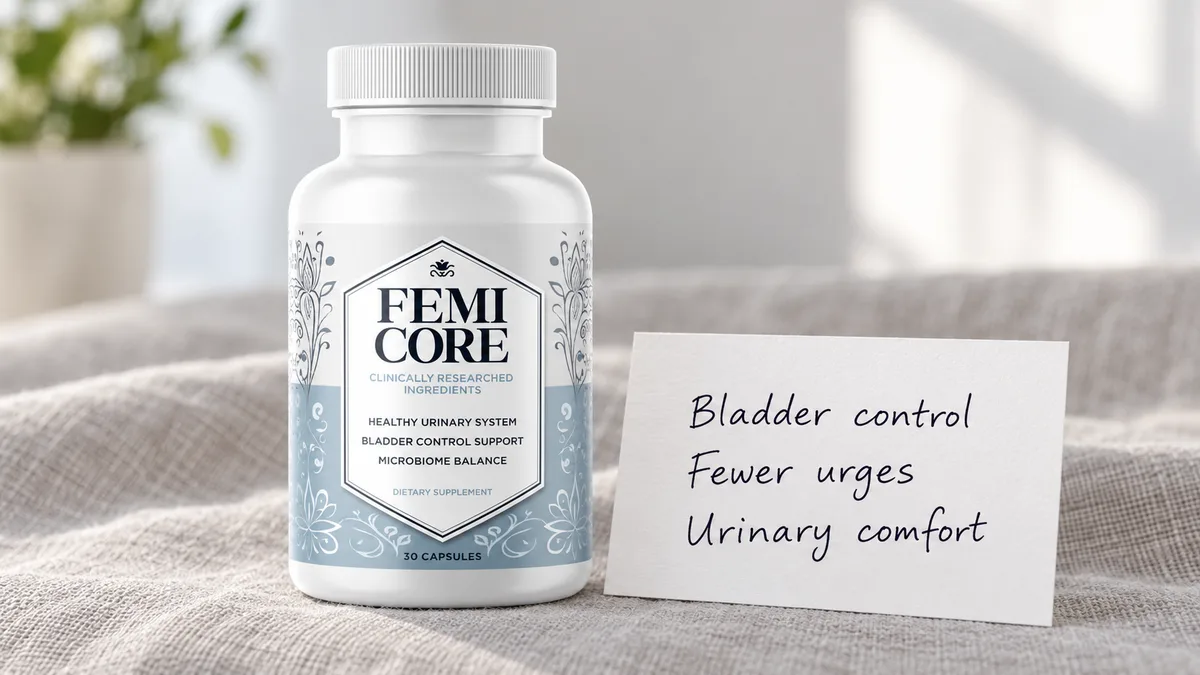
How we label the evidence for each benefit
Before the list, a quick note on the scale, because “clinically studied ingredient” can mean almost anything in supplement marketing.
| Label | What it means here |
|---|---|
| A, strong | Several good human trials or a meta-analysis for this exact use |
| B, moderate | At least one solid randomised trial or a systematic review, with caveats |
| C, limited | Small studies, indirect human data or general research on the ingredient |
| D, weak | Laboratory or animal data, tradition, or no direct study for this use |
Two rules shape every label below. First, we grade the ingredient for the benefit in question, not for whatever else it might do. Berberine, for example, has strong blood sugar research, but that does not make it a bladder ingredient. Second, FemiCore lists all nine ingredients in one proprietary blend without amounts, so even a well-studied ingredient cannot be confirmed at a studied dose. That is why the product as a whole sits at C (Limited), even though two ingredients reach B for one specific purpose.
What are the benefits of FemiCore, according to the manufacturer?
The marketing groups FemiCore’s benefits into a handful of promises. Here they are, matched to the ingredient that is meant to drive each one.
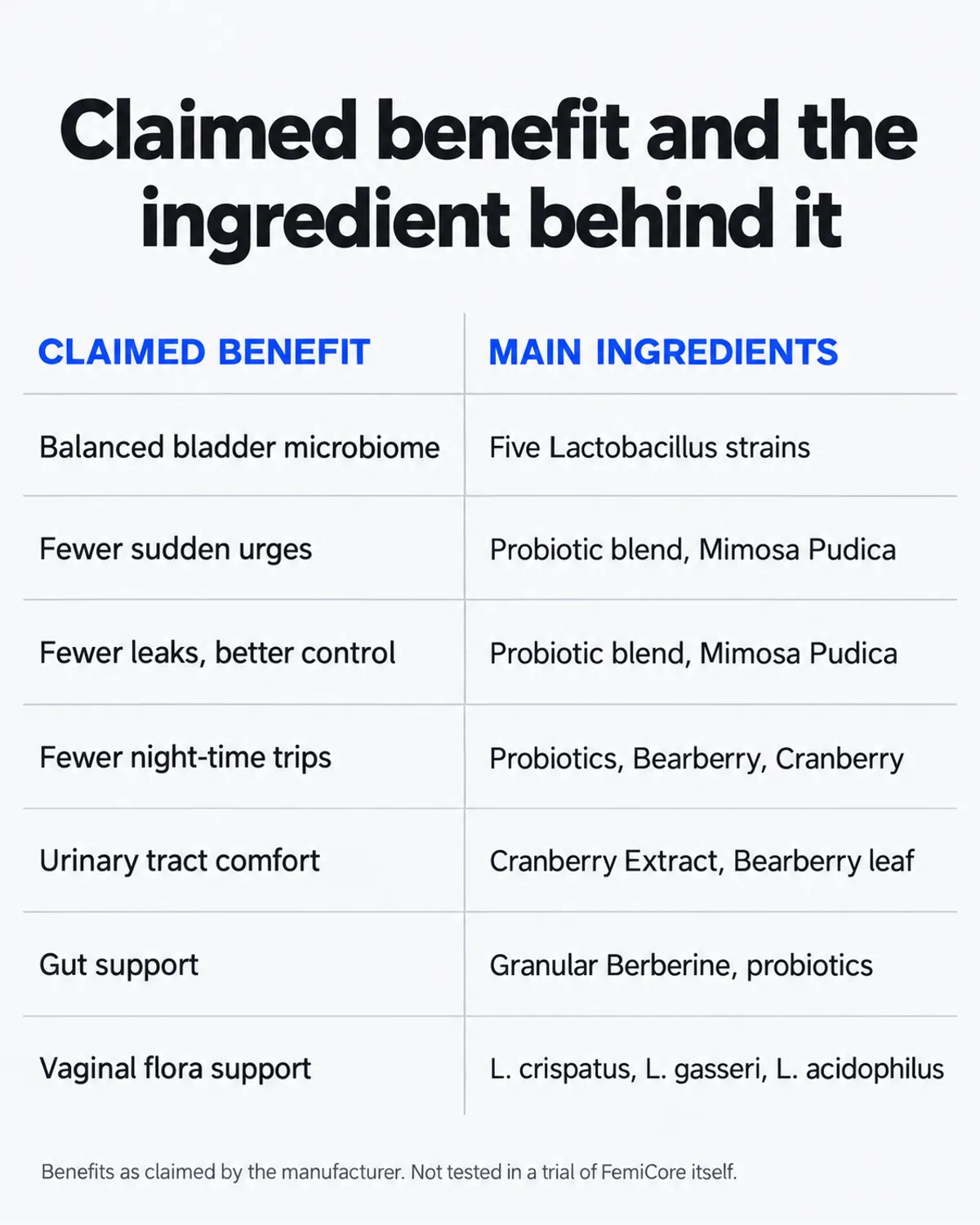
| Claimed benefit | Main ingredient(s) behind it | Proposed mechanism |
|---|---|---|
| A more balanced bladder microbiome | L. crispatus, L. acidophilus, L. plantarum, L. gasseri, L. casei | Restore Lactobacillus dominance in the urogenital tract |
| Fewer sudden urges | Probiotic blend, Mimosa Pudica | Calmer bladder lining, less irritation |
| Fewer leaks and better control | Probiotic blend, Mimosa Pudica | Follows from fewer urges |
| Fewer night-time bathroom trips | Probiotic blend, Bearberry, Cranberry | Less irritation, fewer urgent signals overnight |
| Urinary tract comfort and “cleansing” | Cranberry Extract, Bearberry leaf | Anti-adhesion (cranberry) and antibacterial arbutin (bearberry) |
| Gut support | Granular Berberine, probiotic blend | A healthier gut as the reservoir for urogenital bacteria |
| Vaginal flora support | L. crispatus, L. gasseri, L. acidophilus | Species that dominate healthy vaginal flora |
The pattern is clear once it is laid out: the probiotic blend is asked to carry the headline benefits (urgency, leaks, night trips), while the botanicals carry the “comfort” and infection-related benefits. That split matters, because the evidence is much stronger on the comfort side than on the control side.
Benefit by benefit: what the research says
A more balanced bladder microbiome
This is the scientific starting point for the whole product. Researchers at Loyola University found that women with urgency urinary incontinence tend to have a more varied bladder microbiome with less Lactobacillus, while women without symptoms more often have a Lactobacillus-dominated one (Pearce et al., 2014).
That is a genuine, well-conducted finding, but it is an association. Nobody has shown that swallowing Lactobacillus shifts the bladder microbiome, or that shifting it reduces urgency. Evidence label: C. The theory is plausible; the step from capsule to bladder is untested.
Fewer sudden urges and fewer leaks
These are the benefits most buyers care about, and they have the thinnest support. No ingredient in FemiCore has been tested in a human trial for urgency or leaks. Mimosa Pudica, included to soothe the bladder, has laboratory and animal data only. The probiotic strains have no urgency trials. Evidence label: D.
That does not mean nobody will notice a change. It means any change is not something the research can promise. If leaks happen when you cough, sneeze or lift, that is stress incontinence, and pelvic floor muscle training is the first-line approach with strong trial support (Dumoulin et al., 2018). The microbiome idea applies mainly to urgency.
Fewer night-time bathroom trips
Night-time urination (nocturia) has many causes, including fluid timing, sleep quality, medicines, blood sugar and heart or kidney issues. None of FemiCore’s ingredients has been studied for it. Any benefit would be indirect, through less bladder irritation. Evidence label: D. If night trips are new or getting worse, a check-up is more useful than a supplement.
Urinary tract comfort and infection defence
This is where FemiCore’s ingredient list is on its firmest ground.
- Cranberry Extract. The 2023 Cochrane review of 50 trials found cranberry products reduce symptomatic urinary tract infections in women with recurrent infections (Williams et al., 2023). Grade B for this use. The trials that worked used defined amounts of proanthocyanidins (PACs), and FemiCore does not state its PAC content.
- L. crispatus. A phase 2 randomised trial found fewer recurrent infections with an L. crispatus strain than with placebo (Stapleton et al., 2011). Grade B, with the caveat that it was given as a vaginal suppository, not a capsule, and the FemiCore strain is not named.
- Bearberry (Uva Ursi) leaf. Traditionally used for urinary complaints, but the ATAFUTI trial found no meaningful effect on infection symptoms (Afshar et al., 2018). Grade C, and European guidance limits it to short courses.
Overall label for this benefit: B for the ingredients, unconfirmed for the product, because the doses are hidden. It is also worth being precise: “fewer infections” is not the same as “better bladder control”. This benefit is about comfort and defence, not leaks.
Gut support
All five Lactobacillus species are common probiotics with general gut research, and berberine shifts the gut microbiome in metabolic studies. FemiCore’s logic is that the gut is the reservoir from which bacteria reach the urogenital tract. Evidence label: C for general gut support, D for any knock-on bladder effect.
Berberine deserves a specific note. Its strong evidence is for blood sugar in type 2 diabetes at 1,000 to 1,500 mg a day (Yin et al., 2008). A single capsule containing eight other ingredients cannot hold that amount, so do not count blood sugar control among FemiCore’s benefits. Berberine’s drug interactions, however, apply at any dose. Our FemiCore side effects guide covers who should check with a pharmacist first.
Vaginal flora support
L. crispatus, L. gasseri and L. acidophilus are among the species that dominate healthy vaginal flora, and there is reasonable research on them for that purpose. Without a CFU count or strain IDs, though, there is no way to judge whether FemiCore delivers enough live bacteria. Evidence label: C.
Evidence strength by benefit
Here is the whole picture on one page. If you only read one section, read this one.
| Benefit | Evidence label | Main reason |
|---|---|---|
| Urinary tract infection defence | B (ingredients) | Cranberry Cochrane 2023; L. crispatus phase 2 trial |
| Vaginal flora support | C | Reasonable species research, no CFU or strain IDs |
| Balanced bladder microbiome | C | Strong association study, no intervention trial |
| General gut support | C | General probiotic research |
| Fewer sudden urges | D | No human trial of any ingredient |
| Fewer leaks | D | No human trial of any ingredient |
| Fewer night-time trips | D | No study; many other causes |
| Blood sugar (berberine) | Not a realistic benefit | Studied dose far above what one capsule can hold |
Read from top to bottom, the table explains the overall C grade. The benefits that have the best research are not the headline ones, and the headline ones have the least.
Practical benefits that are not health claims
Some of FemiCore’s advantages have nothing to do with research grades but are still real for a buyer:
- One capsule a day. A single morning capsule with water is easy to stick to, which matters for anything that needs 60 to 90 days to judge.
- No stimulants or hormones. Nothing in the formula is likely to affect sleep or energy.
- Product attributes. The official website describes it as non-GMO and stimulant-free. Those are product attributes, not evidence for any benefit.
- A refund window. The 60-day money-back guarantee lets you test the benefits that matter to you at limited financial risk, as long as you return all bottles with the packing slip.
What would make the benefits more believable
The fastest way for the manufacturer to strengthen its benefit claims would cost nothing in new research: publish the amounts. A cranberry PAC figure, a CFU count at expiry and named strains would let us check the ingredient benefits against the trials that support them. Until then, the honest position is that FemiCore’s ingredient choices point in a sensible direction, and its dose transparency does not let anyone confirm it gets there.
If you want the full ingredient-by-ingredient analysis behind these labels, our complete FemiCore review goes deeper, and our evidence check on whether FemiCore really works sets out a realistic 12-week timeline.
The bottom line on FemiCore benefits
So, what are the benefits of FemiCore that the evidence can actually stand behind? Urinary tract comfort and infection defence, through cranberry and L. crispatus, are the most credible, with moderate ingredient research and unconfirmed doses. A more balanced microbiome and vaginal flora support are plausible but limited. Fewer urges, fewer leaks and fewer night trips, the benefits most women buy it for, have no direct human evidence yet.
That makes FemiCore a reasonable, low-risk experiment for mild urgency alongside pelvic floor work and a doctor’s check, not a product with proven bladder-control benefits. Set your expectations by the table above, take it consistently, and use the guarantee if nothing has changed by week eight.
Frequently asked questions
What are the main benefits FemiCore claims?
The manufacturer markets FemiCore as supporting bladder control, with fewer sudden urges, fewer leaks and fewer night-time trips, plus urinary tract comfort and a balanced urinary microbiome. These are support claims for a dietary supplement, not treatment claims.
Which FemiCore benefit has the strongest evidence?
Urinary tract infection defence. Cranberry has a 2023 Cochrane review showing fewer infections in women with recurrent UTIs, and L. crispatus has a phase 2 trial showing fewer recurrences, although that trial used a vaginal suppository rather than a capsule. Neither study measured leaks.
Is there proof that FemiCore reduces bladder leaks?
No. There is no published trial of FemiCore, and none of its nine ingredients has been tested for leaks or urgency in people. The idea rests on research linking a low-Lactobacillus bladder microbiome to urgency incontinence, which is an association rather than proof that a capsule helps.
Does the berberine in FemiCore help blood sugar?
Berberine has strong evidence for lowering blood sugar, but only at around 1,000 to 1,500 mg a day. A single capsule shared with eight other ingredients cannot contain that much, so FemiCore should not be treated as a blood sugar product. Berberine can still interact with medicines at any dose.
How long before I would notice any FemiCore benefits?
The manufacturer suggests 60 to 90 days of daily use before judging it. Because the 60-day guarantee runs from the day your order is delivered, it makes sense to assess honestly at around week seven or eight.
Can FemiCore replace pelvic floor exercises or a doctor visit?
No. Pelvic floor muscle training is the first-line approach for stress and mixed incontinence, and new or changing bladder symptoms should be checked by a clinician. FemiCore is at most an addition to those steps.
Sources
- 01 Pearce MM, et al. The female urinary microbiome: a comparison of women with and without urgency urinary incontinence. mBio. 2014.
- 02 Stapleton AE, et al. Randomized, placebo-controlled phase 2 trial of a Lactobacillus crispatus probiotic given intravaginally for prevention of recurrent urinary tract infection. Clin Infect Dis. 2011.
- 03 Williams G, et al. Cranberries for preventing urinary tract infections. Cochrane Database Syst Rev. 2023.
- 04 Afshar K, et al. Uva-ursi extract and ibuprofen as alternative treatments for uncomplicated urinary tract infection in women (ATAFUTI). Br J Gen Pract. 2018.
- 05 Yin J, Xing H, Ye J. Efficacy of berberine in patients with type 2 diabetes mellitus. Metabolism. 2008.
- 06 Dumoulin C, et al. Pelvic floor muscle training versus no treatment for urinary incontinence in women. Cochrane Database Syst Rev. 2018.
what are the benefits of femicore · femicore · femicore benefits · bladder control supplement · urinary microbiome · cranberry · lactobacillus crispatus