Ingredients / Guide
TitanFlow Ingredients: The Five-Ingredient Label, Amount by Amount
TitanFlow ingredients explained: pumpkin seed oil, Pygeum africanum, broccoli sprout, lycopene and beta sitosterol, with amounts and the seller's roles.
- Author
- Supplement Health Expert Editorial Team
- Updated
- Reading time
- 8 min
- Sources
- 0 cited
Key takeaways
- 01 Each two-capsule serving lists five named ingredients with printed amounts: 500 mg, 100 mg, 50 mg, 37.5 mg and 30 mg.
- 02 Pumpkin seed oil leads the panel, and the seller pairs it with beta sitosterol to support emptying and flow.
- 03 The seller cites university research on pumpkin seed oil. That is background, not proof that TitanFlow works.
- 04 The capsule shell is gelatin, and the other ingredients are rice flour, silicon dioxide and vegetable-grade magnesium stearate.
- 05 Share the label with your doctor or pharmacist and keep taking your prescribed medicines.
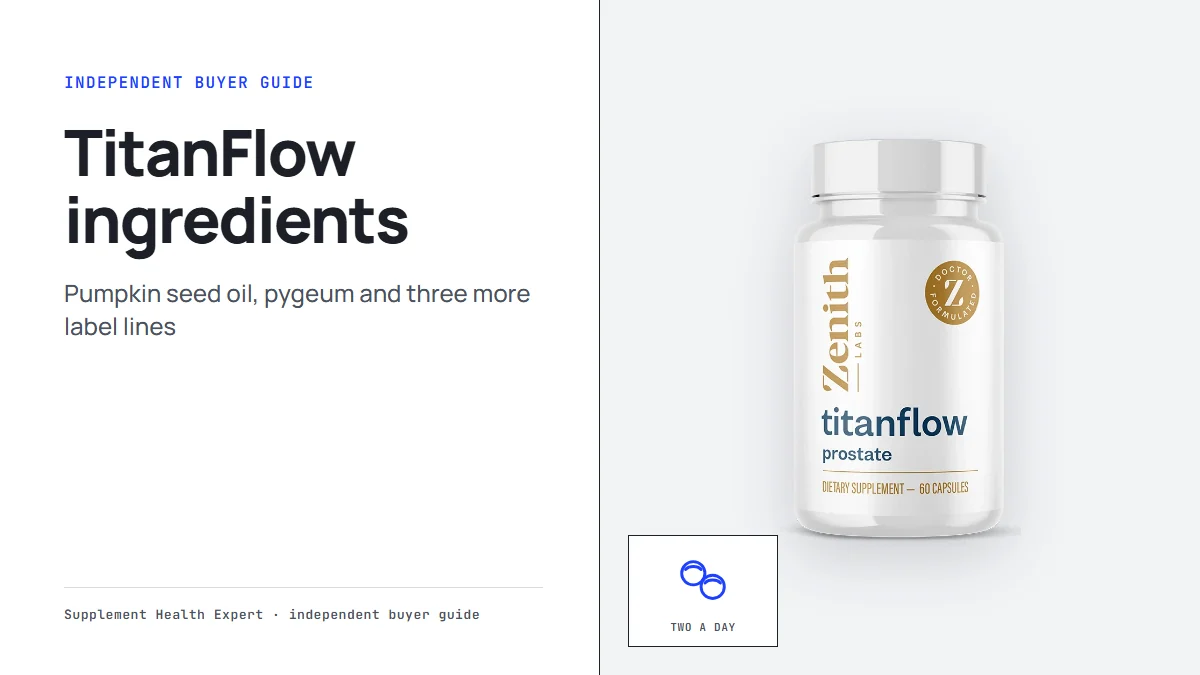
A short, readable label is a good sign, and the TitanFlow ingredients list qualifies: five named actives, each with a printed amount for a two-capsule serving. Zenith Labs aims the formula at men over 40 who want support for healthy urinary flow and complete emptying, according to the seller, and the panel lets you inspect what stands behind that aim before you order. Below we walk through every line, the seller’s reason for it and the fine print that shoppers often skip.
TitanFlow Ingredients at a Glance
One serving equals two capsules, and a 60-capsule bottle holds 30 servings. These are the five active lines and the part the seller assigns to each.
| Ingredient | Amount per serving | What the seller says it is for |
|---|---|---|
| Pumpkin seed oil (Cucurbita pepo) | 500 mg | Traditional backing for urinary health and thorough emptying |
| Pygeum africanum PE 4:1 (bark) | 100 mg | A traditional herbal pick for urinary health and flow |
| Broccoli PE 4:1 (sprout) | 50 mg | An antioxidant addition |
| Lycopene, 5 percent extract (tomato skin) | 37.5 mg | Antioxidant backing for urinary health |
| Beta sitosterol complex | 30 mg | Partners with pumpkin seed oil to support emptying and flow |
Every phrase in the right-hand column comes from the seller. None of it is our claim, and none of it promises a personal outcome.
Pumpkin Seed Oil Leads the Panel
At 500 mg per serving, pumpkin seed oil is the biggest line, and the seller builds the whole formula around it. The seller says it draws on university research on pumpkin seed oil. We see that as background for choosing the ingredient. It is not a finding about TitanFlow, and no reader should take it as proof that the capsule works for any one man.
The seller teams the oil with beta sitosterol to support emptying and flow. That partnership is the core idea: a lead ingredient and a companion that the seller says work as a pair.
Pygeum Africanum: A Bark Extract
The panel lists Pygeum africanum as a 4:1 bark extract, 100 mg per serving. In the seller’s words, pygeum is a traditional herbal ingredient for urinary health. The 4:1 mark signals a concentrate, meaning a larger weight of raw bark went into each unit of extract. Our ingredients page keeps the complete table next to the packages.
Broccoli Sprout and Lycopene: The Antioxidant Duo
Broccoli sprout extract (50 mg, 4:1) and lycopene from tomato skin (37.5 mg, 5 percent extract) arrive as antioxidants, per the seller. Lycopene is the red pigment that colors tomatoes, and the seller describes it as antioxidant backing for urinary health. Together the pair gives the formula a plant-based supporting cast beside the oil and the bark.
Where Each Ingredient Comes From
The label names the plant part behind most lines, so the panel is easy to picture.
| Ingredient | Plant source on the label |
|---|---|
| Pumpkin seed oil | Pumpkin seeds (Cucurbita pepo) |
| Pygeum africanum | Bark |
| Broccoli | Sprout |
| Lycopene | Tomato skin |
| Beta sitosterol | A sterol complex |
Three of the five trace back to foods most of us know, and that familiarity appeals to some shoppers. A familiar source is not a safety guarantee, though, and a concentrated extract is stronger than the food, which is one more reason to show the label to your doctor.
Beta Sitosterol Complex
Beta sitosterol is the smallest line at 30 mg per serving, yet the seller gives it a clear assignment: partner for the pumpkin seed oil, aimed at emptying and flow. A small amount on a label is common and is no flaw. What counts for you is that the figure is printed and that you can hand it to a pharmacist.
How to Read the Panel Yourself
Three details deserve a second look.
- Serving size: two capsules, with 30 servings in each bottle of 60.
- Milligram figures: these cover a serving, not a capsule, so each capsule holds half.
- Extract marks: 4:1 on pygeum and broccoli, and 5 percent on lycopene, describe how concentrated each extract is.
With those three facts in hand, the panel reads like a recipe card, and you can see within seconds how much of each ingredient fits into one day.
The Supporting Ingredients
The panel ends with four helpers that make a capsule possible.
- Rice flour, a filler
- Silicon dioxide, commonly used to keep powders moving
- Magnesium stearate (vegetable grade)
- Gelatin, the capsule shell
Gelatin is animal-derived. If you avoid such ingredients, TitanFlow is the wrong fit, and learning that before you order beats learning it afterward.
The Idea Behind the Formula
The seller’s reasoning is direct. Urinary flow, it says, is not only a matter of prostate size, and TitanFlow concentrates instead on the strength of the urethra walls. The ingredient choices follow that idea: a lead oil, a partner compound, a traditional bark extract and two antioxidants. You can accept or doubt the idea and still appreciate how plainly the label is written. Better yet, you have 180 days under the guarantee to judge it.
The seller also credits Zenith Labs’ Dr. Ryan Shelton, N.D., with formulating it. He is the seller’s own doctor, so take that as the seller’s introduction and not an independent endorsement.
How the Five Fit Together
Read top to bottom, the panel tells a tidy story. The oil is the headline, the sterol complex is its named partner, the bark extract adds a traditional herbal note, and the sprout and tomato extracts bring antioxidants. No line is padded with a vague proprietary blend, because each one carries its own amount. That openness lets you ask your doctor a specific question about a specific milligram figure instead of a general one about a mystery mix. For a side-by-side view with the packages and the guarantee, open the TitanFlow product hub.
Quality Statements, Attributed
The seller says TitanFlow is produced in an FDA-inspected US facility with independent testing. We have audited no facility, so those lines stay the seller’s. Your practical step is the one any careful buyer takes: compare the printed amounts with what the seller advertises.
Taking It Daily
Two capsules, once a day, is the label’s direction, and the seller suggests taking them with your first meal. Because a bottle of 60 lasts 30 days, three bottles cover 90 days and six cover 180. Stay with the stated serving, since more is not better.
A Label That Suits a Habit
Two capsules, one meal, one time a day: the routine is as brief as the ingredient list. That matters because the best formula is the one you remember to take. Linking the capsules to your first meal gives the habit an anchor, and 30 servings per bottle make it easy to count the days left. Simple routines tend to survive busy weeks.
Questions for Your Pharmacist
A pharmacist sees every medicine you take, so a short chat is time well spent. Bring the label and ask three things: does anything here overlap with my prescriptions, does the gelatin shell matter for me, and is there any reason to wait? Questions like these are everyday work for a pharmacist, and a five-line panel keeps the talk brief. The notes on our TitanFlow hub can help you prepare.
Who Might Skip It
Three situations call for honesty. If you are under 18, the label says TitanFlow is not for you. If you avoid animal-derived ingredients, the gelatin shell rules it out. And if you take medication or have a medical condition, the label asks you to consult a physician first, so wait for that go-ahead. Keep taking your prescribed medicines throughout, and ask first if you use anything for the prostate, blood pressure or blood thinning. Our side-effects guide covers the safety notes.
Is It Worth Trying?
For a man who likes a clean label, a two-capsule routine and a generous refund window, yes. The panel is short, the amounts are visible and the guarantee gives you six months from your purchase date. We rate TitanFlow 9.0/10 on our own editorial scale, and our buyer review explains the score.
Frequently asked questions
What are the TitanFlow ingredients?
Per two-capsule serving: pumpkin seed oil (Cucurbita pepo) 500 mg, Pygeum africanum PE 4:1 (bark) 100 mg, broccoli PE 4:1 (sprout) 50 mg, lycopene, 5 percent extract (tomato skin), 37.5 mg and beta sitosterol complex 30 mg.
What are the other ingredients in TitanFlow?
Rice flour, silicon dioxide, magnesium stearate (vegetable grade) and gelatin for the capsule.
Why does TitanFlow use pumpkin seed oil?
According to the seller, pumpkin seed oil is the lead ingredient, paired with beta sitosterol to support emptying and flow. The seller says it draws on university research on pumpkin seed oil.
How many capsules are in one serving?
Two capsules once a day, ideally with your first meal. A bottle holds 60 capsules, which is 30 servings.
Is the TitanFlow capsule plant-based?
No. The capsule is made from gelatin, so it is not suitable if you avoid animal-derived ingredients.
Who formulated TitanFlow?
The seller says Zenith Labs' Dr. Ryan Shelton, N.D., formulated it. That is the seller's statement about its own doctor.
titanflow ingredients · titanflow label · pumpkin seed oil · pygeum africanum · beta sitosterol · lycopene · broccoli sprout extract · titanflow supplement facts