Topical Pain Relief/Ingredients
Arctic Blast Ingredients: The Drug Facts Panel, Line by Line
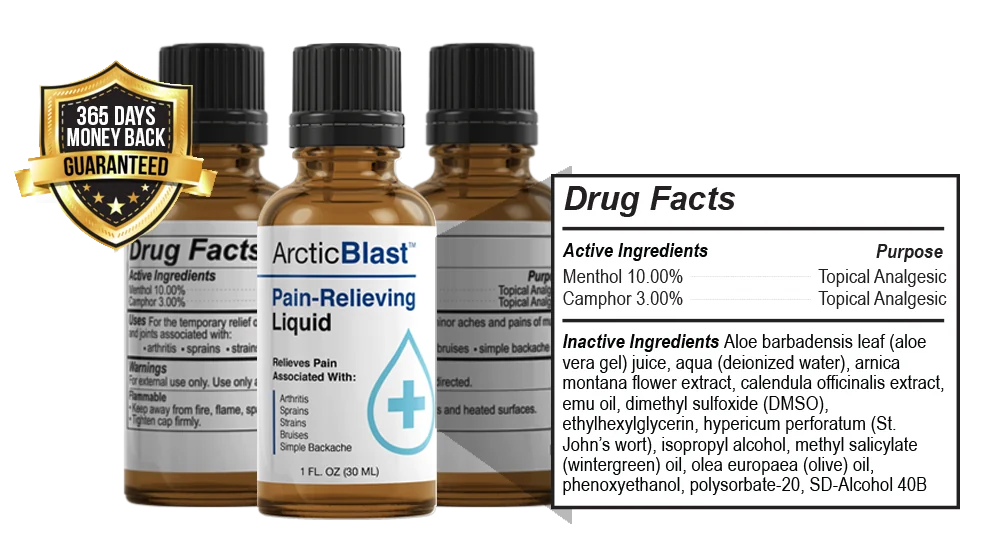
Arctic Blast ingredients from the Drug Facts label: menthol 10.00% and camphor 3.00% as actives, plus the 14 inactive ingredients in label order, DMSO included.
- From $39 per bottle
- 365-day refund
- Topical Pain Relief
By Supplement Health Expert Editorial Team · · 8 min read
- Refund window
- 365-day money-back guarantee from the purchase date; used, unused or empty bottles go back to the seller's returns centre, and support confirms the return steps
- Lowest per bottle
- $39 largest bundle
- Category
- Topical Pain Relief
- Our score
- 8.4/10 editorial
Key takeaways
- 01 Arctic Blast has two labelled active ingredients: menthol at 10.00% and camphor at 3.00%, each with the purpose Topical Analgesic.
- 02 The label lists 14 inactive ingredients in order, DMSO among them, with no amounts printed for any of them.
- 03 The label lists DMSO among the other ingredients, and the seller describes it as the carrier.
- 04 The label asks adults to apply the liquid to the skin no more than three to four times a day and keeps it out of the eyes.
Flip the bottle over before you buy and you will find a clean Drug Facts panel. It follows the standard format, with two active ingredients printed alongside their percentages and the inactive ingredients listed beneath. Here the panel is walked through line by line, so you can see what the liquid contains before it touches your skin.
The Drug Facts panel in one view
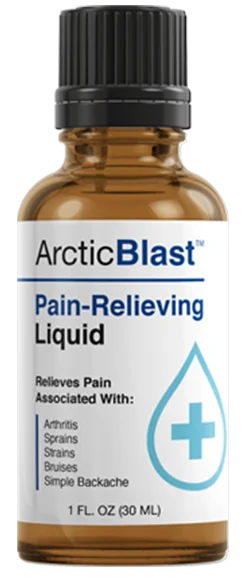
Three elements carry most of the weight on this panel. The active ingredients come first, with a percentage each. The inactive ingredients follow in label order, and the label prints no amounts for them. The net contents line gives the volume, which is 1 FL. OZ (30 ML) per bottle.
The figures in the table below are copied from the label, purpose lines included.
| Active | Printed amount | Printed purpose |
|---|---|---|
| Menthol | 10.00% | Topical Analgesic |
| Camphor | 3.00% | Topical Analgesic |
Those two lines are the only ones with a percentage. Everything else on the panel is an inactive ingredient, shown below in the order the label prints it. Keep that split in mind when you compare pages.
The fourteen inactive ingredients, in label order
No figure appears beside any inactive entry. We preserve the printed order and wording so your bottle can be checked line for line.
| Position | Inactive ingredient, as printed |
|---|---|
| 1 | Aloe barbadensis leaf (aloe vera gel) juice |
| 2 | Aqua (deionized water) |
| 3 | Arnica montana flower extract |
| 4 | Calendula officinalis extract |
| 5 | Emu oil |
| 6 | Dimethyl sulfoxide (DMSO) |
| 7 | Ethylhexylglycerin |
| 8 | Hypericum perforatum (St. John’s wort) |
| 9 | Isopropyl alcohol |
| 10 | Methyl salicylate (wintergreen) oil |
| 11 | Olea europaea (olive) oil |
| 12 | Phenoxyethanol |
| 13 | Polysorbate-20 |
| 14 | SD-Alcohol 40B |
Menthol and camphor, the two actives
Menthol at 10.00%. On the label, menthol is the bigger of the two actives, tagged Topical Analgesic. The seller talks up a cooling menthol-and-camphor feel. In our wording, that phrase points at the labelled ingredients, not at any outcome.
Camphor at 3.00%. Camphor sits second on the panel at 3.00%, and it carries the same purpose line. Menthol and camphor show up side by side in a lot of topical products, which is part of why the pairing looks familiar on a shelf.
Neither active comes with a claim on the panel beyond its purpose line. We do not add one.
The carrier question: DMSO
Dimethyl sulfoxide, or DMSO, draws most of the attention. The label lists DMSO among the other ingredients; the seller describes it as the carrier. The bottle prints no percentage beside it, and the carrier idea mostly comes from the seller’s pitch.
We stick with the label. DMSO is sixth on the list and carries no amount. Anyone hunting for a figure will not find one on the bottle. For advice on pairing DMSO with other products on that same skin, a pharmacist is the person to ask.
The plant and oil ingredients
A handful of entries are botanical or oil-based: aloe vera gel juice, arnica montana flower extract, calendula extract, emu oil, olive oil and St. John’s wort. The panel names each of them and gives no amount for any.
Aloe and olive oil are familiar in personal-care products. Arnica and calendula come from flowers, and the seller lists them among its botanicals. Emu oil is an animal-derived oil. The label does not say how much of any of them is in the bottle, so we describe what each one is and do not rate it.
Alcohols, wintergreen and St. John’s wort
Three items on the list call for a little extra care.
Isopropyl alcohol and SD-Alcohol 40B. Both are alcohols, which is part of why the bottle carries a flammable warning. Store it clear of heat sources and open flames.
Methyl salicylate (wintergreen) oil. It belongs to the salicylate family. If aspirin or salicylates set off an allergy in you, put the question to a doctor or pharmacist before the first use.
Hypericum perforatum (St. John’s wort). If blood thinners or other prescriptions are part of your day, check with a doctor or pharmacist before you begin.
The safety guide turns these three into a fuller checklist.
The additives that hold the mix together
Ethylhexylglycerin, phenoxyethanol, polysorbate-20 and the deionized water are the remaining entries in that group. The panel does not explain their jobs, so we do not guess at them.
How to read a Drug Facts label
If you want to check any topical label, the same steps work every time, and they take about two minutes with the bottle in hand.
- Find the actives first. They are the ingredients with a percentage and a purpose line.
- Note the purpose. On this label both actives say Topical Analgesic.
- Scan the inactive list for triggers. Alcohols, salicylates and plant extracts are the entries to look at first.
- Read the warnings. For this product they cover external use, the eyes, wounds and the flammable warning.
- Check the net contents. On this bottle it reads 1 FL. OZ (30 ML).
Directions that match the panel
The label’s directions are short. Adults 18 and over put enough on the sore spot to cover it, up to three or four applications a day. Per the seller, the texture is oily at first and turns non-sticky after a few seconds. Stay away from the eyes, wounds and damaged skin, and skip any tight bandage.
Why the label is the reference
Two printed percentages and an ordered list of the remaining entries give you something concrete to verify. You can compare it with the seller’s pages, with the bottle in your hand and with the advice of a pharmacist. The seller’s pages talk about the formula in broader terms. The panel stays put, which is why we build this page around it. If you print this page, bring it to the pharmacy with the bottle so both sources are in front of you at once.
Questions to take to your pharmacist
- Menthol and camphor. The percentages and the purpose line.
- DMSO. Whether it is right to use alongside other creams or products on the same area.
- Wintergreen oil and St. John’s wort. Set these against your medicines and any aspirin allergy.
- The alcohols. The flammable warning and how you store the bottle.
Getting more from the panel
The panel is exact about what it names. It gives amounts for the two actives and lists the other ingredients in label order, so you can match each line to your own bottle. If you want to dig into a particular entry, such as the botanical extracts or the alcohols, take the bottle to a pharmacist, or put your question to the seller’s support team. If a bottle arrives looking different from the label on the seller’s page, pause and ask support before you use it.
Using the panel day to day
Keep the bottle upright, capped tightly, somewhere at room temperature and beyond children’s reach. Stay clear of fire and heat. If any is swallowed, consult a physician, because the product is meant for external use only.
Official bundle pricing
As listed on the official order page · checked Nov 17, 2026
1 bottleAbout 1 month
$69per bottle
Total $69
- Free shipping
- 365-day money-back guarantee
3 bottlesAbout 3 months
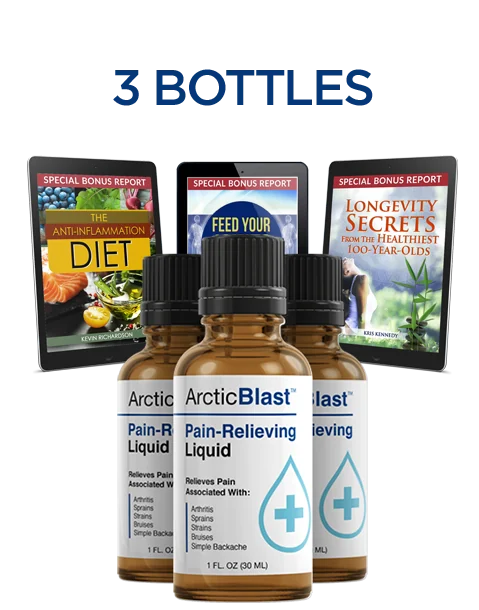
$49per bottle
Total $147
- Free shipping
- 3 free digital bonuses
- 365-day money-back guarantee
Best value
6 bottlesAbout 6 months
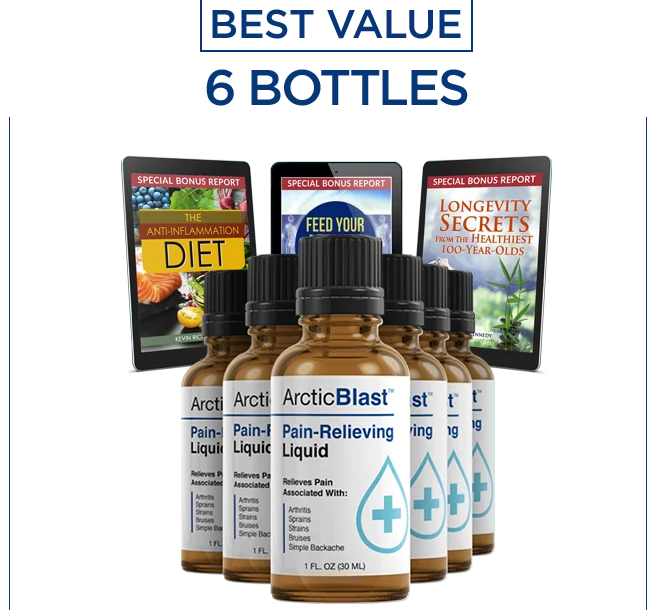
$39per bottle
Total $234
- Free shipping
- 3 free digital bonuses
- 365-day money-back guarantee
Refunds: 365-day money-back guarantee from the purchase date; used, unused or empty bottles go back to the seller's returns centre, and support confirms the return steps.
Frequently asked questions
What are the active ingredients in Arctic Blast?
Menthol at 10.00% and camphor at 3.00%. The Drug Facts panel gives the purpose of both as Topical Analgesic.
Does the label print the amount of each inactive ingredient?
No. The 14 inactive ingredients appear in label order with no amounts, and that includes DMSO. The label lists DMSO among the other ingredients; the seller describes it as the carrier.
Is DMSO an active ingredient?
Not on the label. The Drug Facts panel places dimethyl sulfoxide (DMSO) under inactive ingredients, so the two labelled actives are menthol and camphor.
Does Arctic Blast contain alcohol or salicylate-related ingredients?
The label lists isopropyl alcohol and SD-Alcohol 40B, and it lists methyl salicylate (wintergreen) oil. Anyone allergic to aspirin or salicylates should ask a doctor or pharmacist before use.
What are the other ingredients?
Aloe vera gel juice, deionized water, arnica montana flower extract, calendula extract, emu oil, DMSO, ethylhexylglycerin, St. John's wort, isopropyl alcohol, wintergreen oil, olive oil, phenoxyethanol, polysorbate-20 and SD-Alcohol 40B.
arctic blast ingredients · arctic blast label · arctic blast drug facts · arctic blast menthol · arctic blast camphor · arctic blast dmso · arctic blast