Supplement Reviews / Evidence C · Limited
Does FemiCore Really Work? What the Evidence Supports, a Realistic Timeline and Who Is Likely to Benefit
Does FemiCore really work? We check each claim against the research, set out a realistic 12-week timeline, and explain who is likely and unlikely to benefit.
- Author
- Supplement Health Expert Editorial Team
- Published
- Reading time
- 10 min
- Sources
- 5 cited
Key takeaways
- 01 FemiCore itself has not been tested in a clinical trial. Any answer to whether it works has to be built from the evidence for its ingredients.
- 02 The premise is real: women with urgency incontinence tend to have less Lactobacillus in the bladder (Pearce 2014). Whether a capsule can change that has not been shown.
- 03 Cranberry and L. crispatus have trial evidence for preventing urinary tract infections, not for reducing leaks or urgency.
- 04 The manufacturer suggests 60 to 90 days, but the refund window is 60 days from the day your order is delivered, so the decision point is around week seven or eight of use.
- 05 Our verdict: evidence strength 5/10, overall 6.3/10, grade C. A reasonable guaranteed trial for mild urgency, not a fix for stress leaks or infection.
Does FemiCore really work? It is the right question to ask before spending $200 or more on a bladder supplement, and it deserves a straighter answer than most sales pages give. FemiCore has never been tested as a finished product in a published clinical trial. So the only honest way to answer is to take each thing the formula is meant to do, line it up against the research behind its ingredients, and see where the evidence is solid, where it is thin, and where it is missing.
That is what this article does. It then sets out a realistic 12-week timeline, describes who is most and least likely to notice a difference, and explains how the 60-day guarantee can turn an uncertain product into a controlled experiment. We have no commercial link to the manufacturer. Buttons on this page are affiliate links and do not affect the verdict.
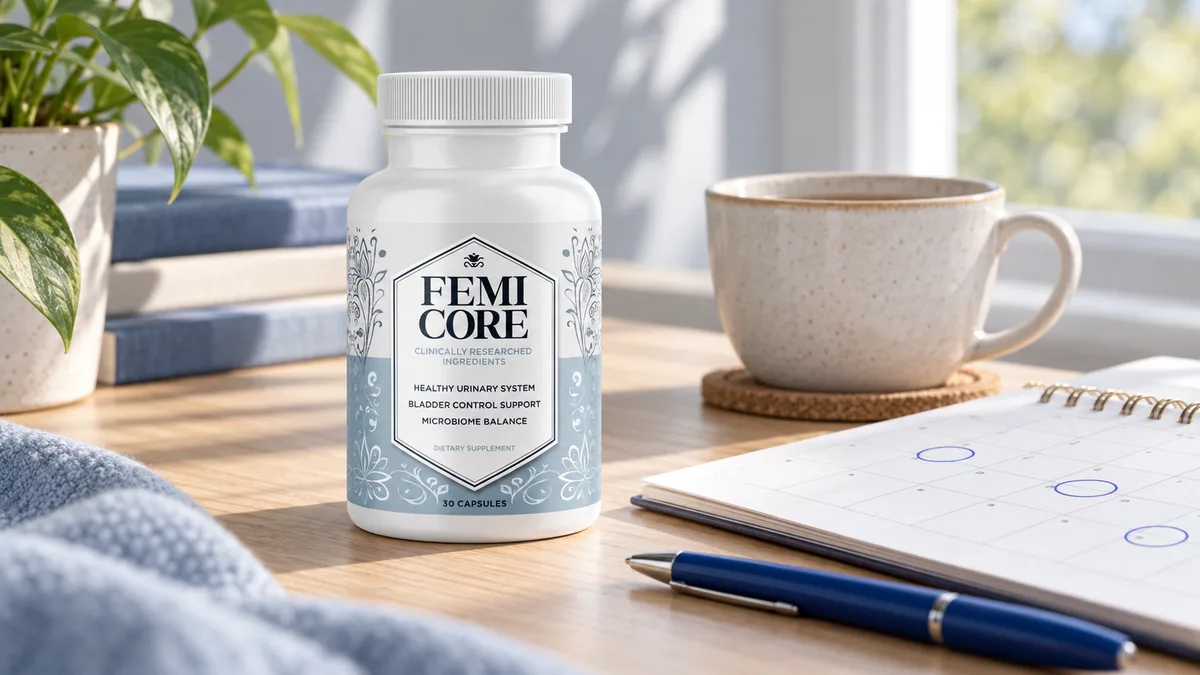
Does FemiCore really work? The short answer
Possibly, for some women, and with less certainty than the marketing suggests. The idea behind FemiCore is grounded in real science. Two of its nine ingredients have good trial evidence for a related urinary outcome. None of its ingredients, and not the product itself, has been shown in a trial to reduce bladder leaks or urgency. And because every dose is hidden in a proprietary blend, nobody outside the company can check whether the capsule contains amounts similar to those studied.
That places FemiCore in the middle: more credible than a random herbal blend, less proven than a treatment your doctor would prescribe. Our overall evidence grade is C (Limited).
What FemiCore is designed to do
FemiCore is sold as a once-daily capsule that supports bladder control and urinary health in women. The mechanism it describes has two parts:
- Rebalance the urinary microbiome. Five Lactobacillus strains, led by L. crispatus, are meant to encourage the kind of bacterial community found in women without bladder symptoms.
- Support the urinary tract while that happens. Cranberry, bearberry leaf, mimosa pudica and berberine are included for urinary tract comfort and the gut environment.
The result promised is fewer urgent trips, fewer night-time trips and better control. Those are the outcomes we check below.
What the evidence supports
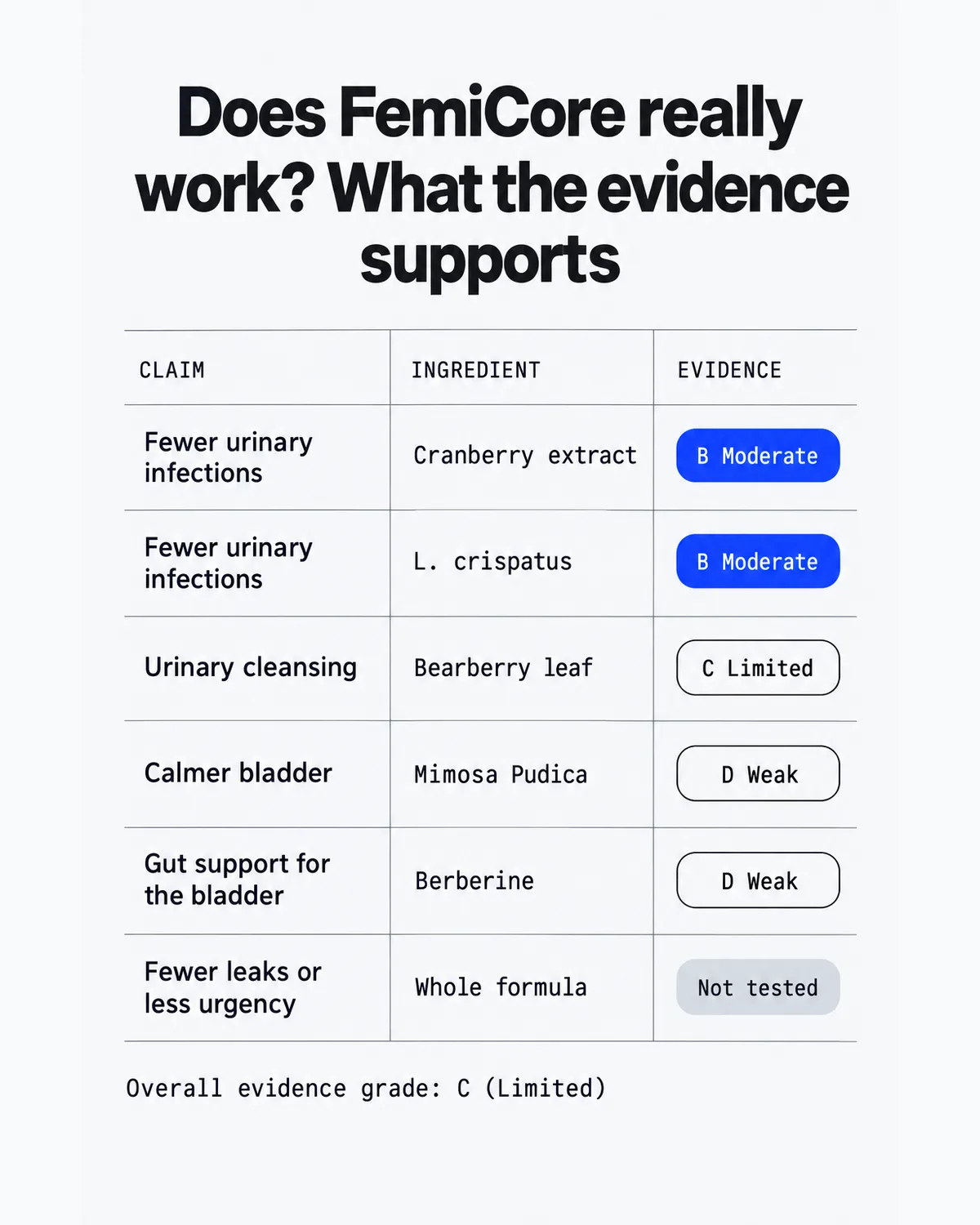
| Claim or idea | Ingredient behind it | Evidence strength |
|---|---|---|
| The bladder has a microbiome linked to urgency | (Premise, not an ingredient) | Good observational evidence |
| Fewer urinary tract infections | Cranberry extract | B, Cochrane review 2023 |
| Fewer urinary tract infections | L. crispatus | B, phase 2 trial, given vaginally |
| Urinary cleansing | Bearberry leaf | C, trial found no symptom benefit |
| Calmer bladder | Mimosa pudica | D, laboratory and animal data only |
| Healthier gut environment for urinary bacteria | Berberine, other Lactobacillus | D for bladder, C for general probiotics |
| Fewer leaks or less urgency | Whole formula | Not tested |
The premise holds up
The scientific starting point is sound. Researchers at Loyola University showed that the bladder of healthy women contains bacteria (Wolfe, 2012), and then that women with urgency incontinence had a more mixed bladder microbiome with less Lactobacillus than women without symptoms (Pearce, 2014). This is not marketing invention; it is published, peer-reviewed work.
What the research does not show is direction. It found an association. It did not show that adding Lactobacillus reduces urgency, and it studied bacteria inside the bladder, not bacteria swallowed in a capsule.
Infection prevention is the strongest link
Cranberry is supported by a large Cochrane review showing fewer symptomatic urinary tract infections in women prone to them (Williams, 2023). L. crispatus reduced repeat infections in a phase 2 trial, though the product was used vaginally (Stapleton, 2011). If your bladder symptoms are tied to frequent infections, this is where FemiCore’s ingredient evidence is most relevant. It is still not a substitute for proper treatment of an active infection.
Leaks and urgency remain untested
This is the gap that matters most. FemiCore is sold for bladder control, yet no trial has measured leaks, urgency episodes or night-time trips with this formula or with its key ingredients taken by mouth. Any improvement you notice would be real for you, but it cannot be predicted from the research.
The proprietary blend problem
Even the ingredients with good evidence only help if they are present in a useful amount. FemiCore lists its nine ingredients in one blend with no individual amounts, no probiotic CFU count and no strain identifiers. Our FemiCore ingredients list breaks down what the label does and does not say.
For the “does it work” question, this means two things. First, you cannot compare the cranberry with the doses that worked in trials. Second, you cannot tell whether the L. crispatus in the capsule is the strain that was tested. The formula could be well dosed. There is simply no way to check.
A realistic 12-week timeline
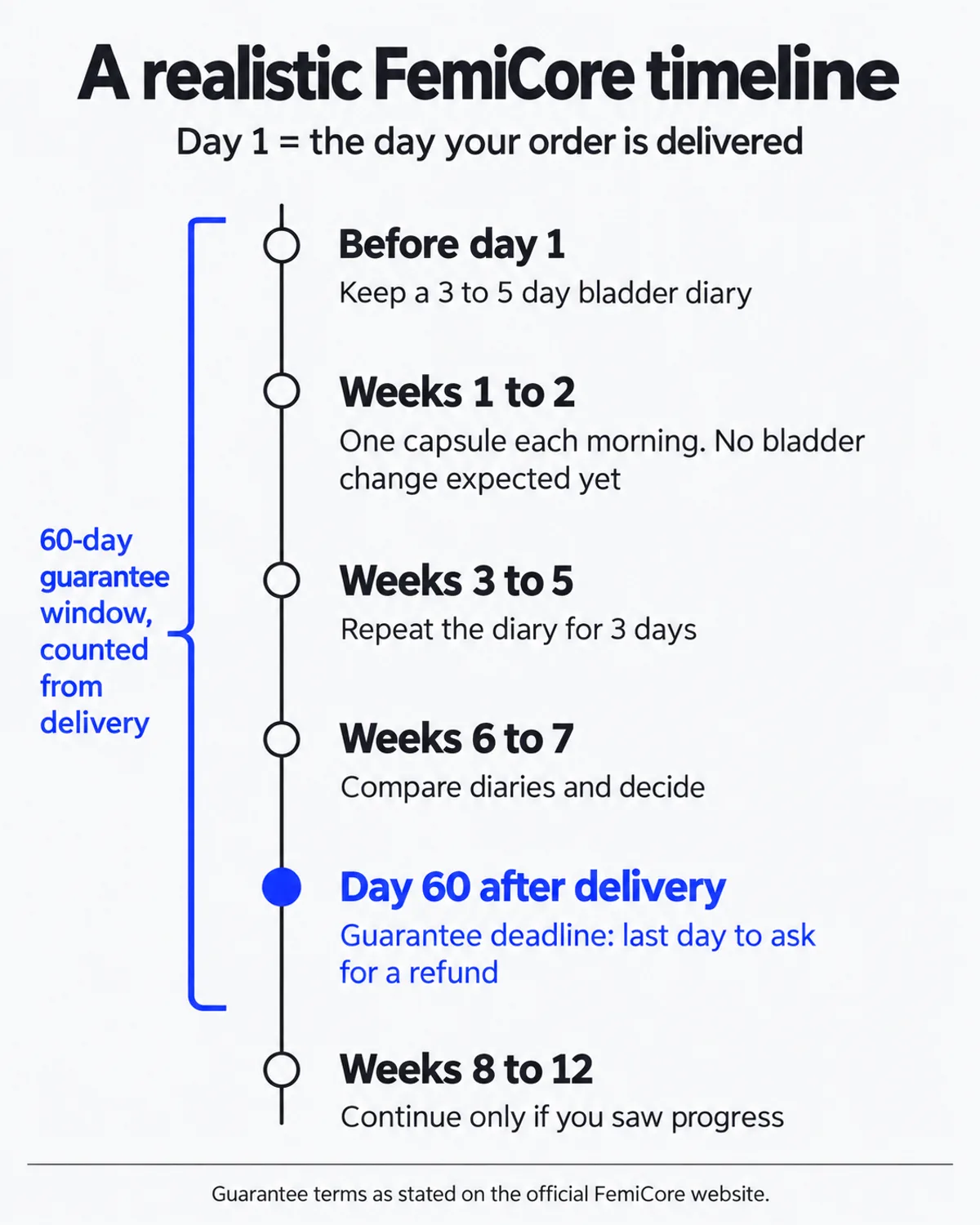
The manufacturer suggests 60 to 90 days of daily use. Probiotic changes, if they happen, are gradual, so judging FemiCore after a fortnight is too early. Judging it at day 90 is too late if you might want your money back, because the guarantee runs for 60 days from the day your order is delivered, not from the day you order. Here is a timeline that respects both facts.
| Period | What to do | What is reasonable to expect |
|---|---|---|
| Before day 1 | Keep a bladder diary for 3 to 5 days | A baseline: trips per day, night trips, urgent episodes, leaks |
| Weeks 1 to 2 | One capsule each morning with water | Possibly mild digestive changes; no bladder change expected yet |
| Weeks 3 to 5 | Keep taking it; repeat the diary for 3 days | An early signal, if any, would usually appear here |
| Weeks 6 to 7 | Compare diaries; make the decision | Some change: continue. No change at all: claim the refund |
| Day 60 | Guarantee deadline (counted from delivery) | Last day to contact support for a refund |
| Weeks 8 to 12 | Continue only if you saw progress | The manufacturer’s suggested window for fuller results |
Allow for shipping time. US orders take 5 to 7 business days, and international orders 10 to 15. Both eat into the 60 days before you swallow the first capsule.
Who is likely to benefit, and who is not
| More likely to be a fit | Less likely to benefit |
|---|---|
| Mild urgency or frequent daytime trips | Leaks mainly when coughing, sneezing, laughing or lifting |
| Night-time trips without another clear cause | Active urinary infection (burning, fever, cloudy or bloody urine) |
| History of recurrent urinary infections, already assessed by a doctor | Prolapse or a feeling of bulging in the vagina |
| Already doing pelvic floor exercises and wanting an add-on | Bladder problems after nerve injury, surgery or a fall |
| Happy to keep a simple diary and decide by week seven | On medicines that interact with berberine, or pregnant |
Leaks when you cough or lift are stress incontinence. The microbiome theory is about urgency, and the best-supported approach for stress leaks is pelvic floor muscle training, which a Cochrane review found clearly improves symptoms (Dumoulin, 2018). If you are unsure which type you have, a GP or women’s health physiotherapist can tell you. Before starting, also read our FemiCore side effects guide, because berberine and bearberry are not right for everyone.
The 60-day guarantee as risk control
When evidence is limited, the guarantee becomes part of the answer. It lets you test FemiCore on yourself with a defined exit. To use it properly:
- Buy from the official website only. Marketplace bottles are not covered. Our FemiCore official website guide explains how to spot the genuine store.
- Choose a package that matches the plan. The 3-bottle package ($207, free US shipping, about $2.30 a day) covers the full 90 days. The 6-bottle package ($294, about $1.63 a day) is cheaper per day but a bigger upfront commitment for an unproven product.
- Keep every bottle and the packing slip. You must return all bottles, empty or full.
- Diarise the deadline. Contact support before day 60, counted from the day your order is delivered. Return shipping is at your own cost, and shipping fees may not be refunded.
How to judge FemiCore fairly
Feelings about a bladder supplement drift. A good week makes it seem to work; a bad night makes it seem useless. A simple diary avoids both traps. For three days before you start, and again at weeks four and seven, write down:
- How many times you pass urine in the day and at night.
- How many times you felt a sudden, hard-to-delay urge.
- How many leaks you had, and roughly how much.
Compare the numbers, not the impression. A clear drop in night trips or urgent episodes is a reason to continue. No movement at all by week seven is a reason to use the guarantee and talk to your doctor about other options.
Our verdict
| Area | Our score |
|---|---|
| Ingredient selection | 7/10 |
| Evidence strength | 5/10 |
| Transparency | 3/10 |
| Guarantee and refund | 8/10 |
| Overall | 6.3/10, grade C |
So, does FemiCore really work? The formula follows real bladder research and includes the two ingredients with the best urinary evidence, but no trial has shown it reduces leaks or urgency, and the hidden doses make the gap impossible to close from the outside. For a woman with mild urgency who has seen a doctor, is doing pelvic floor exercises and is willing to keep a diary, it is a reasonable guaranteed experiment. For stress leaks, infection or prolapse, it is the wrong tool. For the full ingredient grades, see our detailed FemiCore review.
Frequently asked questions
Does FemiCore really work for bladder leaks?
It might help some women, but there is no trial of FemiCore or any of its ingredients showing fewer leaks. The formula is based on real research linking a low-Lactobacillus bladder to urgency, and on infection-prevention studies for cranberry and L. crispatus. That is a plausible basis, not proof.
How long does FemiCore take to work?
The manufacturer suggests 60 to 90 days of daily use before judging it. Because the money-back guarantee runs for 60 days from the day your order is delivered, plan to review your progress around week seven so you can still claim a refund if nothing has changed.
Who is FemiCore most likely to help?
Women with mild urgency or frequent trips to the toilet, who have been checked by a doctor to rule out infection or other causes, are the group the research rationale best fits. Doing pelvic floor exercises at the same time is sensible.
Who is FemiCore unlikely to help?
Women whose main problem is leaking when they cough, sneeze or lift (stress incontinence), anyone with an active urinary infection, prolapse or a nerve-related bladder problem. These need assessment and specific treatment rather than a supplement.
What if FemiCore does not work for me?
Email support with the subject "Refund Request" within 60 days of delivery, return all bottles, empty or full, with the packing slip, and the purchase price is refunded to your original payment method. Return shipping is at your own cost and shipping fees may not be refunded.
Are the FemiCore success ratings real?
The manufacturer states a 4.8 out of 5 rating from 19,263 reviews. We cannot verify that figure independently, so treat it as a marketing claim rather than evidence that the product works.
Sources
- 01 Wolfe AJ, et al. Evidence of uncultivated bacteria in the adult female bladder. J Clin Microbiol. 2012.
- 02 Pearce MM, et al. The female urinary microbiome: a comparison of women with and without urgency urinary incontinence. mBio. 2014.
- 03 Stapleton AE, et al. Randomized, placebo-controlled phase 2 trial of a Lactobacillus crispatus probiotic given intravaginally for prevention of recurrent urinary tract infection. Clin Infect Dis. 2011.
- 04 Williams G, et al. Cranberries for preventing urinary tract infections. Cochrane Database Syst Rev. 2023.
- 05 Dumoulin C, et al. Pelvic floor muscle training versus no treatment, or inactive control treatments, for urinary incontinence in women. Cochrane Database Syst Rev. 2018.
does femicore really work · femicore · does femicore work · femicore results · femicore evidence · bladder microbiome · urgency incontinence