Ingredients / Guide
Gluco6 Ingredients: Sukre, Six Plants and Three Nutrients, and What the Seller Says Each Does
Gluco6 ingredients explained: Sukre (L-arabinose), green tea, gymnema, cinnamon, theacrine, eleuthero, theobromine plus D3, B1 and chromium, per the seller.
- Author
- Supplement Health Expert Editorial Team
- Updated
- Reading time
- 9 min
- Sources
- 3 cited
Key takeaways
- 01 The label lists vitamin D3 (50 mcg), vitamin B1 (100 mg), chromium (1 mg) and a 525 mg proprietary blend.
- 02 The blend holds Sukre (L-arabinose), theobromine, green tea leaf extract, eleuthero root, theacrine, cassia cinnamon bark and gymnema leaf.
- 03 The seller's own highlights are Sukre, TeaCrine, gymnema, chromium, cinnamon and green tea.
- 04 No separate dose is printed for any plant in the blend.
- 05 Three ingredients are caffeine-family compounds, which matters to sensitive readers.
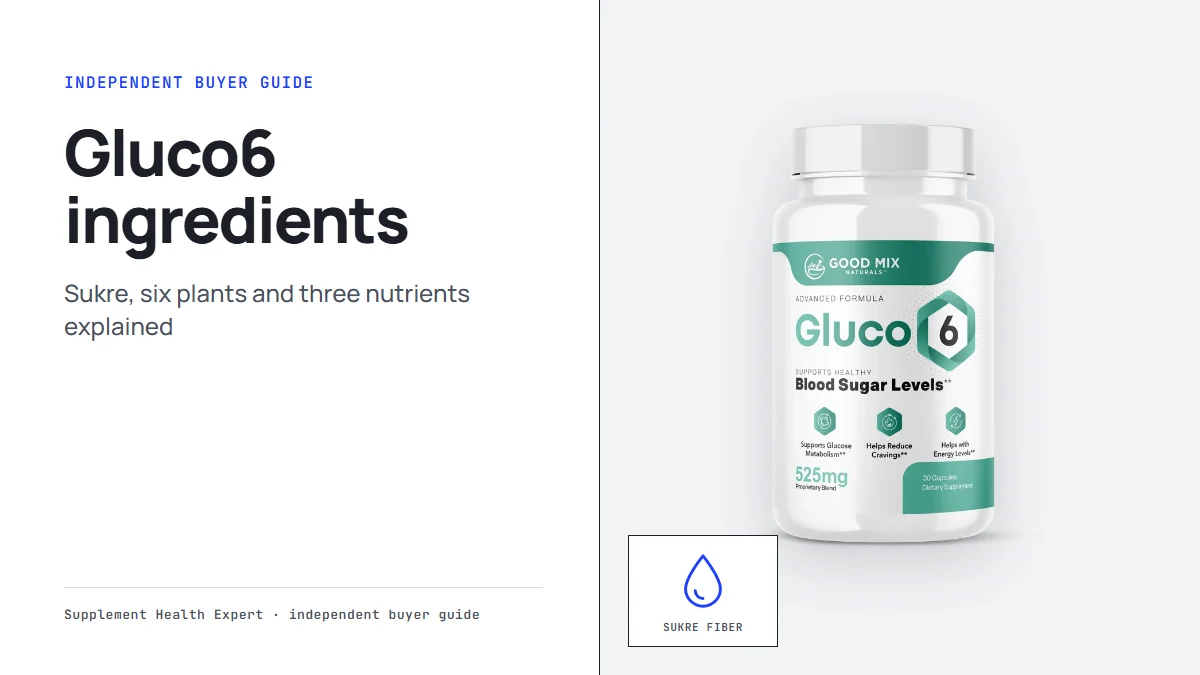
Flip the bottle over and the back panel reveals a surprisingly lively cast. This walk through the Gluco6 ingredients takes each item in turn: three nutrients with printed amounts, then a 525 mg blend of seven plant-based ingredients. For each, the label fact comes first and the seller’s description second, clearly marked as the seller’s. We worked from the bottle label and the seller’s page as they stood on October 28, 2026.
Gluco6 Ingredients: A Short Map
Picture the capsule as two layers. The first layer holds nutrients with exact amounts: vitamin D3, vitamin B1 and chromium. The second is the proprietary blend, 525 mg in total, which gathers gymnema leaf, cassia cinnamon bark, theacrine, eleuthero root, green tea leaf extract, theobromine and the Sukre fiber. Nothing on the label divides the 525 mg between the plants. The profiles below follow the same order.
Sukre (L-Arabinose)
On the label: Sukre prebiotic fiber, written as L-arabinose, within the blend.
The seller’s role: the anchor of the formula, introduced as a healthy sugar derived from plant fiber. The seller’s story turns on how the body deals with the sugar in a meal.
Research: the seller points to three papers on L-arabinose, listed beneath this article. They include a 2000 Japanese nutrition-journal paper, a 2015 study in rats and a 2011 paper about an intestinal enzyme. They deal with the ingredient, not the capsule, and we never present them as evidence that Gluco6 works.
Green Tea Leaf Extract
On the label: green tea (Camellia sinensis) leaf extract, with polyphenols and EGCG named on the panel.
The seller’s role: it associates green tea with healthy weight management. Green tea also supplies caffeine-family compounds, which is why it reappears in the safety notes below.
TeaCrine (Theacrine)
On the label: theacrine, sold under the TeaCrine name.
The seller’s role: the pitch talks of harnessing the power of Chinese tea. Theacrine is itself a caffeine-family plant compound, a detail some readers like to know early.
Gymnema
On the label: Gymnema sylvestre leaf.
The seller’s role: a herb with a history of traditional use, which the seller ties to sugar cravings. The bottle front also says the formula helps reduce cravings, and that line is the label’s own wording.
Cassia Cinnamon
On the label: cinnamon (Cinnamomum cassia) bark.
The seller’s role: the seller pairs cinnamon with a healthy insulin response. Cassia is the familiar cooking type of cinnamon, and it is among the plants that people on blood sugar medicines often raise with a pharmacist.
Chromium
On the label: 1 mg, as chromium niacinate.
The seller’s role: it describes chromium as essential for steady glucose levels. Because the capsule already supplies chromium, the seller’s FAQ urges care with other formulas rich in it.
Eleuthero Root and Theobromine
Two blend members sit outside the seller’s six highlights. The label names eleuthero (Eleutherococcus senticosus) root, a plant root, and theobromine, a compound also found in cacao. We make no claim for either, because the seller offers none. They are on the label, so you should know they are in the capsule. Theobromine joins green tea and theacrine as a third caffeine-family compound.
Vitamin D3 and Vitamin B1
Vitamin D3: 50 mcg, as cholecalciferol.
Vitamin B1: 100 mg, as thiamine mononitrate.
Both are well-known vitamins, and the seller gives them no special part in its story. Since they carry printed amounts, they are the easiest items to set against the rest of your daily intake. Mention them to your doctor or pharmacist if you already take a multivitamin.
The Supporting Cast
The rest is shell and flow aids: the hypromellose vegetable capsule, plus magnesium stearate, microcrystalline cellulose, stearic acid and silicon dioxide. In the seller’s words the formula is vegetarian, non-GMO, soy-free, dairy-free and plant-based, and its badges promise freedom from egg, crustaceans, nuts, BPA and gluten. Those are the seller’s statements, so read the label yourself if you have an allergy.
Reading the Blend Honestly
Because the 525 mg total is not broken down, we cannot say how much green tea, cinnamon or any other plant a capsule holds, and we will not invent figures. It is a common way to label a formula, and it simply means you rely on the seller’s description for the mix. If you want the whole label as a table, our ingredients list guide sets it out line by line.
How the Ingredients Fit Together
It helps to step back and see the design as a whole. One fiber sits at the center. A group of plants is arranged around it, three of them in the caffeine family. Three nutrients with exact amounts frame the blend. Everything else is the machinery of a capsule. If you were explaining it to a friend in one sentence, you might say it is a fiber-led plant blend with three added nutrients, taken once a day. That sentence is accurate and avoids any promise, and it is a useful test for any product description you read: can the claim be restated as simply as a list of what is inside?
The Ingredients by Group
Sorting the list into groups makes it easier to hold in your head. The fiber group has one member, Sukre. The plants group holds gymnema, cassia cinnamon and eleuthero. The caffeine-family group holds green tea, theacrine and theobromine. The nutrients group holds vitamin D3, vitamin B1 and chromium, which are the only entries with printed amounts. Four groups, ten items, one capsule. If you are comparing Gluco6 with another product, this grouping lets you line up like with like and see where the two differ, instead of drowning in names.
Questions to Bring to Your Pharmacist
A pharmacist can check an ingredient list against your medicines in a few minutes, so go prepared. Say that the capsule contains chromium at 1 mg and a blend with three caffeine-family compounds. Name the three plants that people commonly raise when blood sugar medicines are involved. Mention that the label asks for a physician’s advice where medication or a condition applies. Then ask the two questions that matter: is there anything here that should not be combined with what I take, and what should I keep an eye on early on? Write the answers down next to your notebook entries.
Common Misreadings to Avoid
Three misreadings crop up often. The first is treating the seller’s roles as established facts, when they are descriptions of intent. The second is assuming that a long ingredient list means large doses, when the blend’s 525 mg is shared among seven items. The third is reading the research links as studies of the capsule, when they concern L-arabinose alone. Keeping those three distinctions in mind makes the label far easier to read fairly, and it protects you from both overexcited and overcautious takes.
Safety Notes on Ingredients
The label asks buyers to respect the stated dose and to speak to a physician when medication or a medical condition is in the picture. Prescriptions continue as normal, and a pharmacist or doctor should hear about Gluco6 before the first capsule, most of all where diabetes medicines are used. If you are sensitive to caffeine-family compounds, green tea, theacrine and theobromine deserve a mention too. Our side effects guide has more.
Our Take
A short, readable panel, three exact amounts and a seller who names its six highlights make this an easy formula to understand, even with the grouped blend. We score Gluco6 9.2/10 by our own editorial measure. See the ingredients page for the same facts in our product guide and the Gluco6 hub for the packs.
For the packs and the refund terms, our Gluco6 hub is the place to go next.
Ready to Try It
Pick the size that fits the routine you want to test.
Frequently asked questions
What are the main Gluco6 ingredients?
Sukre (L-arabinose) fiber, green tea leaf extract, theacrine, gymnema, cassia cinnamon, eleuthero root and theobromine in a 525 mg blend, plus vitamin D3, vitamin B1 and chromium.
What is Sukre?
L-arabinose under the seller's brand name, a fiber from plants that the seller presents as a healthy sugar.
Is there a dose for each plant?
No. The blend is a single 525 mg total, so individual plant amounts are not listed.
Does Gluco6 contain caffeine-family compounds?
Green tea, theacrine and theobromine belong to that family, so people who are sensitive should ask their doctor. The label gives no caffeine total.
Is there research on any ingredient?
Three L-arabinose papers are cited by the seller; none tests Gluco6.
Can I take it with medicines?
Keep taking what you are prescribed and check with your doctor or pharmacist first, particularly with diabetes medicines.
Sources
- 01 Effect of L-Arabinose on Blood Glucose Level after Ingestion of Sucrose-containing Food in Human. Journal of Japanese Society of Nutrition and Food Science, 2000.
- 02 Hao L, et al. Protective effects of L-arabinose in high-carbohydrate, high-fat diet-induced metabolic syndrome in rats. Food Nutr Res, 2015.
- 03 Krog-Mikkelsen I, et al. The effects of L-arabinose on intestinal sucrase activity: dose-response studies in vitro and in humans. Am J Clin Nutr, 2011.
gluco6 ingredients · gluco6 sukre · gluco6 l-arabinose · gluco6 teacrine · gluco6 gymnema · gluco6 chromium · gluco6 green tea cinnamon