Supplement Reviews / Guide
Is The Genius Song a Scam? What Checks Out, What Does Not, and Our Fair Verdict
Is the Genius Song a scam? We checked the ClickBank checkout, the 90-day refund, the pen-name presenter and the seller's mixed figures, then gave a verdict.
- Author
- Supplement Health Expert Editorial Team
- Published
- Reading time
- 9 min
- Sources
- 5 cited
Key takeaways
- 01 The transaction itself looks sound: ClickBank takes the payment, the product is digital, and a 90-day refund window appears in both the Terms and the checkout.
- 02 The warning signs are in the marketing: a pen-name presenter, customer counts that disagree, a refund page copied from another product and strong pressure to buy today.
- 03 The seller's own Terms call its products entertainment and admit that testimonials may be acted, paid or untypical.
- 04 Nobody has published a study of this track. Think of it as a $39 trial with a way out, not as a proven brain treatment.
Is the Genius Song a scam, or is it a real product you can safely pay for? People use the word “scam” for two quite different situations. In the first, a seller pockets your money and delivers nothing at all. In the second, you do get a product, but it arrives buried under hype. To work out which picture fits, we read the seller’s pitch in both of its forms (the long video and the written /text/ version), went through the legal pages and the separate returns page, and opened the ClickBank checkout. Then we sorted the solid facts from the shaky ones.
Who we are matters here: this page is written by an independent review team, and the seller has no say in it. A few links below are affiliate links, and an order placed through one of them may pay us a commission. That has no bearing on the verdict.
Is The Genius Song a scam or a legit purchase?
First, the product itself. The Genius Song is a short sound recording that, according to the seller, lasts around 7 minutes. The instructions are simple: headphones on, eyes shut, one session daily. The pitch claims the sound wakes up gamma, which it calls a dormant “super brain wave”, and that sharper thinking, good luck, money and happier relationships follow. You pay $39 once.
That leaves two separate questions. Does the purchase work the way the seller says it does? And is the story told around it an honest one? We reach different answers for each, so the sections below keep them apart.
What checks out
Here is what the seller’s documents and the payment page confirmed for us.
| Check | What we found | Where |
|---|---|---|
| Payment | Taken by ClickBank, which the site names as its retailer | Checkout page |
| Product type | Marked digital, never shipped, charged once | Checkout page |
| Price | $39; buyers outside the US see their own currency plus tax | Terms of Sale, checkout |
| Refund window | 90 days counted from the first purchase | Terms, checkout |
| Card statement | Shows up as CLKBANK*Genius Song | Checkout page |
| Order help | ClickBank, 1-800-390-6035 or clkbank.com | Checkout page |
| Product help | [email protected] | Sales page, Terms |
That table matters. A pure money grab rarely runs through a retailer that offers its own refund path. In its own words, ClickBank “will allow for the return or replacement of any product within 90 days from the date of purchase.” An unhappy buyer can therefore get help without depending on the seller to answer.
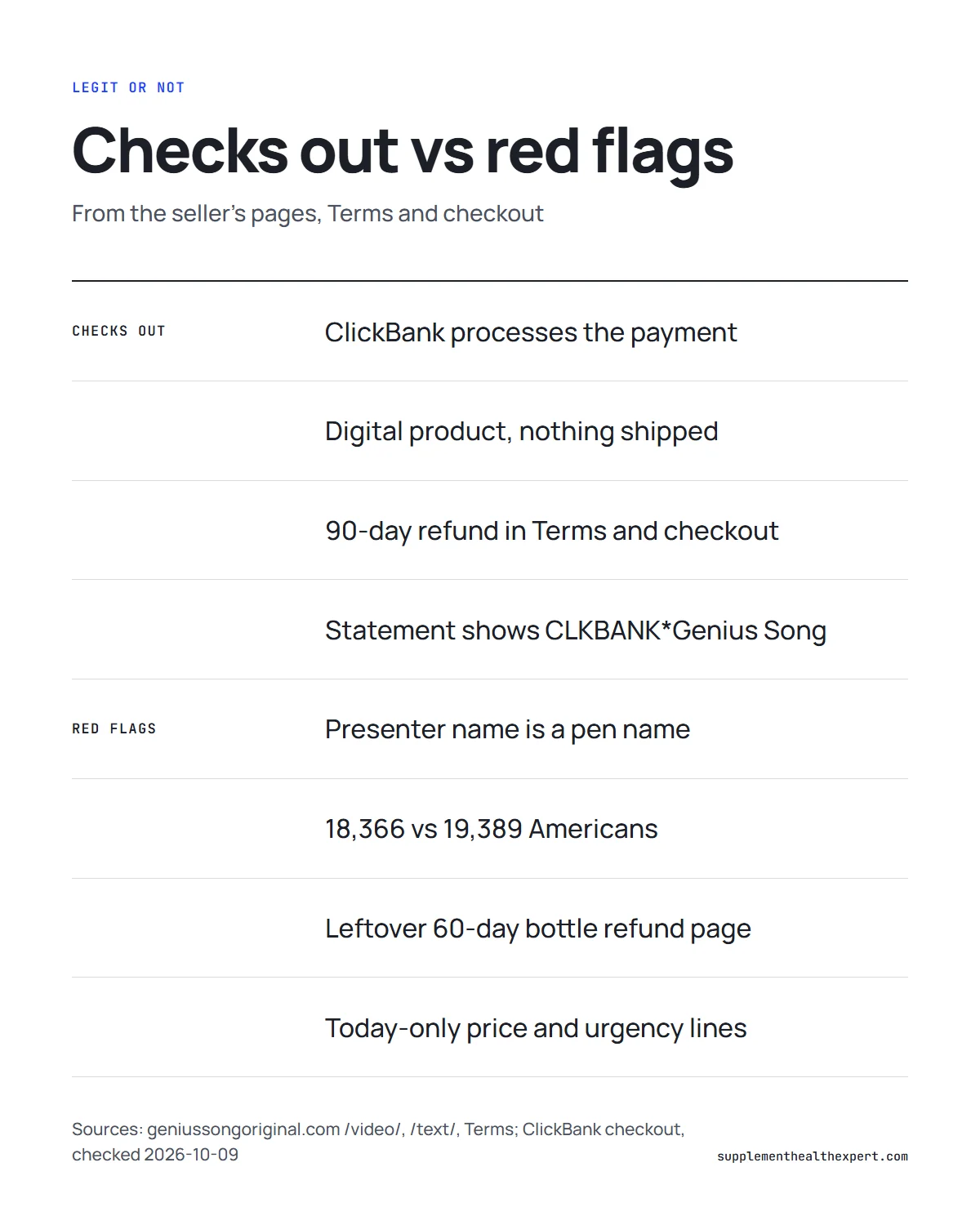
The red flags we found
No single item below proves fraud. Each one is a reason to read the pitch slowly.
A presenter without a real name
The man presenting the video goes by Dr. Robert Lake, which is a pen name according to the site’s own disclaimer. That disclaimer insists the credentials behind the name are genuine, yet without a real name nobody can test that. The marketing calls him a “Top NASA Scientist” and a “NASA-Trained Neuroscientist”, and in the video he mentions a clinic in New York City and 34 years in neuroscience. Each of those comes from the sales copy, and we were unable to confirm a single one.
Customer counts that disagree
In the video, the track is said to have helped 18,366 “everyday Americans”, and the main text of the /text/ page uses that figure too. Yet the headline sitting above it on that page reads 19,389. The presenter also refers to “thousands of five star reviews” but never says where they can be read. We could verify neither number, and the gap between them shows how casually they are used.
A returns page written for something else
Click “Returns” in the footer and you land on /TOS/refunds/, which sets out a policy for “NeuroActivate” bottles: 60 days, unopened only, sent back to an address in Tallmadge, Ohio. You cannot return a bottle you never received. It reads like a template nobody updated. The Terms also keep a shipping section about goods leaving Ohio, which is just as irrelevant to an audio download.
Pressure to buy right now
The video warns that the $39 price “is not guaranteed beyond today”, that your order is “set aside” for you but could be “given away to someone else” if you close the page, and that the offer will not stay online forever. A digital file can be copied without limit, so the idea of it being handed to someone else does not hold together. We treat these lines as sales pressure. The crossed-out “regular” prices of $200, $100 and $49 on the order box are the seller’s own reference figures.
Testimonials the Terms tell you to discount
The video tells stories about “Rachel, a nurse from Tustin, California”, “Michael in Dallas” and “Hannah from Manhattan”, among others. The legal text explains how to read them. It says names were changed and pen names used, that feedback may be acted out by “digital representations, avatars, or actors”, that some speakers may be “early supporters, friends, or family members of the company’s founders”, that some people were paid, and that the results shown are “exceptional results” a typical buyer may never see. Those are advertisements, not independent reviews. American regulators have also tightened up here: a 2024 FTC rule targets fake and misleading testimonials, so sales-video stories deserve extra care everywhere.
Small mismatches across the pages
The opening hook promises a “seven second” trick, but what you buy is a track of roughly 7 minutes. On the video page, the browser tab is titled “The Gamma Song”. Even the bonus count wobbles. The video announces “three” bonuses and then describes four, while the /text/ page promises four and shows three. Up to four digital bonuses are listed by the seller, and which ones you see depends on the page.
What the seller’s own Terms admit
The most telling document is not the video at all. It is the Terms page, dated 20 January 2026. Under the heading “For Entertainment Purposes Only”, the seller writes:
“brain entrainment is not an exact science and we recommend that you do not treat it as such. The products are provided for entertainment purposes only.”
Another section, “Not Professional Advice”, warns against using the information as medical, financial or legal guidance. Strangely, a different passage claims that “All claims regarding brainwave entrainment, focus, and mental energy are substantiated by established scientific research.” The seller is pulling in two directions inside one legal text. When a sales video promises luck and promotions but the legal page says entertainment, we trust the legal page more.
The company named in the Terms is Happy Consumer LLC of Puerto Rico, and Puerto Rico law governs the agreement. Buyers have to be at least 18.
Do the science claims hold up?
The pitch name-drops MIT, Princeton, Columbia, an Einstein Center in Berlin and a British double-blind trial. We could not confirm any of those claims in the form the seller states them. What the research we know of actually says, put plainly:
- Gamma exists. It is a fast family of brain rhythms, very roughly 30 to 100 cycles a second, that scientists link to attention and memory processing.
- The 40 Hz research is at an early stage. Researchers in the Tsai lab at MIT have tested 40 Hz flickering light and sound, mostly in mice bred to model Alzheimer’s disease, plus small early trials in people. This work says nothing about fortune, income or intelligence scores.
- The “monk” story is a simplification. Lutz and colleagues, writing in PNAS in 2004, measured unusually strong gamma in experienced meditators during meditation. No audio track was involved.
- Results for sound entrainment are mixed. A 2019 meta-analysis and a 2023 systematic review on binaural beats both describe small, brief and patchy effects on attention, memory or anxiety.
As far as we can tell, nobody has published research on The Genius Song track. We test each of the video’s promised outcomes one by one in our claims-versus-evidence check. In fairness, when asked about a customer’s casino winnings, the presenter admits there is “no evidence to support that the genius song caused that.” That candour does not reach the rest of the pitch. The track is not a treatment for migraine, pain, smoking or weight, and the site itself states that the product “is not intended to diagnose, treat, cure or prevent any disease.”
The refund route: your real safety net
Since none of the promises can be tested before buying, the refund window is your protection. Here is how to use it:
- Keep ClickBank’s receipt email. Your order number is in it.
- Note the date you paid. The 90 days run from that day, under both the Terms and the checkout.
- Contact ClickBank through clkbank.com or 1-800-390-6035, rather than the bottle address on /TOS/refunds/.
- Look at your card statement for the entry CLKBANK*Genius Song.
Our verdict and score
We rate The Genius Song at 4.7 out of 10 on our editorial score. It is our judgment, not a rating from customers. The category reasoning is set out at length in our full review of what $39 buys.
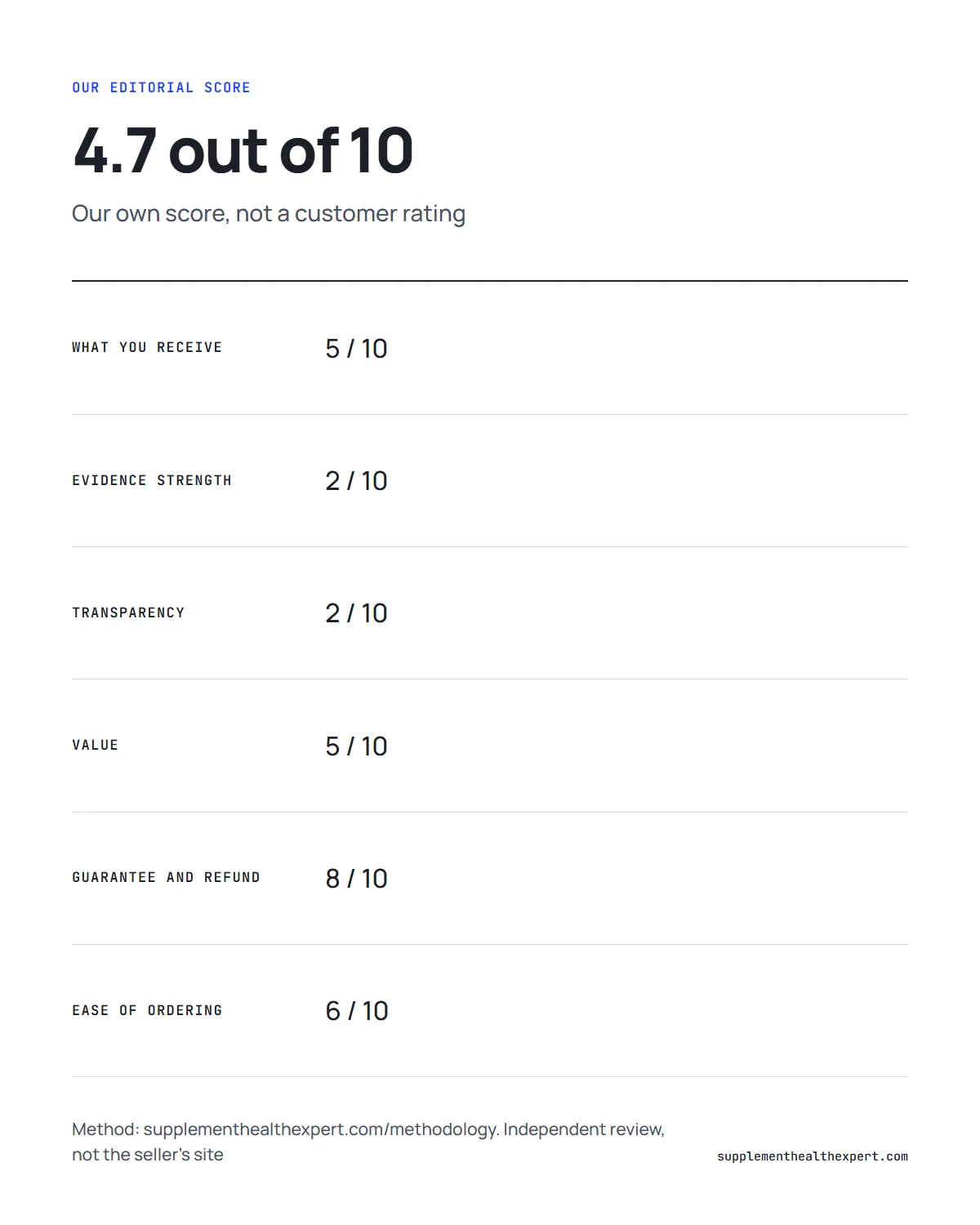
| Category | Our score | Why |
|---|---|---|
| What you receive | 5/10 | One brief audio file, plus whatever extras the page lists |
| Evidence strength | 2/10 | No study of the track; gamma research is early |
| Transparency | 2/10 | Pen name, clashing numbers, leftover pages |
| Value | 5/10 | $39 for one track is neither cheap nor outrageous |
| Guarantee and refund | 8/10 | 90 days, in the Terms and at ClickBank |
| Ease of ordering | 6/10 | Simple checkout, but the home page sells another title |
Put fairly: nothing we saw suggests a take-the-money-and-vanish operation. What we did see is a pitch resting on claims no one can check, a legal page that calls the product entertainment, and a string of careless or pushy details. Whether that earns the word “scam” depends on what you were expecting. If you hoped for a proven brain upgrade, nothing supports that hope.
If you try it, listen safely
This advice is ours and applies to any audio of this type. Keep the sound at a level that feels easy on the ears, because loud audio through headphones can damage hearing over time. Do not play it while driving or using machinery, since the routine has you shut your eyes and wind down. Anyone with epilepsy, past seizures or hearing trouble should talk to a doctor before starting.
Where to order, if you still want it
According to the seller, the track is sold only on its own site and is not on Spotify, YouTube, Amazon or any app store. One thing surprises many visitors: the landing page at the root of the seller’s site currently promotes The Genius Wave, another audio title by this seller, while the Genius Song pitch sits on that site’s /video/ page. The seller presents them as two separate products, so read the product name on the checkout before paying.
Next, see our guide to spotting copycat pages and fake deals around this product, or read our quick guide for a short summary.
Frequently asked questions
Does The Genius Song actually deliver something after you pay?
ClickBank labels the order a digital product that is never shipped and says access starts once the payment clears. How you receive it is described in two ways by the seller: the video talks of an emailed download, the /text/ page of a login to a Private Audio Portal. We did not place an order, so we cannot confirm which version buyers see.
Is Dr. Robert Lake a real scientist?
Dr. Robert Lake is a pen name, and it is the seller's own footer disclaimer that says so. The NASA training, the New York City clinic and the decades as a neuroscientist all come from the sales material, and we found no way to confirm any of them.
Why do the customer numbers differ between the seller's pages?
The video and the body text of the /text/ page give 18,366 Americans, but the headline at the top of that same page gives 19,389. Both figures come from the seller alone, they contradict each other, and we found no outside record backing either one.
Can I trust the testimonials in the video?
Treat them as advertising. According to the Terms, names were changed, pen names are used, some stories may be performed by actors or avatars, some speakers may be friends or relatives of the founders, some were paid, and the outcomes shown are exceptional rather than what a typical buyer gets.
Will I really get a refund within 90 days?
For digital products the Terms set a 90-day refund window counted from the first purchase, and ClickBank's checkout repeats that number. Go through ClickBank and quote the order number printed on your receipt.
Is there proof the track raises gamma or intelligence?
No. Gamma activity is a genuine brain rhythm, and a few small sound studies report brief effects, yet reviews of that research describe it as inconsistent. Nothing we found tests this particular track, and nothing shows it lifts intelligence, luck or income.
Why does the refund page talk about bottles?
The /TOS/refunds/ page was written for an unrelated item called NeuroActivate: 60 days, unopened bottles only, returns sent to Ohio. A downloadable track has no bottle, so ignore it and rely on the Terms page and ClickBank's own 90-day promise.
Sources
- 01 Lutz A, et al. Long-term meditators self-induce high-amplitude gamma synchrony during mental practice. PNAS, 2004.
- 02 Ingendoh RM, et al. Binaural beats to entrain the brain? A systematic review. PLOS ONE, 2023.
- 03 Garcia-Argibay M, et al. Efficacy of binaural auditory beats in cognition, anxiety, and pain perception: a meta-analysis. Psychological Research, 2019.
- 04 Federal Trade Commission. Final rule banning fake reviews and testimonials, 2024.
- 05 NIDCD. Noise-induced hearing loss.
is the genius song a scam · the genius song · genius song legit · clickbank · brainwave audio