Buying Guides / Guide
The Genius Song Scam Warnings: Copycat Sites, Fake Discounts, Surprise Emails and Refunds
The Genius Song scam risks explained: copycat pages and re-uploads, fake discounts, emails after purchase, the CLKBANK charge and how to get your money back.
- Author
- Supplement Health Expert Editorial Team
- Published
- Reading time
- 9 min
- Sources
- 4 cited
Key takeaways
- 01 The seller says it sells the track only through its own site, so free uploads, app listings and third-party shops are not its product.
- 02 A genuine order ends on a ClickBank payment page at $39 plus any local tax. A page that takes card details anywhere else is a warning sign.
- 03 Buying signs you up for the publisher's email lists, which can include third-party offers. Every email carries an unsubscribe link.
- 04 Your charge should read CLKBANK*Genius Song. Refunds run through ClickBank for 90 days from purchase, not through the site's bottle return page.
Most people who search for a genius song scam want to know one practical thing: how do I avoid losing money? The bigger risk is usually not the $39 track of The Genius Song itself but everything that grows up around a popular online product. That means copied sales pages, free “versions” uploaded by strangers, too-good-to-be-true discounts and a flood of emails after you buy. This guide walks through each of those, then shows how to read your card statement and how to get a refund if something goes wrong.
Quick disclosure: we run an independent review site, separate from the seller and its staff. The buttons below are affiliate links, so buying through one can earn us a commission. That arrangement does not shape the advice.
Where a genius song scam usually comes from
It helps to separate the product from the noise around it. The product is a single sound file, which the seller says runs about 7 minutes, sold once for $39. You receive it digitally, and the seller describes this both as an emailed download and as a login to a “Private Audio Portal”. We have a full look at the product’s own claims and fine print in our article on whether the purchase is legit.
The problems readers run into tend to fall into four groups:
| Risk | What it looks like | Your defence |
|---|---|---|
| Look-alike pages | A copied sales page on a different web address | Check the domain before entering card details |
| Re-uploads | Free “Genius Song” audio on video or music platforms | Seller says it only sells on its own site |
| Fake discounts | A “today only” price far below $39 | Compare with the ClickBank checkout price |
| Unwanted email | Offers you did not ask for after purchase | Use the unsubscribe link in every email |
| Odd charges | A card line you do not recognise | Match it against CLKBANK*Genius Song |
Look-alike sites and re-uploaded copies
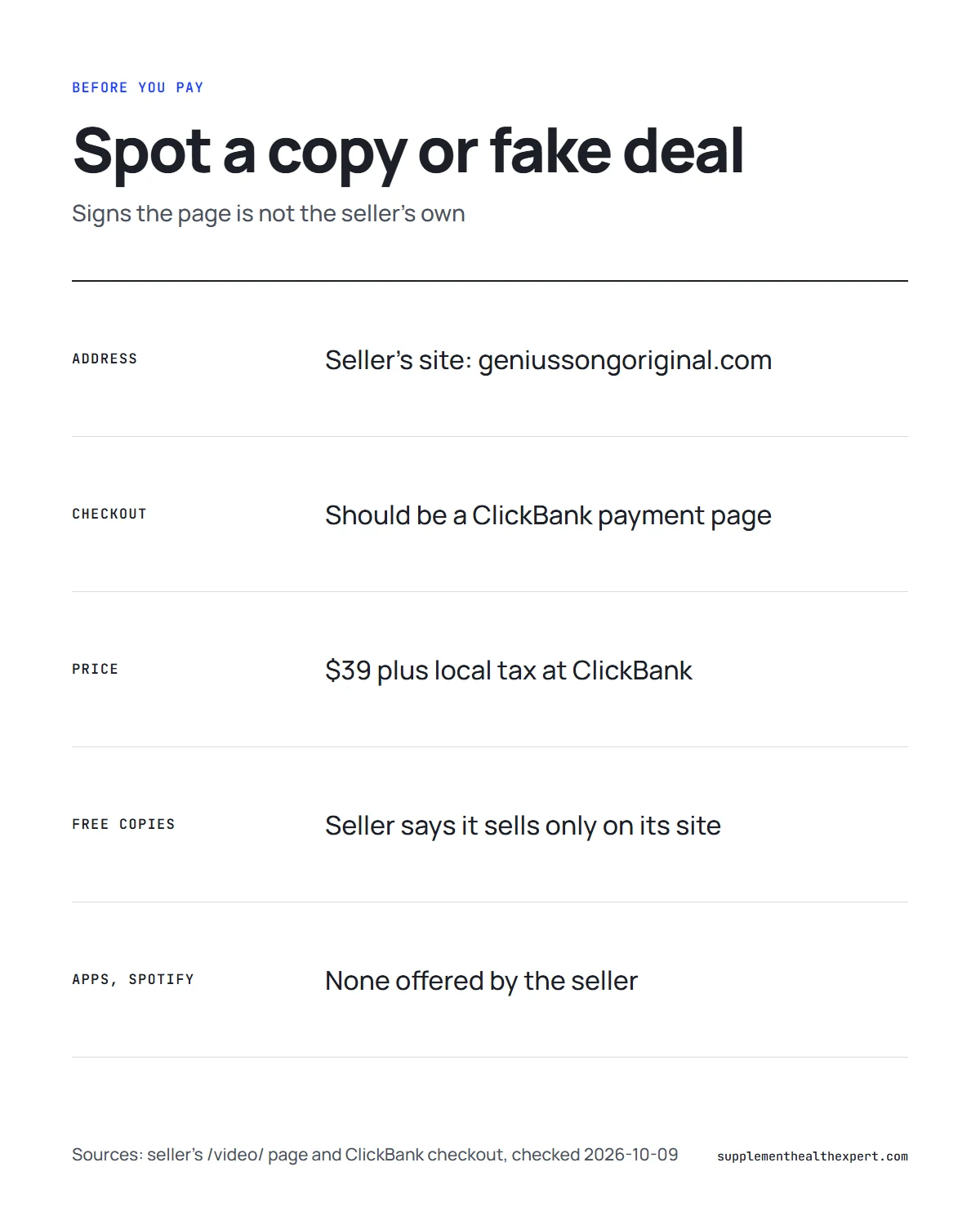
The seller’s sales pages sit on geniussongoriginal.com. The pitch video lives at /video/ on that domain, with a written version at /text/. Copied pages can borrow the same images and headings, so the address bar is your best guide. Before typing card details, look at the domain of the payment page too. A genuine order moves to a ClickBank payment page, not to a form on some unrelated site.
Re-uploads are a different trap. In the video, the presenter (who uses a pen name, Dr. Robert Lake, as the site’s own disclaimer admits) says the track is offered only “direct through this website”, adding that what it contains “cannot be found anywhere else, including on YouTube or Spotify.” We cannot know what any given upload contains. What we can say is that, by the seller’s own account, none of them come from the seller. The same goes for apps: no app is offered on the site, the checkout or in the video, so an app store listing using the name did not come from this seller.
Why care about a free copy? Unknown downloads can carry unwanted software, and an unofficial file gives you no refund rights at all. If you want to try the real thing, the 90-day refund window only covers an order placed through ClickBank.
Fake discount pages and pricing tricks
The pages we checked showed one price: $39. The order box also displays crossed-out “regular” prices of $200, $100 and $49. Those are the seller’s own reference figures, not proof that anyone ever paid them. The video then frames $39 as a special price, saying it “is not guaranteed beyond today” and that your order might be “given away to someone else” if you leave. That is pressure, not a scarcity you need to react to. A digital file cannot run out.
Pages that promise a much lower price, a “secret coupon” or a bundle deal should make you slow down. Before paying, ask:
- Does the payment page belong to ClickBank? The seller’s checkout runs on ClickBank, and the product there is labelled “The Genius Song (90-Day 100% Money Back Guarantee)”.
- Does the product name on the checkout match? The seller also sells other audio titles, so read the line before paying.
- Is the price in line with $39? ClickBank shows the total in your own money with tax on top for buyers abroad, which explains small gaps. A dramatic cut does not.
- Is the payment method normal? Card or standard checkout options are expected. Gift cards, wire transfers or crypto are not.
Because we never placed an order, any upsell screens after payment remain unknown to us. Should one appear, saying no is always an option.
Emails after purchase: what is normal and what is not
Many buyers are surprised by their inbox after ordering, and some then suspect a scam. The explanation is in the seller’s Terms. A purchase “automatically” subscribes you to email lists run by HappyConsumerPublishing.com, the publisher behind the site. In the seller’s words, some emails offer products “such as the Law of Attraction, MMO, Spirituality, Prayer Astrology, Numerology and other topics. These offers may be from 3rd parties.”
That is legal and disclosed, but it is easy to miss. Here is how to handle it:
- Unsubscribe with the link at the bottom of any of these emails. The Terms say you can opt out at any time.
- Know the real addresses. Marketing for this product comes from GeniusSongOfficial.com, and product support is listed as [email protected].
- Treat outside offers on their own merits. A third-party offer in your inbox has not been checked by us or vouched for by ClickBank.
- Be wary of messages asking for passwords or card details. A real receipt does not need you to re-enter payment information.
Pages that repackage the sales video’s stories as “customer reviews” are another trap. Our guide to finding honest buyer feedback shows how to tell a copied review page from a real one, and our breakdown of the testimonials and the fine print behind them explains what the seller admits about its stories.
How to check your card statement
According to the checkout page, your bank will list the payment as CLKBANK*Genius Song. One wrinkle is worth knowing: ClickBank’s own settings for this item also contain the label “TheGeniusWave”, the name of a related product from the same seller. If you see a CLKBANK line with a similar name, compare the date and amount with your receipt and ask ClickBank before assuming fraud.
Two more points help. Outside the US, the amount appears in your local currency with tax included, so it will not read exactly $39. And the order is not a subscription: the checkout marks it as a one-time digital purchase, so a repeat monthly charge would be a reason to contact ClickBank straight away.
How to get your money back
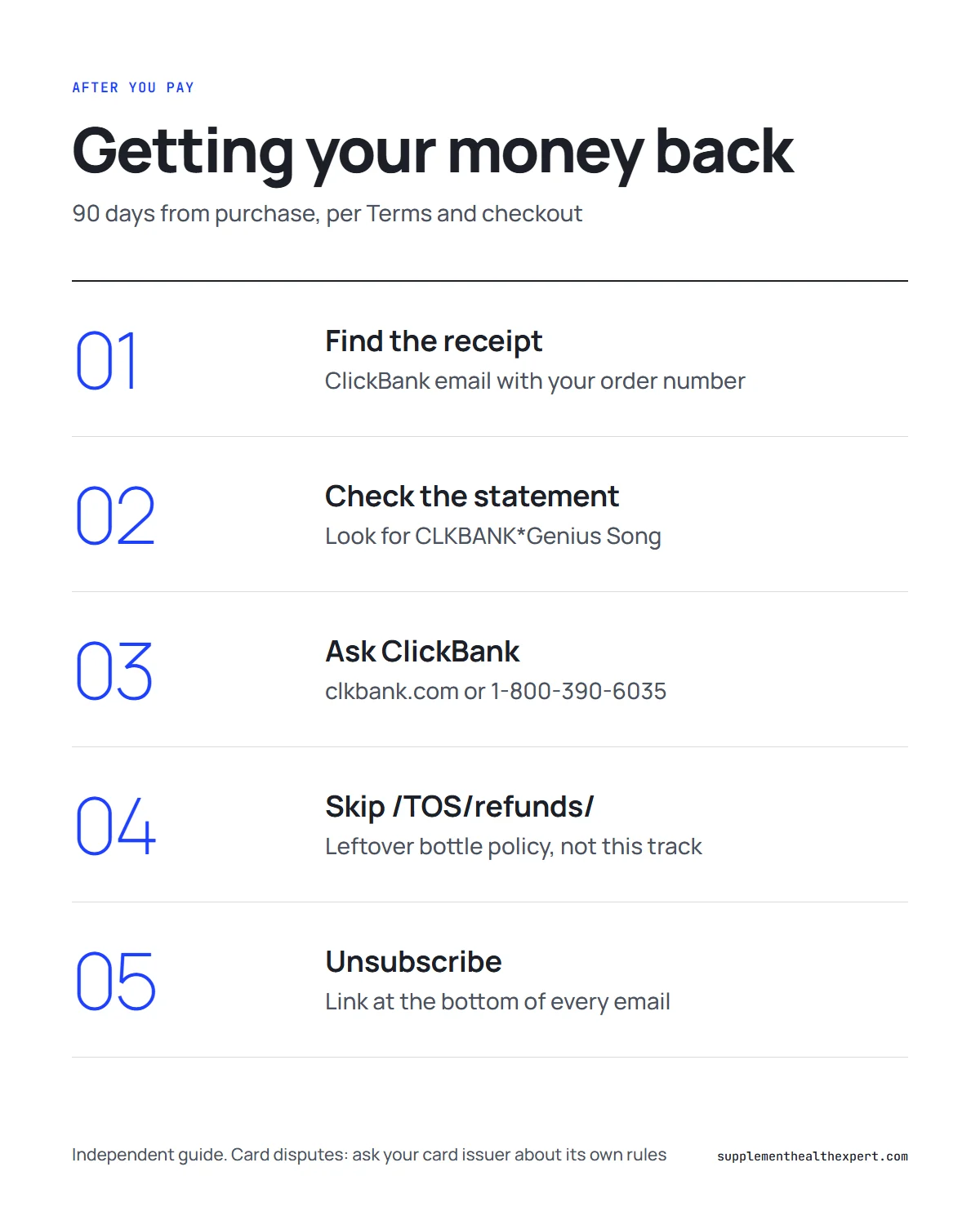
The guarantee is one of the stronger parts of this offer. The Terms allow a refund on digital items when the request arrives inside 90 days of the original order, and ClickBank’s checkout repeats the 90-day promise. Follow these steps:
- Find the ClickBank receipt. It holds the order number.
- Contact ClickBank at clkbank.com or by phone on 1-800-390-6035.
- Ignore /TOS/refunds/. That page is a leftover policy for “NeuroActivate” bottles, with 60 days, unopened items only and an Ohio return address. It does not fit an audio file.
- Keep a record of the date you asked and any reference number you are given.
- Unsubscribe from the emails once your refund is settled, if you no longer want them.
If ClickBank cannot help, or you find a charge you never made, call your card issuer. The FTC publishes a plain-language guide on how card disputes work.
The fine print that protects the seller
Protecting yourself also means reading what the seller itself admits. Three points stand out:
- Entertainment only. The Terms carry a heading “For Entertainment Purposes Only” and say: “brain entrainment is not an exact science and we recommend that you do not treat it as such. The products are provided for entertainment purposes only.”
- Testimonials are not independent. The Terms say names were changed, some stories may be acted out by “digital representations, avatars, or actors”, some speakers may be “early supporters, friends, or family members of the company’s founders”, some were compensated, and their results are “exceptional results” rather than typical ones. A US rule from the FTC, adopted in 2024, targets fake testimonials, which is a good reminder to read sales stories carefully.
- A pen-name presenter. The man in the video is introduced as a NASA-trained neuroscientist, but those credentials are claims from the sales page, and the name is a pen name.
The seller’s own customer figures also disagree, with 18,366 in one place and 19,389 in another, and we could not verify either. None of this means you will be cheated at checkout. It means the promises in the video are not something you should pay for on trust. Research on this exact recording does not exist in any journal we searched, and nothing about it qualifies as therapy for an illness.
Listening safely, if you go ahead
Whatever you play through headphones, turn it down to a gentle level; hearing damage from loud sound builds up without warning. The routine is done with closed eyes, so never combine it with driving or operating equipment. People living with epilepsy or past seizures, or who already struggle with their hearing, should get a doctor’s view first. That is our own advice, not the seller’s.
The safe way to order
To keep everything inside the refund window, order through the seller’s own site and pay on the ClickBank checkout. Be aware that the seller’s home page currently shows a related audio, The Genius Wave, rather than this product; you reach the Genius Song pitch by way of the /video/ address on that domain. The two are sold as different titles, so confirm the name on the checkout. Extras are promised as well, as many as four digital bonuses, but the seller’s pages disagree on which ones.
Frequently asked questions
Are free uploads on YouTube or Spotify the real track?
By the seller's account, its own website is the only place the track is sold, and uploads elsewhere do not match it. We cannot test what any particular upload contains, but nothing on those platforms comes from the seller by its own account.
How can I tell a fake discount page from the seller's checkout?
The real order path ends on a ClickBank payment page, and the price we saw there was $39 plus local tax. Be wary of any page that asks for card details on a different domain, quotes a much lower price, or wants payment by gift card, bank transfer or crypto.
Why am I getting so many emails after buying?
The seller's Terms say that a purchase automatically subscribes you to email lists run by HappyConsumerPublishing.com, and the Terms warn that some of what arrives will be outside promotions. An unsubscribe link sits at the foot of every message.
What will the charge look like on my card statement?
The checkout says the charge appears as CLKBANK*Genius Song. Outside the US you see your local currency and any local tax, so the amount may differ from $39.
Who do I contact for a refund, the seller or ClickBank?
Start with ClickBank (clkbank.com, or 1-800-390-6035) and have your receipt's order number ready. The Terms and the checkout both give 90 days from purchase. For questions about the track itself, the seller lists [email protected].
Should I dispute the charge with my bank?
Try ClickBank's refund route first, since it is usually quicker. If that fails, or if you see a charge you never made, your card issuer can explain its dispute process. The FTC publishes a plain guide to how card disputes work.
Is there an app version I can install from an app store?
No app is offered anywhere on the seller's site, checkout or video. Any app using the name was not published by the seller, as far as its own pages show.
Sources
genius song scam · the genius song · clickbank refund · fake discount pages · online shopping safety