Ingredients / Guide
NeuroSalt Ingredients: Five Botanicals, Every Label Amount Explained
NeuroSalt ingredients explained: passionflower, marshmallow root, corydalis, prickly pear and California poppy, with each amount and a plain role.
- Author
- Supplement Health Expert Editorial Team
- Updated
- Reading time
- 7 min
- Sources
- 0 cited
Key takeaways
- 01 Two capsules supply five botanicals: passionflower 145 mg, marshmallow root 110 mg, corydalis 100 mg, prickly pear extract 50 mg and California poppy seed 45 mg.
- 02 The whole label is published, so you can see every amount instead of a hidden proprietary total.
- 03 Passionflower, corydalis and California poppy are traditionally used as calming herbs, which is why the seller pairs them with soothing marshmallow root.
- 04 A 60-capsule bottle lasts 30 days at two capsules a day with an 8 oz glass of water.
- 05 Keep taking prescribed medicines and show the label to your doctor before you begin.
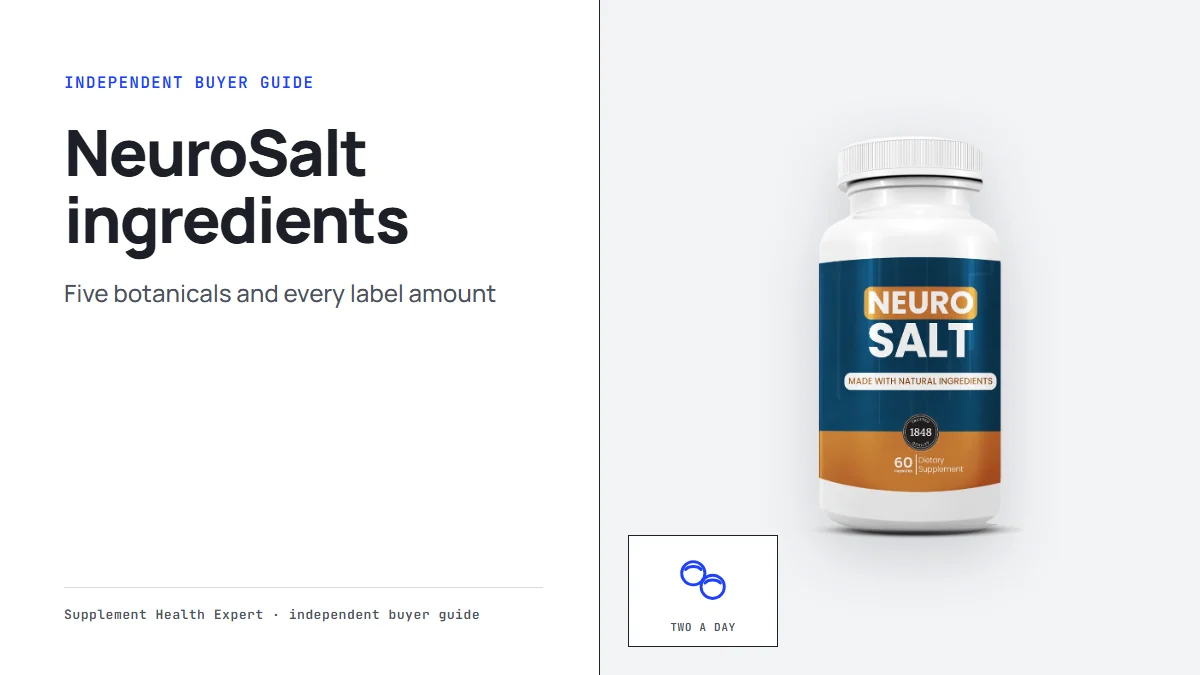
Anyone adding a capsule to their day should know what it contains. The NeuroSalt ingredients are refreshingly easy to read: five plant botanicals, each with its own amount on the Supplement Facts panel, and no vague blend total hiding anything. Below we take the five in turn, explain in simple words why a formula like this might appeal, and set the label beside the seller’s pitch for a capsule aimed at nerve comfort, a calm nervous system and restful sleep.
NeuroSalt Ingredients at a Glance
Serving size is two capsules, and a bottle holds 30 servings.
| Ingredient | Per 2 capsules | Traditional role (soft) |
|---|---|---|
| Passionflower (Passiflora incarnata) | 145 mg | A calming herb |
| Marshmallow (Althaea officinalis) root | 110 mg | A soothing plant |
| Corydalis (Corydalis yanhusuo) powder | 100 mg | A calming herb from traditional Chinese herbalism |
| Prickly pear (Opuntia phaeacantha) 20:1 extract | 50 mg | A concentrated cactus extract |
| California poppy (Eschscholzia californica) seed | 45 mg | A calming herb |
Those roles describe how the plants have traditionally been used in herbal practice. They promise nothing about your own experience.
Passionflower: The Largest Amount
Passionflower leads the label at 145 mg. A climbing vine, it has long been an evening herb, often steeped as a tea by people winding down. Its top spot suits the seller’s story of calmer evenings. It is also part of why drowsiness is mentioned in the safety notes, so schedule your first dose for a moment when no driving lies ahead.
Marshmallow Root: The Gentle Base
Marshmallow root (110 mg) is the root of Althaea officinalis, a plant that has nothing to do with the campfire treat. Herbalists have long valued the root for its soft, mucilage-rich texture, and it is typically described as soothing. In this blend it plays the supporting part, rounding out the three calming herbs with something mild.
Corydalis: The Traditional Chinese Herb
Corydalis (Corydalis yanhusuo, 100 mg) goes by yan hu suo in traditional Chinese herbalism, and here it is listed as a powder, not a standardized extract. Like passionflower it is a traditional calming herb, which is why it figures in the notes on drowsiness and sedatives.
Prickly Pear: The Concentrated Extract
Prickly pear (Opuntia phaeacantha, 50 mg) is the one entry labeled as a 20:1 extract, meaning a concentrated form of the cactus. Its pads and fruit have long featured in desert cooking and folk use. In a small daily amount it widens the plant mix beside the three calming herbs.
California Poppy Seed: The Smallest Line
California poppy seed (Eschscholzia californica, 45 mg) is the lightest line. The state flower of California is traditionally used as a calming herb, and its modest amount suits a gentle, evening-friendly capsule.
Why These Five Together
According to the seller, NeuroSalt rests on soothing herbs for a relaxed nervous system. Three of the five (passionflower, corydalis, California poppy) are traditional calming plants, marshmallow root adds softness, and prickly pear extract rounds out the mix. You need no herbal lore to see the logic: a short list that stays on theme.
Other Ingredients and the Capsule
After the five botanicals, the label adds microcrystalline cellulose, hydroxypropyl methylcellulose (the capsule shell) and magnesium stearate. These are everyday supplement ingredients used in filling and shaping. The seller says the product is made in the USA in an FDA-registered facility from naturally derived ingredients, which is the seller’s statement and not an approval.
What the Label Tells You at the Checkout
On the order page, hold the bottle you see against the table above: the name NeuroSalt, 60 capsules, two a day with an 8 oz glass of water. Matching details are a fast way to confirm the right page. Our official website guide covers the remainder.
Questions to Bring to Your Doctor
Walk in with the label and a short list of questions:
- Could any of these herbs interact with my prescriptions?
- Does the drowsiness note matter for my daily schedule?
- Should I wait because I am pregnant, nursing or under 18?
Stay on every prescription while you talk it through, since a supplement is no replacement for treatment. More on the cautions is on our NeuroSalt safety page and in our side effects guide.
Reading the Amounts Sensibly
Milligrams show how much of each botanical sits in a serving. They cannot show how one person will respond, and even the seller is careful, saying only that the capsule is designed for nerve comfort, a calm nervous system and restful sleep, with results varying. The takeaway is that the formula is short and open, which makes it simple for you and your doctor to review.
How the Capsule Fits Into a Day
Directions are as plain as the label: two capsules daily, washed down with an 8 oz glass of water. With three traditional calming herbs inside, the evening, once the day’s driving is done, can be a sensible slot. That is personal planning, not a rule from the seller. Whatever hour you choose, repeat it, because a steady rhythm is easier to judge across 30 days than a shifting one.
What a Published Amount Does Not Tell You
Knowing that passionflower is 145 mg does not tell you how it will feel for you. It does not tell you how your body handles it alongside your other medicines either, and that is why the doctor conversation matters. Treat the table as a map. It shows what is in the capsule, it makes comparison with other products possible, and it gives your doctor or pharmacist a concrete list to check.
Comparing the Label With Other Formulas
When you look at other nerve-comfort or evening-routine products, compare like with like. Count the botanicals, look at whether each amount is printed, and check how many capsules make a serving. This list is short, with five plants and three capsule ingredients, and every plant has an amount beside it. That makes side-by-side comparison straightforward, and it is one reason we give the formula a 9 out of 10 for ingredients in our own scoring.
A Note on Quality Statements
The label itself tells you what is in the capsule, but statements about production come from the seller. Alongside the line about an FDA-registered facility, the seller mentions naturally derived ingredients. We report those lines as the seller’s wording, and we suggest you read the order page for yourself. If a detail matters to you, such as allergies or a particular dietary need, ask your pharmacist to read the panel with you, because a professional can spot things that a quick scan misses.
Who Tends to Find This Kind of Formula Appealing
People drawn to a short, plant-based list often like the idea of a routine they can understand. If you prefer capsules that name each botanical and its amount, this one fits. If you prefer long, multi-vitamin style formulas, it will feel simpler than what you are used to. Neither preference is wrong. The useful question is whether you would be comfortable explaining every line of the label to your doctor, and with five plants you can.
Our Take
A label you can read in a minute is a good start. Five botanicals, every amount shown, a two-capsule routine and a refund window of 60 days from purchase make NeuroSalt a tidy option for anyone drawn to plant-based evening habits. We score it 9.0/10 overall, with ingredients among the strongest marks. The full overview lives on the NeuroSalt hub, and the ingredients page there repeats the label.
Frequently asked questions
What are the NeuroSalt ingredients?
Per two capsules the label lists passionflower 145 mg, marshmallow root 110 mg, corydalis powder 100 mg, prickly pear 20:1 extract 50 mg and California poppy seed 45 mg.
What are the other ingredients?
Microcrystalline cellulose, hydroxypropyl methylcellulose (the capsule shell) and magnesium stearate.
Which herbs in NeuroSalt are calming plants?
Passionflower, corydalis and California poppy are traditionally used as calming herbs. Because of that, the advice about drowsiness, alcohol and driving is worth reading.
How many capsules do I take?
Two capsules a day with an 8 oz glass of water. Each bottle holds 60 capsules, so it lasts 30 days.
Does the seller publish each ingredient amount?
Yes. The Supplement Facts panel on the order page lists every botanical with its amount per serving.
Can I take NeuroSalt with my regular medicines?
Do not change or stop any prescribed medicine. Ask your doctor first if you take medicines for nerve pain, diabetes, blood pressure, blood thinners or sleep.
neurosalt ingredients · neurosalt label · neurosalt passionflower · neurosalt corydalis · neurosalt california poppy · neurosalt supplement facts · neurosalt formula