Ingredients / Guide
Nitric Boost Ingredients List: All Eight Names in One Table, Plus What the Seller Does Not Publish
Nitric Boost ingredients list in one table: eight names, what each is and the seller's role, plus what is not published, such as amounts and flavor.
- Author
- Supplement Health Expert Editorial Team
- Updated
- Reading time
- 7 min
- Sources
- 0 cited
Key takeaways
- 01 The seller lists eight ingredients and calls the formula a proprietary blend.
- 02 No amount is published for any ingredient, and we found no supplement facts image.
- 03 Flavor, scoop capacity and a list of other ingredients are also not stated.
- 04 A short email to the seller's support can ask for the missing details.
- 05 Ask your doctor or pharmacist first if you take medicine, and show them this table.
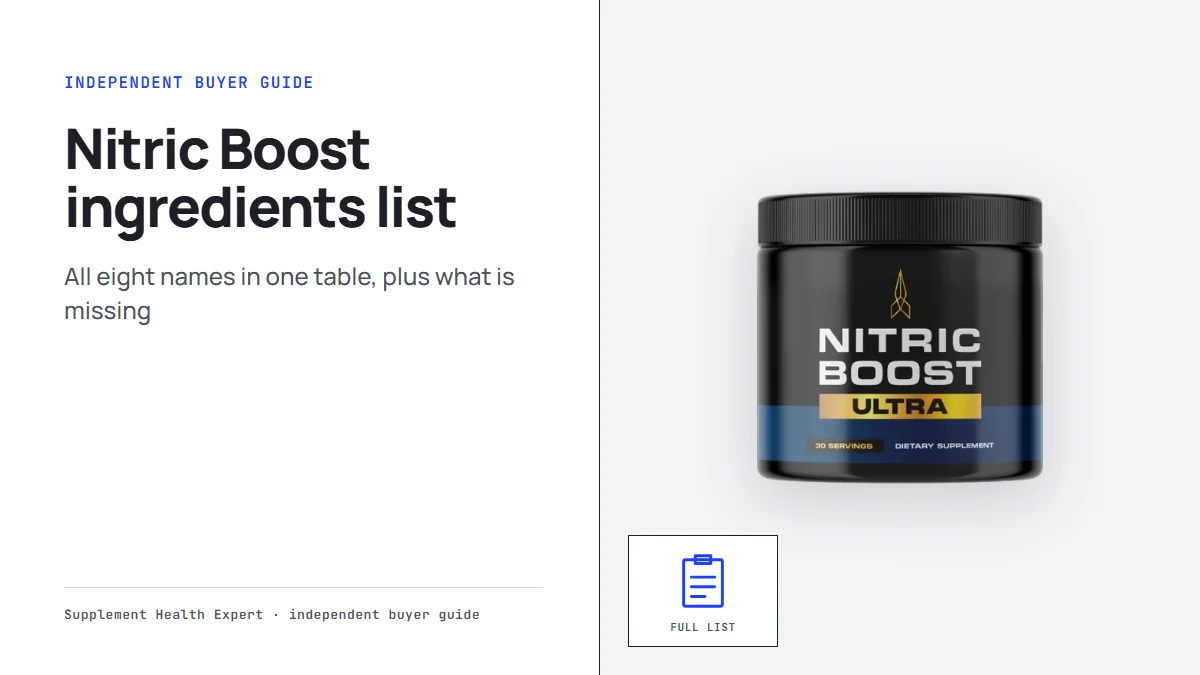
Sometimes you want the list and nothing else. Here is the Nitric Boost ingredients list in a single table, followed by a second table that records what the seller does not publish. Both are drawn from the order page and FAQ as read on October 28, 2026. If you would like each ingredient explained in prose, our ingredient-by-ingredient guide does that, and this page is the quick reference you can screenshot or show to a pharmacist.
The Table: Eight Ingredients
| # | Ingredient | What it is | The seller’s stated role |
|---|---|---|---|
| 1 | Beet root powder | Dried, ground root vegetable | Source of nitrates the body turns into nitric oxide; runners favor it for endurance |
| 2 | L-arginine | Amino acid | Starting material for nitric oxide, says the seller |
| 3 | L-citrulline DL-malate | Amino acid paired with malate | Pairs with L-arginine to back nitric oxide levels; malate is credited with energy |
| 4 | Niacin (vitamin B3) | Vitamin | Supports healthy, flexible blood vessels |
| 5 | Epimedium | A traditional herb | None passed along on our pages |
| 6 | Ginkgo biloba powder | Leaf powder | Antioxidant support that helps protect blood vessels |
| 7 | Dong quai | A traditional herb | Called a circulatory tonic of traditional use; supports blood flow |
| 8 | D-aspartic acid | Amino acid | None passed along on our pages |
Every entry in the right-hand column is the seller’s description, and none is a result we measured.
The Second Table: What Is Not Published
| Detail | Published? | What we do |
|---|---|---|
| Amount of each ingredient | No, called a proprietary blend | Show no doses |
| Supplement facts image | None found | Show none |
| Other ingredients | No list | Say nothing about them |
| Flavor | Not stated | Make no taste claim |
| Sweetener | Not stated | Make no claim |
| Scoop capacity | Not stated | Make no claim |
| Manufacturer | Not named | Name only the ship-from and returns address |
If you want a figure for any of these, the seller’s support is the place to ask. Our safety page lists questions for your doctor as well.
How to Use the Tables
You can use the first table in three practical ways. Show it to your pharmacist along with your medicine list. Compare it by name with the list on another powder you are considering. Tick off the items you already take in other products, such as niacin in a multivitamin. The second table tells you what to ask for, and it keeps your expectations realistic.
What a Proprietary Blend Means for You
When a formula is called a proprietary blend, the seller discloses the ingredient names but not the individual amounts. In practice, that makes the list useful for recognition and less useful for comparison. You can see that two products share beet root and L-citrulline, but you cannot see whether one holds twice as much as the other. The sensible response is not to assume the worst or the best. It is to rely on the things you can check, like the guarantee, and to ask for what you cannot.
Spelling and Name Variants You May Meet
Ingredient names change a little from page to page, and a variant is not a different ingredient. Beet root is often written as beetroot. L-arginine is sometimes shortened to arginine, and L-citrulline appears as citrulline or citrulline malate. Niacin is also called vitamin B3. Ginkgo biloba is a leaf, and the seller lists it as a powder. Dong quai has several spellings in the wild. If you compare Nitric Boost with another product, match by the underlying name and not by the exact punctuation.
A Checklist to Take to Your Pharmacist
A pharmacist can scan your medicines quickly if you bring the right information. Carry these four things:
- This table, saved on your phone or printed
- Your own list of medicines and supplements
- A note that the seller publishes no amounts
- One question to ask: does anything on this list clash with what I take?
That is all it takes, and it makes the conversation short and useful. Write down the answer and keep it with your order papers.
Why the Order of the List Tells You Little
On the seller’s list beet root opens the line-up and D-aspartic acid closes it. In some products, ingredient order reflects amounts, with the largest first. Because this seller publishes no amounts, we draw no conclusion from the order. The order is kept only because it is the seller’s own, which makes cross-checking easy.
What the Jar Itself Shows
On the jar front you will see the product name, 30 servings and the words dietary supplement. The seller’s page shows that same jar in every package, and the image does not include a supplement facts panel. When your parcel arrives, check the jar against the photo. If the jar you receive carries a label with more information than the order page, such as amounts, that label is the better source, and we would be glad to hear that it exists.
The Second Table in Practice
Take the “not published” table and turn it into action. Pick the item that matters to you most, whether amounts, flavor or scoop capacity, and ask about that one first. Short, specific questions tend to get specific answers, and a polite single-topic email is easier for support to answer than a long list.
A Note on Research
A few general references on nitric oxide in the body appear on the seller’s site. We do not print their titles, because they discuss general chemistry and not Nitric Boost itself, and we would not want to imply that they say anything about this powder. If you read around the individual ingredients, regard what you find as background. The most direct evidence you can gather is your own, over the 60 days the guarantee allows.
Reading the Tables in One Minute
Start with the first table and read down the last column only; that is the seller’s story in short form. Then read the second column to see how many names are plants, amino acids or vitamins. Finally, glance at the second table and pick one gap to ask about. The whole exercise takes under a minute, and it leaves you with a clearer sense of what you are being asked to stir into a glass every morning.
A Sample Email to the Seller
If you would like the missing details, a short message does the job. You might write something like this:
Subject: Question before I order
Hello, I am considering Nitric Boost. Could you tell me how much one scoop holds, what the flavor is and whether a supplement facts panel is available? Thank you.
Send it to [email protected] and keep any reply with your order records. If you decide to request a refund later, the subject line the seller asks for is “Refund Request”, so use that instead.
Grouping the List by Type
Sorting the eight names by type can help you picture the formula. There is one root powder, which is beet. There are three amino acids: L-arginine, L-citrulline and D-aspartic acid. There is one vitamin, niacin. And there are three plants, Epimedium, ginkgo and dong quai. The seller’s logic leans on the root and the first two amino acids for the nitric oxide idea, and on the vitamin and two plants for vessel and circulation talk.
Taking Medicines? Read This First
A few names here act on the nitric oxide pathway, and niacin, ginkgo and dong quai show up regularly around blood thinners, so show the list to a pharmacist if you take any medicine. No interaction is asserted here as fact. The seller’s own advice is to see your doctor before adding a supplement and to keep taking prescribed medicines until the doctor says otherwise.
See the Nitric Boost hub for the packages, and our safety guide for the medicine questions this table raises.
The Nitric Boost Ingredients List in Summary
Eight names, one scoop a day and a clear set of gaps: that is the Nitric Boost ingredients list. For most buyers, the combination of a recognizable list and a 60-day guarantee from purchase is enough to take the next step. The Nitric Boost hub and the ingredients page show the list beside the packages.
Frequently asked questions
What is on the Nitric Boost ingredients list?
A root powder, three amino acids, one vitamin and three plants, eight names in all.
Is there a supplement facts panel?
We found none on the seller's pages, so we show no doses and no other-ingredients list.
What is a proprietary blend?
A formula whose ingredients are named but whose individual amounts are not disclosed.
Can I ask the seller for amounts?
You can email [email protected]. Keep any reply with your order details.
How many ingredients are there?
Eight named ingredients, in one scoop a day.
nitric boost ingredients list · nitric boost ingredient table · nitric boost supplement facts · nitric boost what is not published · nitric boost proprietary blend · nitric boost questions for support · nitric boost ultra