Ingredients / Guide
Nitric Boost Ingredients: Meet All Eight, From Beet Root Powder to D-Aspartic Acid
Nitric Boost ingredients: beet root, L-arginine, L-citrulline, niacin, Epimedium, ginkgo, dong quai and D-aspartic acid, with the seller's role for each.
- Author
- Supplement Health Expert Editorial Team
- Updated
- Reading time
- 9 min
- Sources
- 0 cited
Key takeaways
- 01 The seller lists eight ingredients: beet root powder, L-arginine, L-citrulline DL-malate, niacin (vitamin B3), Epimedium, ginkgo biloba powder, dong quai and D-aspartic acid.
- 02 Every role described here is the seller's description, not a result we measured.
- 03 The seller calls the formula a proprietary blend and publishes no amount for any ingredient.
- 04 Beet root and the two amino acids carry the seller's nitric oxide story.
- 05 If you take medicine, show the ingredient list to your doctor or pharmacist before starting.
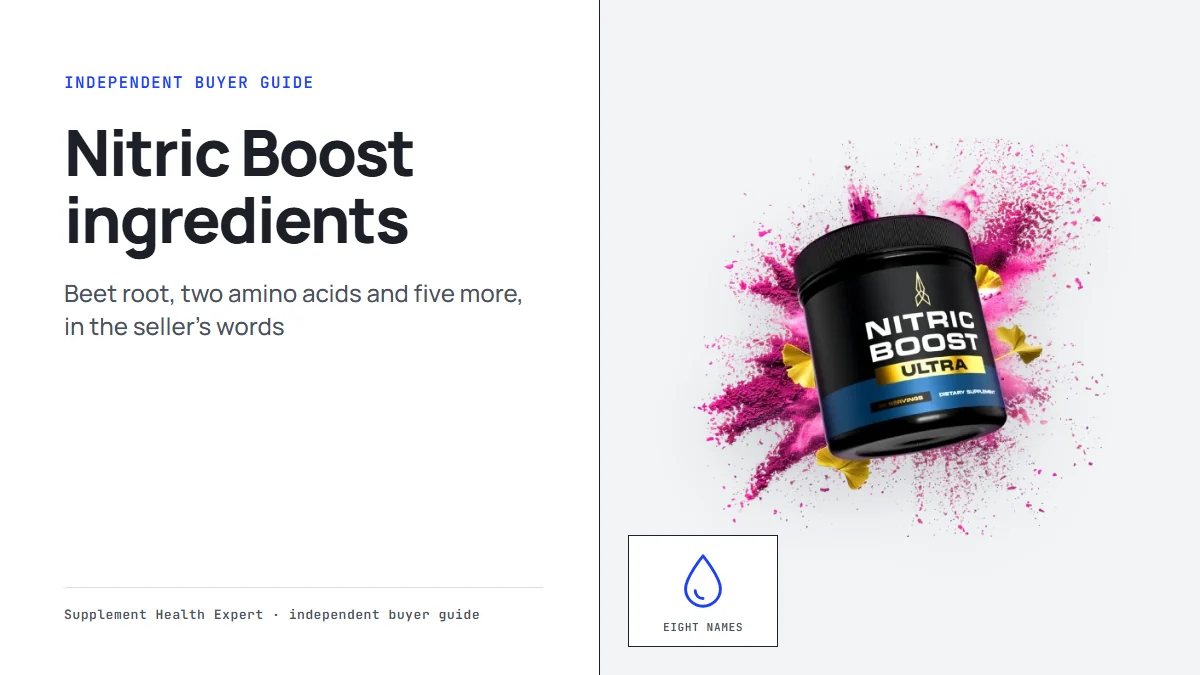
A short ingredient list is a gift to a curious shopper, because you can actually read it. The Nitric Boost ingredients run to just eight names, so you can hold the whole formula in your head: beet root, then two amino acids, then niacin, three plants and a final amino acid. This guide meets each one in turn, passing on the role the seller gives it and saying plainly where the seller says nothing. We read the order page and FAQ on October 28, 2026, and every description below is the seller’s, not a result of ours.
First, What Is Missing: Amounts
Every ingredient entry below comes with the same caveat, so we will state it once. The formula is labeled a proprietary blend by the seller, and no figure appears next to any name. We found no supplement facts image. That means we cannot tell you how much of anything is in a scoop, and nothing here should be read as a dose. If amounts matter to you, a short email to [email protected] before you order is the right step.
The Seller’s Core Idea in a Sentence
Boiled down, the pitch runs like this: the body produces nitric oxide, a gas the seller links to relaxed, widened vessels, and each scoop is meant to supply ingredients the body can use for it. The first three ingredients carry most of that story.
1. Beet Root Powder
Beet root powder comes first on the list. Per the seller, this root is rich in nitrates which the body turns into nitric oxide, and endurance runners are said to favor it. For a shopper, beet root is also the easiest ingredient to picture: it is a root vegetable, dried and milled to a powder, and many people already know it from juices and smoothies.
2. L-Arginine
L-arginine is an amino acid, which means a building block of protein. As the seller puts it, this is the base material for making nitric oxide. You will find L-arginine on its own in many sports-nutrition aisles, so it is a familiar name to people who train.
3. L-Citrulline DL-Malate
The third entry is another amino acid, L-citrulline, bonded to malate. The seller says it works alongside L-arginine to support nitric oxide levels, and that the malate side supports energy. The pairing of the two amino acids is the core of the formula’s design, as the seller presents it.
4. Niacin (Vitamin B3)
Niacin is the list’s sole vitamin, and the seller ties it to healthy, flexible blood vessels. If you take a multivitamin, you may already get niacin from it, and because the seller publishes no amount for Nitric Boost, it is worth mentioning the product to your pharmacist when they look at your list.
5. Epimedium
Epimedium is a traditional herb. No role for it appears on our pages, because the seller’s wording is not something we repeat, and we will not improvise one. Most shoppers meet this name for the first time here, which makes it an obvious item to mention when you show the list to a pharmacist.
6. Ginkgo Biloba Powder
In this formula ginkgo biloba comes as a leaf powder. The seller frames it as antioxidant support that helps protect blood vessels. Ginkgo is a name that often surfaces in blood-thinner discussions, so mention it to your pharmacist if you take one.
7. Dong Quai
Dong quai is a plant with a long record of traditional use. The seller calls it a traditional circulatory tonic, one that supports healthy blood flow. Like ginkgo, it is a plant that pharmacists often ask about when they look at a medicine list.
8. D-Aspartic Acid
The last item is D-aspartic acid, an amino acid. We stop there, since nothing the seller says about it belongs on our pages.
How the Eight Fit Together
If you group the ingredients by the job the seller gives them, a pattern appears. Beet root brings the nitrates. L-arginine and L-citrulline DL-malate bring the amino acids. Niacin, ginkgo and dong quai are described in terms of vessels and circulation. Epimedium and D-aspartic acid close the list without a role of their own on our pages. The seller’s whole proposition is that a single scoop brings all of these together in one daily drink.
Why Nitrates Matter in the Seller’s Story
Because the first ingredient carries so much of the narrative, it is worth a second look. Nitrates are compounds found in many vegetables, and beet root is among the best-known sources. In the seller’s account, the body can turn the nitrates in beet root into nitric oxide, which the seller says helps blood vessels relax and widen. That is how the seller links a root vegetable to the idea of healthy blood flow.
We pass this on as the seller’s explanation. We have no measurement from Nitric Boost itself to add, and the lack of published amounts means we cannot say how much beet root a scoop contains. What we can say is that the storyline is coherent and that it explains why the formula opens with beet root and the two amino acids that follow.
Reading a List Without Amounts
A list of names with no figures is still useful if you read it with a few questions in mind.
- Do I recognize most of the names? Here the answer is usually yes, because beet root plus L-arginine and L-citrulline, both amino acids, appear all over sports nutrition.
- Is anything unfamiliar? For most readers it is Epimedium, and a pharmacist can say more.
- Does the list overlap with what I already take? Niacin is the obvious one, since many multivitamins include it.
- Can I judge the product another way? The 60-day guarantee lets you do exactly that.
Lists like this are common among powders. The honest response is to use the information that exists and to ask for the rest.
Questions We Hear About the Ingredients
Does the seller list other ingredients? It names eight and publishes no separate list of others, so we say nothing about anything beyond those eight.
Is there anything artificial? The seller publishes no flavor or sweetener list, and we make no claim either way.
Is it suitable for vegetarians? The seller’s FAQ calls it vegetarian and its badges say vegan. Those are the seller’s statements.
Why are some ingredients described and others not? We pass on only the soft, attributed roles that the seller’s pages give. For Epimedium and D-aspartic acid we add nothing beyond what they are.
What Our Score Says About the List
Our editorial score of 9.2/10 rewards the ingredients mark highly, because the list is short, recognizable and logically organized around the seller’s idea. The transparency mark is lower because amounts are missing. Both are fair, and they sit comfortably alongside a value mark and a guarantee mark that are at the top.
What the Seller Says About the Powder Itself
The FAQ describes the powder as soy-free, dairy-free and vegetarian as well as non-GMO, says it is made in the USA in a GMP-certified facility, and refers to third-party inspections. Its badges also say vegan. We have not audited any of it, so it stays labeled as the seller’s account. Other ingredients, sweeteners and flavors are simply not itemized, so we keep quiet on all three.
Your Medicines and This List
Some names here belong to the nitric oxide story. Niacin, ginkgo and dong quai, for their part, turn up often when blood thinners come up in conversation. Anyone on medicine for blood pressure, a nitrate medicine or a blood thinner, or living with a heart condition, or facing surgery, should show this list to a doctor or pharmacist before starting. The seller itself advises consulting your doctor before any new supplement. Our safety guide goes through it calmly.
The Nitric Boost hub shows the same names beside the offer.
Our Take on the Nitric Boost Ingredients
A short, recognizable list is easy to like, and the logic of the formula is easy to follow. The gap is amounts, and the guarantee is the answer to it: 60 days from purchase, empty jars accepted. For a table version of the list, see our ingredients list post, and for the packages open the Nitric Boost hub, then the ingredients page.
Frequently asked questions
What are the Nitric Boost ingredients?
Eight names: beet root, L-arginine, L-citrulline, niacin, Epimedium, ginkgo, dong quai and D-aspartic acid.
Are the amounts published?
No. It is a proprietary blend per the seller, with no figure per name and no facts image that we could find, so we print no doses.
What is Epimedium?
A traditional herb. We add no role for it beyond that.
What does the seller say beet root does?
It says beet root supplies nitrates the body converts into nitric oxide, and that runners take it for endurance.
Is Nitric Boost vegan?
The seller describes the powder as vegan, dairy-free and soy-free. Those are the seller's statements.
nitric boost ingredients · nitric boost formula · nitric boost beet root · nitric boost l-arginine l-citrulline · nitric boost epimedium ginkgo dong quai · nitric boost no doses · nitric boost ultra