Ingredients / Guide
ProstaVive Ingredients: Nettle Root, Tongkat Ali, Panax Ginseng and the Rest, With Label Doses
ProstaVive ingredients explained: nettle root, tongkat ali, panax ginseng, fenugreek and more, each with its label dose, the seller's soft role and research.
- Author
- Supplement Health Expert Editorial Team
- Updated
- Reading time
- 9 min
- Sources
- 4 cited
Key takeaways
- 01 The three headline plants are stinging nettle root (200 mg), cordyceps (250 mg) and panax ginseng (50 mg).
- 02 Vitamin D3, vitamin B6, magnesium, zinc and boron sit beside them, each with a printed dose.
- 03 Fenugreek, artichoke, ashwagandha, maca and tongkat ali round out the plant list.
- 04 Six more plants share a single 200 mg blend with no individual doses.
- 05 Roles shown here are the seller's descriptions; the research cited covers single ingredients, not ProstaVive.
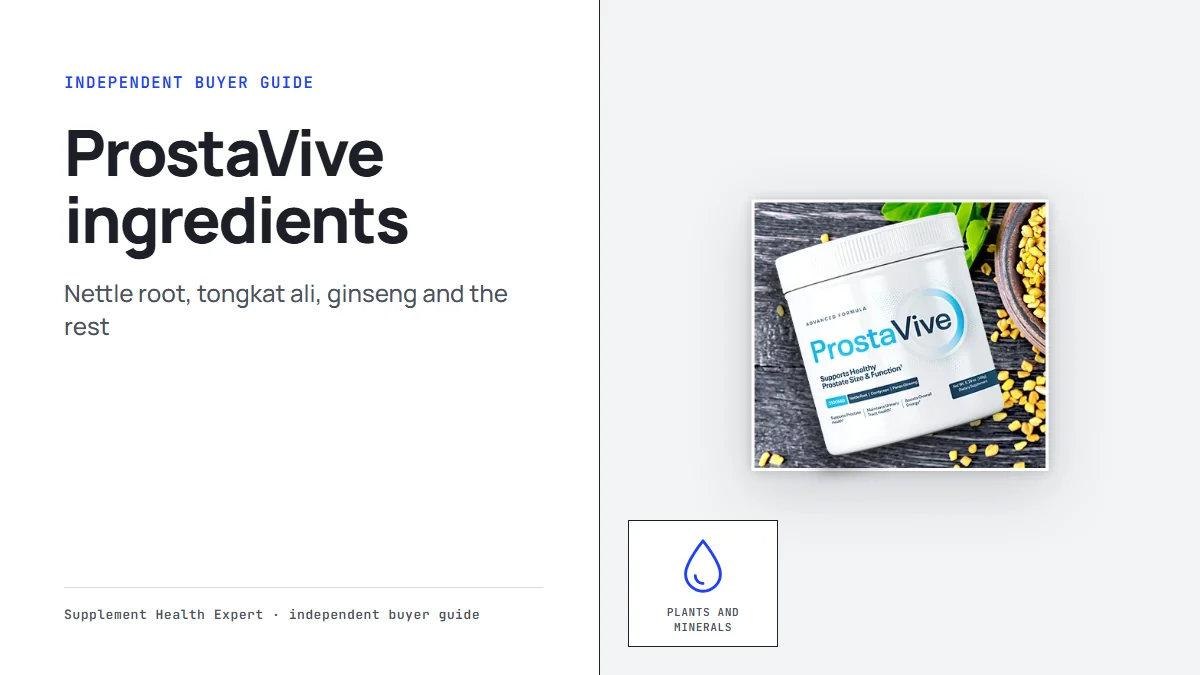
A good ingredient list invites questions, and the ProstaVive label invites plenty. This guide to ProstaVive ingredients goes through the panel item by item: what each one is, how much is in a scoop and what the seller says it is for. The doses come from the supplement facts image, and the roles are the seller’s own descriptions, so we attribute them as the seller’s. We keep to the soft, everyday roles the seller names and stay away from medical claims. Facts were read on October 28, 2026.
ProstaVive Ingredients: The Idea Behind the Formula
The seller frames ProstaVive as a circulation-and-nutrient-support formula. Instead of leaning on one plant, it pairs three headline plants with vitamins, minerals and several supporting extracts in a single daily scoop of about 4.93 g. The tub front headlines nettle root, cordyceps and panax ginseng; the full panel shows how much more is inside.
The Headline Plants
Stinging nettle root extract, 200 mg. The first plant on the tub. The seller links nettle root with urinary tract health in men and with prostate health.
Cordyceps powder, 250 mg. Printed on the tub front beside nettle root and ginseng. The seller’s pages assign it no role of its own, so we report just the dose and its place on the label.
Panax ginseng extract, 50 mg. In the seller’s account it supports healthy blood flow in the prostate and clear thinking.
The Vitamins and Minerals
Vitamin D3, 50 mcg. A vitamin supplied here as cholecalciferol. The seller describes vitamin D as important to general health, with mentions of prostate function, mood and bones.
Vitamin B6, 10 mg. Supplied as pyridoxine hydrochloride. The seller’s pages give no separate role for it, and the amount is high enough that we suggest comparing it with any other supplement you take.
Magnesium, 50 mg. From magnesium citrate. The seller connects magnesium with deeper sleep, healthy blood vessels, energy and clear thinking.
Zinc, 12 mg. From zinc citrate. According to the seller, zinc supports a healthy prostate and better sleep.
Boron, 5 mg. From boron citrate. The seller describes boron as supporting a healthy inflammation response, along with brain function.
Sodium, 70 mg. From sea salt. It is a mineral on the label rather than a headline ingredient, and it matters mainly to people watching their sodium intake.
The Supporting Plants
Fenugreek seed powder, 500 mg. The largest single amount on the panel. The seller connects fenugreek with prostate function, healthy stress and a good mood.
Artichoke extract, 300 mg. From the whole herb and standardized on the label to a stated cynarin content. The seller describes artichoke as rich in antioxidants.
Ashwagandha root extract, 250 mg. Standardized on the label to a stated withanolide content. The seller links it with the body’s own detoxification processes.
Maca root extract, 250 mg. The seller links maca with energy and a better mood.
Tongkat ali extract, 100 mg. A 100 to 1 extract of Eurycoma longifolia root. The seller describes it as an antioxidant that supports healthy stress.
The 200 mg Blend
One line covers six ingredients (raspberry, pomegranate, broccoli leaf, black currant, alfalfa leaf and beet root) at 200 mg combined. The label does not split the amount among them, so we cannot give you a dose for any one. It is the only place the panel groups ingredients, and it is why we score transparency a little below the top.
Other Ingredients
The other ingredients are stevia leaf extract, citric acid, sea salt and flavors, with no flavor named. The seller further calls the formula free of animal products, gluten, dairy, soy, wheat and barley and lists no known allergens. With allergies, read the label personally; our summary is no substitute.
Adding Up the Plant Amounts
The tub front prints a figure, 2100MG, and the label explains where it comes from: it equals the plant amounts added together. Try it: fenugreek 500 mg, artichoke 300 mg, then 250 mg each of maca, cordyceps and ashwagandha, the blend and nettle root 200 mg each, tongkat ali 100 mg and panax ginseng 50 mg. That comes to 2,100 mg of plant material in a scoop of about 4.93 g, which leaves the rest of the scoop for the vitamins, minerals, boron and the other ingredients. The panel is the number to rely on, and the total on the front is simply that arithmetic done for you.
Reading Milligrams and Micrograms
Two units appear on the panel, and the difference matters. A milligram (mg) is a thousandth of a gram. A microgram (mcg) is a thousandth of a milligram. Vitamin D3 is listed in micrograms, at 50 mcg, because it is needed only in tiny amounts, while the plants are listed in milligrams, because they are used in larger quantities. If you compare ProstaVive with another product, make sure you are comparing the same unit. A figure of 50 mcg is not 50 mg, and mixing them up is the easiest way to misread a label.
Ingredient Groups at a Glance
| Group | Items | Typical amounts |
|---|---|---|
| Headline plants | Nettle root, cordyceps, panax ginseng | 200 mg, 250 mg, 50 mg |
| Vitamins | D3, B6 | 50 mcg, 10 mg |
| Minerals | Magnesium, zinc, boron, sodium | 50 mg, 12 mg, 5 mg, 70 mg |
| Supporting plants | Fenugreek, artichoke, ashwagandha, maca, tongkat ali | 500, 300, 250, 250, 100 mg |
| Blend | Beet root, alfalfa, black currant, broccoli, pomegranate, raspberry | 200 mg total |
What the Research Covers
Research on single ingredients appears on the seller’s references page. We cite only entries that avoid disease topics and describe each by title.
- Tongkat ali: a 2013 paper on mood and stress hormones in moderately stressed subjects.
- Ashwagandha: a 2015 paper on cardiorespiratory endurance in healthy athletic adults.
- Magnesium: a 2015 review, Magnesium in Prevention and Therapy.
- Zinc: a 2013 paper on dietary zinc and supplementation in older adults.
Each concerns one ingredient at its own dose in its own group of people. None is a study of ProstaVive, and none shows what the finished powder does. The links are in the sources list below.
How the Ingredients Work Together, According to the Seller
The seller’s story is that a daily scoop gives a broad base: plants for the prostate and urinary tract, minerals and vitamins that support general wellness and a few extracts for energy and mood. We repeat that as the seller’s design idea. It is not a claim about outcomes, and the seller says individual results vary. If you want a longer view, our does it work guide explains the timeline the seller suggests.
Who Should Look Twice
People who take prescription medicine, who are pregnant or nursing, or who live with a medical condition should tell a doctor first. The seller also cautions against pairing ProstaVive with supplements containing similar ingredients. The vitamin D3 and vitamin B6 amounts are high, so compare them with any multivitamin you take. Our side-effects guide covers these points, and the ingredients page on the hub summarizes the panel.
Our View of the Formula
A wide formula, doses on nearly every line and one grouped blend: that is the profile. That mix explains why ingredients score 9.5 and transparency 8.5 inside our 9.2/10 editorial rating. The ProstaVive hub sets the label beside the offer.
The ProstaVive hub carries a compact version of this ingredient guide.
Order With the Label in Mind
Read the panel one more time, then pick the supply that fits your plan.
Frequently asked questions
What are the main ProstaVive ingredients?
Nettle root, cordyceps and panax ginseng lead on the tub; the label adds the vitamins, zinc, magnesium, boron, fenugreek, artichoke, ashwagandha, maca and tongkat ali.
Are the doses printed?
Yes, on 14 lines. A six-plant blend gets a single 200 mg figure.
How much nettle root is in a scoop?
200 mg of stinging nettle root extract.
What does the seller say tongkat ali does?
The seller describes it as an antioxidant that supports healthy stress. The label amount is 100 mg of a 100 to 1 extract.
Is the research about ProstaVive?
No. The papers we cite are about single ingredients and are described by their titles only.
Sources
- 01 Talbott SM et al. Effect of Tongkat Ali on stress hormones and psychological mood state in moderately stressed subjects. J Int Soc Sports Nutr, 2013.
- 02 Choudhary B et al. Efficacy of Ashwagandha (Withania somnifera [L.] Dunal) in improving cardiorespiratory endurance in healthy athletic adults. Ayu, 2015.
- 03 Gröber U et al. Magnesium in Prevention and Therapy. Nutrients, 2015.
- 04 Mocchegiani E et al. Zinc: dietary intake and impact of supplementation on immune function in elderly. Age (Dordr), 2013.
prostavive ingredients · prostavive nettle root · prostavive tongkat ali · prostavive panax ginseng · prostavive fenugreek · prostavive ashwagandha · prostavive zinc magnesium vitamin d3