Supplement Reviews / Guide
The Genius Song by Dr Lake: Who the Presenter Is, per the Site's Own Disclaimer
The genius song by dr lake: the seller's own disclaimer says Robert Lake is a pen name. What the sales pages claim about him, and why that matters for trust.
- Author
- Supplement Health Expert Editorial Team
- Published
- Reading time
- 8 min
- Sources
- 3 cited
Key takeaways
- 01 The footer disclaimer on the seller's own sales pages says "Dr. Robert Lake is a pen name". The name on screen does not point to a checkable person.
- 02 NASA training, a New York City clinic and 34 years as a neuroscientist are statements made on the sales pages. We could confirm none of them.
- 03 The seller's Terms also say customer names are altered, pen names are used and testimonials may be performed by avatars or actors.
- 04 What can be checked is the deal itself: a $39 digital audio track, a ClickBank checkout and 90 days to ask for a refund.
People who look up the genius song by dr lake usually want one thing settled: who is the doctor in the video, and can his background be trusted? The answer sits on the seller’s own website, in small print at the bottom of the sales pages. Below we go through what that disclaimer admits, line up every credential the sales material hands the presenter, and explain why the name on screen should play no part in whether you buy.
About us, briefly. We run an independent review page; the seller has no say over it. A few links here carry affiliate tracking, so an order placed through one can earn us a fee. Our view of the presenter would be the same without that.
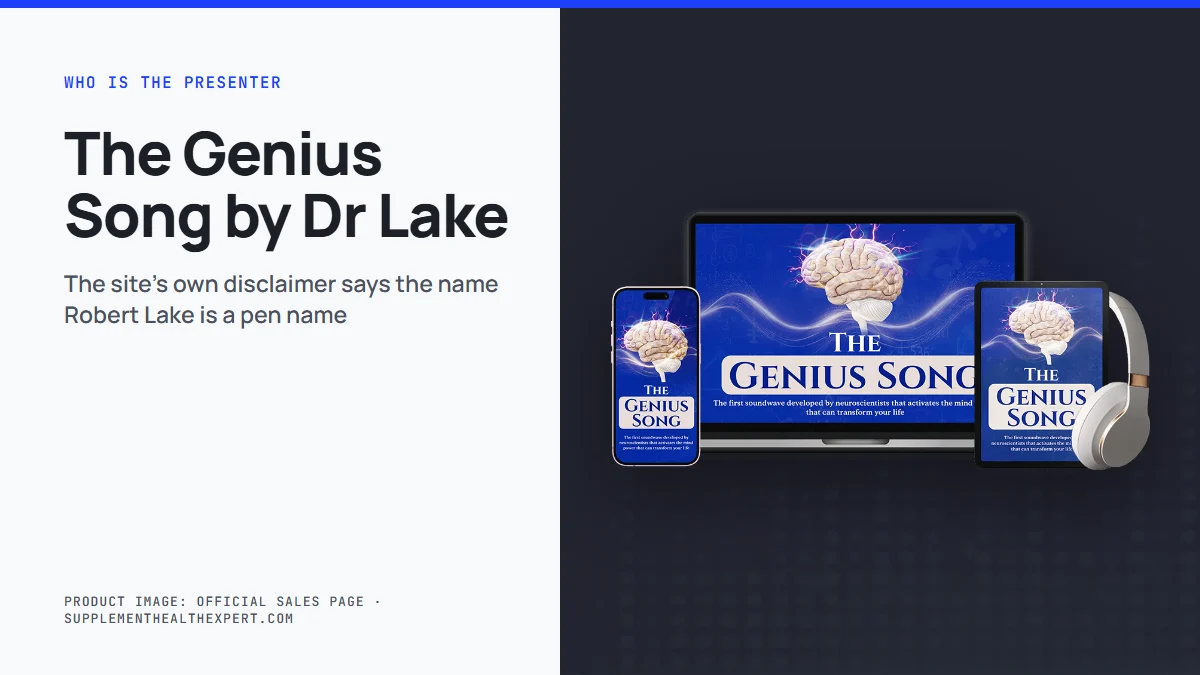
The Genius Song by Dr Lake: what the disclaimer says
Early in the sales video the presenter announces, “My name is doctor Robert Lake”. From then on the story runs in the first person: his colleagues, his findings, his patients. Few viewers ever reach the footer, where the seller concedes the name is invented.
On a novel, an invented author name harms nobody. On a scientist, it changes everything, because the pitch leans almost entirely on scientific authority. You are asked to believe that a senior researcher found a way to wake a “dormant” brain wave and squeezed it into a seven-minute track. If his identity is hidden, so are his record, his papers and any proof that he exists in the form described.
Every credential claim, and where it comes from
Below is each statement about the presenter’s background that we found in the sales material, with the place it appears. We could confirm none of them.
| Claim about the presenter | Where the seller makes it | Could we verify it? |
|---|---|---|
| His name is Dr. Robert Lake | Sales video, about 1 minute 43 in | No. The footer calls it a pen name |
| “NASA-Trained Neuroscientist” | Text version of the sales page | No |
| “Top NASA Scientist” | Headline of the text page | No |
| Runs a “New York City clinic” | Sales video, near 18 minutes | No. No clinic name or address given |
| “thirty four years as a neuroscientist” | Sales video, near 24 minutes | No |
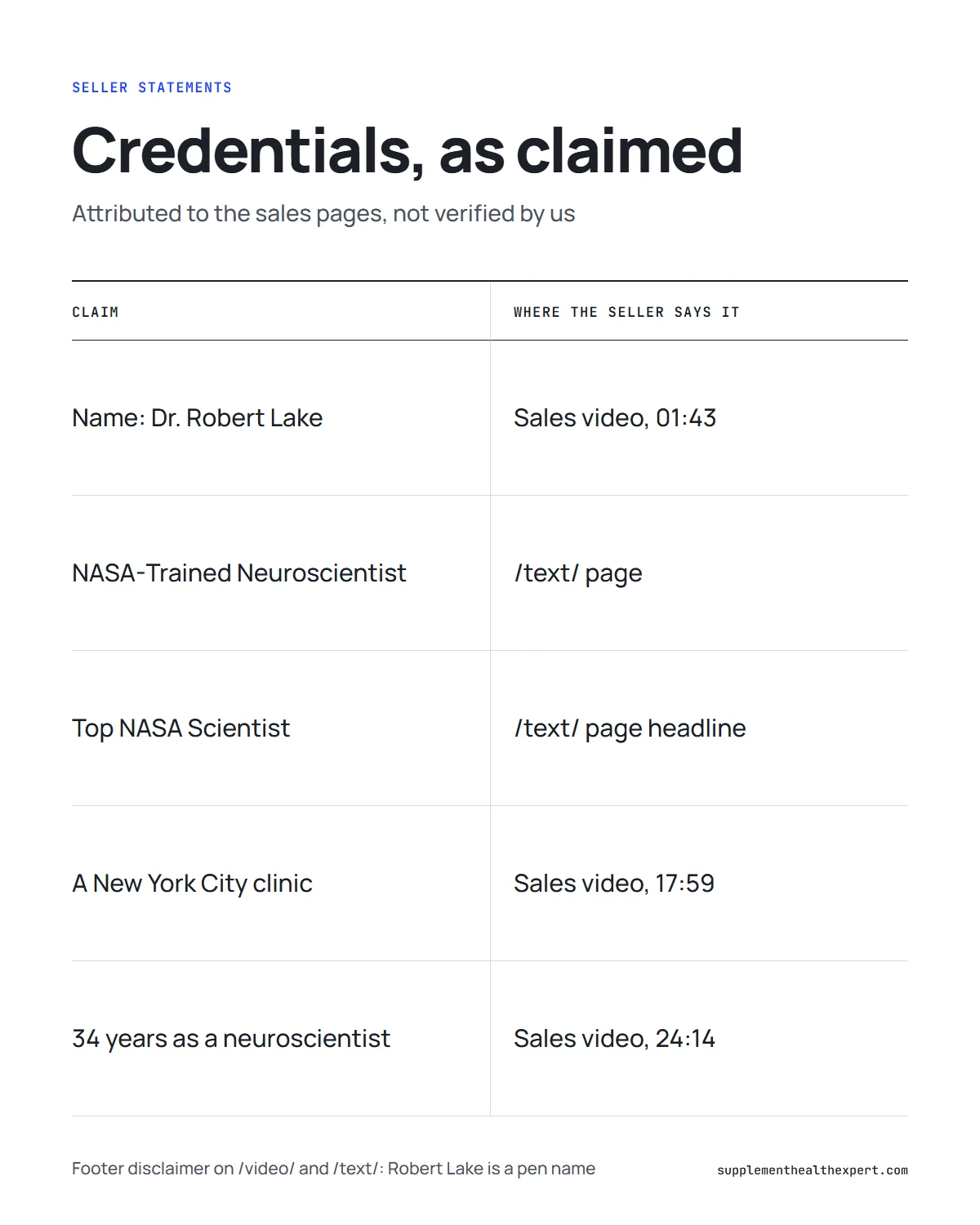
We are not saying the person behind the pen name lacks qualifications. We are saying a shopper has no means to find out, which is why those statements should count for nothing when you weigh the offer.
NASA in one version, Princeton in the other
The two versions of the pitch do not quite agree. In the video, the breakthrough begins when a colleague hands the presenter a report from Princeton. The text page tells the same tale with NASA in that role, and replaces the Berlin researchers with “colleagues in Japan”.
Swaps like these are common when a sales script gets rewritten for another format. Here they matter, since the presenter’s authority is the glue holding the story together. When the institution in an anecdote changes from page to page, the anecdote is hard to accept as a factual report of research.
The video also opens with the line “MIT found that all lucky, wealthy, successful people have this one brain wave”. We found no published study showing anything of the sort. Genuine research on gamma activity does exist, including EEG work on long-term meditators, yet none of it concerns luck or wealth.
The same rules apply to the people in the video
The invented name is not an isolated case. The Terms state: “Names of people mentioned in our marketing material have been changed to protect the privacy of those involved. We use pen names for this purpose, for example.” They add that parts of the marketing were dramatised.
That reaches the customers too. The video features Rachel, introduced as a nurse from Tustin, California, along with Michael in Dallas and Hannah from Manhattan, plus a string of listeners whose questions are read aloud with first names and home cities. Per the Terms, such feedback can be acted out by avatars or actors. Some of the people telling stories may be friends, relatives or early backers of whoever founded the company, a few received payment for sharing, and the outcomes are labelled exceptional rather than typical.
So treat none of these as independent reviews. In 2024 the FTC in the US finalised a rule aimed at fake reviews and testimonials, a sign of how closely regulators watch this area. We make no claim that this seller broke that rule. We simply note that its own fine print tells you to read its stories as marketing.
When the presenter sets his own limits
In fairness, the video is not certainty from start to finish. Asked about luck at a casino, the presenter answers: “there is, of course, no evidence to support that the genius song caused that.” It is the most useful sentence in the whole presentation, and it applies far beyond casinos.
The Terms go further still. Under the heading “For Entertainment Purposes Only”, they say that “brain entrainment is not an exact science and we recommend that you do not treat it as such. The products are provided for entertainment purposes only.” That sits awkwardly beside the image of a NASA-trained expert. Yet the same document also says: “All claims regarding brainwave entrainment, focus, and mental energy are substantiated by established scientific research.” Both lines live in one document, and reading them together is instructive.
What you can check without knowing who he is
Happily, the parts of the deal that protect you do not hinge on the presenter. These you can test:
- The company. Happy Consumer LLC of Puerto Rico, per the Terms. The same publisher also puts out an audio called The Genius Switch.
- The price. “You are paying $39 today for The Genius Song,” per the Terms of Sale, with ClickBank converting currency and adding tax at checkout.
- Delivery. Digital only. The video talks about an email with the track, while the text page promises access to a “Private Audio Portal”; neither page names a file format.
- The refund. Ninety days from purchase under the Terms, matched by the ClickBank checkout. A stray page at /TOS/refunds/ covers sealed NeuroActivate bottles, 60 days and an Ohio return address; ignore it, go through ClickBank, and keep the receipt.
- Support. Product questions to [email protected], order questions to ClickBank.
If you head over through our links, expect a small detour. They open the seller’s home page, which presently promotes a related audio named The Genius Wave rather than this track. The Genius Song pitch, with Dr. Lake, lives on the /video/ page of that same website.
How the pen name shapes our score
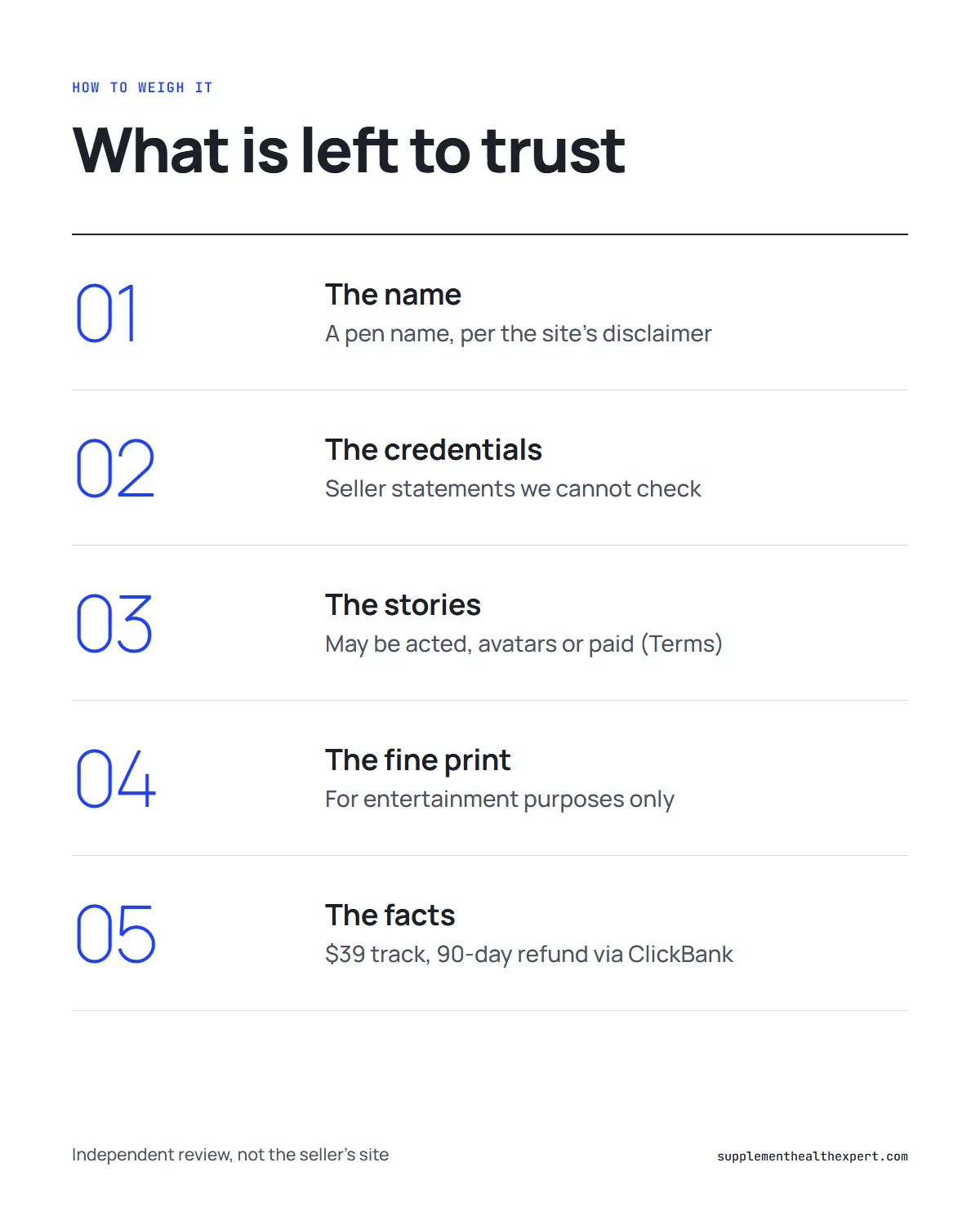
We give The Genius Song 4.7/10 as our editorial score. Transparency is its weakest category at 2 out of 10, and the pen name is a big part of that: the supposed designer cannot be identified, the institutions in his story shift between pages, and the customer tallies disagree (18,366 Americans in the video and body text, 19,389 in a headline). Evidence strength also sits at 2, since no published study tests this track. A score of 8 for guarantee and refund is what pulls the total up. Each category is explained on our methodology page.
Listening anyway? A few precautions
These are our own precautions for audio of this sort, not the seller’s. Pick a gentle volume. Keep it away from the car and from any machinery. Anyone with past seizures, epilepsy or a hearing condition should clear it with a doctor first. It is no remedy for any illness, and it is not an app, a game or something stocked on Spotify, YouTube or Amazon.
Our view
By the seller’s own admission, the doctor in the video is a character with a borrowed name. That does not make the file vanish, but it does mean the credentials, the colleagues and the research anecdotes should not sway you. Judge The Genius Song as what it verifiably is: a $39 audio experiment you can reverse within 90 days. Whether the whole offer counts as a scam is a separate question, weighed in our scam verdict. If price is your next question, we unpack the struck-through figures in the genius song discount guide.
Frequently asked questions
Does Dr. Robert Lake actually exist under that name?
Not as far as the seller's own footer is concerned. It describes the name as "a pen name used with the consent of our leading neuroscientist" and never says who that neuroscientist is, so there is nobody you can look up.
Did a NASA scientist create The Genius Song?
The text version of the pitch labels the presenter a NASA-trained neuroscientist, and its headline goes further with Top NASA Scientist. Those are seller statements. With the real identity hidden, a buyer cannot test the NASA link, and neither could we.
Does the presenter run a clinic in New York City?
He mentions one in the video, saying many people could not afford to visit him there. No clinic name or street address appears anywhere, so the statement stays unconfirmed.
Why would a seller use a pen name for its expert?
Privacy is the usual explanation offered. For you as a buyer the outcome is identical either way: credentials tied to a borrowed name cannot be checked, so give them zero weight.
Are the customers in the video real people?
The Terms explain that names in the marketing are altered, that pen names are part of the practice, and that feedback can be dramatised with avatars or actors. Read Rachel, Michael, Hannah and the others as sales material, not as independent reviews.
Who actually sells The Genius Song?
Happy Consumer LLC of Puerto Rico, according to the Terms, which also fall under Puerto Rico law. ClickBank takes the payment and is the retailer of record, which its own wording says is not an endorsement.
Does the pen name mean the product does not exist?
No. You pay for, and should receive, a digital audio track, with 90 days to request your money back under the Terms and the checkout. The pen name changes how far you should trust the pitch, not whether a file turns up.
Sources
the genius song by dr lake · dr robert lake · the genius song presenter · pen name · the genius song