Buying Guides / Guide
The Genius Song Discount: Reading the Crossed-Out Prices and the $39 Offer
The genius song discount, checked: why $200, $100 and $49 are seller reference prices, why $39 needs no coupon, and why the refund window matters most.
- Author
- Supplement Health Expert Editorial Team
- Published
- Reading time
- 8 min
- Sources
- 3 cited
Key takeaways
- 01 The $200, $100 and $49 figures in the order box are reference prices printed and struck through by the seller. The price in the seller's Terms of Sale is $39.
- 02 No coupon code is needed to see $39, and none of the seller's pages or Terms mention a coupon.
- 03 Countdown lines in the video are sales tactics. Judge the $39 on its own, not against the crossed-out numbers.
- 04 The most useful protection is the 90-day refund window stated in the Terms and at the ClickBank checkout. Keep your ClickBank receipt.
Most searches for the genius song discount end in one of two places: a page that promises a secret coupon, or the seller’s own order box with three prices struck through and a fourth in bold. Neither tells you what you will really pay or what a fair price looks like. Our notes come from four places: the long sales video, the text-only copy of the pitch, the Terms of Sale, and a ClickBank checkout screen we opened ourselves. From those, this page works out what the numbers mean, whether any code exists, and how to keep the money at risk as small as possible.
Who is talking: an independent editorial team, on a site the seller does not run. If you click one of our buttons and place an order, the seller’s affiliate program may pay us a cut. The arithmetic below would read the same if it did not.
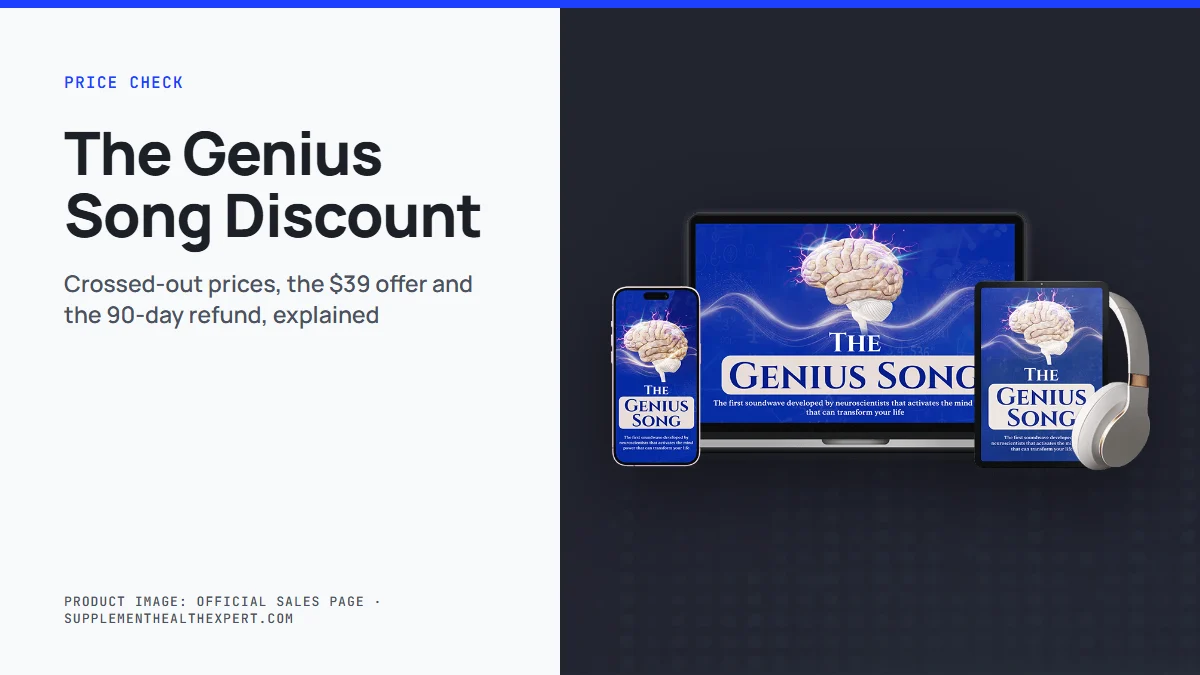
The Genius Song discount: what the order box really says
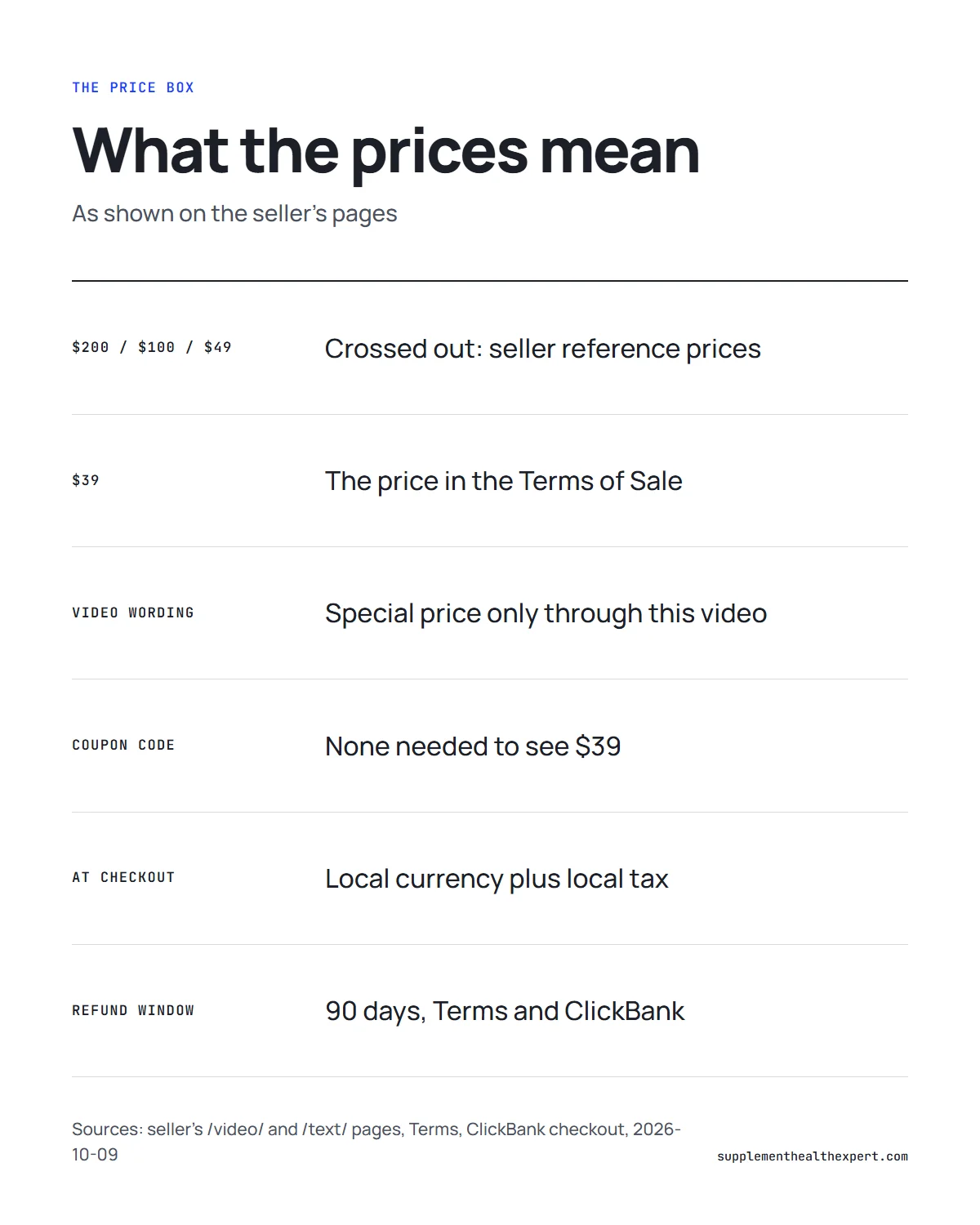
The order box sits on the seller’s video page and again on its text page. Here is each line, next to what it amounts to.
| Line on the seller’s page | What it is |
|---|---|
| “Regular Price: $200 / $100 / $49”, crossed out | Anchor prices chosen and printed by the seller |
| “Today Just For $39” | The offer every visitor is shown |
| Terms of Sale | “You are paying $39 today for The Genius Song.” |
| ClickBank checkout | Converts to your currency and adds tax where due |
| Type of order | One-off digital item, no repeat billing |
Nothing on the pages we read shows the track ever selling for $200 or $100. Those figures exist to make $39 feel small. Anchoring like this is an old retail habit and not unlawful in itself, yet the gap between $200 and $39 is not money you get to keep. A better question is plainer: would you pay $39 for a short audio experiment, knowing you can ask for it back?
Forty-nine, then thirty-nine: the countdown in the video
The presentation runs close to 39 minutes, and money is not mentioned until late. First the presenter says you will not need to spend two hundred dollars, or even one hundred. He then names $49, “more than forty percent off our original price”. Moments later he knocks off ten dollars more and calls $39 “a special price available only through this video”.
That last phrase does not survive a look at the text page, which carries the identical $39 with no video at all. The Terms of Sale say $39 too. So $39 is not a reward for patience; it is just what the track costs, and sitting through the whole presentation unlocks nothing cheaper.
A small coding detail points the same way. On the video page, the order button is set to stay hidden for 1,104 seconds, roughly 18 minutes. Readers who would rather skim can find the same order box on the text page straight away.
Urgency lines, read as sales tactics
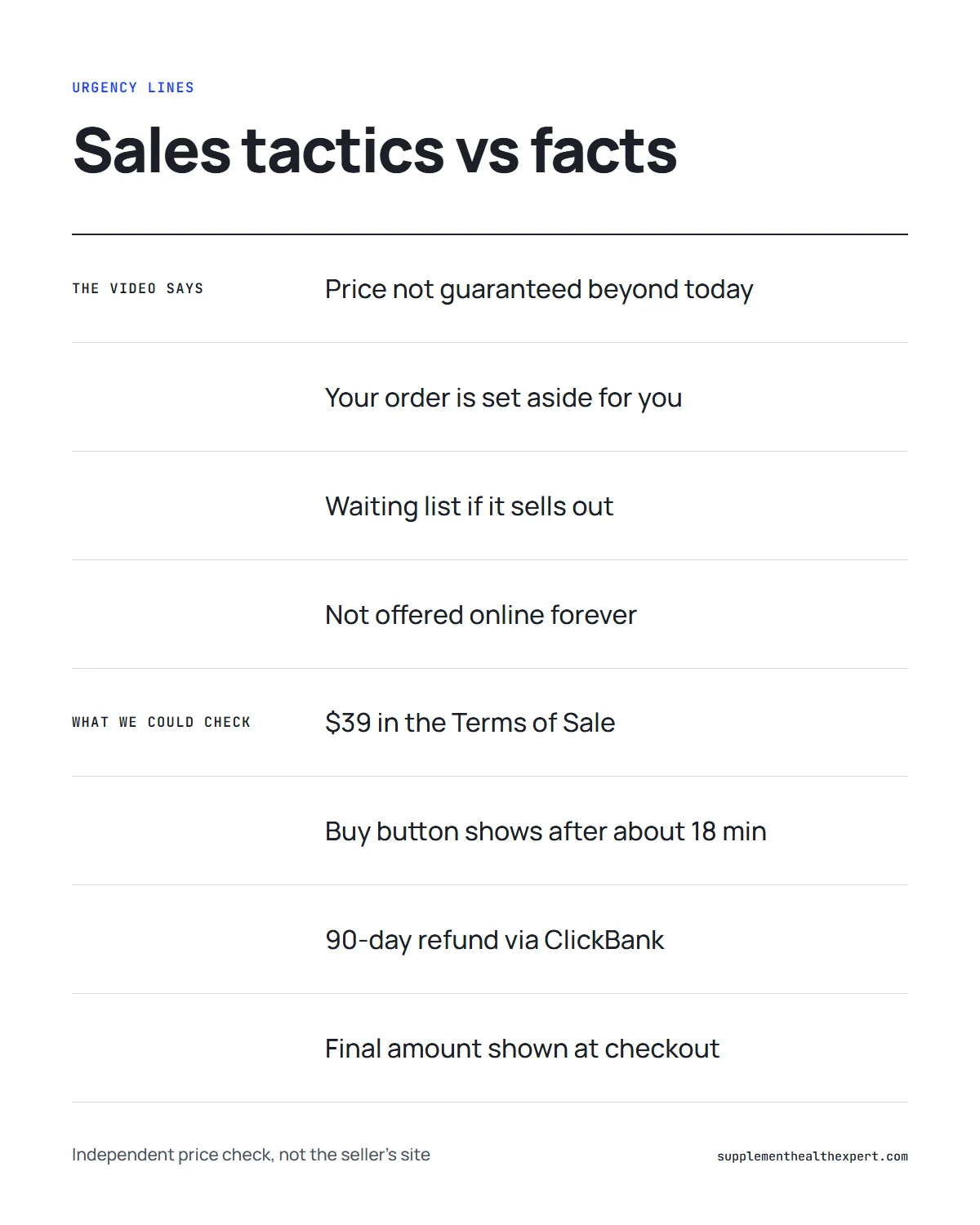
Several lines in the video are built to make you act before you think. Here they are, so you can spot them:
- “this thirty nine dollar price is not guaranteed beyond today”
- “your order is set aside for you. But if you leave the page, it may be given away to someone else”
- talk of a “waiting list” should the track sell out
- “I will not be offering this online forever”
A downloadable file has no shelf to empty, so a reserved order or a waiting list is hard to read literally. None of these lines comes with a date, a stock count or a checkable reason. Our suggestion: if you feel hurried, close the tab, read the Terms, and return when you are calm.
Do you need a coupon code?
No. Anyone who scrolls to the order box sees $39 without typing anything. We searched the video transcript, the text page and the Terms for the word coupon and came up empty.
If another site claims to hold a special code, slow down. The seller insists its website is the sole place the track is sold. A page that asks you to install a helper tool, enter card numbers anywhere except ClickBank, or grab the track from a file locker is not handing you a bargain. It is handing you something no refund will ever cover. Our scam warnings page lists more of these traps.
What you pay at checkout, by country
The $39 is quoted in US dollars. At checkout, ClickBank switches it into your own money and adds tax where that is owed. When we loaded the checkout from India, it read ₹4,207.93 plus ₹757.43 tax, a total of ₹4,965.36. Your total will not match ours, which is why only the final screen counts.
No extra item was pre-ticked on the checkout we saw. Since we did not complete a purchase, we could not see whether more offers follow payment. If any do, saying no is always an option.
The cheapest legitimate route
Paying under $39 does not seem possible. Paying no more than $39, while keeping the right to reclaim it, is. This is the path we would follow:
- Order through the seller’s own site and its ClickBank checkout, never a re-upload or a third-party shop.
- Read the total in your currency before typing card details.
- Untick or skip any add-on you had not planned for.
- File the ClickBank receipt email and note the date.
- Put a reminder in your calendar a few weeks ahead of day 90.
For every click from link to receipt, our step-by-step order walkthrough shows each screen.
A heads-up before you click. Our links lead to the seller’s home page, which right now advertises a separate audio from the same company, named The Genius Wave. You will find The Genius Song pitch on that site’s /video/ page instead. They are distinct products, so make sure the order box says The Genius Song before paying.
The refund window is the real discount
If you want something that behaves like a discount, look at the guarantee. The Terms state: “For Digital Products, you may get a refund on any purchase requested within 90 days of your initial purchase.” ClickBank’s checkout gives the same 90 days. The video, by contrast, praises a “one hundred percent ironclad money back guarantee” but never puts a number on it, so lean on the Terms and the checkout for the window.
Watch for one trap. A separate page at /TOS/refunds/ talks about sending sealed NeuroActivate bottles back to Ohio within 60 days. It belongs to some other product and makes no sense for an audio file. Go through ClickBank instead: phone 1-800-390-6035 or open a request at clkbank.com, with your receipt nearby.
What the $39 actually buys
For your money you get one brief audio track, about seven minutes long by the seller’s account. Nothing is posted to you. The video speaks of the file arriving in your inbox, while the text page promises login details for a “Private Audio Portal”. Neither page names a file format.
Bonuses are a moving target. The presenter promises three extras and then describes four: The Genius Child, aimed at kids; a century-old book on attracting money; a guided visualisation credited to a well-rated Calm app creator; and a printable with five habits. The text page announces four and shows three. Expect no more than four digital freebies, with a line-up that shifts from page to page.
You will not find the track in an app store, a game library, Spotify, YouTube or Amazon. Ordering also adds you to the seller’s mailing lists, which may push other offers.
Who is selling it, and what the Terms admit
The man on screen goes by Dr. Robert Lake, though the footer disclaimer on the sales pages admits that “Robert Lake is a pen name used with the consent of our leading neuroscientist”. His stated background therefore cannot be checked. We look at it closely in our page about the presenter behind The Genius Song.
The Terms carry a heading, “For Entertainment Purposes Only”, under which the seller writes that “brain entrainment is not an exact science and we recommend that you do not treat it as such. The products are provided for entertainment purposes only.” Elsewhere the Terms concede that success stories can be performed by “digital representations, avatars, or actors”, that names get swapped, that some storytellers know the founders personally or were paid, and that what you hear is exceptional rather than normal. Even the headcounts clash: 18,366 Americans in the video, 19,389 in a text page headline. We could confirm neither.
On the money side, we rate value at 5 and the refund setup at 8, which feed into our editorial score of 4.7/10 overall. The scoring method is on our methodology page.
A word on listening safely
Our own rule of thumb for brainwave-style audio: keep it at a modest volume, never play it in a car or at the controls of any machine, and speak to your doctor first if seizures, epilepsy or hearing trouble are part of your history. No illness is treated by it, and the seller’s site itself says it is not meant to diagnose or prevent disease.
Bottom line on price
The struck-through numbers are decoration, the countdown is a script, and $39 is what you pay whichever page you land on. What matters is whether a short audio trial is worth $39 to you when it can be refunded inside 90 days. For the essentials on a single screen, our quick guide has them.
Frequently asked questions
Is there a coupon code for The Genius Song?
We found none, and you do not need one. The order box already shows $39, the Terms of Sale confirm that figure, and neither the sales pages nor the Terms mention coupons anywhere. Be wary of any page that wants you to download something or type card details outside ClickBank to unlock a so-called code.
Was The Genius Song ever sold for $200?
Nothing we read shows it changing hands at $200 or $100. Those numbers sit struck through in the order box under the label of a regular price. Read them as anchors picked by the seller, not as evidence of a real markdown.
Will the $39 price go up after today?
The presenter warns that today's figure may not last and that he will eventually stop offering the track online. Those are pressure lines with no date or reason attached. We cannot forecast future pricing, so look at the checkout on the day you actually order.
Can I find it cheaper on Amazon, Spotify or YouTube?
The seller says its own website is the single place it sells the track, and the presenter claims versions floating around on streaming sites differ from his. We found no app, game or marketplace listing. A cheap copy from elsewhere would also leave you without the 90-day ClickBank refund.
Do I pay tax on top of the $39?
Possibly. ClickBank converts the dollar figure into your own currency and adds any tax due where you live, so two buyers in different countries can see two different totals. Trust the number on the checkout screen.
Is the $39 a subscription?
No. The checkout records it as a one-off digital item with no repeat billing. Ordering does put your address on the seller's mailing lists, and every message carries an unsubscribe link.
Do the bonuses cost extra?
No separate charge is attached to them. Just do not let a particular extra drive the purchase, because the line-up of up to four freebies changes depending on which seller page you read.
Sources
the genius song discount · the genius song price · genius song coupon · clickbank refund · the genius song