Ingredients / Guide
VisiFlora Ingredients: Vitamins, Carotenoids and Plant Extracts, Explained One by One
VisiFlora ingredients explained: seven vitamins and minerals with amounts, plus a 351 mg blend with lutein, astaxanthin, ginkgo, bilberry and saffron.
- Author
- Supplement Health Expert Editorial Team
- Updated
- Reading time
- 9 min
- Sources
- 3 cited
Key takeaways
- 01 Seven vitamins and minerals carry printed amounts, from vitamin A through to chromium.
- 02 A 351 mg proprietary blend names 14 more ingredients, including lutein, zeaxanthin, astaxanthin, bilberry, saffron and ginkgo.
- 03 No single dose is printed for any blend ingredient, so we give none.
- 04 The seller describes the roles in soft terms such as antioxidant support and eye comfort.
- 05 The research we cite covers ingredients and a topic, not VisiFlora itself.
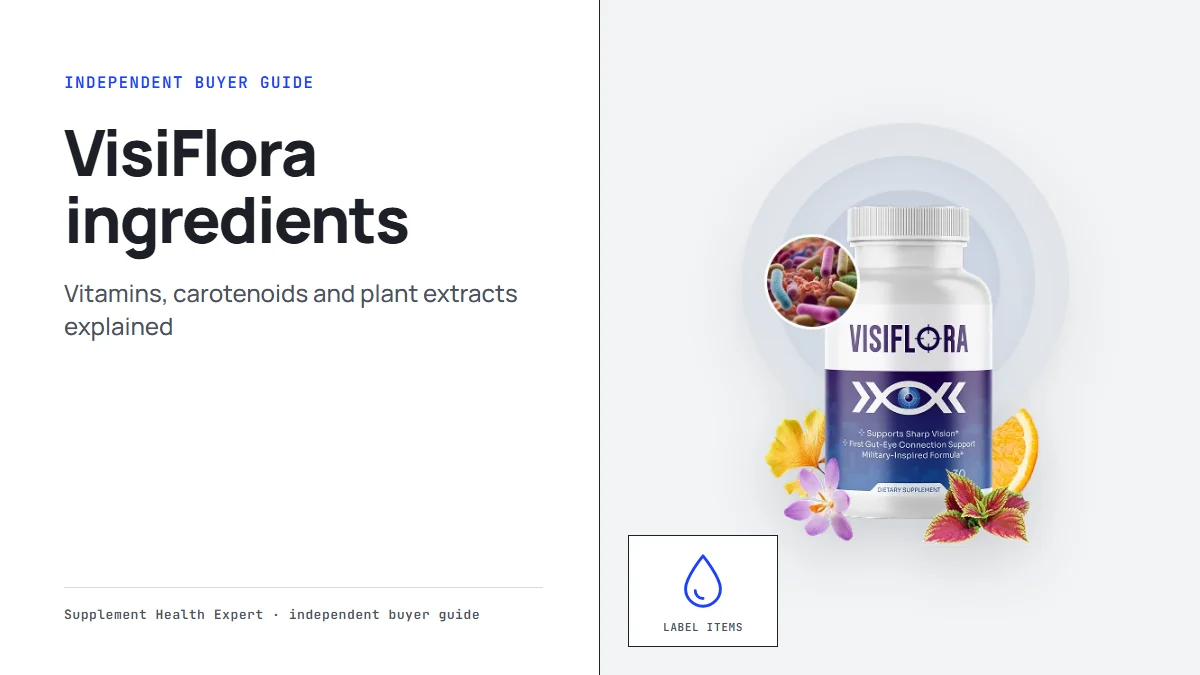
Turn a bottle of VisiFlora around and the label reads like a short cast list: seven nutrients with amounts and a longer line for a blend with 14 names. This guide takes the VisiFlora ingredients in groups, with the amount where the label gives one, the role the seller describes in its own soft words and a pointer to research where there is any. Our sources are the supplement facts and the seller’s pages as of October 28, 2026, and we add nothing the label does not state.
The Map in One Table
| Group | Items | Amounts on the label |
|---|---|---|
| Vitamins and minerals | A, C, E, zinc, selenium, copper, chromium | Printed for each |
| Carotenoids | Lutein, zeaxanthin, astaxanthin, lycopene | Inside the 351 mg blend, no single dose |
| Plant extracts | Ginkgo, eyebright, bilberry, saffron, grape seed, coleus forskohlii | Inside the blend |
| Helpers | Taurine, alpha lipoic acid, rutin, quercetin | Inside the blend |
The serving is a single capsule, and 30 of them fill a bottle.
Group 1: Vitamins and Minerals With Amounts
These are the label lines where numbers are printed.
- Vitamin A, from beta carotene. Printed at 450 mcg RAE; the seller counts it in the formula’s foundation.
- Vitamin C, 90 mg. Described by the seller as an antioxidant nutrient.
- Vitamin E, 15 mg, as DL-alpha tocopheryl acetate. Also an antioxidant nutrient, in the seller’s description.
- Zinc, 11 mg, as zinc oxide. A trace mineral.
- Selenium, 20 mcg, as selenium AAC. Called an essential mineral by the seller.
- Copper, 0.9 mg, as copper gluconate. Another essential mineral, per the seller.
- Chromium, 15 mcg, as chromium picolinate. The seller ties it to metabolic function.
Several of these reach a full daily amount in one capsule, so check what your multivitamin already supplies. For the panel in table form, open our ingredients list post.
Group 2: Carotenoids
Four carotenoids sit inside the blend. Lutein and zeaxanthin are the two the seller describes as carotenoids found in the eye. Astaxanthin is described as a potent carotenoid antioxidant, and lycopene as an antioxidant. The label gives no individual amounts. Below this article are links to a review covering lutein, zeaxanthin and beta-carotene and the eye, and to a lycopene overview. They concern the ingredients, and neither tests VisiFlora.
Group 3: Plant Extracts
Six botanical extracts round out the blend.
- Ginkgo leaf. The seller pairs it with coleus forskohlii as support for healthy circulation and nutrient delivery around the eyes.
- Eyebright. A herb with a long traditional association with eye comfort, in the seller’s words. One laboratory study tested eyebright extract on human corneal cells; it is background on the plant, nothing more.
- Bilberry fruit extract. Rich in anthocyanins, according to the seller.
- Saffron stigma extract. Called a carefully studied botanical by the seller.
- Grape seed extract. A bioflavonoid source that the seller connects with healthy circulation near the eyes.
- Coleus forskohlii root. Grouped with ginkgo in the seller’s description.
Group 4: Helpers
Taurine is described as supporting cellular hydration. Alpha lipoic acid is another antioxidant on the seller’s list. Rutin and quercetin, both from Sophora japonica, join grape seed as bioflavonoids. These are the quieter members of the cast, and the label gives them no single dose either.
The Blend: What the Label Does and Does Not Say
The blend totals 351 mg and holds 14 named ingredients, listed in the label’s order. The label does not split the total, so we cannot tell you how many milligrams of saffron or bilberry a capsule contains, and we will not estimate. That is the single limit of an otherwise readable panel. The upside of a full ingredient list is that every item can be looked up and shown to a doctor. Our VisiFlora hub keeps the panel and its explanations together, and the ingredients page gives each item a short profile.
The Seller’s Story, in One Sentence
As the seller frames it, the formula draws on research into digestion and eye health, a claim we did not test.
What the Research Is and Is Not
Three papers are listed under this article. One reviews lycopene as an antioxidant. One is a laboratory study of eyebright extract and corneal cells. The third is the carotenoid review. They are ingredient or topic research. They do not show that VisiFlora will do anything for you, and individual results vary. We include them so you can read the background yourself.
How to Read the Label Lines
A few small conventions make the panel easier to read. Amounts come in two units: mg (milligrams) for the larger ones and mcg (micrograms) for the smaller ones, and a microgram is a thousandth of a milligram. The words after “as” name the form of each nutrient, for example vitamin C as ascorbic acid or zinc as zinc oxide. RAE means retinol activity equivalents, which is how vitamin A is measured. And “proprietary blend” means the maker lists the ingredients in descending order of weight but prints a single total for the group. Armed with those four notes, you can read any supplement panel with confidence, including the one on the VisiFlora bottle.
Questions About the Ingredients
Is VisiFlora a multivitamin? Not quite. Seven vitamins and minerals are in it, yet the seller built it for an eye-comfort routine around carotenoids and botanicals, so its scope is narrower.
Why are some ingredients listed without amounts? They sit inside the 351 mg proprietary blend, which the label gives as one total.
Is the capsule vegetarian? The shell is plant-based hypromellose, and the seller says it suits vegetarians.
Can I take it with my multivitamin? Ask your doctor or pharmacist. Set both labels together and add up what each lists for vitamin A, zinc, copper and selenium.
Do I need to take it with food? The label gives only a daily capsule; for lunch or dinner with water, see the seller’s FAQ.
Ingredients and the Rest of Your Day
Ingredients matter, but habits matter too. Short breaks from the screen, good lighting for the task, regular eye exams and a varied diet sit beside any capsule. The seller’s nutrition plan e-book, with 21 easy recipes, is aimed at the food side of that picture. Think of the capsule as one small part of a routine instead of the whole routine.
Who Should Ask a Doctor First
The label excludes people under 18 and those pregnant or nursing, and wants medicine users and people with a condition to consult a physician. Our addition: because the blend has four botanical items, ask first if blood thinners, blood-pressure or diabetes drugs, or an operation are in your picture. Our side effects guide covers it in full.
The Other Ingredients
Hypromellose, a vegetable material, makes the shell. Silicon dioxide, magnesium stearate and rice flour close out the label’s other ingredients. The seller describes it as non-GMO and stimulant-free, suitable for vegetarians, and mentions a certified facility.
How to Use This Guide With Your Bottle
When your bottle arrives, open this guide beside it. Find each group on the label, check the printed amounts against what we list and note which items sit inside the blend. If something on the label does not match what we describe, trust the label and tell support at [email protected]. A few minutes spent comparing now means you will understand every line the next time you read it.
Our Take on the VisiFlora Ingredients
A clear cast, seven dosed and 14 named, with a single total for the blend. See the VisiFlora hub for the packages that carry it. We score the ingredients 9 out of 10 inside our 9.2/10 editorial score, and our does it work guide explains how to test it fairly.
Frequently asked questions
What are the main VisiFlora ingredients?
A vitamin and mineral base with printed amounts, and a 351 mg blend of carotenoids such as lutein, zeaxanthin and astaxanthin, extracts such as ginkgo, bilberry and saffron, and helpers such as taurine.
How much of each blend ingredient is in a capsule?
The label gives one total of 351 mg for the 14-ingredient blend, not the amount of each.
Which ingredients should I mention to my doctor?
Four in the blend: ginkgo, coleus forskohlii, quercetin and grape seed. That matters most with blood thinners, blood-pressure or diabetes drugs, or upcoming surgery.
Does research prove VisiFlora works?
No. The papers we cite concern single ingredients or a topic, and none tests VisiFlora.
Is there anything besides the active ingredients?
Yes. The label lists a hypromellose shell and three processing helpers.
Sources
- 01 Lycopene: A Potent Antioxidant with Multiple Health Benefits. Journal of Nutrition and Metabolism, 2024.
- 02 Assessment of eyebright (Euphrasia officinalis L.) extract activity in relation to human corneal cells using in vitro tests. Balkan Medical Journal, 2014.
- 03 A Mechanistic Review of beta-Carotene, Lutein, and Zeaxanthin in Eye Health and Disease. Antioxidants (Basel), 2020.
visiflora ingredients · visiflora astaxanthin · visiflora lutein zeaxanthin · visiflora bilberry saffron · visiflora ginkgo eyebright · visiflora vitamins · visiflora grape seed quercetin