Ingredients / Guide
Arctic Blast Ingredients: The Full Drug Facts Label, Line by Line
Arctic Blast ingredients from the Drug Facts label: menthol 10.00% and camphor 3.00% as the actives, 14 other ingredients in order and a 365-day guarantee.
- Author
- Supplement Health Expert Editorial Team
- Updated
- Reading time
- 7 min
- Sources
- 0 cited
Key takeaways
- 01 The Drug Facts label names two actives: menthol at 10.00% and camphor at 3.00%, both listed for the purpose Topical Analgesic.
- 02 Fourteen other ingredients follow in label order, and the label prints no amount beside any of them.
- 03 The label lists DMSO among the other ingredients, not the actives; the seller describes it as the carrier.
- 04 Wintergreen oil (methyl salicylate) and St. John's wort are on the list, so ask a doctor first if either matters for you.
- 05 The label's use line reads: for the temporary relief of minor aches and pains of muscles and joints.
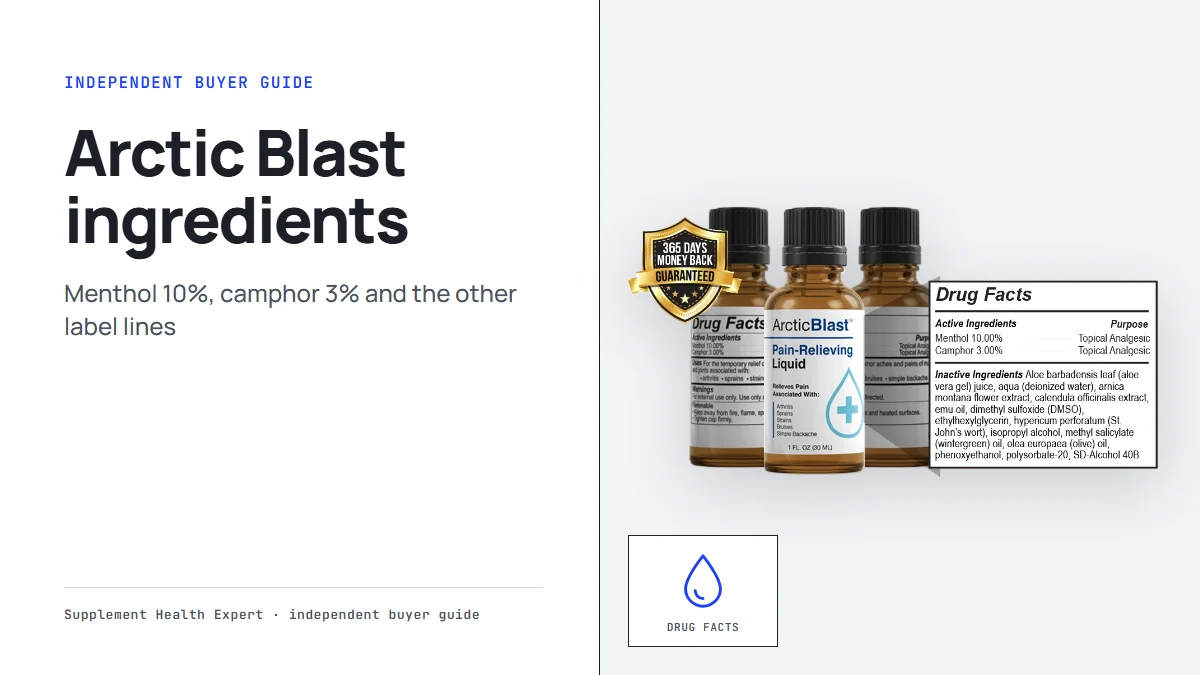
Before any liquid goes on your skin, it pays to know what it contains, and this label makes that possible. The Arctic Blast ingredient list sits on a Drug Facts panel, where the actives, the other ingredients and the directions can all be checked without leaning on sales copy. We went through that panel from top to bottom, and this guide follows the sequence printed on the bottle.
Arctic Blast Ingredients: The Two Labeled Actives
The panel begins with the actives, and this product has two of them. Menthol appears at 10.00% and camphor at 3.00%. The label files each under the purpose Topical Analgesic, its own wording. Those are the only entries carrying printed percentages, which makes them the quickest figures to hold up against another topical bottle.
Menthol is generally linked with a cool sensation on skin, while camphor contributes a sharper, cooling note that shows up across topical products in general. Read together, the two actives account for the cooling menthol-and-camphor feel we mention. That wording reflects our reading of the ingredient list. It makes no promise about what you will sense or how fast anything shifts.
Reading the Panel Top to Bottom
Panels of this kind run in a fixed sequence, so reading them the same way each time helps. Start with the active ingredients and their percentages. Next comes the purpose line, which says what each active is listed for. The other ingredients come after that, usually as one run-on list, and some labels print amounts beside them. The directions and warnings sit below, and the net contents line closes the panel.
The net contents line closes this panel and states 1 FL. OZ (30 ML). Our side-effects guide covers the directions and warnings in full, so we will not repeat them here. For this page, focus on the top of the panel: two actives with printed figures, then a long list of other ingredients with none.
The Inactive Entries, Listed as Printed
Fourteen other ingredients follow the actives in the sequence the label uses. No amount is printed for any of them, so the list tells you what is present rather than how much. Hold the printed list on your own bottle against these fourteen entries, and raise any mismatch with support before you apply the liquid. Where the seller’s written sales copy says something about one, we quote that as the seller’s claim and stop there.
- Aloe barbadensis leaf (aloe vera gel) juice. The seller’s written pitch mentions aloe vera gel among the formula’s contents.
- Aqua (deionized water). Printed on the label as the water base; the seller assigns it no separate function.
- Arnica montana flower extract. Among the botanicals, the seller’s pitch singles out arnica.
- Calendula officinalis extract. Shown on the label only; the seller’s copy never highlights it.
- Emu oil. Included in the formula, according to the seller’s written materials.
- Dimethyl sulfoxide (DMSO). This slot is where the label places it. The seller, though, uses the term carrier for it.
- Ethylhexylglycerin. On the label list; the seller states no role for it.
- Hypericum perforatum (St. John’s wort). Appears on the label; our caution further down covers it.
- Isopropyl alcohol. One of two alcohols here, and a reason the liquid is flammable.
- Methyl salicylate (wintergreen) oil. Printed on the label. Our salicylate note below explains why it matters.
- Olea europaea (olive) oil. Printed on the label; the seller defines no separate purpose for it.
- Phenoxyethanol. On the label, and the seller does not explain its function.
- Polysorbate-20. Given on the label; the seller attributes no function to it.
- SD-Alcohol 40B. The second alcohol on the list, which brings the same flammability caution.
DMSO: Two Descriptions, Side by Side
DMSO earns its own section, since the label and the seller describe it in different terms. The panel places dimethyl sulfoxide inside the other-ingredients group, between emu oil and ethylhexylglycerin, with no percentage next to it. In the seller’s own pitch, the same compound is called the carrier for the formula.
Both descriptions stay in the text exactly as the sources word them, and the comparison is yours to make. Only menthol and camphor carry percentages on the panel. No DMSO figure appears anywhere on the label we read, and we have no basis for supplying one.
From our side, a practical point about DMSO: it can move other substances across the skin. Start on clean skin, and check with a pharmacist before pairing this with any other cream or product.
Salicylate, St. John’s Wort and the Two Alcohols
Three entries call for care before any first application. Methyl salicylate (wintergreen oil) is a member of the salicylate group, the same family aspirin belongs to, so an aspirin allergy deserves a conversation with a pharmacist. St. John’s wort, printed here as hypericum perforatum, is a separate concern for anyone on blood thinners or other prescription medicine, who should seek advice first.
Methyl salicylate and wintergreen oil appear together on the panel because wintergreen oil is mostly methyl salicylate, so one caution covers both names. Should aspirin have caused you trouble in the past, flag this entry to your doctor before the first application.
Isopropyl alcohol and SD-Alcohol 40B drive the flammability caution on the label. Store the bottle well clear of flames and sparks, and screw the cap shut after every application. Sensitive skin should get a patch test before full use, since any ingredient has the potential to irritate.
How the Label Says to Use It
The seller’s directions cover adults 18 and older. Apply the liquid to the spot in need, no more than three to four times a day, using enough to blanket the area. The product is for outside use only, so keep it away from the eyes, avoid open cuts and broken skin, and leave the area unwrapped afterward.
According to the seller, the liquid feels oily when first applied and turns non-tacky after a few seconds. The same source suggests a bottle goes about a month, though your own usage determines the real figure. Read both as the seller’s estimates, not as promises.
What the Actives Do Not Tell You
The actives tell you what the label says is in the bottle. They do not tell you how your skin will respond, how quickly you will notice anything, or whether the liquid suits a particular routine. That is why the rest of this guide matters: the seller’s directions, the label cautions and our own safety notes. A bottle that reads well on paper still needs a test on a small patch of skin first, a review of any medicines you already take, and a doctor visit if your pain shows warning signs.
Why the Label Is the Best Yardstick
Sales copy tells you what a product hopes to be. A Drug Facts panel tells you what the product contains. When you compare any two topical liquids, begin with the actives and their percentages, then look at the other ingredients and check whether any of them carries an amount. The Arctic Blast label prints the actives in full and gives no amounts for the rest. That is a clear picture, and it is the one our own scoring method starts from.
The catalog page holds the same breakdown in its own format: see the ingredients page. The full offer sits on the Arctic Blast hub. Totals and the per-day math live in the price guide. To see how the cautions work alongside daily routines, read the side-effects guide, which goes through them one at a time. Our drops review lines this label up against the seller’s terms, and the hub pulls every page into one place.
Frequently Asked Questions and Next Steps
The questions this label raises are answered in the FAQ at the end of this guide, and each answer comes straight from the label or the seller’s own wording. Nothing in those answers goes past what the label itself and the seller’s material state.
Once the panel is read, package size is the only decision left. Pick the bottle count that suits your plan, then look over the total in the summary before paying.
Frequently asked questions
What are the main ingredients in Arctic Blast?
The two labelled actives are menthol at 10.00% and camphor at 3.00%, both listed with the purpose Topical Analgesic. The other ingredients follow in label order, and none of them has a printed amount.
Does Arctic Blast contain DMSO?
Yes. The label lists dimethyl sulfoxide (DMSO) among the other ingredients rather than the actives, and it prints no percentage beside it. The seller describes DMSO as the carrier for the formula.
Which ingredients should I check before using it?
Look at methyl salicylate (wintergreen oil), hypericum perforatum (St. John's wort) and the two alcohols on the list. If you are allergic to aspirin or salicylates, take blood thinners, or have sensitive skin, ask a doctor or pharmacist before the first use.
Is Arctic Blast taken by mouth?
No. Arctic Blast is a topical liquid for the skin and for external use only. It is not something to swallow, and the label warns to avoid the eyes.
Which plant ingredients appear on the label?
Aloe vera gel juice, arnica montana flower extract, calendula officinalis extract, olive oil and St. John's wort are all listed among the other ingredients, with no amounts printed beside them.
How often can an adult apply it?
The seller's directions cover adults 18 and over. Apply it to the affected area not more than three to four times a day, enough to cover the area, and avoid the eyes, wounds and damaged skin.
arctic blast ingredients · arctic blast ingredients list · arctic blast drug facts · arctic blast menthol · arctic blast camphor · arctic blast dmso · arctic blast inactive ingredients · arctic blast aloe arnica emu oil · arctic blast wintergreen