Supplement Reviews / Guide
FemiCore Formula: Why It Mixes Plants With Probiotics, What the Blend Hides and How It Compares
The FemiCore formula examined: why the seller pairs plants with probiotics, what its proprietary blend hides, a full-disclosure checklist and simpler options.
- Author
- Supplement Health Expert Editorial Team
- Published
- Reading time
- 9 min
- Sources
- 2 cited
Key takeaways
- 01 The formula combines four plant ingredients with five Lactobacillus species, matching the label's three aims: a healthy urinary system, bladder control support and microbiome balance.
- 02 All nine sit in a proprietary blend, so the label shows no individual doses, no CFU count, no strain codes and no PAC or arbutin figures.
- 03 Without those numbers you cannot compare the formula with the amounts used in research, and the finished formula has never been tested in a trial of its own.
- 04 Single-ingredient options are narrower but usually easier to check. Pelvic floor training and a urologist visit are non-supplement routes worth weighing too.
The FemiCore formula is a design decision before it is anything else. Someone chose to put four plant ingredients and five probiotic species into one daily capsule, and chose not to print how much of each one goes in. This article looks at those two choices. We cover why the seller pairs plants with probiotics, what a proprietary blend hides and why that matters, a checklist of what a fully disclosed formula would show you, and how this combined approach compares with simpler single-ingredient options. It is not an ingredient-by-ingredient research review; that lives in our full ingredient list with research notes.
Disclosure: we are an independent publisher, and this article is our own work rather than the seller’s. Store links on it are affiliate links; if you buy through one we may be paid a commission, and your price does not change.

The FemiCore formula in one view
| Component | Group | What research has looked at |
|---|---|---|
| Cranberry extract | Plant | Fewer repeat UTIs among women who get them often |
| Bearberry (uva ursi) | Plant | Lab antibacterial action; traditional short-course use |
| Granular berberine | Plant | Blood sugar and cholesterol, not the bladder |
| Mimosa pudica | Plant | Lab and animal reports only |
| L. crispatus | Probiotic | A vaginal, not oral, product in a small UTI trial |
| L. acidophilus, L. plantarum, L. gasseri, L. casei | Probiotic | Effects depend on the strain, which is not named |
Every row has something behind it, but almost none of it is research on bladder leaks or urgency, and none of it is research on this exact combination.
Why the seller combines plants and probiotics
The label gives three aims: “Healthy urinary system, Bladder control support, Microbiome balance”. The formula splits neatly along those lines.
The plant half: the urinary aims
Cranberry has been studied for repeat urinary infections, and bearberry has a traditional use for mild urinary complaints. Mimosa pudica has lab and animal reports of anti-inflammatory, antimicrobial and antispasmodic effects, while berberine is better known for blood sugar and cholesterol than for the bladder. Together they cover the “healthy urinary system” and “bladder control” side of the pitch.
The probiotic half: the microbiome aim
The five Lactobacillus species cover “microbiome balance”. Behind that sits a fairly young area of research. From around 2012, gene-sequencing work at Loyola University Chicago and other centres overturned the old belief that a healthy female bladder is germ-free. Several of those studies reported lower Lactobacillus levels among women who had urgency incontinence. So the thinking behind the probiotic half is reasonable. The missing link is evidence that probiotics taken by mouth shift bladder symptoms at all, and the formula depends on exactly that link.
What the pairing promises, and what it does not
Combining both halves lets one capsule speak to infections, bladder control and the microbiome at once. That is a strong marketing story. Scientifically, a combination is only as good as the dose of each part, and the formula never tells you those doses. For the seller’s full account of the mechanism and how it lines up with research, see our article on how the capsule is supposed to act.
What a proprietary blend hides
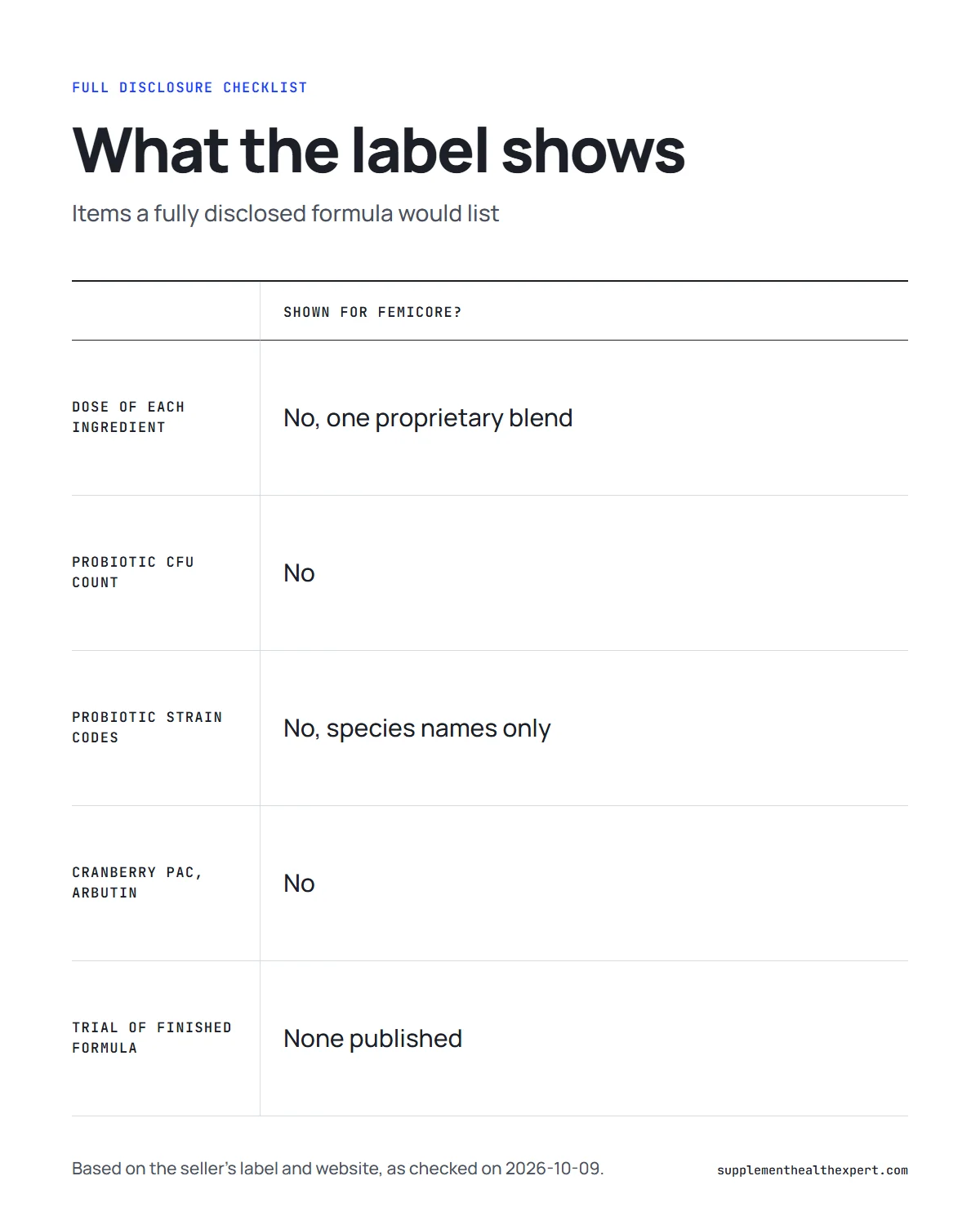
A proprietary blend lists several ingredients under one heading without the amount of each. It is legal, and plenty of supplements use it. For a buyer, it has three practical costs.
You cannot match the doses used in research. Berberine studies for blood sugar typically used around 1,000 to 1,500 mg a day. Cranberry results depend on the PAC dose. Probiotic results depend on the strain and the count. With a blend, you cannot tell whether one capsule comes anywhere near those amounts.
You cannot tell what dominates the mix. Nine names on a label give no sense of proportion. A capsule that is mostly one plant powder and a capsule with a careful balance of all nine would look the same on paper.
You cannot check the safety-relevant amounts. Bearberry is traditionally meant for courses of about a week, while FemiCore is a daily product taken for months. Berberine causes most of the possible drug interactions in the formula. In both cases the dose is the thing you would want to know, and it is the thing the blend withholds.
A full-disclosure checklist
If the formula were fully disclosed, the label or the website would show every item below. This is the list we use when judging any combination supplement.
| What a full label would show | Why it matters | Shown for FemiCore? |
|---|---|---|
| Amount of each ingredient in mg | Lets you compare with doses used in studies | No |
| Probiotic count (CFU) per capsule | Tells you how many live bacteria you get | No |
| Strain codes for each probiotic | Effects are strain-specific | No, species only |
| Cranberry PAC content | The effect depends on PAC dose | No |
| Bearberry arbutin content | Relevant to both effect and safety | No |
| Berberine dose | Key for interactions and blood sugar | No |
| Certificate of analysis | Confirms the contents of a batch | Not published |
| Trial of the finished product | Shows the combination itself works | None |
The only items you do get are the nine ingredient names and the seller’s statements that the product is non-GMO and has no stimulants. The official site also displays five seals: “GMP Certified”, “Made in USA with imported ingredients”, “Natural ingredients”, “Made in an FDA registered facility” and “Non-GMO”. Neither the maker nor the certifying body is named. As for the FDA, FemiCore is handled like any other supplement brand. It answers to the agency’s dietary supplement regulations, which are separate from the approval process a prescription medicine has to pass. A registered-facility badge is a statement about the building where the capsules are made, which is registered with the FDA. It reveals nothing about the doses inside.
Combination formula vs single-ingredient options
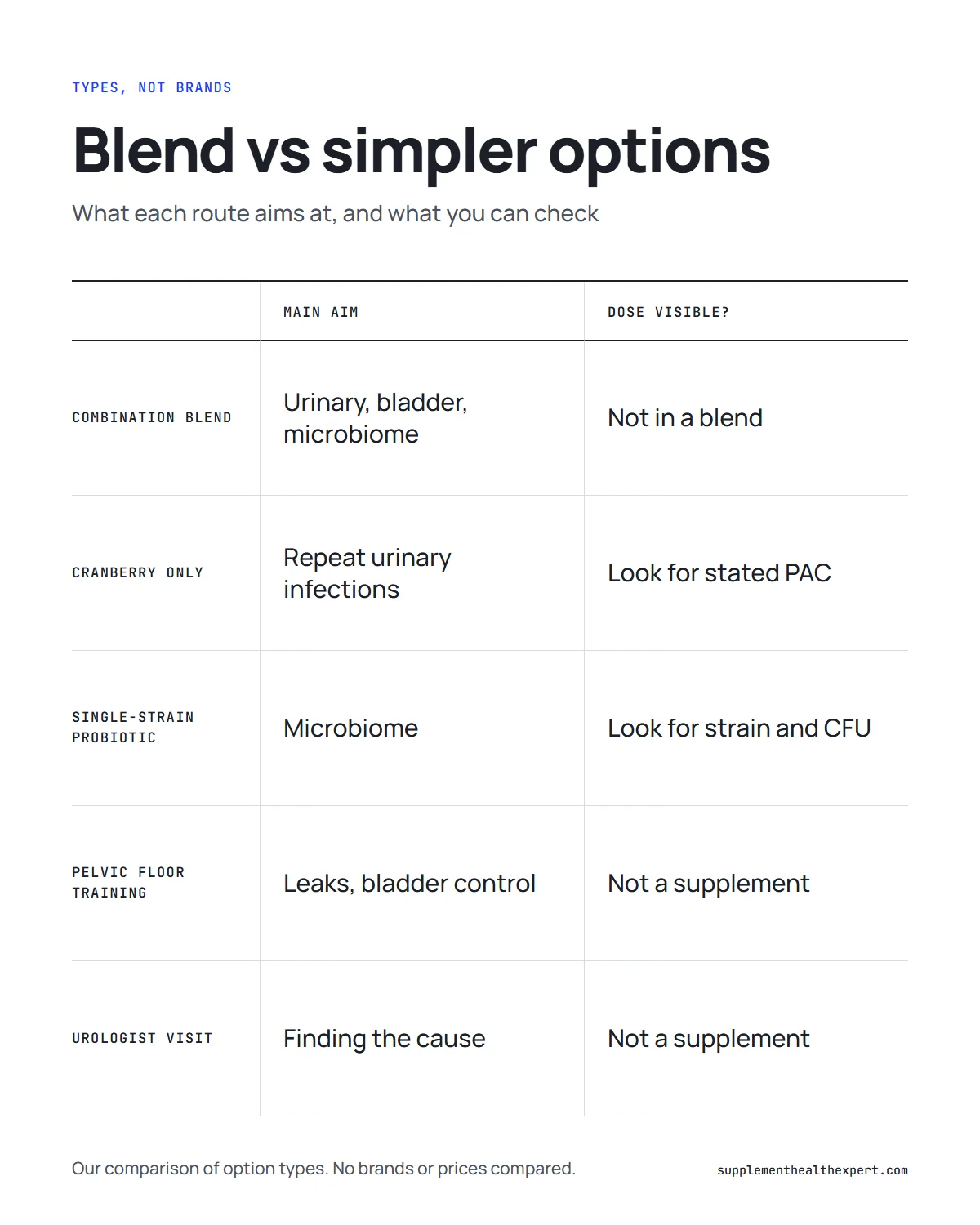
The fair comparison is not FemiCore against another brand, but the combination approach against the simpler routes people take for the same worries. We compare types only.
| Option | Main aim | Can you check the dose? | Trade-off |
|---|---|---|---|
| Combination formula like FemiCore | Urinary health, bladder control, microbiome | Not when it is a proprietary blend | Broad cover, low transparency |
| Cranberry-only supplement | Fewer repeat urinary infections | Possible: look for a stated PAC dose | Narrow; not studied for leaks or urgency |
| Single-strain women’s probiotic | Vaginal and urinary microbiome | Possible: look for a strain code and CFU | One strain; evidence is strain-specific |
| Pelvic floor training | Leaks and bladder control | Not a supplement | Takes regular effort and time |
| Seeing a urologist | Finding the cause | Not a supplement | Appointment needed; covers serious causes |
A few points come out of this table.
If repeat infections are your main concern, a cranberry product with its PAC dose printed on the label shows you exactly what you are taking, which a blend cannot match.
If the microbiome idea is what interests you, a single-strain probiotic with a named strain code ties you to specific research. FemiCore’s five unnamed strains do not.
If leaks and urgency are the problem, none of the supplement routes has strong evidence for them. Pelvic floor training is the non-supplement route, and a urologist can look for the cause.
If you want one capsule that covers several aims, the combination format is convenient, and FemiCore’s 60-day refund from delivery limits the cost of finding out. You simply cannot check the doses first.
Who the combined design suits
The formula makes most sense for a woman who wants a single daily capsule rather than several products, is comfortable trusting a blend without seeing the numbers, and uses the refund window as her safety net. It makes less sense for anyone who wants to match doses to research, who has a specific single goal, or who takes medicines that could interact with berberine, bearberry or cranberry. A combination also means more ingredients that could interact with something else you take, so the more medicines you use, the more a pharmacist’s view is worth.
For the practical side of taking it, see our guide to the capsule itself, which covers the daily routine, storage and travel.
Our verdict on the FemiCore formula
The design has a clear logic: plants for the urinary aims, probiotics for the microbiome aim, all in one daily capsule. The weakness is disclosure. With no doses, no CFU count, no strain codes and no PAC or arbutin figures, you cannot judge whether each part is present at an amount that research would recognise, and the combination has never been tested on its own.
That is why transparency is the lowest part of our editorial score for FemiCore, which stands at 6.3/10 overall (how we score). For prices, the guarantee and our full buyer overview, see our FemiCore product guide.
Frequently asked questions
Why does FemiCore mix botanicals and probiotics in one capsule?
The label promises support in three areas: the urinary system, bladder control and the balance of the microbiome. The plant ingredients are there for the urinary side, and the five Lactobacillus species for the microbiome side. Combining them is the seller's design choice; it has not been tested as a whole.
What is a proprietary blend?
A group of ingredients listed together under one blend name without the amount of each ingredient. It is legal and common in supplements, but it stops you checking each dose.
Which probiotic strain codes does the label give?
None. The label names five species, such as Lactobacillus crispatus, without the letter and number codes that identify a specific strain. Because probiotic effects are strain-specific, the codes are what would link the capsule to research.
What is PAC and why does it matter for cranberry?
PAC stands for proanthocyanidins. A-type PACs are the cranberry compounds that stop E. coli sticking to the urinary tract wall, and the effect seen in studies depends on the PAC dose. FemiCore does not state its PAC content.
Is a single-ingredient product better than a combination formula?
Not automatically. A single-ingredient product does one job and usually shows its dose, so it is easier to judge. A combination covers more ground but hides more if the doses are not disclosed. Which suits you depends on the problem you want to address.
Has the finished formula been tested in a trial?
No. The clinically researched wording on the label is about the separate ingredients and the studies done on them. We found no published trial in which the whole capsule was tested.
Can I ask the seller for the exact amounts?
You can email support and ask. We have not seen the amounts, CFU count or strain codes published anywhere by the seller, so regard any answer you get as the seller's statement.
Sources
femicore formula · femicore · proprietary blend · supplement labels · cranberry pac · probiotic strains